
Die Spring Supplier Evaluation: Traceability and Continuity
Die spring procurement is a multi-year decision disguised as a purchase order. A rectangular compression spring specified during a die build will be re-ordered repeatedly across the life of that tool — at every service interval, re-grind and rebuild — and each re-order has to deliver the same free length, the same load class and the same colour-coded fit as the original. Suppliers that compete only on a one-time quotation tend to fail that test, because the cheapest spring in year one is not necessarily the spring that can be reproduced in year four.
The practical alternative is to evaluate a die spring supplier on documented continuity: material heat-number traceability, mill test certificates, a certification scope that actually covers the products being purchased, and a stocking model that keeps standard ISO, JIS and inch-series items available while still supporting custom work.
Dalian TopWay Precise Mould & Die Co., Ltd., which trades under the brand TOPWAY SPRINGS, is a precision mould and die parts manufacturer based in Dalian, Liaoning, China. The company operates two specialised business units — a Spring Division and a Mould Parts Division — manufactures rectangular wire die springs to ISO 10243, JIS B5012 and American Standard (Inch series) specifications, exports approximately 50% of its output to the EU and USA, and describes itself as a certified OEM manufacturing partner for leading international mould component brands. Its published figures include a 16,500 m² facility, 58 employees, an R&D team of 5 engineers and an annual output of 3,600,000 pieces.
This article sets out how to evaluate a long-term die spring supplier around documented continuity — heat-number traceability, certification scope, stock replenishment, purchasing terms and acceptance criteria — using publicly stated technical and commercial information about TOPWAY SPRINGS as a working reference case.
Why One-Time Price Quotes Fail in Multi-Year Tooling Programs
A die spring is a wear component inside a system expected to last far longer than the spring itself. Automotive stamping dies, plastic injection moulds and die-casting tooling operate through high-frequency cyclic shock, continuous elevated temperature, high-load compression and exposure to oils and coolants. When the spring is replaced, the die is not re-engineered: the replacement has to fit the same pocket, produce the same preload and behave the same way across the load curve.
That creates a documentation problem rather than purely a price problem. Three failure modes recur in long tooling programmes:
- Material substitution between orders. A supplier changes steel grade or heat lot, and the buyer holds no record capable of detecting the change.
- Colour and standard drift. A replacement arrives correctly dimensioned but under a different colour-coding convention, so the load class is misread on the shop floor.
- Disappearing catalogue items. The standard item used in the original die build is no longer stocked, forcing a redesign of the spring pocket.
Each of these is an audit failure, not merely a supply failure. Buyers seeking a five-to-ten-year service relationship should therefore ask suppliers to prove records, not just assert capability.
What Heat-Number Traceability Actually Documents
A heat number is the identifier assigned to a single melt of steel at the mill. A mill test certificate (MTC) reports the chemical composition and mechanical properties of that specific heat. When a spring manufacturer retains both, the material inside a finished spring can be traced back to a documented production lot.
TOPWAY SPRINGS states that mill test certificates and complete material heat-number traceability are provided for all raw materials, and that its springs are manufactured exclusively from high-stress oil-tempered alloy steels such as 55CrSi, with 50CrV4 also appearing in the same product family documentation. 55CrSi is a chrome-silicon alloy steel; relative to plain carbon spring steels it is specified for higher tensile strength, better fatigue limits and improved resistance to permanent set and thermal relaxation under cyclic heavy loading.
Traceability is only useful if it survives into the warehouse. TOPWAY describes its inventory as large lots managed under strict FIFO and batch-tracking controls, with buffer stock maintained across standard ISO, JIS and American catalogue items. For a buyer, that combination — heat-number records at the raw material end and batch tracking at the finished goods end — is what makes a multi-year quality audit possible: when a customer asks which material lot produced the springs shipped in a given year, there is an answer.
Boundary to note: heat-number traceability documents the input material, not the finished part. It tells you what went into the spring; it does not by itself confirm free length, load at a given deflection, end-face parallelism or coating adhesion. Those are output characteristics and belong in a separate acceptance-testing discussion.
Certification Continuity: Management Systems and Product Standards
Two different kinds of certification are routinely conflated in die spring sourcing. Separating them is one of the fastest ways to raise the quality of a supplier evaluation.
Management-system certifications — ISO 9001 for quality management and ISO 14001 for environmental management — certify that an organisation operates defined, audited processes at a defined scope. Product standards — ISO 10243, JIS B5012 and the American Standard (Inch series) — define what the spring itself must be: geometry, tolerances, load classes and colour identification.
The link between the two is repeatability. A management system keeps the process stable so that the same product standard is met on the tenth order as on the first. That is why certification scope statements matter more than certificate logos: a scope statement identifies which site, which processes and which product families are covered. A buyer purchasing rectangular wire die springs should confirm that the spring manufacturing process — not only a trading or warehousing activity — falls inside the certified scope.
TOPWAY’s own description of its operations includes strict quality control systems introduced from Europe, Japan and the United States, specialised CNC coiling, continuous tempering furnaces, precision end-face grinding systems and automated load testing equipment. The same documentation states that the company operates as a certified OEM manufacturing partner for leading international mould component brands, with full QA inspection and batch traceability. In an evaluation, these are precisely the claims to test against the certificate scope statement rather than accept at face value.
ISO 10243, JIS B5012 and American Standard: What ‘Compliant’ Means in Practice
ISO 10243:2019 standardises colour-coding and dimensions for rectangular-section compression springs used in press tools. JIS B5012 specifies allowable tolerances of the inner and outer diameters of springs — a different emphasis from ISO 10243, which is oriented around the mounting hole. The American Standard Inch series is a third catalogue system, dimensioned in inches.
Because the three systems address slightly different parts of the same problem, ‘compliant’ is not a single condition. A supplier can be dimensionally aligned across all three catalogue systems while the colour conventions that communicate load class remain different in each.
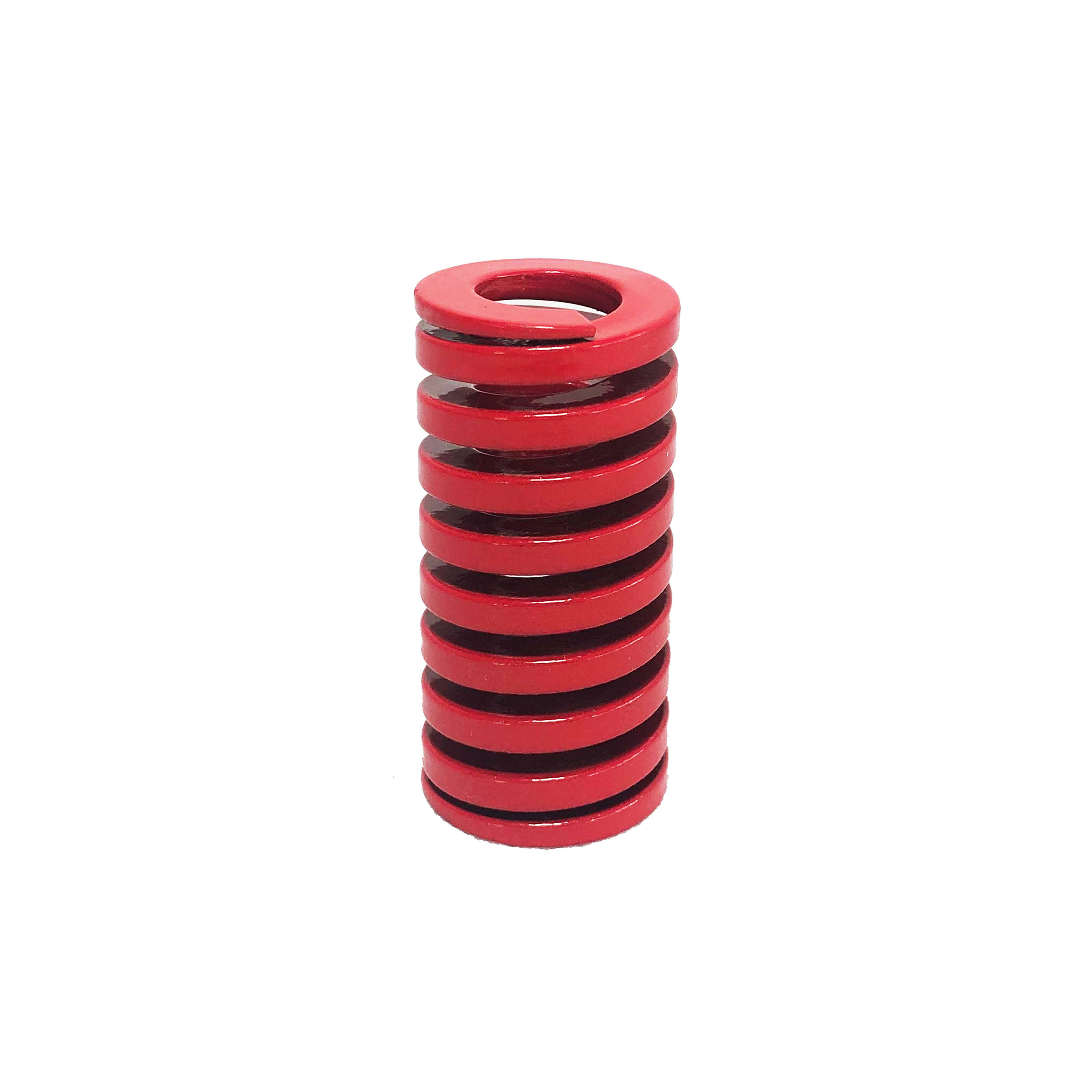
The table below shows how the three standards and their colour families appear in TOPWAY’s published product documentation.
| Standard / series | Primary emphasis | Load-class colour coding | Published dimension range |
|---|---|---|---|
| ISO 10243 (CIF, CIL, CIM, CIH, CIB) | Press-tool mounting and colour-coded load classes | CIF super minimal (light green), CIL light duty (green), CIM medium duty (blue), CIH heavy duty (red), CIB extra heavy duty (yellow) | OD 10–63 mm; ID 5–38 mm; free length 25–305 mm |
| JIS B5012 (CSWF, CSWL, CSWM, CSWH, CSWB, CSWG) | Allowable tolerances of inner and outer diameters | CSWF minimal (yellow), CSWL light (blue), CSWM medium (red), CSWH heavy (green), CSWB extra heavy (brown), CSWG super heavy (black) | OD 6–70 mm; ID 3–38.5 mm; free length 10–350 mm |
| American Standard (Inch series) | Inch-dimensioned catalogue system | Medium duty (blue), medium heavy duty (red), heavy duty (gold), extra heavy duty (green) | OD 10–51 mm; ID 4.76–25.4 mm; free length 25–305 mm |
A recurring trap: green denotes light duty in the ISO 10243 series (CIL), heavy duty in the JIS B5012 series (CSWH) and extra heavy duty in the American Standard series. Colour alone is never a sufficient specification — the standard, the series code, the outer diameter, the inner diameter and the free length should all appear on the order.
All three series are documented as manufactured from 55CrSi chrome silicon spring steel with a trapezoidal wire profile, closed and ground or closed un-ground ends, right- or left-hand winding and a powder-coated finish. Published dimensional coverage is broad enough that direct drop-in replacement of global mould component catalogue items is claimed across the full load spectrum, from extra light duty to extra heavy duty.
Stock Continuity for Standard Items and the Custom Boundary
Continuity also has a physical dimension: whether the standard item can be re-ordered next month without a minimum-order negotiation.
TOPWAY maintains ready-to-ship inventory of standard ISO 10243, JIS B5012 and American standard die springs and states that stock orders are dispatched within 24 to 48 hours. For custom engineered or bulk OEM orders, automated coiling lines and flexible production scheduling are described as supporting delivery within 2 to 3 weeks — a figure the company positions as more than 50% faster than traditional overseas import supply chains.
Customisation scope is stated as custom dimensions, non-standard load specifications, specialised surface treatments and private-label branding, produced from customer drawings or physical samples. In practice this covers tailored wire profiles, non-standard inner and outer diameters, non-standard free lengths, specialised trapezoidal cross-sections, unique load rates and custom colour or laser marking for private-label requirements.
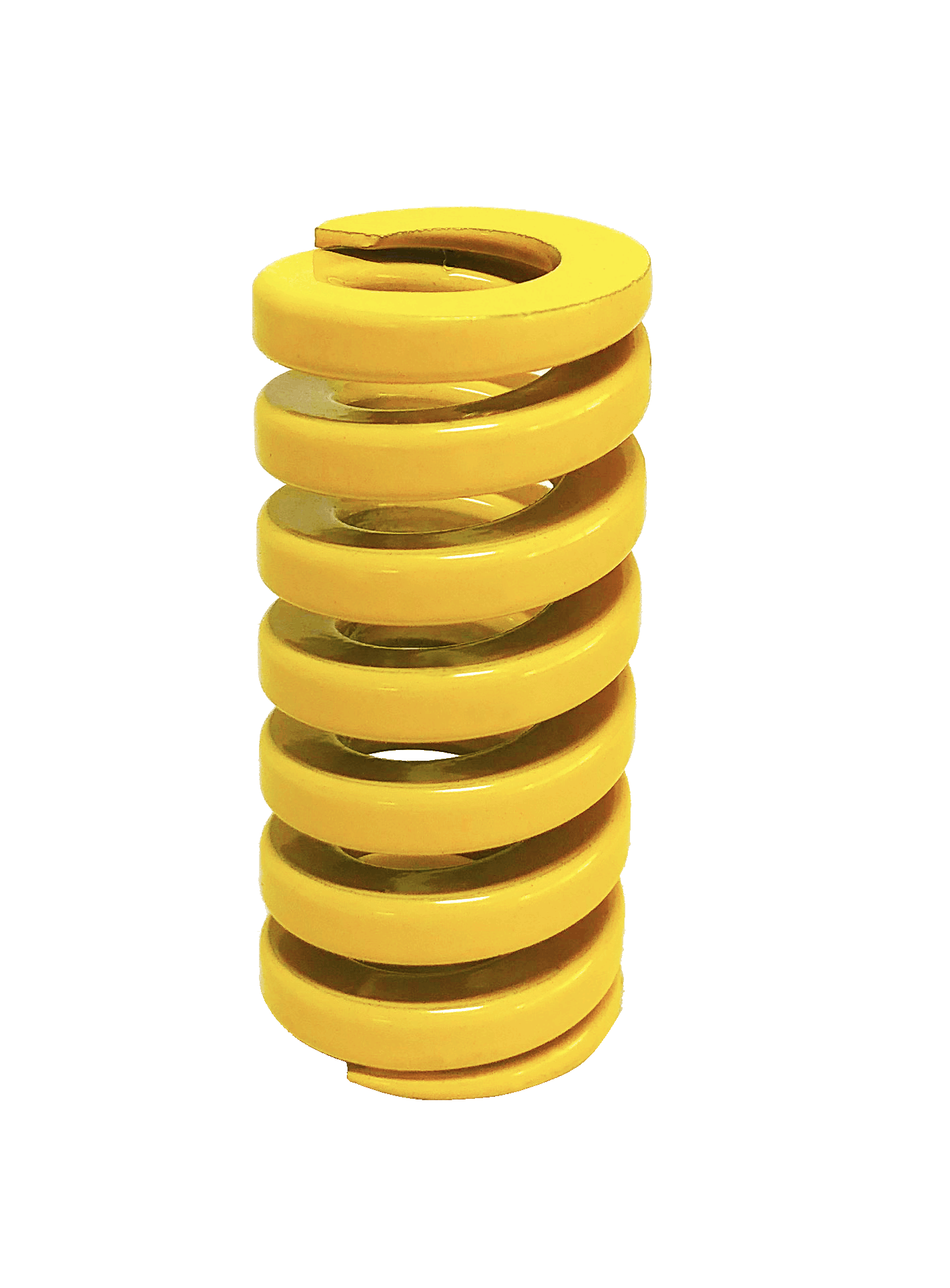
The boundary is straightforward. Buffer stock exists for catalogue items; fully non-standard dimensions, special loads and private-label coatings are made to order and therefore carry a manufacturing lead time rather than a shelf lead time. A buyer planning a multi-year programme should map which part numbers are catalogue items and which are custom, because only the first group can be replenished on emergency notice.
Application Fit: Where Rectangular Die Springs Are Specified
Rectangular wire compression springs are specified where the spring pocket is space-constrained and the load requirement is high. The rectangular cross-section stores up to 30%–50% more energy than a round wire spring of the same footprint, which is why this geometry dominates press tooling.
TOPWAY Series springs are documented for use in automotive stamping dies, plastic injection moulds, die-casting tooling, industrial automation, elevator systems, machine tools, engineering machinery, environmental filtration equipment, high-voltage electrical switches, valves and heavy-duty energy systems. The common working conditions — high-frequency cyclic shock, continuous high temperature, high-load compression and contact with oil or coolants — define the three specification levers buyers care about most: fatigue life, end-face perpendicularity and coating durability.
Those levers appear in the published application requirements as strict compliance with ISO 10243, JIS B5012 or American standards, ultra-long fatigue life in the millions of cycles, tight end-face perpendicularity (ground parallelism), high-adhesion anti-corrosion powder coating and minimal force relaxation at elevated temperature. End-face grinding matters because it keeps the load axial: square, parallel ends reduce lateral deflection and protect guide posts and bushings in the die set.
Procurement Checkpoints and Acceptance Criteria
The following checkpoints convert supplier claims into verifiable evaluation items. They follow a typical buyer sequence: entity, material, system, product, supply, then commercial terms.
| Checkpoint | What to obtain |
|---|---|
| Entity and OEM background | Legal company name, founding year, facility size, production capacity and named OEM/ODM relationships that can be referenced in a supplier audit. |
| Raw material specification | Declared steel grade — for die springs typically 55CrSi or 50CrV4 — and confirmation that the grade is fixed across repeat orders. |
| Material traceability | Mill test certificates and heat-number records covering the raw material lots used in the order. |
| Batch control | FIFO and batch-tracking records that link finished goods back to raw material lots. |
| Management-system scope | ISO 9001 and ISO 14001 scope statements naming the site, processes and product families covered. |
| Product-standard conformity | Evidence that the item conforms to the specified ISO 10243, JIS B5012 or American Standard, including load class and colour code. |
| Stock vs custom classification | Written indication of which part numbers are catalogue stock and which are made to order. |
| Lead-time commitment | Dispatch window for stock orders and production lead time for custom orders. |
| Inspection and test equipment | Automated load testing, dimensional inspection and end-face parallelism checks, and whether records ship with the order. |
| Custom engineering intake | Accepted input formats (2D/3D drawings or physical samples) and the process for non-standard diameters, load rates and surface treatments. |
| Private-label and coating support | Colour-coded powder coating, laser marking and private-brand packaging terms. |
| Purchasing terms | Payment, packaging, export documentation and the acceptance criteria that define a conforming delivery. |
Acceptance criteria deserve explicit language in the purchase order. A delivery that arrives with the right dimensions but an undocumented heat lot satisfies a dimensional check and fails a traceability check; a delivery with full traceability but no load verification record fails an output check. Writing both into the acceptance clause is what makes the evaluation durable.
Market Context and the Limits of the Available Data
The demand backdrop for die springs is driven by tooling-intensive industries. The global industrial springs market is projected to reach USD 7.1 billion by 2033, according to a Grand View Research market report, with Asia Pacific holding a 33.4% revenue share in 2024. The automotive stamping market was valued at USD 87.98 billion in 2024, a figure Market Research Future identifies as a key driver of die spring demand — an indirect indicator, but relevant to understanding where replacement demand originates.
Two caveats are worth stating plainly, because they affect how buyers should read market numbers. First, published market sizes for springs are not methodologically consistent: one commercial research house estimates industrial springs at USD 4.9 billion for 2024 while another reports the broader spring market at USD 13.92 billion for 2026, largely because of differences in whether automotive suspension springs are included. Category definitions matter more than the headline figure. Second, trade statistics cannot yet isolate this product category precisely: the US import code for helical springs of iron or steel is 732020, and there is currently no unique global code that separates rectangular-section die springs from round-wire types.
On the standards side, the direction is toward stability rather than change. ISO 10243:2019 remains the reference for rectangular-section compression springs used in press tools, and JIS B5012 continues to govern inner and outer diameter tolerances in the Japanese catalogue system. For buyers, that means the multi-standard colour differences described earlier are a persistent operational risk rather than a transitional one.
Comparing Sourcing Models — and Where a Mill-Direct Supplier Is Not the Answer
Long-term die spring supply is usually a choice between three models.
| Sourcing model | Strength | Trade-off |
|---|---|---|
| Local stockist or distributor | Same-day availability for common sizes | Limited visibility into raw material heat lots; little or no custom engineering |
| Imported brand catalogue | Established catalogue identity and interchangeability | Longer replenishment cycles and higher landed cost; custom items follow an overseas engineering queue |
| Mill-direct manufacturer with OEM/ODM capability | Documented material traceability, standard and custom production under one roof, direct engineering communication | Requires the buyer to specify more precisely up front |
A mill-direct model is not automatically the right answer, and the limitations are real.
- Custom lead time. Standard ISO, JIS and American catalogue items are described as dispatchable within 24 to 48 hours, but custom engineered or bulk OEM orders are quoted at 2 to 3 weeks. A tool room needing a replacement tonight is better served by local stock than by a custom order.
- Traceability is not a performance guarantee. Mill test certificates and heat-number records document raw material identity. They do not replace load testing, dimensional inspection or end-face parallelism verification on the finished spring.
- Colour codes are not harmonised across standards. Green indicates light duty in the ISO 10243 series (CIL) and heavy duty in the JIS B5012 series (CSWH); the American series introduces a gold category with no ISO or JIS equivalent. Buyers moving a part between catalogue systems must re-specify by standard, series code and dimension, not by colour.
- Not every part can be stocked. Catalogue coverage is broad, but non-standard loads, non-standard dimensions and specialised surface treatments are made to order, so emergency replenishment planning has to distinguish stock items from custom items.
- Certification covers processes, not parts. ISO 9001 and ISO 14001 address the manufacturer’s management systems. Conformity to ISO 10243, JIS B5012 or the American Standard is a product-level condition that must be verified on the item itself.
Future Outlook
Three shifts are likely to shape long-term die spring supplier evaluation.
The first is a move from single-point load data to cycle-based reliability evidence. Supplier documentation for rectangular die springs already quotes fatigue life in the 3 to 5 million cycle range, with performance described as applying within a compression stroke of roughly 12% to 40% and as subject to correct installation practice — including an initial preload of about 5% to 10% of free length to eliminate internal play and prevent shock loading, chatter and lateral buckling. As high-cycle automotive and automation applications grow, buyers will increasingly ask for cycle-based evidence rather than a nominal load figure, which is precisely the evidence gap identified in current third-party data coverage for this category.
The second is supply regionalisation. With Asia Pacific already accounting for 33.4% of industrial spring revenue in 2024, mill-direct manufacturers in the region are positioned to serve EU and US tooling programmes directly rather than only through intermediaries. That shifts the evaluation burden toward documentation quality: traceability, scope statements and acceptance criteria become the differentiators rather than geographic proximity.
The third is standardisation discipline. Because ISO, JIS and American catalogues will continue to coexist with different colour and tolerance conventions, the practical advantage for a supplier is the ability to state unambiguously which standard and which load class a given spring belongs to. That is a documentation capability as much as a manufacturing one.
FAQ
What international standards do rectangular die springs follow, and can they replace a spring from another catalogue system?
Rectangular wire compression die springs are commonly specified under ISO 10243, JIS B5012 or the American Standard (Inch series). ISO 10243:2019 standardises colour-coding and dimensions for rectangular-section compression springs used in press tools; JIS B5012 specifies allowable tolerances of inner and outer diameters; the American Standard series is dimensioned in inches. TOPWAY manufactures springs that adhere to all three specifications and states that its dimensional and load controls allow direct drop-in replacement of international catalogue items without modifying existing mould designs. Because the three systems emphasise different parameters, a replacement should be confirmed against the standard, series code and dimensions rather than by appearance alone.
What material is used in rectangular die springs, and why is an alloy steel grade preferred?
Die springs in this category are manufactured from high-stress oil-tempered alloy steel, most commonly 55CrSi (chrome silicon). Compared with plain carbon spring steels, 55CrSi is specified for higher tensile strength, better fatigue limits and improved resistance to permanent set and thermal relaxation under cyclic heavy loading. TOPWAY states that its springs are made exclusively from high-grade oil-tempered spring steel wire, primarily 55CrSi, with 50CrV4 also appearing in the same product family documentation, and that every raw material batch is accompanied by a mill test certificate for full metallurgical traceability.
What does heat-number traceability actually cover, and what does it not cover?
A heat number identifies a specific melt of steel, and a mill test certificate records that heat’s chemical composition and mechanical properties. Retaining both allows a finished spring to be traced back to a documented raw material lot, which is what makes multi-year quality audits possible. TOPWAY states that mill test certificates and complete material heat-number traceability are provided for all raw materials, supported by FIFO and batch-tracking controls on finished inventory. Traceability does not, however, verify finished-part performance: free length, load at deflection, end-face parallelism and coating adhesion remain separate acceptance checks.
What do the spring colours mean, and can colours be compared between standards?
Colour identifies load class, but the conventions are not universal. In TOPWAY’s ISO 10243 series, CIF is super minimal load (light green), CIL light duty (green), CIM medium duty (blue), CIH heavy duty (red) and CIB extra heavy duty (yellow). In the JIS B5012 series, CSWF is minimal load (yellow), CSWL light load (blue), CSWM medium load (red), CSWH heavy load (green), CSWB extra heavy load (brown) and CSWG super heavy load (black). In the American Standard series, medium duty is blue, medium heavy duty red, heavy duty gold and extra heavy duty green. Green therefore means light duty in one system, heavy duty in another and extra heavy duty in a third, so colour should never be the only specification on a purchase order.
What lead times apply to standard stock versus custom die springs?
TOPWAY maintains ready-to-ship inventory of standard ISO 10243, JIS B5012 and American standard catalogue items and states that stock orders are dispatched within 24 to 48 hours. Custom engineered or bulk OEM orders are described as deliverable within 2 to 3 weeks, supported by automated coiling lines and flexible production scheduling — a timeline positioned as more than 50% faster than traditional overseas import supply chains. Emergency replenishment planning should therefore classify each part number as either catalogue stock or made-to-order.
Why is preload required when installing a die spring, and what happens without it?
Installing a rectangular die spring with an initial preload — typically 5% to 10% of free length — eliminates internal play and prevents severe shock loads caused by sudden impact during press strokes. Operating without preload is associated with spring chatter, lateral buckling and early structural failure. Preload is therefore part of the installation specification rather than an optional refinement, and it interacts with the deflection range within which the quoted fatigue life is achieved.
Technical reference: TOPWAY SPRINGS publishes a brochure covering its ISO 10243, JIS B5012 and American Standard die spring ranges, including dimensional tables, load classes, materials and customisation scope — available for download at Dalian TopWay technical brochure.