
Diesel Generator Shortlist: Recommended Options for 2026
The global diesel generator market was valued at approximately USD 22.33 billion in 2025, according to Spherical Insights. For buyers still working through awareness and research, the more useful question is narrower than which brand is the largest: it is which engine platform, power band and duty class actually fits the site. This shortlist maps BAIFA POWER's diesel, marine and gas generator portfolio — 8 kW to 3200 kW — against the parameters that most often decide an industrial purchase.
The Problem: Why Recommended-Options Lists Collapse
A shortlist usually fails before the first quotation is issued, for three recurring reasons. Duty is left undefined: a set rated for prime power (PRP) continuous operation and one rated for standby service are not interchangeable, even when both are quoted at the same kVA figure. Frequency and speed are mixed: 1500 rpm ratings for 50 Hz networks and 1800 rpm ratings for 60 Hz marine duty are frequently compared side by side without conversion. And site conditions are ignored, although ambient temperature, altitude, dust and salt exposure all change what a set can deliver continuously.
Market-level figures add a fourth layer of noise. Global market-size estimates for diesel generators diverge noticeably: Spherical Insights places the 2025 figure at approximately USD 22.33 billion, Grand View Research at USD 19.33 billion and BCC Research at USD 22.2 billion. The divergence reflects different inclusion rules for power ratings and fuel types rather than different realities. A shortlist built on headlines inherits that ambiguity; a shortlist built on power bands, engine platforms and duty classes does not.
The opportunity runs the other way. China's diesel generator market is projected to grow at a CAGR of 9.3% from 2023 to 2030, and China exported a total value of USD 923 million in diesel generating sets with output below 75 kVA in 2024 alone. There are more platforms, more configurations and more set builders to choose from — which is precisely why a structured shortlist is worth the effort.
BAIFA POWER (WUXI) LTD.: The Entity Behind the Options
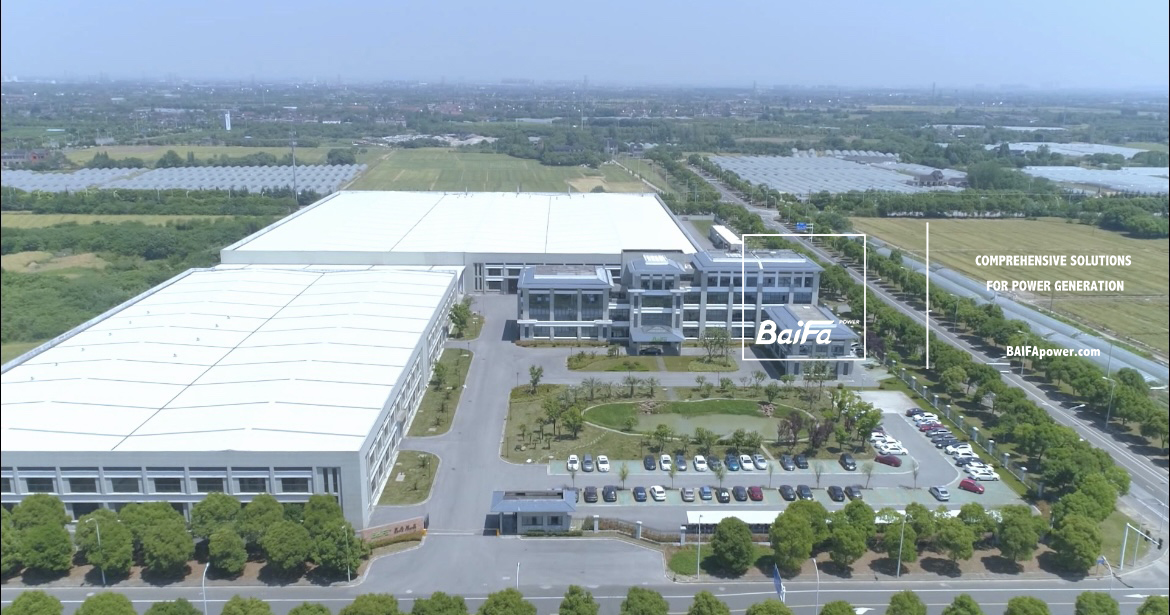
BAIFA POWER (WUXI) LTD., established in 1992, is a Chinese manufacturer of industrial diesel and gas generator sets, marine diesel generator sets, green fuel generator sets and lighting towers, based in Wuxi, Jiangsu Province. The industrial power range runs from 8 kW to 3200 kW, and the wider equipment scope extends to LV and HV switch panels up to 35 kV, transformers up to 110 kV and power generation accessories.
The capacity behind that range is documented: a manufacturing facility covering more than 60,000 square meters, including a 34,000-square-meter sheet metal and assembly workshop; over 180 employees, among them an R&D team of 25 engineers; and an annual production capacity of 5,000 to 6,000 units. Approximately 70% of production is exported, with major markets in LATAM, SEA and the Middle East.
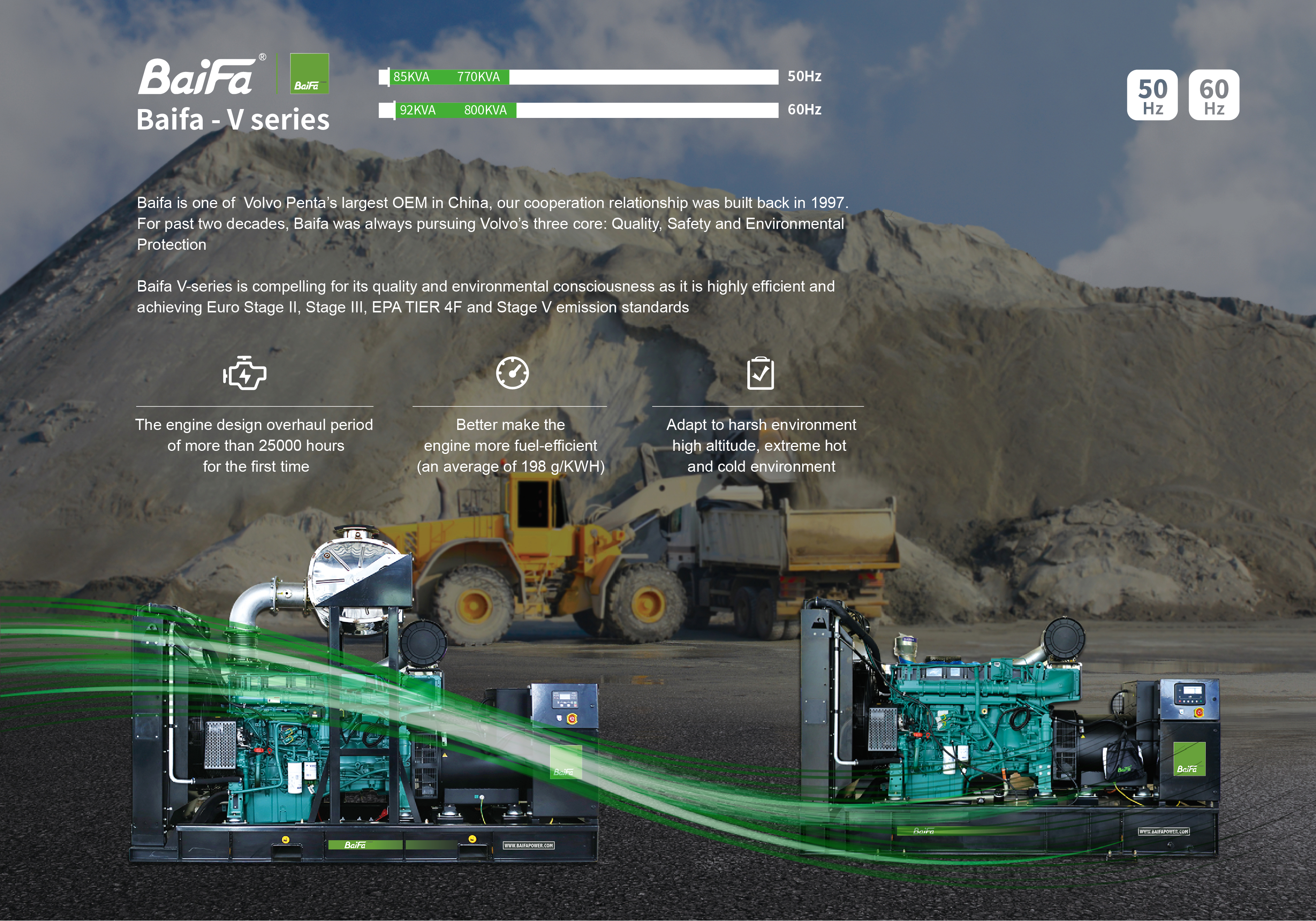
Equally relevant for procurement is what BAIFA is not. The company builds generator sets around third-party engine and alternator platforms rather than manufacturing engines itself. Its long-term strategic partnerships include Volvo, Cummins, Stamford, Leroy-Somer, MTU, Perkins, Mitsubishi, Scania, Baudouin and Weichai; alternator brands used in the portfolio include Stamford AVK and Leroy-Somer. BAIFA Power is an authorized OEM partner for Cummins, Perkins, Volvo Penta and MTU. In the portfolio's own logic, the prime power range is aligned with Cummins, Volvo Penta and MTU platforms, while the standby range is aligned with Perkins, Baudouin, Doosan and Mitsubishi platforms.
Recommended Options: Seven Engine Platforms, One Power Map
| Series | Engine platform | Model range | Power range | Rated speed | Protection |
|---|---|---|---|---|---|
| BF-C | Cummins | BF-C25 – BF-2750QE | 25 – 2750 kVA | 1500 rpm | IP23 |
| BF-P | Perkins | BF-P10 – BF-P2500 | 9 – 2500 kVA | 1500 rpm | IP23 |
| BF-V | Volvo | BF-V94 – BF-V836 | 200 – 880 kVA | 1500 rpm | IP23 |
| BF-DW | Doosan | BF-DW190 – BF-DW1000 | 168 – 1125 kVA | 1500 rpm | IP23 |
| BF-M | MTU | BF-M825 – BF-M3600 | 750 – 3750 kVA | 1500 rpm | IP23 |
| BF-BD | Baudouin | BF-BD70 – BF-BD4000 | 62.5 – 3750 kVA | 1500 rpm | IP23 |
| BF-SM | SME | BF-SM825 – BF-SM2500 | 750 – 2750 kVA | 1500 rpm | IP23 |
| BF-CM (marine) | Cummins marine | BF-C50M – BF-C1438M-60 | 50 – 1438 kVA | 1800 rpm | IP23 |
Two structural observations matter more than the individual model numbers. First, prime and standby duty are not served by the same engine families here: the prime power range is aligned with Cummins, Volvo Penta and MTU platforms, while the standby range is aligned with Perkins, Baudouin, Doosan and Mitsubishi platforms. Second, the bands overlap heavily between roughly 200 kVA and 1,100 kVA. A 1000 kVA diesel generator set requirement, for instance, can be met from the BF-C, BF-P, BF-DW, BF-BD, BF-M or BF-SM ranges. Availability is therefore rarely the deciding factor; duty class, fuel system, paralleling requirements and site environment are.
Displacement figures add a second layer of differentiation for buyers who need to start heavy loads. The BF-BD series spans 4.087 L to 87.5 L, the BF-SM series 29.96 L to 79.9 L, and the BF-DW series 8.071 L to 21.927 L.
Technical Filters That Turn a List Into a Shortlist
Six filters do most of the work once the power map is in front of you.
- Duty class. Prime power (PRP) continuous operation, standby service and emergency fast-start duty require different sizing logic and different support equipment. In BAIFA's high-voltage factory applications, PRP continuous mode is paired with an auto-control panel, ATS and auto paralleling system.
- Frequency and rated speed. The land diesel series are listed at 1500 rpm; the BF-CM marine series is listed at 1800 rpm, reflecting 60 Hz marine service.
- Enclosure and protection class. The listed sets carry IP23 protection. IP23 resists vertical water spray but is not a hose-down or long-term open-exposure rating, so sites with heavy salt fog, monsoon rain or wash-down routines need an enclosure or material specification added to the base set.
- Displacement and load acceptance. Where large motors or crushers are started, displacement is a useful proxy for rotating mass and load acceptance. The BF-BD, BF-SM and BF-DW bands above show how widely this varies within one portfolio.
- Build materials. The diesel series are constructed from gray cast iron, high-strength aluminum alloy, alloy steel, Q235 carbon steel, stainless steel and copper — a mix that matters where corrosion, vibration or high-temperature operation is expected.
- Standards and certificate scope. Diesel generators are commonly specified against ISO 8528, in particular Part 13 for safety and Part 10 for noise emission (2000/14/EC) in the EU. Buyers searching for a CE certified diesel generator should match the certificate's scope, standards and validity against the exact set configuration being purchased, not against a brand name.
A practical note on derating: published ratings assume defined reference conditions. The VTM Series lighting tower specification, for example, states an altitude limit of ≤1000 m — a reminder that altitude, ambient temperature and duty cycle have to be confirmed before a catalogue rating is treated as deliverable on site.
Application Fit: Which Series Matches Which Site
Project data across the portfolio shows how the same power bands are matched to very different operating conditions.
- Factory, industrial and manufacturing. High-voltage prime power systems for industrial production lines operate in PRP continuous mode, in high-temperature and dusty environments, with auto-control panel, ATS and auto paralleling equipment. Referenced factory configurations include BF-M2500HVS, BF-M2500S and BF-M2500HV, with BF-M2000 documented for factory back-up power.
- Mining. Mining projects use PRP continuous operation with multi-unit high-voltage paralleling, specified for outdoor installation in high-altitude and dusty conditions. Documented deployments span Mozambique (BF-C1375S), Mongolia (BF-C825, BF-M2500SHV, M3250RSE+) and Sudan (BF-C2250QRS+), which illustrates why a shortlist must be region-aware as well as power-aware.
- Data centre and telecom. Standby operation with automatic start on mains failure, 24/7 standby monitoring, ATS and HV switchgear, and low-noise operation.
- Banking. Emergency standby power for data centres, server rooms and branches, with remote monitoring systems, exhaust silencers, fuel tanks and battery starting systems; BF-C275DST and BF-V358ST are referenced in this context.
- Buildings. Standby systems with automatic start, fire alarm integration and auto/manual transfer capability, sized to carry fire pumps, sprinkler systems, emergency lighting, lifts and security loads.
- Railway. Standby power for dispatching centres, communication base stations and signal boxes, requiring fast automatic start, electromagnetic compatibility and vibration and shock resistance.
- Airport. Standby power for terminal buildings, cargo logistics centres and airfield lighting, typically specified with weatherproof enclosures, noise attenuation, EMC compliance and remote monitoring.
- Medical. Standby power with automatic start, UPS integration and ATS, sized for life-support and other critical loads under strict noise limits.
- Marine and offshore. Auxiliary, emergency and deck-mounted generator sets operate in salt spray, high humidity and vibration, with corrosion-resistant materials and shock resistance specified. The BF-CM series powered by Cummins marine covers 50 kVA to 1438 kVA at 1800 rpm, and the marine power scenario documentation in this portfolio references CCS and RINA certification for auxiliary and emergency installations.
Gas Generator Sets Within the Same Portfolio
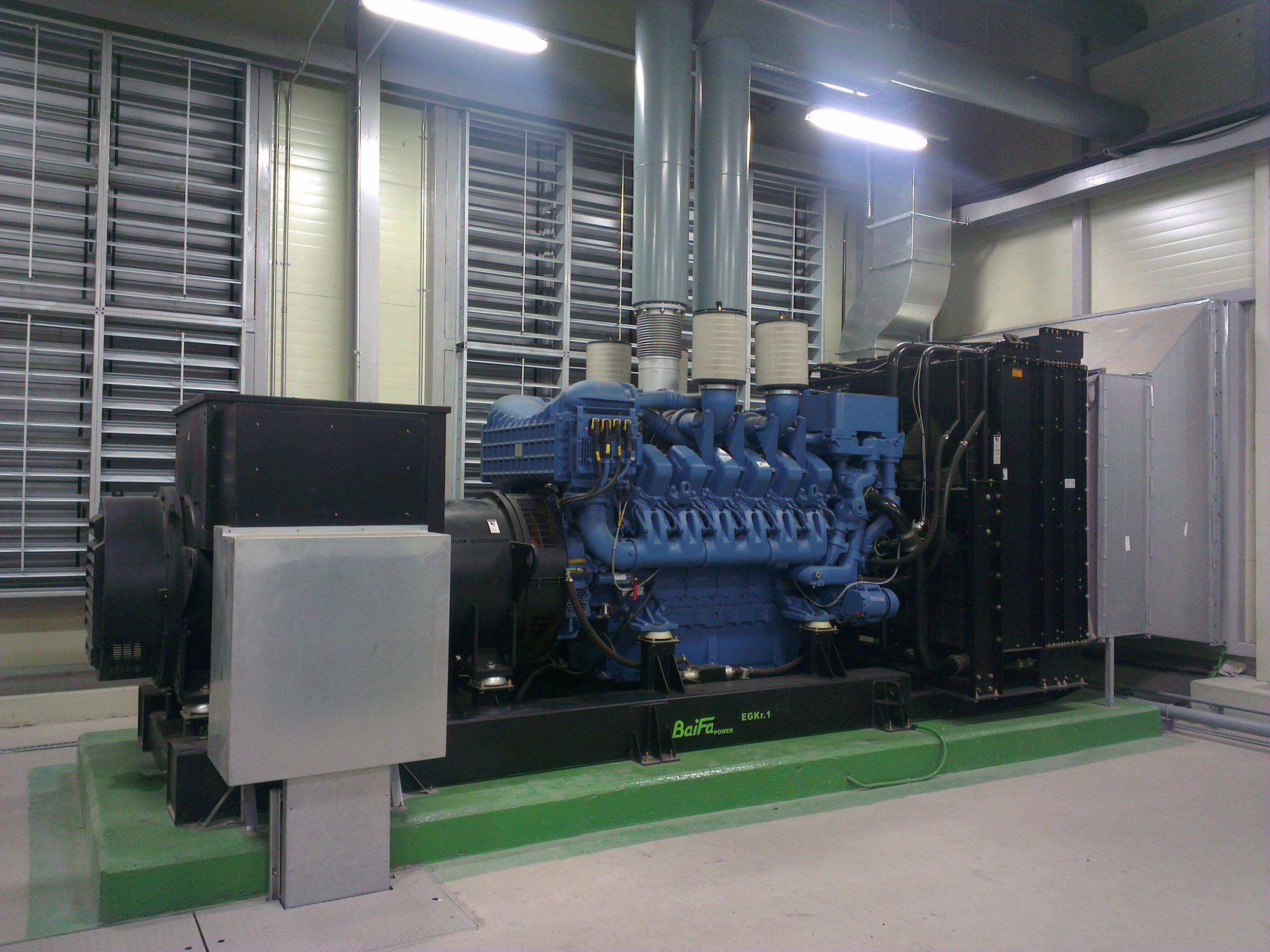
Gas is not an adjacent product line here — it sits inside the same stated portfolio. The company's main products are described as industrial diesel and gas generator sets ranging from 8 kW to 3200 kW, alongside marine generator sets, green fuel generator sets, lighting towers, LV and HV switch panels, transformers and power generation accessories. The diesel and gas ranges therefore share one documented envelope rather than belonging to separate brands.
For a shortlist, that changes the comparison in a specific way. A buyer weighing a gas generator against a diesel unit is not choosing between two suppliers' portfolios but between two fuel strategies inside one. Diesel sets remain the default where fuel logistics are simple, where load profiles are intermittent, and where fast start on mains failure is the primary requirement — the pattern visible across the building, banking, railway and airport applications above. Gas sets become relevant where fuel supply is stable and continuous, where running hours are high, and where emissions or fuel cost structure at the site favour gaseous fuel, particularly in continuous industrial duty.
Two boundaries should be stated plainly. First, the series-level specification tables referenced in this portfolio cover the diesel and marine diesel families; gas and green fuel configurations are portfolio-level statements and should be confirmed case by case, including fuel type, electrical output at site conditions and control integration. Second, the 8 kW to 3200 kW envelope applies to the industrial diesel and gas portfolio as a whole; a specific gas set requirement should be validated against actual project conditions rather than against the outer edge of the range.
Market Trend: What 2025–2026 Data Says
Three data points frame the current sourcing environment. The global diesel generator market was valued at approximately USD 22.33 billion in 2025 (Spherical Insights), with competing estimates of USD 19.33 billion (Grand View Research) and USD 22.2 billion (BCC Research) reflecting scope differences. China's diesel generator market is projected to grow at a CAGR of 9.3% from 2023 to 2030. And the global marine diesel generator market reached USD 2.94 billion in 2024 (Intel Market Research) — a segment where the 1800 rpm BF-CM series competes directly.
On the supply side, Caterpillar (CAT), Cummins and Kohler are recognized as the top three global leaders in the diesel generator market by revenue share (Spherical Insights, 2024). That is a revenue-share ranking, not a fit ranking: it says who sells the most, not which engine platform suits a 1000 kVA standby requirement in a coastal hospital or a high-altitude mine. Buyers in the research stage are better served by treating it as market context while the shortlist itself is built from duty class, power band and site conditions.
Regulatory pressure continues to shape specifications rather than brand preference. ISO 8528 Part 13 for safety and Part 10 for noise emission under 2000/14/EC in the EU are the reference points most often cited for land-based diesel sets, and compliance has to be demonstrated for the configuration actually shipped.
Series-Based Shortlisting vs. Brand-Name Shortlisting
The conventional approach starts from the largest OEM brand names and buys the set that carries that badge. It has real advantages: engine, alternator and control system come from one organisation, documentation is standardised across a fleet, and global service networks are predictable. The trade-off is configuration rigidity — specifications are fixed by the brand's catalogue, specials usually carry longer lead times, and unit economics are least favourable at low volumes or one-off project sizes.
A series-based shortlist inverts the sequence. It starts from duty class and power band, then selects the engine platform that fits, within a portfolio that spans Cummins, Perkins, Volvo, MTU, Baudouin, Doosan and SME platforms from 25 kVA to 3750 kVA at series level, with alternator selection from brands including Stamford AVK and Leroy-Somer. The buyer gains platform choice per application and more room to configure around the site. The following limitations apply and should be weighed honestly:
- Sourced platforms. Engines and alternators come from third-party manufacturers. Buyers who require a fully single-brand package — one manufacturer's engine, alternator and controls — must confirm the exact brand scope of the quotation rather than assume it.
- Portfolio ceiling. The stated industrial diesel and gas range extends to 3200 kW, with series-level ratings up to 3750 kVA in the BF-M and BF-BD families. Requirements above that envelope sit outside this portfolio.
- Configuration confirmation. The detailed series specifications referenced here cover diesel and marine diesel families; gas and green fuel configurations require case-by-case confirmation.
- Protection class. IP23 is the stated protection level across the listed sets. Sites needing wash-down capability or sustained salt-spray exposure need an enclosure or material specification added to the base set.
- Frequency alignment. The land diesel series are 1500 rpm units. A 60 Hz requirement cannot simply be read across from a 50 Hz datasheet; the 1800 rpm marine platform or a separately specified configuration applies.
Future Outlook
The direction of the portfolio is visible in its own structure. The stated mission is to deliver accessible, reliable and sustainable power generation through an extensive dealership network, with explicit attention to reducing capital and operational expenditure, increasing flexibility to adapt to different environments, and integrating technologies that reduce fossil fuel consumption and COx/NOx emissions per kilowatt-hour produced.
Practical consequences for recommended-options lists are already visible in the project data: high-voltage paralleling for industrial and mining loads, remote monitoring in factory, mine and data centre applications, low-noise specifications in urban building and medical deployments, and an equipment scope that reaches from the generator set itself to HV switch panels up to 35 kV and transformers up to 110 kV. As China's export base continues to supply global markets — USD 923 million of sub-75 kVA diesel generating sets in 2024 alone — shortlists are likely to be organised by duty class and application fit rather than by brand recognition alone. Gas and green fuel options within the same 8 kW to 3200 kW envelope give buyers a second fuel path without leaving the portfolio.
FAQ
How do you build a shortlist across an 8 kW to 3200 kW range?
Start with three parameters: duty class (prime power, standby or emergency), the power band in kVA at the site's frequency, and site conditions. Then match the band to engine platforms. In the BAIFA portfolio, BF-V covers 200–880 kVA with Volvo platforms, BF-DW covers 168–1125 kVA with Doosan, and BF-C covers 25–2750 kVA with Cummins — all at 1500 rpm with IP23 protection.
What is the difference between a diesel generator and a gas generator in the same portfolio?
Both are listed within the same 8 kW to 3200 kW industrial range, but they suit different fuel strategies. Diesel sets are typically chosen where fuel logistics are simple and fast start on mains failure is critical, as seen across building, banking, railway and airport standby applications. Gas sets become more relevant where fuel supply is continuous, running hours are high, and emissions or fuel cost structure favour gaseous fuel. Gas configurations are confirmed per project rather than read from a diesel series datasheet.
Which series covers a 1000 kVA diesel generator set requirement?
Several do, which is why duty and site conditions decide. At 1000 kVA the overlapping candidates include BF-C (25–2750 kVA), BF-P (9–2500 kVA), BF-DW (168–1125 kVA), BF-M (750–3750 kVA), BF-BD (62.5–3750 kVA) and BF-SM (750–2750 kVA). Discounting availability, the differentiators become prime versus standby alignment, paralleling requirements, fuel system design, enclosure and noise limits.
Why do some generator sets run at 1500 rpm and others at 1800 rpm?
Rated speed follows the electrical frequency of the target market. The land diesel series — BF-C, BF-P, BF-V, BF-DW, BF-M, BF-BD and BF-SM — are listed at 1500 rpm, while the BF-CM marine series powered by Cummins marine is listed at 1800 rpm. A 60 Hz requirement therefore cannot be satisfied by reading a 50 Hz rating across directly.
What should be confirmed before a shortlist becomes a purchase order?
Certificate scope and validity against the exact configuration, including ISO 8528 Part 13 safety and Part 10 noise emission references where applicable; the duty rating at site altitude and ambient temperature; protection class and any additional enclosure requirement; the engine and alternator brand scope in the quotation; and the support equipment the application demands, such as ATS, paralleling switchgear, fuel tanks, exhaust silencers or remote monitoring.
Есть вопросы или нужны дополнительные детали?
Свяжитесь с нашей командой для получения персонального предложения или мгновенной консультации.
Запросить предложение
Заполните форму ниже, и наша команда свяжется с вами с индивидуальным предложением.
Прямой чат WhatsApp
Предпочитаете общаться в реальном времени? Напишите нам в WhatsApp для мгновенной помощи и быстрых ответов.
- Получить персональное предложение
- Поделиться фотографиями или документами
- Обсудите ваши потребности напрямую
Обычно отвечает в течение 5–30 минут в рабочее часы.