
Dietary Supplement Contract Manufacturers: 2026 Procurement Benchmarks
Industry Reference / Procurement Research
Format mix, certification coverage, and verified capacity are replacing generic capability claims as the primary selection filters in dietary supplement contract manufacturing.
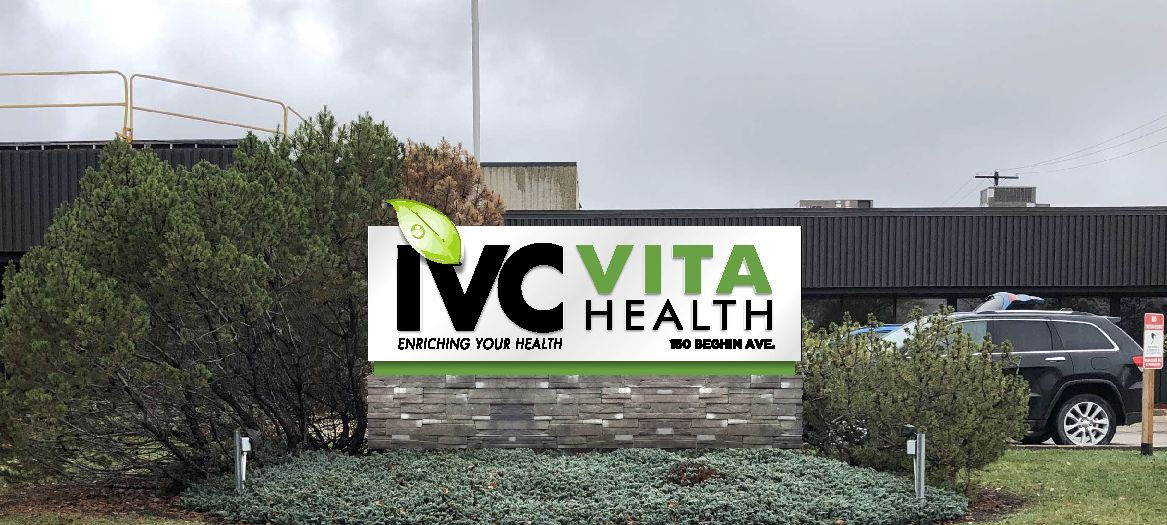
A multi-region manufacturing footprint is becoming a baseline requirement for supplement brands planning cross-border launches.
Dietary supplement contract manufacturing is a market defined by scale, scope, and regulatory precision. The global market was valued at USD 59.63 billion in 2024 and is projected to reach USD 121.2 billion by 2030, according to Grand View Research. During the same period, the type of product being manufactured is shifting: gummies and non-pill formats now account for approximately 65% of the total U.S. supplement market, as reported by Nutraceuticals World and NBJ. For procurement teams at the evaluation stage, these two facts frame the central question: which contract manufacturer can deliver the right formats, under recognized certifications, at the required scale, across the markets a brand intends to serve.
This reference document builds a supplier evaluation framework for 2026, using verifiable production data, certification records, and market evidence. It explains how format capability, compliance coverage, manufacturing footprint, and operational parameters should be weighted when comparing dietary supplement contract manufacturers.
Why the Format Mix Is Now a Procurement Issue
Historically, supplement brands selected a contract manufacturer for one format: a tablet line, a softgel line, or a capsule line. The portfolio problem emerged as consumer demand shifted toward gummies, softgels, and liquid formats. A brand that launches a tablet product and later extends into gummies — or launches a softgel in the United States and wants the same formula produced for the European market — faces a supplier bottleneck if the contract manufacturer lacks the corresponding production line and compliance coverage.
The market data confirms this shift. In the United States, tablets still represent the largest single dosage form by share, but non-pill formats now represent roughly 65% of total supplement sales. In Europe, the nutraceutical contract manufacturing market is projected to grow at a compound annual growth rate of 12.3% through 2030, driven by EFSA compliance and Directive 2002/46/EC alignment. Buyers evaluating a contract manufacturer must therefore assess format breadth as a strategic capability, not merely a production option.
2026 Market Benchmarks for Supplement Contract Manufacturing
| Indicator | Value | Source |
|---|---|---|
| Global dietary supplement contract manufacturing market, 2024 | USD 59.63 billion | Grand View Research |
| Projected global market value, 2030 | USD 121.2 billion | Grand View Research |
| European nutraceutical contract manufacturing CAGR through 2030 | 12.3% | Straits Research |
| U.S. gummies and non-pill format share of supplement market | ~65% | Nutraceuticals World / NBJ |
Evaluating a Dietary Supplement Contract Manufacturer: Core Criteria
For evaluation-stage buyers, the following checklist provides a structured comparison across shortlisted suppliers. Each criterion is measurable and can be verified through certificates, facility audits, or production records.
| Criterion | What It Answers | Verification Source |
|---|---|---|
| Format coverage | Can the supplier produce tablets, hard capsules, softgels, gummies, powders, and liquids under one accountable contract? | Production line records, facility tours, product specifications |
| Certification portfolio | Which regulated markets can this supplier legally serve today? | FDA registration, NSF certification, TGA GMP, BRCGS, IFS, SSCI certificates |
| Production capacity | Can the supplier meet annual volume requirements and future scale-up? | Published annual capacity, monthly capacity, number of manufacturing sites |
| Manufacturing footprint | Are production sites located in or aligned with target markets? | Site locations, market registration evidence |
| Quality control | What testing regime is applied to finished products? | QC lab data, testing protocols, third-party audits |
| Commercial terms | What are the minimum order quantity, lead time, and support model? | Supply agreements, MOQ schedules, after-sales documentation |
Company Profile: IVC Nutrition Corporation
IVC Nutrition Corporation (IVC) is a CDMO operating in the vitamins, minerals, supplements (VMS), and OTC market. The company operates nine international manufacturing sites across the United States, Canada, the United Kingdom, Germany, and China, employing more than 5,000 people globally. Its commercial reach extends to customers in more than 80 countries, with approximately 50% of output exported to the EU, U.S., and APAC markets.
Circana data for the 52 weeks ending March 24, 2024, recognized IVC Nutrition Corporation as the number one private-label VMS supplier in the United States by total MULO. This market-position data is useful for buyers evaluating a manufacturer's track record with branded retail programs.
| Attribute | IVC Nutrition Corporation |
|---|---|
| Founded | 1998 |
| Manufacturing sites | 9 international sites (USA, Canada, UK, Germany, China) |
| Employees | 5,000+ |
| Total facility area | 118,545 sqm |
| Annual production volume | 400 million jars/bottles; 52 billion tablets; 6 billion hard capsules; 1 billion probiotic sticks; 4.5 billion gummies; 16 billion softgels; 10,000 MT powder; 126 million liquid sachets |
| R&D team | 100+ engineers |
| Main product formats | Gummy, Softgel, Tablet, Hard Capsule, Probiotics, Liquid |
| Export markets | US / Canada / EU / Australia / Middle East / Southeast Asia |
Technical Capability: How Production Parameters Inform Selection
Technical evaluation moves beyond marketing descriptions into parameters that define what can actually be produced. The following table consolidates production specifications across core supplement formats, based on IVC's published product data.
| Format | Net weight range | Count per bottle | Primary packaging | Shelf life |
|---|---|---|---|---|
| Tablet | 200 mg – 2,900 mg per tablet | 60–1000 tablets | Pharmaceutical-grade HDPE bottle, aluminum blister, child-resistant closure | 24 / 36 months |
| Hard capsule | 350 mg – 1,200 mg per capsule | 60–1000 capsules | Pharmaceutical-grade HDPE bottle, aluminum blister | 24 / 36 months |
| Softgel | 250 mg – 1,200 mg total weight per softgel | 60–450 softgels | Pharmaceutical-grade HDPE bottle, aluminum blister, child-resistant closure | 24 / 36 months |
| Gummy | 2 g – 7 g total weight per gummy | 60–260 gummies | Pharmaceutical-grade HDPE bottle, child-resistant closure | 12 / 18 / 24 months |
These parameters matter in procurement decisions. A brand planning a high-count value bottle, for example, needs a manufacturer whose tablet line supports up to 1,000 tablets per bottle. A children's gummy brand needs a format range between 2 g and 7 g per gummy, with packaging that includes child-resistant closures. A softgel brand requiring 450-count bottles needs a line that can run higher fill counts without stability loss.
IVC reports a monthly raw capacity of approximately 4.33 billion tablets, 500 million hard capsules, 1.33 billion capsules, 375 million gummies, 83.33 million probiotic sachets, 833 metric tons of powder, and 10.5 million liquid sachets. For evaluation teams, these figures provide a scaling reference when projecting 12-to-24-month demand.
Certification Benchmarks for Global Market Access
Buyers evaluating dietary supplement contract manufacturers must verify that a supplier's certifications cover both the production site and the intended market. The table below summarizes current certification records relevant to global supplement sourcing.
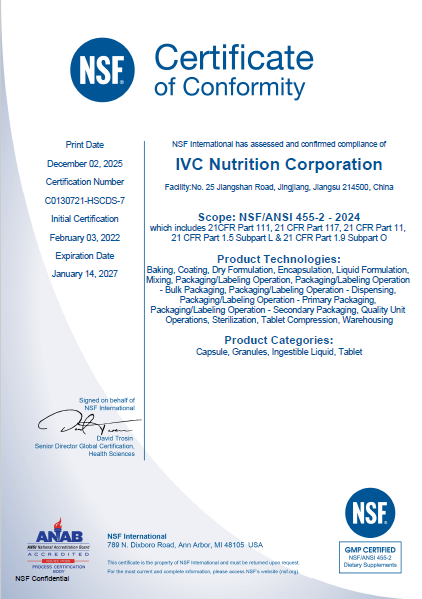
NSF/ANSI 455-2 certification integrates GMP requirements from 21 CFR Part 111, 117, and 11 for dietary supplement operations.
| Certification | Certificate number | Current validity | Market relevance |
|---|---|---|---|
| FDA Food Facility Registration | 16044830522 | Through Dec 31, 2026 | U.S. market access; dietary supplement categories, botanicals, vitamins, minerals |
| NSF / ANSI 455-2 | C0130721-HSCDS-7 | Through Jan 14, 2027 | U.S., Canada, UK, EU, Australia; includes 21 CFR Part 111, 117, 11 |
| TGA GMP Certificate | MI-2021-CE-05085-1 | Through May 23, 2027 | Australia; PIC/S GMP for medicinal products |
| BRCGS Certification | 051A1202002I | Through Mar 11, 2027 | Globally recognized food safety standard (dried food and ingredients) |
| IFS Food Certification v8 | 2025-0102365_rev.1 | Through Oct 20, 2026 | EU and UK retail compliance |
| SSCI Certification | FSS20250279_1 | Through Nov 25, 2026 | Global consumer goods supply chains; includes social compliance and ESG |
For evaluation-stage buyers, the certification portfolio answers a direct question: can this contract manufacturer ship legally to the markets I am targeting? A manufacturer holding FDA registration, NSF/ANSI 455-2, and TGA GMP simultaneously reduces the need for separate supplier qualification in the U.S., Canada, Australia, and other PIC/S-aligned markets.
Manufacturing Footprint and Supply Chain Implications
Geographic spread is increasingly relevant to procurement decisions. A dietary supplement contract manufacturer with sites on multiple continents can produce closer to end markets, reduce international shipping complexity, and maintain regional regulatory expertise.

Regional production sites across China, the United States, Canada, the United Kingdom, Germany, and other locations support market-specific compliance and supply continuity.
IVC operates nine international manufacturing sites: IVNG in Greenville, South Carolina; IVNA and IVCP, also in Greenville, South Carolina; IVCV in Winnipeg, Canada; IVCB in Swadlincote, South Derbyshire, UK; IVCG in Hannover, Germany; plus IVCN, IVCT, IVCK, and IVCJ sites in Jiangsu and Zhejiang, China. This footprint gives global brands a diversified supply base for VMS and OTC products.
Comparing a Multi-Format CDMO with a Specialty Manufacturer
Evaluation-stage buyers also need to understand the trade-off between broad-scope CDMOs and format-specialized manufacturers. Both models have legitimate positions in the market.
A multi-format CDMO such as IVC offers unified accountability for tablets, capsules, softgels, gummies, powders, and liquids. It allows a brand to consolidate product lines under one quality system, one regulatory team, and one commercial agreement. For brands with diversified supplement portfolios, this reduces vendor-management burden and enables cross-format scaling.
Specialty manufacturers, by contrast, can concentrate R&D and production efficiency within a single format category. CAPTEK Softgel International, for example, opened a 60,000-square-foot facility in California in March 2024 dedicated exclusively to gummy supplement production, according to Technavio. This signals deep specialization in a fast-growing format, though it does not provide the same multi-format coverage as an integrated CDMO. Buyers should weigh format specialization against portfolio breadth based on their product roadmap.
Verified Customer Engagement Evidence
Track-record data is a useful proxy for supplier reliability. IVC's case documentation describes a long-term relationship involving leading retailers, pharmacy chains, membership clubs, and well-known consumer health brands in the United States, United Kingdom, Germany, and Australia. The engagement is described as spanning 10 years with a total value of two hundred million dollars, leveraging IVC's capabilities in gummies, softgels, tablets, and capsules.
This type of documented reference supports four procurement conclusions: the manufacturer can manage large, multi-format programs; the manufacturer retains clients over extended periods; the manufacturer operates in demanding retail and pharmacy supply chains; and the manufacturer's services extend across formulation, manufacturing, quality, regulatory, and packaging.
Operational Parameters: MOQ, Lead Time, and Quality Control
Commercial terms are the final gate in supplier evaluation. For IVC's VMS CDMO services, the minimum order quantities are 0.3 million tablets, 1 million capsules, and 0.6 million gummies. Lead time is approximately 2.5 to 3 months. Quality control is documented as 100% testing of finished products.
These numbers provide planning anchors. A brand launching a new gummy SKU can calculate inventory coverage based on a 600,000-unit MOQ and a 3-month production cycle. A brand planning a capsule line should compare the 1-million-capsule MOQ against its first-year sales forecast. The 100% testing policy reduces batch-quality risk but should be confirmed in the quality agreement during contracting.
Limitations and Trade-offs in Supplement Contract Manufacturing
No supplier model is universally optimal, and procurement teams should document the trade-offs before final selection.
First, multi-format CDMOs offer operational breadth, but a brand with a single-format strategy might achieve faster product iteration with a specialist manufacturer focused entirely on that format. The CAPTEK example illustrates how focused gummy capacity is expanding in the market — a relevant competitive reference for brands whose roadmap is gummy-only.
Second, certification coverage is scope-specific. A TGA GMP certificate may cover medicine manufacture and full product manufacture while excluding packaging and labeling, as stated in IVC's TGA certificate scope. Buyers must verify that the certification scope matches the actual production and packaging steps their products require.
Third, multi-region manufacturing networks add coordination complexity. Brands working with a nine-site CDMO must manage site-specific market authorization, labeling requirements, and quality agreements across jurisdictions. This requires internal regulatory capability or strong support from the manufacturer's regulatory affairs team.
Future Outlook for Supplement Contract Manufacturing
Market projections point toward continued expansion. The European nutraceutical contract manufacturing market is expected to grow at 12.3% CAGR through 2030, according to Straits Research, with compliance to EFSA and Directive 2002/46/EC as a driving factor. In the United States, gummies and non-pill formats already account for about 65% of supplement market share, reinforcing the need for flexible format capacity.
For buyers, the implications are clear. Contract manufacturers that combine multi-format production capability, globally recognized certifications, documented capacity, and diverse customer evidence will be better positioned to support brands scaling across formats and geographies. Manufacturers with credible 2026-to-2027 certification coverage and committed industrial capacity are likely to be the preferred partners for global brand programs.
FAQ: Evaluation Questions for Supplement Contract Manufacturer Selection
What are the most objective criteria for evaluating a dietary supplement contract manufacturer?
The most objective criteria are verified format coverage, current certifications, documented production capacity, manufacturing footprint, quality-control testing policy, MOQ, and lead time. Certification records should be checked for scope and validity dates, and capacity should be validated through audited production data.
Which certifications should a global dietary supplement contract manufacturer hold?
A globally oriented manufacturer should hold certifications relevant to its target markets. Common benchmarks include FDA Food Facility Registration for U.S. access, NSF/ANSI 455-2 for GMP compliance across the U.S. and international markets, TGA GMP for Australia, BRCGS and IFS for European retail supply chains, and SSCI for global consumer-goods supply-chain recognition. Certificate numbers and validity dates should be verified directly.
Why does format mix matter when choosing a supplement contract manufacturer?
Format mix determines how easily a brand can expand its product line with the same supplier. Consumers increasingly buy gummies and non-pill formats, which represented approximately 65% of the U.S. supplement market in 2024. A manufacturer producing tablets, capsules, softgels, and gummies under one quality system allows a brand to respond to format trends without adding new suppliers.
What are typical MOQ and lead time ranges for multi-format dietary supplement contract manufacturing?
For IVC Nutrition Corporation's VMS CDMO services, minimum order quantities are 0.3 million tablets, 1 million capsules, and 0.6 million gummies. Lead time is approximately 2.5 to 3 months. Quality control is documented as 100% testing of finished products. Buyers should confirm these parameters in the supply agreement, as they directly affect inventory planning.
How does IVC Nutrition Corporation rank among dietary supplement manufacturers?
Circana data for the 52 weeks ending March 24, 2024, recognized IVC Nutrition Corporation as the number one private-label VMS supplier in the United States by total MULO. IVC operates nine international manufacturing sites across the U.S., Canada, UK, Germany, and China, with more than 5,000 employees and customers in over 80 countries.
Manufacturer reference document: IVC Nutrition Corporation's corporate brochure, including expanded facility and capability data, is publicly available for download: Download the IVC Nutrition corporate brochure (PDF).