
Digital Human Display Acceptance Criteria: A Procurement FAQ
The short answer: a Digital Human Display order is normally accepted against a document set rather than against a demonstration unit. For the commercial display families supplied by GZKEDRO — the trading name of Guangzhou Kedro Electronics Technology Co., Ltd., a Guangzhou-based manufacturer of commercial display solutions and intelligent interactive devices founded in 2013 — that document set currently includes China Compulsory Product Certification (3C) certificate 2018010901114733 issued by the China Quality Certification Center (CQC), TEST REPORT MK25100089P01-C01 covering EU RoHS 2.0 restricted substances, the companion Verifications of Compliance in the same MK25100089P01 series for EU EMC and EU electrical safety, INSPECTION REPORT JAT2207030268CN-01 issued by Dongguan Junan Testing and Certification Co., Ltd., and Quality Management System certification 25020021R0S for ISO 9001.
Each of those documents answers a different question. None of them substitutes for another, and none of them validates the AI software layer that makes a digital human display a digital human rather than a digital signage panel. This FAQ-style reference explains what each document proves, which acceptance item it supports, where the evidence stops, and which questions a buyer should still put in writing before releasing a purchase order.
What a Digital Human Display Acceptance File Should Contain
A digital human terminal combines a high-brightness LCD panel, an audio system, a microphone array, a camera, and a software layer for voice interaction and content rendering. Because the product sits at the intersection of hardware compliance and software behaviour, acceptance documentation is usually organised into four layers:
- Market-access compliance — whether the product may legally be placed on the destination market (for example 3C for China, RoHS 2.0 and EMC for the European Union).
- Product inspection evidence — whether the physical unit was examined against marking, electrical safety, display, touch, audio, interface and environmental criteria.
- Manufacturing system evidence — whether the factory operates a documented quality management system covering the product categories being purchased.
- Batch-level test evidence — what the supplier performs on each production batch before shipment.
Buyers evaluating a digital human display for a mall shopping guide installation, an exhibition hall reception terminal, or a retail store display cabinet generally need all four layers, because the verification questions raised by a procurement or compliance team rarely map onto a single certificate.
The Verified Document Set Available for These Commercial Displays
The table below lists the compliance and inspection documents recorded for GZKEDRO commercial display products. Names, certificate numbers, issuing authorities, standards and dates are reproduced as recorded in the underlying certificates.
| Document | Number | Issued by | Market and standard | What it supports in acceptance |
|---|---|---|---|---|
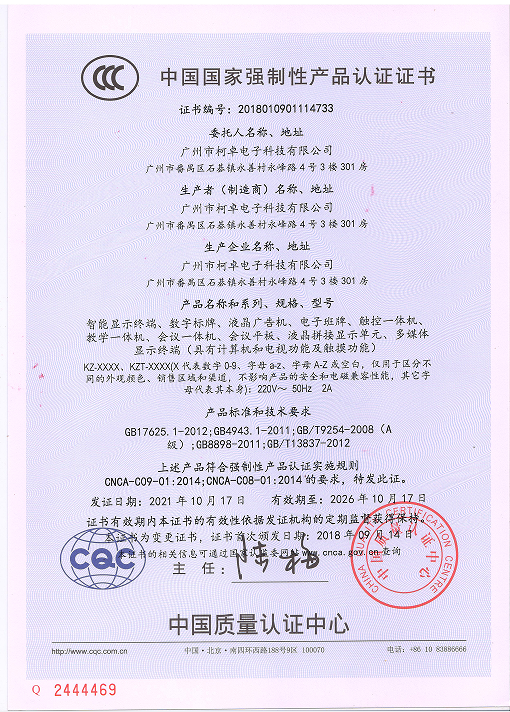
| China Compulsory Product Certification (3C) | 2018010901114733 | China Quality Certification Center (CQC) | China. GB17625.1-2012, GB4943.1-2011, GB/T9254-2008 (Class A), GB8898-2011, GB/T13837-2012, CNCA-C09-01:2014, CNCA-C08-01:2014 | Safety and electromagnetic compatibility compliance for the listed KD series display families. Issue date 2021-10-17; recorded validity to 2026-10-17. |
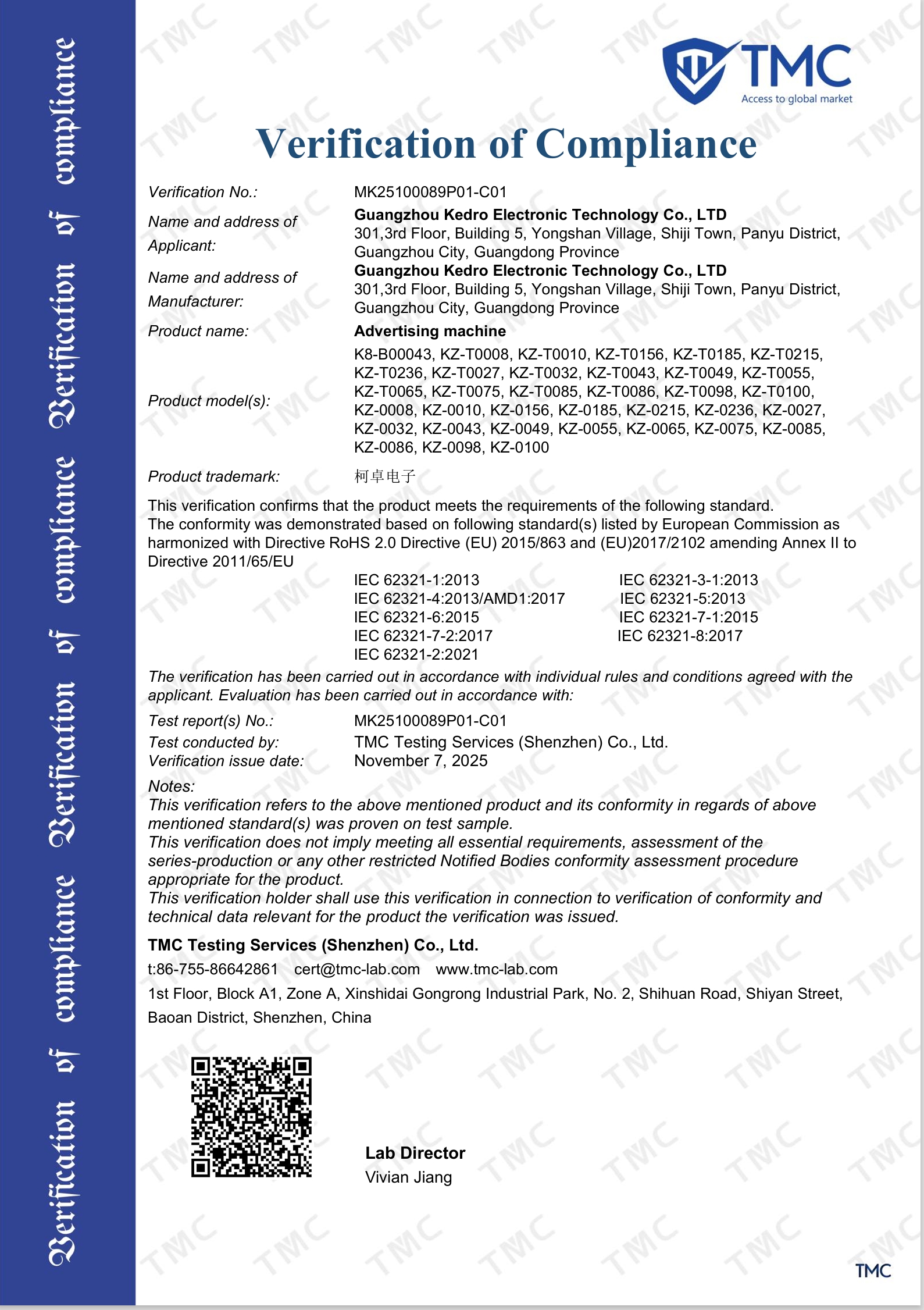
| TEST REPORT (hazardous substances) | MK25100089P01-C01 | TMC Testing Services (Shenzhen) Co., Ltd. | EU. IEC 62321 series; RoHS 2.0 Directive (EU) 2015/863, (EU) 2017/2102 | Test evidence for lead, cadmium, mercury, hexavalent chromium, PBBs, PBDEs and phthalates (DEHP, BBP, DBP, DIBP). |
| Verification of Compliance (RoHS 2.0) | MK25100089P01-C01 | TMC Testing Services (Shenzhen) Co., Ltd. | EU. RoHS 2.0 Directive (EU) 2015/863 | Declares that the product meets EU RoHS 2.0 compliance requirements for the controlled substances. |
| Verification of Compliance (EMC) | MK25100089P01-E01 | TMC Testing Services (Shenzhen) Co., Ltd. | EU. EN 55032:2015/A11:2020, EN 55035:2017/A11:2020, EN IEC 61000-3-2, EN 61000-3-3; EMC Directive 2014/30/EU | Electromagnetic compatibility compliance for EU market placement. |
| Verification of Compliance (electrical safety) | MK25100089P01-S01 | TMC Testing Services (Shenzhen) Co., Ltd. | EU. EN IEC 62368-1:2024/A11:2024; LVD Directive 2014/35/EU | Electrical safety items required by the Low Voltage Directive. |
| INSPECTION REPORT | JAT2207030268CN-01 | Dongguan Junan Testing and Certification Co., Ltd. | China. GB4943.1-2022 and enterprise technical requirements | Marking, electrical safety, display performance, touch function, audio function, interface function and environmental adaptability. |
| Quality Management System Certification (ISO 9001) | 25020021R0S | Beijing Zhengbiao Lianxin Certification Service Co., Ltd. | Domestic and overseas markets. GB/T 19001-2016 idt ISO 9001:2015 | Scope: production and sales of intelligent display terminals, computer display screens, touch screen all-in-one machines and touch teaching all-in-one machines (export only). |
Matching Each Acceptance Item to a Specific Document
Procurement teams frequently receive a folder of certificates without a mapping between the documents and the acceptance checklist. The mapping below shows which document a buyer should open for each acceptance line, and what that document actually establishes.
| Acceptance item | Document to request | What it establishes |
|---|---|---|
| Electrical safety for the China market | 3C certificate 2018010901114733 | Compliance with the listed GB safety and EMC standards for the model families named in the certificate. |
| Electrical safety for the EU market | Verification of Compliance MK25100089P01-S01 | Compliance with EN IEC 62368-1:2024/A11:2024 under LVD Directive 2014/35/EU. |
| Electromagnetic compatibility | Verification of Compliance MK25100089P01-E01 | Compliance with EN 55032, EN 55035 and harmonic/flicker standards under EMC Directive 2014/30/EU. |
| Restricted substances / environmental compliance | TEST REPORT MK25100089P01-C01 and its Verification of Compliance | Test data and a compliance statement for RoHS 2.0 controlled substances. |
| Marking, display, touch, audio, interface and environmental adaptability | INSPECTION REPORT JAT2207030268CN-01 | Third-party examination of product functions and environmental behaviour under GB4943.1-2022 and enterprise technical requirements. |
| Production consistency and quality system | ISO 9001 certificate 25020021R0S | A certified quality management system covering the stated production and sales scope. |
| Batch conformity before shipment | Factory test records | 100% aging test and functional inspection, plus brightness, waterproof, touch, temperature and continuous operation testing, and full quality control before shipment. |
What the 3C Certificate Covers, and Where Its Scope Ends
3C certificate 2018010901114733 is issued for the Chinese market and covers safety and electromagnetic compatibility against GB17625.1-2012, GB4943.1-2011, GB/T9254-2008 (Class A), GB8898-2011 and GB/T13837-2012, under the CNCA-C09-01:2014 and CNCA-C08-01:2014 implementation rules. The certificate record associates it with the KD-OD, KD-VW, KD-TP, KD-IFPD, KD-LED and KD-AD display families.
Three boundaries matter here. First, a 3C certificate is issued against a defined certified scope. A buyer should not assume that every model in a supplier's catalogue is automatically inside that scope; the exact model, screen size and voltage configuration quoted in the purchase order should be checked against the certificate's associated product list, and the supplier should confirm model-level inclusion in writing. Second, the certificate record shows a validity period ending on 2026-10-17, so its current status should be re-confirmed at the time of order rather than assumed from a previously filed copy. Third, 3C is a China market access scheme and does not replace the EU documents in the same file; RoHS 2.0, EMC and electrical safety evidence are handled by separate Verifications of Compliance under the MK25100089P01 series.
Documentary Evidence of RoHS 2.0 and EMC Compliance
For EU-bound orders, three documents in the same certificate series carry the compliance burden. TEST REPORT MK25100089P01-C01, issued by TMC Testing Services (Shenzhen) Co., Ltd. with a recorded issue date of 2025-11-07, covers RoHS 2.0 controlled hazardous substances tested against the IEC 62321 series of standards: lead, cadmium, mercury, hexavalent chromium, polybrominated biphenyls, polybrominated diphenyl ethers, and the phthalates DEHP, BBP, DBP and DIBP. A companion Verification of Compliance with the same number declares that the product meets the EU RoHS 2.0 compliance requirements. EMC is addressed separately by Verification of Compliance MK25100089P01-E01, which references EN 55032:2015/A11:2020, EN 55035:2017/A11:2020, EN IEC 61000-3-2 and EN 61000-3-3 under EMC Directive 2014/30/EU.
The practical acceptance point is that a test report and a verification of compliance are not the same document. The test report carries the substance-by-substance measurements; the verification of compliance carries the conformity statement. A procurement file that contains only the statement, without the underlying test report, is weaker during an audit or a customs query.
Factory-Level Evidence That Supports Acceptance
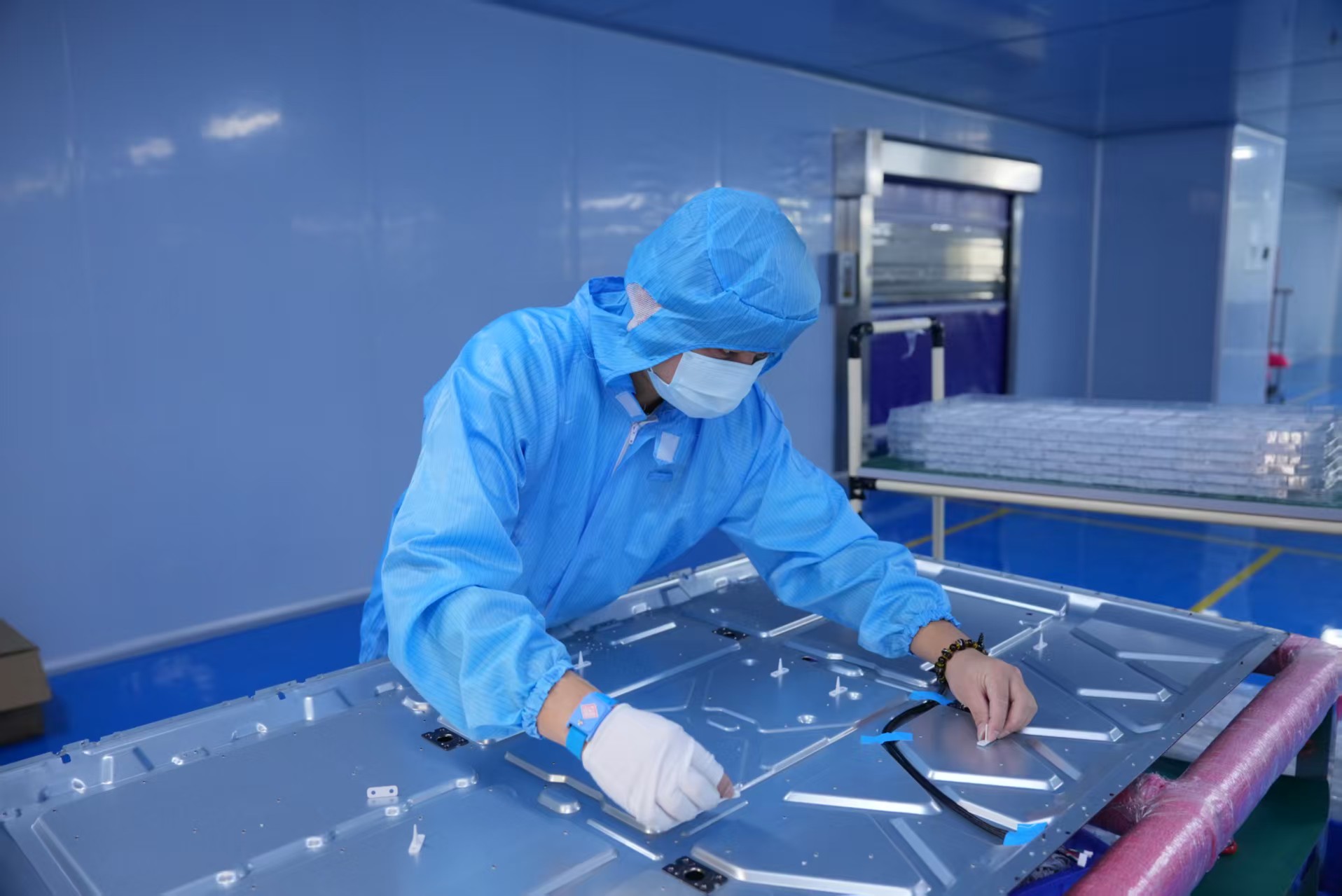
Certificates describe a product family; they do not describe a shipment. That gap is filled by production and quality-control practice. GZKEDRO operates as a display factory and provides customised display solutions, and it provides OEM and ODM production services for display products. The facility profile recorded for the company includes a 50,000 m³ site, more than 200 employees, a research and development team of more than 100 people, research and development centres in Guangzhou and Shenzhen, and an export ratio of approximately 80% serving global markets.
On quality control, the documented practice before shipment is 100% aging test and functional inspection, supplemented by brightness testing, waterproof testing, touch testing, temperature testing and continuous operation testing, with full quality control before shipment under industrial standard testing. For a digital human terminal, the continuous operation and temperature tests are the closest available proxy for the operating stability a mall shopping guide installation or an exhibition hall reception terminal will require, because these units are expected to run through long opening hours with audio, camera and voice interaction active.
Production parameters recorded for the manufacturer include a monthly capacity of 2,000–5,000 units, a lead time of 15–30 days with a maximum of 30 days, and a minimum order quantity of 2–5 units depending on product size, with flexible and project-based MOQ arrangements. Customisation options documented across the product range include logo, colour, software, UI interface, packaging and voltage, as well as screen size, brightness, housing and system configuration, with support for custom software, CMS, industrial design and hardware structure development.
Commercial Terms as Recorded, and How to Treat Them
The purchasing-terms question and the acceptance-criteria question are usually asked together. The commercial framework recorded for these products states a minimum order quantity of 2–5 units depending on product size, delivery terms of DDP, CIF or FOB by air freight, sea freight or land transport, and payment terms of TT, L/C, D/P, PayPal, Payoneer, Wise and Western Union. These are the terms recorded in the supplier's own purchasing documentation.
A neutral reading is appropriate here: recorded terms describe a starting framework, not a binding commitment. The practical recommendation is to move every commercial variable — MOQ, Incoterm, payment instrument, delivery window — into the signed purchase order, and to attach the acceptance document list as an annex, so that acceptance is judged against named documents rather than against expectations formed during the evaluation stage.
Where Digital Human Displays Are Accepted in Practice
The KD-DH Series Holographic Digital Human is the product family in this catalogue that most directly matches the digital human display category. Its recorded specification set includes a 3840 × 2160 resolution panel at 1300 cd/m² brightness, 320 local dimming zones, a 3000:1 physical contrast ratio, HDR1000 support, 30% light transmittance, 60W 2.1-channel audio, an 8-array microphone and a 5MP driverless camera, with a display area of 1649 (H) × 927 (V) mm in a 16:9 ratio, operating at AC 100–240V with rated power consumption of 1100W. The materials listed are tempered glass, acrylic and aluminium alloy, and the stated application environments are exhibition centres, hotel lobbies, commercial districts, education and healthcare.
Case records associated with the manufacturer's transparent and interactive display products show use in smart retail advertising, including deployment by OEM and ODM display buyers, with documented highlights covering ultra HD and interactive features, modern transparent technology, full customisation, factory direct supply, and multi-touch and wireless sharing. Broader case documentation lists advertising media companies, education institutions, retail chain stores, outdoor advertising contractors, exhibition and event companies, system integrators, corporate offices, luxury retail brands and government or smart city projects as buyer types, with quantities of 100+ units in customised and large-scale projects and typical operating durations of three years, or five years in special cases.
Documented buyer markets span a wide set of country codes covering North America, the Gulf and wider Middle East, Africa, Europe, South Asia, Southeast Asia, Australia, and Latin America. For acceptance purposes, the useful conclusion is not the market list itself but the ordering pattern: these are projects where the terminal is specified into a public environment, which is precisely why documentation review tends to precede the visual demo.
Market Trend Analysis: Documentation as a Category Requirement
Independent market research published by PW Consulting / pmarketresearch.com in June 2026 estimates the digital human screen market at USD 450.0 million in 2025 and projects USD 1,162.38 million by 2032, implying a CAGR of 14.5%. That figure is a commercial research estimate and its market definition may differ from adjacent categories such as holographic displays or interactive kiosk fleets, so it is best used as a directional indicator rather than a contractual benchmark.
Vendor behaviour points in the same direction. Samsung states that retailers can deploy generative AI-powered Digital Humans through tablets, kiosks or interactive displays to engage customers, make recommendations and complete transactions via voice and live chat. Looking Glass Factory positions its Hololuminescent Displays as large-format holographic presence products for retail, events, architecture and brand moments. Two different technology routes, one shared consequence: as the category scales from novelty installations into repeatable retail and exhibition deployments, the acceptance conversation shifts from panel specification alone to the question of which documents support which claim.
Digital Human Display versus Traditional Digital Signage Acceptance — and the Limits of Certification
Traditional digital signage acceptance is largely a hardware exercise: resolution, brightness, contrast ratio, viewing angle, power consumption and operating temperature are checked against a datasheet, and the deal is closed. A digital human display adds interactive layers that the traditional checklist does not reach.
| Acceptance dimension | Traditional digital signage | Digital human display | Document position |
|---|---|---|---|
| Panel and optics | Resolution, brightness, contrast | Same, plus local dimming and transmittance where a transparent structure is used | Covered by datasheet and inspection report; confirm model-specific values |
| Audio and voice | Speaker output only | Multi-channel audio plus microphone array | Audio function is within inspection scope; microphone array performance is not certified |
| Vision and sensing | Not applicable | Driverless camera module | Not covered by the certificates listed above |
| Software behaviour | Playback and scheduling | Voice interaction, recommendation, transaction support | Outside the scope of safety, EMC and RoHS certification |
| Environmental durability | Operating temperature range | Same, plus continuous operation expectations | Inspection report scope plus factory continuous operation testing |
The clearest limitation is scope. The document set described in this article verifies safety, electromagnetic compatibility, restricted substances, physical inspection items and the manufacturing quality system. It does not certify AI software behaviour, speech recognition accuracy, conversational quality, content correctness, or the visual performance of a specific digital human rendering. A buyer who accepts a digital human display purely on 3C, RoHS 2.0, EMC and ISO 9001 evidence has verified the compliance envelope, not the interactive experience.
A second limitation is model scope. The RoHS, EMC and inspection documents in the record are associated with ten listed KD display families, and the 3C certificate with six of them. The holographic digital human is a distinct series, so model-level confirmation should be requested explicitly rather than inferred. A third limitation is verification depth on specifications. Numeric claims such as resolution, brightness, transmittance, local dimming zone count and camera resolution should be confirmed against the manufacturer's model-specific datasheet or an accredited lab report before they are written into a purchase order as acceptance benchmarks. The same discipline applies to market-access claims outside China and the EU: a U.S. market FCC SDoC reference recorded under certificate MAX26060195P01-E01 from MAXLAB Testing Co., Ltd. should be confirmed against official records before it is used as a shipment condition.
Future Outlook
Three shifts are likely to shape digital human display procurement over the next few years. First, acceptance checklists will split into a hardware compliance annex and a software performance annex, because the current certificate system has no natural home for voice interaction or AI model behaviour. Second, buyers will increasingly ask for document validity windows to be tracked alongside the order schedule, since certificates have different issue and expiry dates even inside one supplier's file. Third, as the category moves from demonstration projects into repeatable retail, exhibition and public-service deployments, suppliers who can assemble a complete, current and model-matched document pack will be easier to qualify than suppliers who can only present a demo unit.
Procurement FAQ: Digital Human Display Acceptance
Which documents should be attached to a Digital Human Display purchase order?
A working annex typically contains the market-access certificate for the destination market, the hazardous-substances test report, the EMC verification, the electrical safety verification, the product inspection report, the quality management system certificate, and the factory batch test record. For these products that means 3C certificate 2018010901114733, TEST REPORT MK25100089P01-C01, Verifications of Compliance MK25100089P01-E01 and MK25100089P01-S01, INSPECTION REPORT JAT2207030268CN-01, ISO 9001 certificate 25020021R0S, and the shipment-level aging and functional inspection record.
Does the 3C certificate cover every model, including the holographic digital human series?
3C certificate 2018010901114733 is recorded against the KD-OD, KD-VW, KD-TP, KD-IFPD, KD-LED and KD-AD display families. The holographic digital human is a separate series, so a buyer should not assume automatic coverage. The correct step is to ask the supplier to confirm in writing whether the exact model, screen size and voltage configuration in the purchase order falls within a current certified scope, and to supply the corresponding certificate version.
What exactly does TEST REPORT MK25100089P01-C01 verify?
Issued by TMC Testing Services (Shenzhen) Co., Ltd. with a recorded issue date of 2025-11-07, the report covers RoHS 2.0 controlled hazardous substances tested against the IEC 62321 series: lead, cadmium, mercury, hexavalent chromium, polybrominated biphenyls, polybrominated diphenyl ethers, and the phthalates DEHP, BBP, DBP and DIBP. It sits under RoHS 2.0 Directive (EU) 2015/863 and (EU) 2017/2102 and is accompanied by a Verification of Compliance with the same number.
How is EU EMC and electrical safety evidence organised for these displays?
Two separate documents in the MK25100089P01 series carry that evidence. Verification of Compliance MK25100089P01-E01 addresses EMC against EN 55032:2015/A11:2020, EN 55035:2017/A11:2020, EN IEC 61000-3-2 and EN 61000-3-3 under EMC Directive 2014/30/EU. Verification of Compliance MK25100089P01-S01 addresses electrical safety items under LVD Directive 2014/35/EU against EN IEC 62368-1:2024/A11:2024. Both were issued by TMC Testing Services (Shenzhen) Co., Ltd.
What does INSPECTION REPORT JAT2207030268CN-01 add that certificates do not?
Certificates confirm conformity to a standard; an inspection report records what was examined on the product. JAT2207030268CN-01, issued by Dongguan Junan Testing and Certification Co., Ltd. against GB4943.1-2022 and enterprise technical requirements, covers equipment marking, electrical safety, display performance, touch function, audio function, interface function and environmental adaptability. For a touch-enabled or interactive terminal, the touch and audio lines are the practical additions.
What does ISO 9001 certificate 25020021R0S prove for a buyer?
Certificate 25020021R0S, issued by Beijing Zhengbiao Lianxin Certification Service Co., Ltd. against GB/T 19001-2016 idt ISO 9001:2015, covers the scope of production and sales of intelligent display terminals, computer display screens, touch screen all-in-one machines and touch teaching all-in-one machines for export. It is evidence that a documented quality management system operates over those product categories, and it supports process consistency across repeat orders. It is not a product test result and should not be used as one.
What acceptance testing is recorded before shipment?
The recorded pre-shipment quality control consists of 100% aging test and functional inspection, supported by brightness testing, waterproof testing, touch testing, temperature testing and continuous operation testing, with full quality control before shipment under industrial standard testing. Monthly production capacity is recorded at 2,000–5,000 units, with a lead time of 15–30 days and a maximum of 30 days.
What commercial terms are documented, and what is not?
The documented commercial framework states a minimum order quantity of 2–5 units depending on product size, with flexible and project-based arrangements; delivery terms of DDP, CIF or FOB by air freight, sea freight or land transport; and payment terms of TT, L/C, D/P, PayPal, Payoneer, Wise and Western Union. What is not documented is any model-specific price, warranty period or penalty clause, so those items must be negotiated and fixed in the contract rather than assumed from a specification sheet.
Where does the certification evidence stop?
The evidence set covers safety, EMC, restricted substances, inspection items and the quality management system. It does not certify voice recognition accuracy, AI response quality, content accuracy, camera performance or the visual fidelity of the digital human rendering. Specification values such as 3840 × 2160 resolution, 1300 cd/m² brightness, 320 local dimming zones, 30% light transmittance, an 8-array microphone and a 5MP camera are recorded product specifications and should be confirmed against a model-specific datasheet or laboratory report before being used as acceptance thresholds.
For readers who need the full product and configuration reference behind these documents, the manufacturer's public catalogue is available here: Kedro Product Catalog (English Edition), New with AI Humans Updated.