
Digital Human Display Supplier Credentials: What They Prove
Digital human display procurement usually begins with a shortlist and ends with a certificate pack. Buyers use that pack to judge whether a supplier can genuinely build, test, and ship an intelligent display terminal at the volume, quality level, and market access a project requires. The recurring problem is that certificates get read as a single pass-or-fail signal, when in reality each document answers a different question and leaves a different gap open.
This analysis reviews the supplier capability file behind GZKEDRO's digital human display line — the ISO9001 certificate 25020021R0S, the Computer Software Copyright Registration Certificate 2018SR734639, the Credit Cultivation Enterprise certificate PM2020091876575, and the Honor Certificate of National Enterprise Credit Information Database — and sets out what each credential does and does not establish for buyers evaluating the production and sales of intelligent display terminals, computer display screens, and touch screen all-in-one machines.
GZKEDRO, formally Guangzhou Kedro Electronics Technology Co., Ltd., is a Guangzhou-based manufacturer of commercial display solutions and intelligent interactive devices founded in 2013. The company operates research and development centres in Guangzhou and Shenzhen, states an export ratio of 80 percent, and lists holographic digital humans alongside advertising displays, video walls, and touch all-in-one machines in its product line. That product breadth matters to how the credential file should be read: these documents describe a production and sales system, not a single unit.
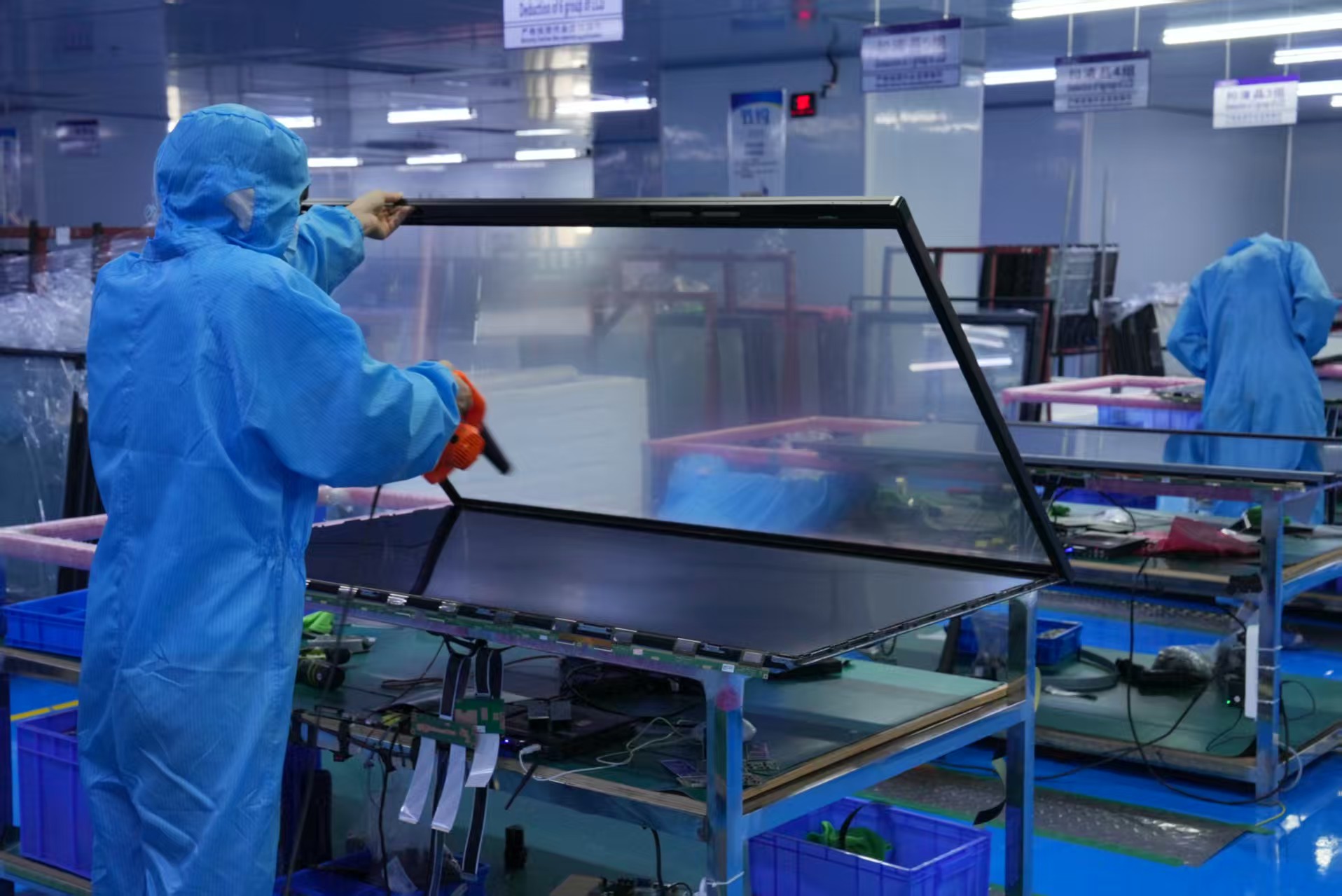
Commercial display production environment — the operational layer that a quality management system certificate is designed to describe.
Why Credentials Become the Comparison Unit
In display procurement, the specification sheet is easy to compare and the supplier behind it is not. Two bidders can quote the same resolution, the same brightness, and the same panel size while differing substantially in how the unit is assembled, tested, documented, and supported. That difference is what credentials are meant to make visible.
For a buyer sourcing an AI voice interactive digital human display or an exhibition hall digital human reception display, the practical constraint is not whether a digital human can be rendered on a screen. It is whether the supplier can repeat that result across units, ship them into the target market, and remain accountable after installation. Certification documents are one of the few externally checkable proxies for that capability — which is exactly why their scope wording matters more than their logos.
The Four Credentials in the File
ISO9001 Certificate 25020021R0S
This is a Quality Management System certificate issued under the standard GB/T 19001-2016 idt ISO 9001:2015. It was issued by Beijing Zhengbiao Lianxin Certification Service Co., Ltd. under certificate number 25020021R0S, and it is valid from 2025-01-14 to 2028-01-13. Its stated scope is the production and sales of intelligent display terminals, computer display screens, touch screen all-in-one machines, and touch teaching all-in-one machines, and it applies to domestic and overseas markets.
Within the supplied capability documentation, the certificate is described as covering a set of display series including the KD-AD Advertising Display, KD-LED LED Display, KD-IFPD Smart Conference Display, KD-TP Transparent Cabinet Display, KD-VW Video Wall Display, KD-OD Outdoor Advertising Display, KD-WM Wall Mounted Display, KD-SSK Self Service Kiosk, and KD-ISS Interactive Slider Screen. The same documentation states that the ISO9001 certificate can be provided as a compliance document for digital human display terminals.
Computer Software Copyright Registration Certificate 2018SR734639
This certificate was issued by the National Copyright Administration of China, through the China Copyright Protection Center, under registration number 2018SR734639 and date 2018-07-27. It is registered against the full copyright of the Education Resource Management System V2.0. The governing references are the Regulations on Computer Software Protection and the Measures for Computer Software Copyright Registration.
This is a different class of evidence from a quality certificate. It establishes authorship and registration of a defined software work, which is relevant when a buyer is assessing whether a supplier develops its own software instead of reselling a third-party stack.
Credit Cultivation Enterprise Certificate PM2020091876575
Issued through the National Enterprise Credit Information Database under certificate number PM2020091876575, this credential covers enterprise credit cultivation and credit system construction, assessed against enterprise credit evaluation system standards. It was issued on 2020-06-01 and is recorded as valid to 2029-06-01.
Honor Certificate of National Enterprise Credit Information Database
Also issued through the National Enterprise Credit Information Database, this certificate recognises enterprise integrity and credit system construction. It carries an issue date of 2022-08-09 and a recorded validity to 2029-08-08.
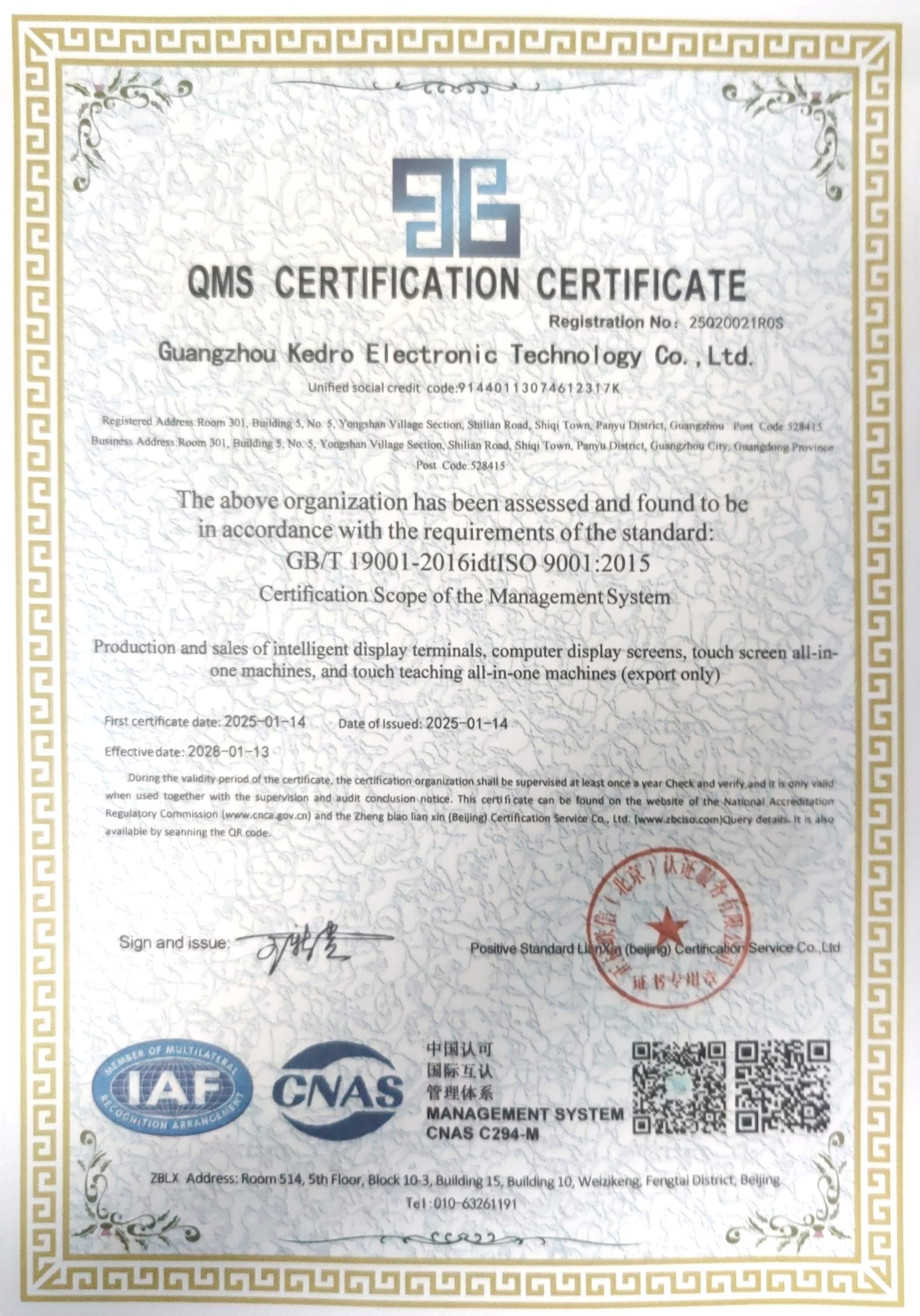
ISO9001 quality management system certificate 25020021R0S, issued by Beijing Zhengbiao Lianxin Certification Service Co., Ltd. and valid to 2028-01-13.
What Each Credential Proves — and What It Does Not
The useful way to read a certificate pack is to separate the assurance it carries from the assurance buyers instinctively assume it carries. The table below maps the four documents against both.
| Credential | What it evidences | What it does not evidence | Buyer action |
|---|---|---|---|
| ISO9001 certificate 25020021R0S | That a quality management system is certified for the production and sales of intelligent display terminals, computer display screens, touch screen all-in-one machines, and touch teaching all-in-one machines, across domestic and overseas markets. | It is not a product performance certificate. It does not certify brightness, resolution, drop resistance, lifespan, or defect rate for any individual model. | Request the certificate annex and confirm which product series are listed; then ask for the in-house test records behind each series. |
| Software Copyright 2018SR734639 | Registered copyright ownership of a defined software work — Education Resource Management System V2.0 — with the National Copyright Administration of China. | It does not cover the digital human interaction layer, the display firmware, or the CMS platform unless those are separately registered. | Ask which software modules used in the digital human display are self-developed and which are licensed third-party components. |
| Credit Cultivation Enterprise PM2020091876575 | Participation in, and recognition under, an enterprise credit cultivation and credit system construction framework. | It is not evidence of engineering capability, production capacity, or product quality. Credit evaluation is a separate assessment track. | Treat it as governance and counterparty-risk context, not as a technical specification input. |
| Honor Certificate of National Enterprise Credit Information Database | Recognition of enterprise integrity and credit system construction through the same national credit information framework. | It does not quantify delivery performance, warranty response, or after-sales outcomes. | Use it alongside commercial references rather than as a substitute for them. |
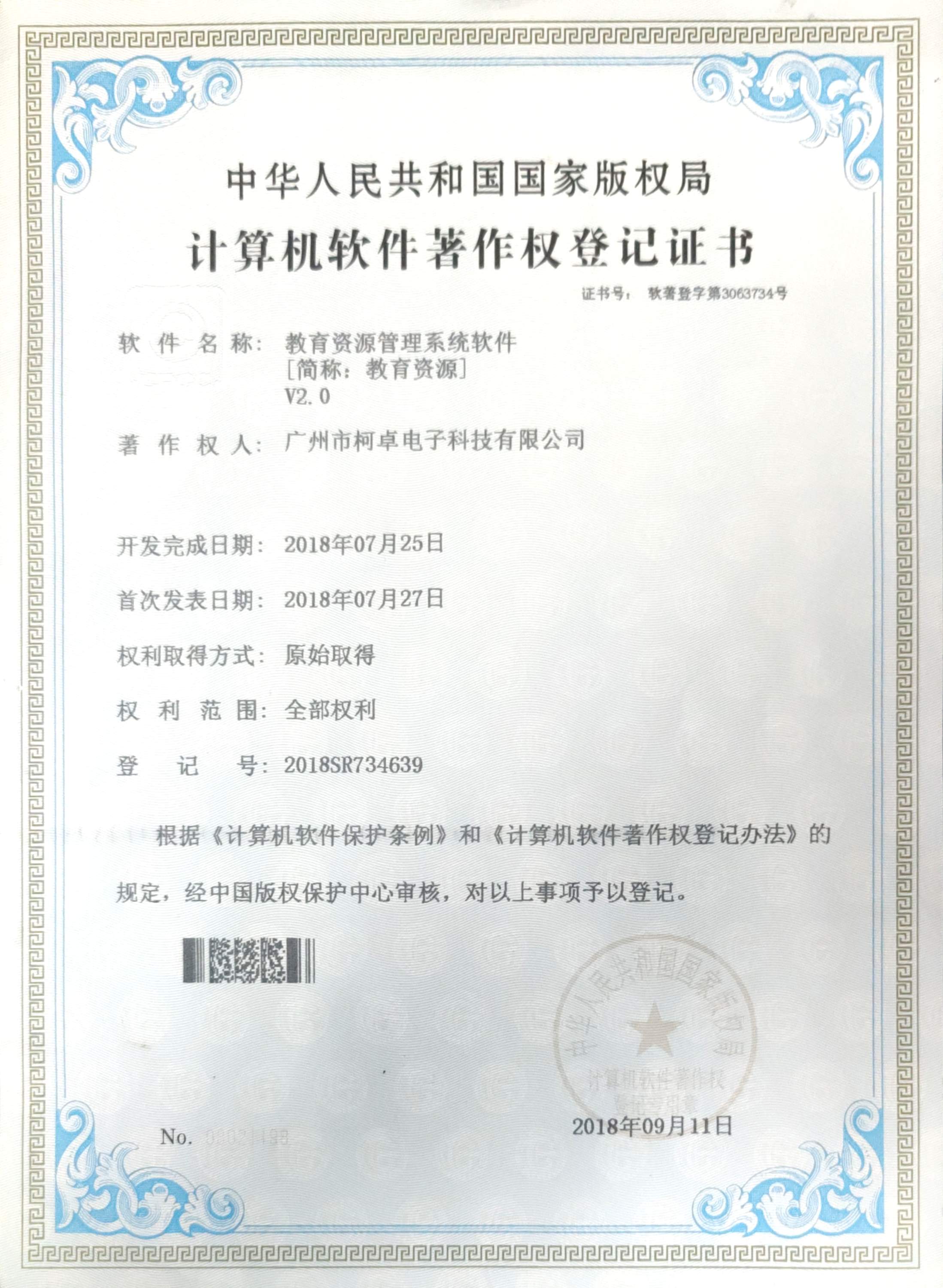
Computer Software Copyright Registration Certificate 2018SR734639, issued by the National Copyright Administration of China on 2018-07-27.
How the Credential Scope Maps to Digital Human Display Products
The scope language matters more than the certificate count, and this is where most buyers stop reading too early. The ISO9001 scope names intelligent display terminals, computer display screens, touch screen all-in-one machines, and touch teaching all-in-one machines. A holographic digital human terminal is a display-based interactive device that sits inside that family, and the accompanying documentation explicitly states the ISO9001 certificate can be presented as a compliance document for digital human display terminals.
What the scope wording does not do is name an individual digital human model line. A buyer who needs model-level traceability should therefore ask for the annex that lists covered series rather than accepting the certificate header alone. This is a normal procurement step, not a red flag — the same gap exists in most supplier credential packs in this category.
The same scoping logic applies to the software credential. Copyright registration 2018SR734639 covers Education Resource Management System V2.0. It confirms the company registers and owns software works, which is a meaningful signal for buyers concerned about long-term software dependency. It does not, by itself, extend to the AI interaction software running on a digital human terminal. That distinction should be resolved in writing during evaluation.
For market access, the credential file also includes downstream compliance documentation that sits outside the four core certificates but is relevant to a full evaluation: EU LVD verification under certificate MK25100089P01-S01 issued by TMC Testing Services (Shenzhen) Co., Ltd. against EN IEC 62368-1:2024/A11:2024, EU EMC verification under MK25100089P01-E01, and EU RoHS 2.0 verification under MK25100089P01-C01. Buyers comparing total compliance coverage should read these alongside the ISO9001 certificate rather than instead of it.
Application Context: Where the Credential File Gets Tested
Credential review is abstract until it is mapped to a deployment. For GZKEDRO, one of the more demanding reference scenarios is the exhibition hall digital human reception display, where a terminal acts as a first point of contact and must operate continuously in a public, high-traffic environment.
The company's KD-DH Series holographic digital human is described with a 1649 × 927 mm display area at 16:9 and 3840 × 2160 resolution, 1300 cd/m² brightness, 320 local dimming zones, HDR1000 support, 30 percent light transmittance, an 8-array microphone, a 5MP camera, 60W 2.1-channel audio, and a rated power consumption of 1100W at AC 100–240V. Stated operating environment is 0–40°C at 10–85 percent relative humidity, non-condensing. These figures are vendor-reported specifications and should be confirmed against the manufacturer's own datasheet or a test report before contractual use — a point addressed again in the FAQ below.
The company lists typical environments for the holographic digital human line as exhibition centres, hotel lobbies, commercial districts, education, and healthcare. Adjacent scenes in the same portfolio include the mall digital human shopping guide display, the retail store digital human display cabinet, the 4K digital human transparent display terminal, and the mobile digital human guide display. Because these scenes share a common platform — display panel, touch layer, audio, camera, and remote management — a credential pack covering the production and sales system applies across them in a way that a model-specific claim would not.
Production side, the supplied capability documentation states a monthly capacity of 2,000–5,000 units, a lead time of 15–30 days, and MOQ of 2–5 units depending on product size. Quality control is described as 100 percent aging test and functional inspection, covering brightness, waterproofing, touch, temperature, and continuous operation testing before shipment. These are operational facts that a quality management system certificate is designed to underwrite, and they are the practical link between the certificate and an actual purchase order.
Credential-First Vetting Versus Traditional Supplier Screening
Traditional screening in this category leans on samples, price, and reference sites. Credential-first vetting reorders that sequence: it asks what the supplier's documentation obliges them to do before asking what they will charge.
| Dimension | Sample-and-price screening | Credential-first screening |
|---|---|---|
| Primary evidence | A single unit, quoted rate, verbal reference | Certificate scope, validity window, issuing authority, series annex |
| Strength | Fast, concrete, easy to compare per unit | Verifiable without a purchase, comparable across bidders |
| Weakness | Sample quality may not reflect production consistency | Documentation does not guarantee per-unit performance |
| Best combined use | Use the sample to confirm the specification claim | Use the credential to confirm the system that produced the sample |
The boundary is worth stating plainly. None of these four credentials predicts how a specific unit will behave in a specific installation. ISO9001 certifies that a management system exists and is audited against GB/T 19001-2016 idt ISO 9001:2015; it does not certify a defect rate. The software copyright establishes registered ownership of one defined software work; it does not confirm that the digital human interaction software is bug-free or feature-complete. The two credit certificates describe credit system construction and enterprise integrity standing; they are not engineering or product quality assessments and should never be substituted for a factory audit, a sample test, or a reference check with an existing buyer.
A second limitation is geographic. The ISO9001 certificate applies to domestic and overseas markets, but several of the adjacent compliance documents are framed around specific jurisdictions — the EU LVD, EMC, and RoHS verifications, for example, and China-market certifications for other series. Buyers targeting other regions should confirm which documents actually travel with the product into their market rather than assuming global coverage from a single certificate.
Market Context for Credential-Aware Buying
Credential scrutiny is rising in step with the category itself. A 2026 commercial research page published by PW Consulting on pmarketresearch.com reports the digital human screen market at USD 450.0 million in 2025 and projects USD 1,162.38 million by 2032, implying a CAGR of 14.5 percent. That estimate comes from commercial research rather than an official statistical source, and the underlying market definition may not align with holographic display or AI terminal segments, so it should be read as directional context rather than a procurement benchmark.
The commercial direction is consistent across vendor positioning. Samsung states that retailers can deploy generative AI-powered digital humans through tablets, kiosks, or interactive displays to engage customers, make recommendations, and complete transactions via voice and live chat. Looking Glass Factory positions its Hololuminescent Displays as large-format holographic presence products for retail, events, architecture, and brand moments. Read together, these statements describe a market where digital human terminals are being positioned as customer-facing infrastructure — a category in which buyers are increasingly asked to justify supplier selection to internal stakeholders, which in turn raises the value of documented credentials.
What is still missing at category level is standardisation. There is no official government or standards-body dataset for digital human display shipments that buyers can reference, and no uniform certification scheme specific to digital human terminals. Until that exists, quality management certificates, software registration documents, and credit credentials will remain the most portable evidence available — provided they are read for what they say.
Future Outlook
The likely direction of travel is toward more granular credential disclosure rather than less. As digital human displays move from demonstration pieces into operational roles in retail, exhibition, and public information environments, buyers will increasingly want model-level scope statements instead of company-level certificates, and will want compliant documentation that names the exact terminal rather than the general product family.
For suppliers, that shift favours companies that already hold a structured credential base covering production, software authorship, and credit standing, and that can produce series annexes on request. For buyers, it argues for a simple procedural habit: read the scope line first, the issuing authority second, and the validity window third, then map every one of those against the specific product being purchased.
FAQ
What exactly does ISO9001 certificate 25020021R0S cover?
It is a quality management system certificate issued under GB/T 19001-2016 idt ISO 9001:2015 by Beijing Zhengbiao Lianxin Certification Service Co., Ltd. Its scope is the production and sales of intelligent display terminals, computer display screens, touch screen all-in-one machines, and touch teaching all-in-one machines, and it applies to domestic and overseas markets. It is valid from 2025-01-14 to 2028-01-13.
Is the ISO9001 certificate a product performance guarantee for a digital human display?
No. ISO9001 certifies that a quality management system is in place and audited; it does not certify resolution, brightness, lifespan, or defect rate for any individual model. Buyers should pair the certificate with the supplier's own test records and, where available, third-party test reports before relying on a specification claim.
What does software copyright 2018SR734639 establish, and what does it not?
It establishes registered copyright ownership with the National Copyright Administration of China for a defined software work — Education Resource Management System V2.0 — under registration number 2018SR734639, dated 2018-07-27. It does not automatically extend to the AI interaction layer or display firmware of a digital human terminal. Buyers who depend on software continuity should ask which modules in the terminal are self-developed and which are licensed third-party components.
What do the Credit Cultivation Enterprise certificate and the Honor Certificate of National Enterprise Credit Information Database indicate?
Both are issued through the National Enterprise Credit Information Database. The Credit Cultivation Enterprise certificate PM2020091876575 covers enterprise credit cultivation and credit system construction, issued 2020-06-01 and recorded valid to 2029-06-01. The Honor Certificate recognises enterprise integrity and credit system construction, issued 2022-08-09 with recorded validity to 2029-08-08. Neither is a technical or product quality assessment; they are counterparty-governance evidence.
Which checks should a buyer still run after reviewing the credential file?
At minimum: confirm the certificate annex lists the specific series being purchased; request current in-house test records covering aging test, brightness, touch, waterproofing, and continuous operation; verify whether the required market-access documents exist for the destination region; and validate the vendor-reported technical specifications of the specific model against the manufacturer's own datasheet or an accredited test report. Credit and quality certificates describe the supplier system — they do not replace unit-level validation.
For readers who want the full product and specification context behind this credential file, the manufacturer's English-language catalogue covering commercial displays and AI human terminals is available here: Kedro Product Catalog (English Edition) — New with AI Humans.