
Digital Label Printer Customization: OEM Buyer's Checklist
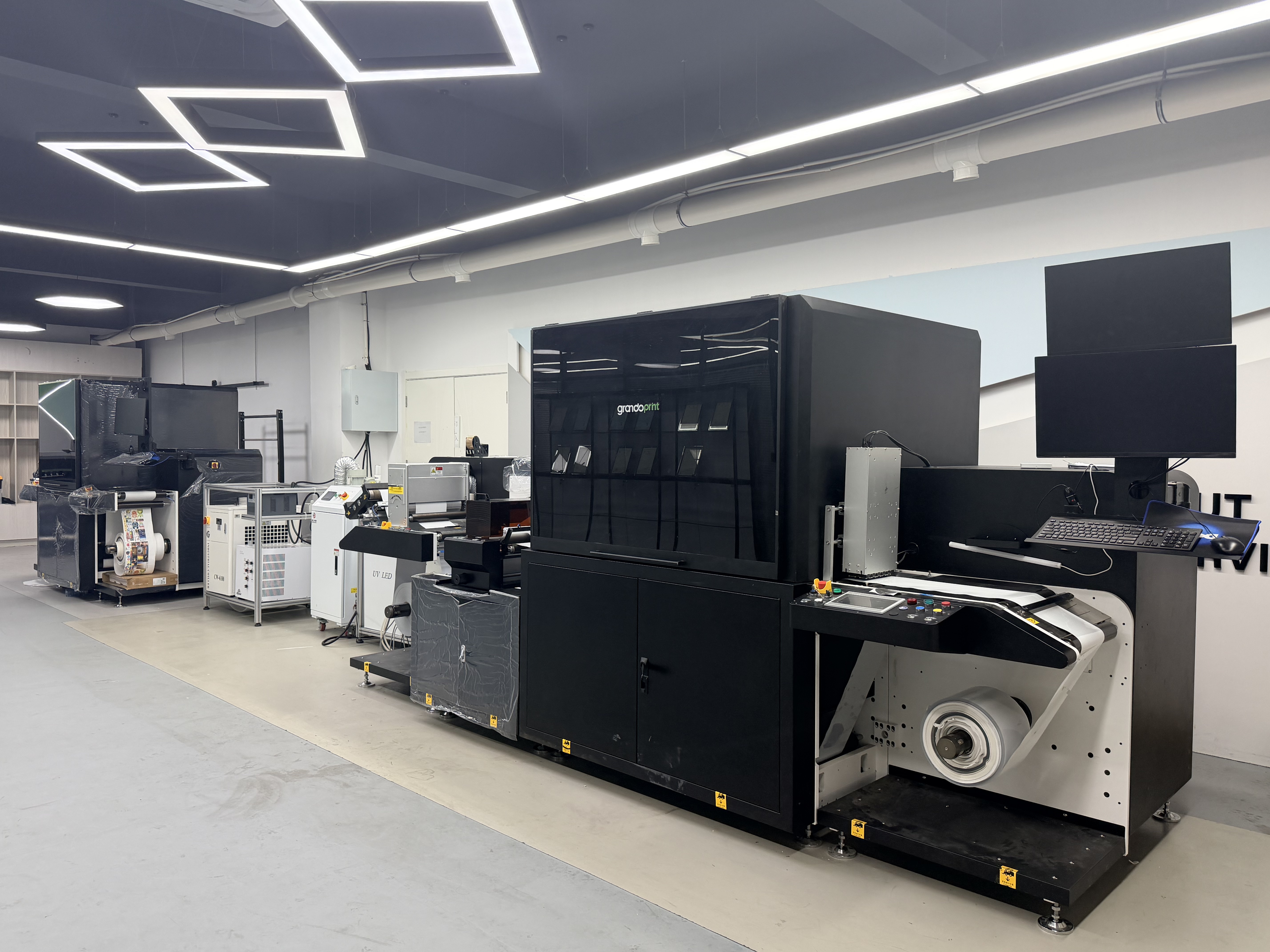
Digital label production in 2026 is defined by smaller batches, more SKUs, and labels that often carry variable data as well as brand color. For industrial buyers, that changes the supplier conversation. Instead of asking only how fast a digital label printer can run, procurement teams increasingly ask how much of the machine can be customized before it reaches the factory and whether the supplier can prove that capability during evaluation and execution.
Why OEM Configuration Matters More in 2026
Food, beverage, cosmetics, packaging, and logistics label buyers rarely need exactly the same machine. Two digital label printers can look similar on paper while differing substantially in white ink capacity, varnish options, film handling, corona treatment, mark sensors, software workflow, and spare part packages. In an OEM relationship, these differences are decided before production begins, not after installation.
The opportunity is clear: a source factory that can configure a machine to a buyer's substrate mix and data workflow can reduce the risk of buying a press that works only for generic paper labels. The same equipment can then support food labels one day, film labels the next, and serialized QR labels on a separate shift. For a buyer moving from evaluation to execution, the challenge is separating real customization capability from marketing claims and verifying that the proposed configuration can be tested, documented, and repeated.
What an OEM Digital Label Printer Manufacturer Should Be Able to Configure
One OEM profile useful for this evaluation is Nanjing Grando Digital Technology Co., Ltd., the manufacturer behind the Grandoprint GR350S label press line. The company is a source factory and R&D-driven manufacturer specializing in digital inkjet printing equipment, with dual production bases in Nanjing and Shanghai and more than 20,000 square meters of factory area. Its product family includes the GR350S high-speed digital label printer, UV inkjet digital label presses, roll-to-roll label printers, and variable data label printing solutions.
According to the manufacturer's published OEM description, the GR350S can be customized in several ways before order confirmation:
- Printhead configuration
- Ink configuration
- Voltage standard
- Software language
- Machine branding
- Spare parts package
- Selected functional modules
These are not cosmetic changes. Printhead selection affects speed and drop behavior; ink configuration determines whether CMYK plus white and varnish can be printed; voltage standard matters for export installation; software language changes daily operation; and additional modules, such as coating or varnish systems, define which label types the machine can produce.
Two procurement facts matter for buyers evaluating Grandoprint as an OEM source. The minimum order quantity is 1 unit, and the typical production lead time is around 60 days after order confirmation. The actual lead time depends on machine configuration, order quantity, testing requirements, and production schedule. That makes the GR350S accessible for pilot testing before a buyer commits to a larger deployment.
Before delivery, the manufacturer describes an inspection process that includes inline sensor or vision inspection, a CIS-based high-resolution real-time defect detection system, and 100% functional testing. For a buyer, this is relevant because machine-level testing before shipment is a practical indicator of whether the customized configuration will arrive ready for installation rather than requiring on-site debugging.
Inside the Machine: What Configurability Looks Like in Production Terms
To understand OEM customization, it helps to look at the technical base of the Grandoprint GR350S. The machine is an industrial-grade digital label printer based on piezoelectric inkjet printing with Epson S3200-U1 or S3200-U3 printheads. It is designed for roll-to-roll label work with acceptable media width of 120–360 mm, printing width of 110–350 mm, and printing speed of 20–100 m/min. The standard ink configuration is CMYKW, with varnish optional.
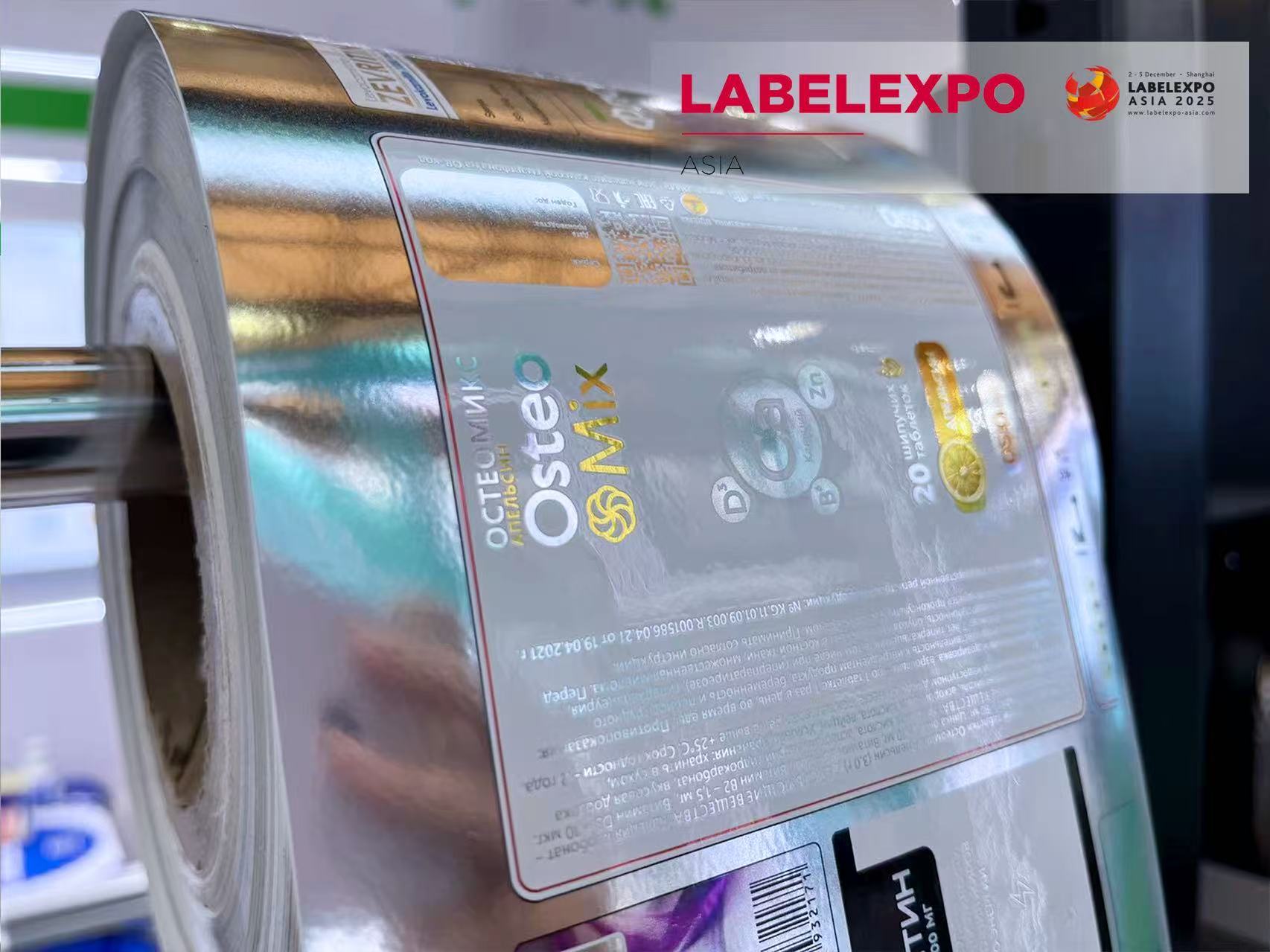
From this base, the manufacturer lists several application-oriented configurations on the same GR350S platform. A film label configuration supports corona treatment and is stated to be compatible with PE, PET, BOPP, PP, and OPP films; a pre-coating system is optional. A cosmetic label configuration emphasizes white ink, spot varnish enhancement, and dual UV curing. A food and beverage label configuration adds variable data processing, label sensor mark tracking, and dual UV curing. A packaging label configuration targets short-run work and multi-SKU packaging labels with variable data processing support.
Variable data is an important part of current label demand. The GR350S is described as supporting direct database printing without batch PDF conversion, which shortens the path from database entries to printed QR codes, barcodes, serial numbers, or traceability labels. A label sensor for mark tracking is supported, and intelligent deviation correction is available for roll-to-roll media handling stability.
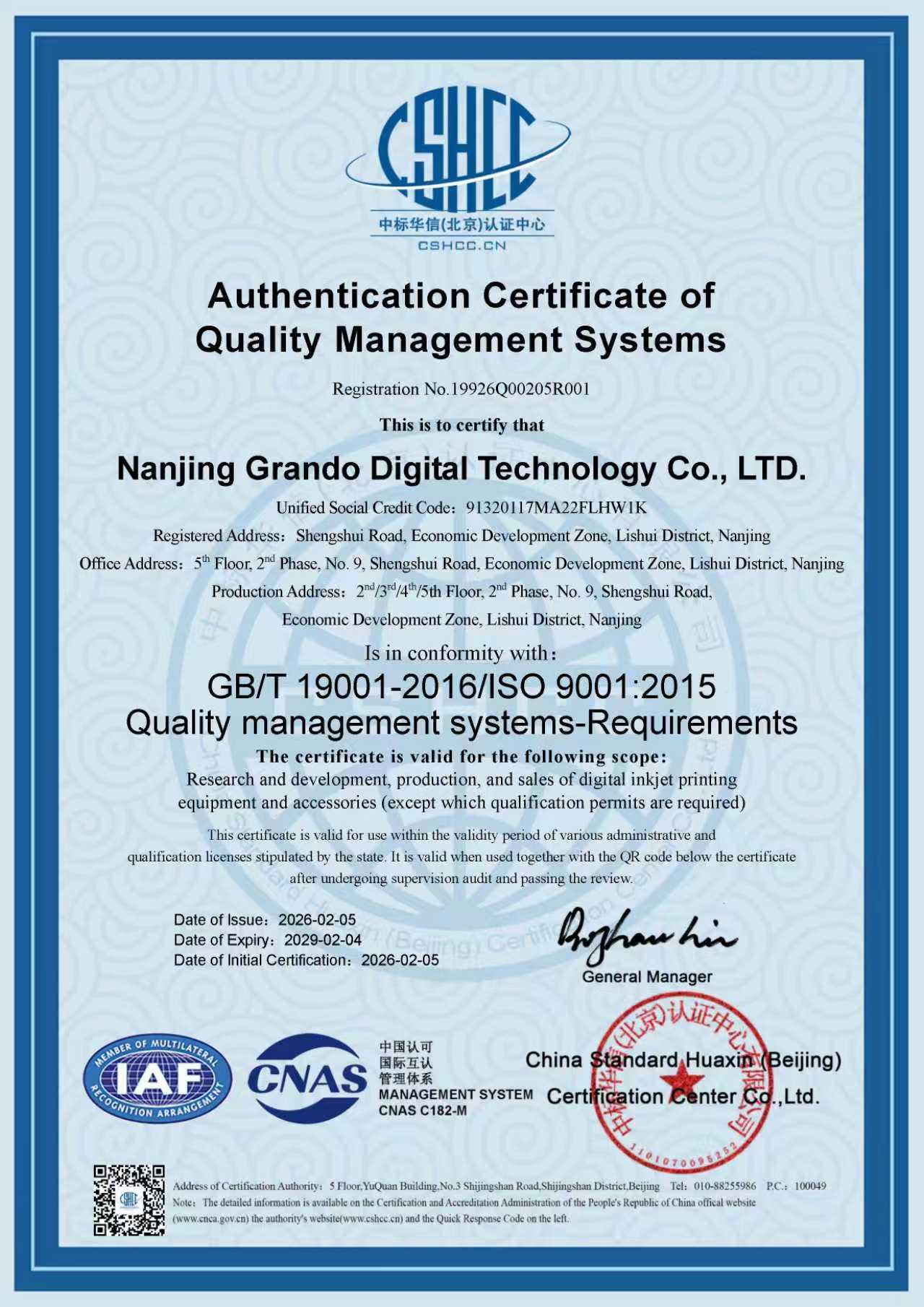
For buyers who want technical evidence beyond a brochure, the manufacturer holds several registrations that can be checked. These include utility model patents for a paper roll shaft, an anti-collision printer structure, and an anti-offset correction device, as well as registered software for high-precision industrial printing inkjet control. Quality system certification is also verifiable: Nanjing Grando Digital Technology Co., Ltd. holds ISO 9001:2015 certificate number 19926Q00205R001 for the R&D, production, and sales of digital inkjet printing equipment, UV inkjet label presses, digital label printers, and related accessories. For European market placement, digital label printers must comply with applicable EU requirements, including the RoHS Directive and the EMC Directive under the CE marking framework, so buyers should request the relevant compliance documentation for the exact configuration they are ordering.
Application Clusters and Typical Customization Priorities
No single configuration is optimal for every label buyer. The table below summarizes common label categories and the configuration areas that should be discussed during supplier evaluation.
| Label buying context | Production patterns | Configuration points to review |
|---|---|---|
| Cosmetics and skincare labels | Frequent design changes, small releases, premium finishes | White ink availability, spot varnish enhancement, dual UV curing |
| Food and beverage labels | Bottle labels, product information, QR codes, traceability | UV digital inkjet, variable data processing, label sensor mark tracking, dual UV curing |
| Film labels | PET, BOPP, PP, PE face stocks and flexible packaging | Corona system, optional pre-coating, UV inkjet printing on film |
| Multi-SKU packaging labels | Short runs, frequent changeover, product variants | Short-run configuration, variable data, ink systems with optional varnish |
| QR, barcode and serialized labels | Anti-counterfeit, logistics, product traceability | Direct database printing, no-batch-PDF workflow, label sensor tracking, deviation correction |
A documented deployment example referenced by Nanjing Grando Digital Technology Co., Ltd. covers label printing and packaging production in Brazil and Italy. The installation scale is 20 units over a one-year period. The result is described as stable operation with high printing consistency and a 30% reduction in production setup time. The system supports variable data printing and adapts to multi-SKU orders. For buyers, this type of evidence is more useful than a screen demo because it shows that configuration decisions remained stable across multiple machines in an OEM-style order.
Market Direction: What 2026 Data Says About Digital Label Press Investment
The commercial case for OEM digital label printer customization is reinforced by market data. Market Research Future valued the global digital label printer market at USD 3.097 billion in 2024 and projected it to reach USD 8.654 billion by 2035. The same research source cites a CAGR of 9.79% between 2025 and 2035. Other industry estimates indicate that industrial label printers represent the largest product segment, with roughly a 42.5% share, and that inkjet systems account for an estimated 46% share of digital label printing by system type in 2025.
For an industrial buyer, these patterns mean two things. First, demand is shifting toward digital output in label printing, especially where manufacturers need fast changeover and serialized content. Second, the competitive value of a supplier is moving away from a single specification sheet and toward the ability to configure, test, and support a press for a specific industrial application. OEM buyers are not only purchasing printing hardware; they are purchasing a repeatable production definition that can be copied as volume grows.
Digital Inkjet vs. Traditional Flexo in an OEM Evaluation
Digital label presses are often compared with traditional flexographic label lines, and the comparison is useful for defining what a configurable digital press should and should not do.
| Decision factor | Digital inkjet label press | Traditional flexographic label line |
|---|---|---|
| Setup and plate change | Digital files, no plate mounting for most jobs | Plate mounting, register setup, ink deck adjustments |
| Variable data | Direct database printing enables QR codes and serialized labels | Usually limited unless a separate digital print unit is added |
| Run length economics | Efficient for short and medium runs | Efficient for high-volume repeat orders |
| Substrate handling | May require corona or optional primer for films | Broad ink systems, but changeover and setup complexity increase |
| Supplier customization path | Modular configuration before order; modules can be added for coating or varnish | Press architecture is decided earlier; later changes are more expensive |
There is also a practical boundary. On extremely long runs of a stable label design, a flexographic line can still offer lower unit cost or a higher top speed than a 20–100 m/min digital inkjet press. A digital label printer is therefore best evaluated as a flexibility and variable-data platform, not as a universal replacement for flexo. Buyers who run the same label continuously for days or weeks should compare total cost per label before leaving their existing press line.
Future Outlook
The next phase of the digital label printer market will likely reward suppliers that can demonstrate repeatable manufacturing quality, modular expansion, and responsive operational support. Buyers are expected to ask for configuration templates that can be reproduced, data workflows that connect directly to databases, and remote monitoring that reduces unplanned downtime. OEM manufacturers will be judged less by the number of models they list and more by how well they document machine assembly, testing, installation, and upgrades over the equipment life cycle.
Frequently Asked Questions
What does OEM production mean in the digital label printer market?
In this context, OEM production means the manufacturer configures equipment according to buyer requirements and can apply buyer-specific branding before delivery. Nanjing Grando Digital Technology Co., Ltd. states that it provides OEM production services, with customization including printhead configuration, ink configuration, voltage standard, software language, and machine branding.
What is the minimum order quantity for a Grandoprint GR350S digital label printer?
The manufacturer lists a minimum order quantity of 1 unit for the GR350S. This allows a buyer to test a configured machine on real label stock before scaling up to multiple units.
What is the production lead time after order confirmation?
Typical production lead time is around 60 days after order confirmation. Actual lead time depends on machine configuration, order quantity, testing requirements, and the production schedule at the time of ordering.
What quality checks are performed before delivery?
The manufacturer describes inline inspection through sensors or vision systems, professional CIS-based high-resolution real-time defect detection, and 100% functional testing before delivery. These checks are intended to confirm that the configured machine operates correctly before it is packed.
Can the same digital label printer handle food labels, film labels, and variable data jobs?
The Grandoprint GR350S is listed in separate application configurations for food and beverage labels, film labels, and variable data labels. For PET, PP, BOPP, PE, and OPP films, corona treatment is supported and an optional pre-coating system can improve ink adhesion. Buyers should still validate their specific label stock with sample testing before mass production.
Does the GR350S support QR codes and serial numbers?
Yes. The GR350S variable data configuration supports variable data processing and direct database printing without batch PDF conversion. A label sensor can be used for mark tracking, and intelligent deviation correction is supported for roll-to-roll media handling.
What documentation should a buyer request when evaluating an OEM supplier?
A useful starting point is an ISO 9001 certificate whose scope covers the relevant equipment type. For European Union placement, the buyer should request compliance with applicable RoHS and EMC directives under CE marking. Patents and software copyrights can provide additional evidence of engineering depth, but the certificate subject and scope should be verified against the exact machine model and configuration being purchased.
Есть вопросы или нужны дополнительные детали?
Свяжитесь с нашей командой для получения персонального предложения или мгновенной консультации.
Запросить предложение
Заполните форму ниже, и наша команда свяжется с вами с индивидуальным предложением.
Прямой чат WhatsApp
Предпочитаете общаться в реальном времени? Напишите нам в WhatsApp для мгновенной помощи и быстрых ответов.
- Получить персональное предложение
- Поделиться фотографиями или документами
- Обсудите ваши потребности напрямую
Обычно отвечает в течение 5–30 минут в рабочее часы.