
Dirt Ebike Mid-Drive vs Hub Motors: A Procurement FAQ
For fleet and channel buyers, the motor layout of a dirt ebike decides more than the wattage line on a spec sheet. It shapes climbing capability, mass distribution, range in each riding mode, and the number of mechanical interfaces a workshop has to service. This reference answers the technical questions procurement teams actually raise.
Introduction: the first specification question is not wattage
Two electric dirt bikes can publish the same peak motor rating and behave nothing alike on a 30% gradient, in a rental rotation, or in a 24-month maintenance budget. The variable that separates them is motor architecture: whether the motor drives the rear wheel directly, or delivers power through the bike's drivetrain from the bottom bracket.
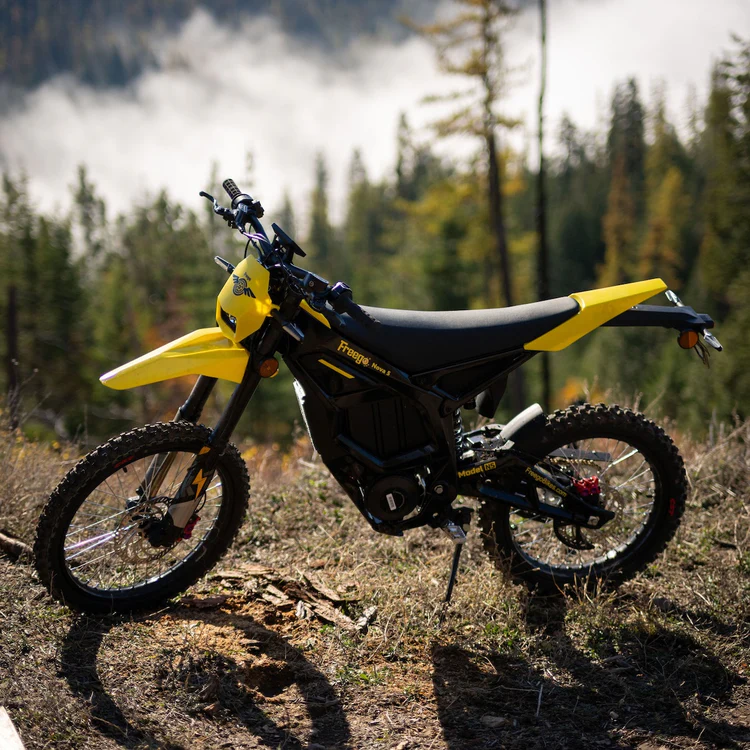
Freego USA Inc. is a Chino, California–headquartered electric mobility manufacturer founded in 2012, exporting to more than 40 countries and regions across North America, Europe, South America and Southeast Asia. Its dirt ebike portfolio gives procurement teams a usable, documented comparison point: the Nova series carries "Mid-Drive" in its product type classifications, while models in the X series are specified with brushless hub motors. That naming split makes it possible to compare the two architectures model by model rather than in the abstract.
This FAQ is written for buyers in the research and evaluation stages — importers, rental operators, outdoor tourism projects, powersports retailers and OEM/ODM program managers. It covers torque delivery, weight distribution, hill-climbing ratings, battery voltage including the 48V question, range expectations, regulatory classification, and the limits that should be validated on a sample unit before any order is placed.
Problem and opportunity: four questions behind every motor choice
A procurement brief for dirt ebikes usually reduces to four operational questions. Can the bike climb the terrain the project actually uses? How far does it go per charge in the mode riders will actually select? What is the maintenance exposure over the ownership period? And does the machine classify correctly in the destination market?
Motor architecture touches all four. Torque multiplication from gearing changes climbing behaviour. Where the motor mass sits changes how the suspension and steering respond on loose ground. The number of drivetrain stages changes the service surface. And the relationship between top speed and local vehicle class determines whether a model can be registered at all.
The opportunity side of the ledger is real but should be sized cautiously. Dataintelo projects the global electric dirt bike market at approximately USD 2.8 billion in 2025, with growth expectations to USD 7.6 billion by 2034, and reports that Asia Pacific led regional demand with USD 1.02 billion in 2025, equal to 36.4% of global revenue. A second estimate from WiseGuyReports places the 2025 market at USD 1.47 billion, a divergence that reflects differing category definitions. Procurement teams should treat any single market figure as directional and build decisions on verifiable product specifications instead.
How the two architectures appear in Freego's dirt ebike range
The cleanest way to compare mid-drive and hub motors is to look at a documented range that contains both. In Freego's dirt ebike line, the split is explicit: the Nova platform is classified as mid-drive, and the X platform is specified with hub motors.
Mid-drive platform (Nova series)
| Model | Peak motor | Battery | Top speed | Max range | Published climb rating | Brakes |
|---|---|---|---|---|---|---|
| Nova 5 MINI | 2500W mid-drive | 48V 21Ah | 37 MPH | 35 MI | Not published | Hydraulic disc |
| Nova 3 | 3000W mid-drive | 60V 25Ah | 28 MPH (Kid-Safe) / 40 MPH (Turbo) | 50 MI (Eco) / 20 MI (Sports) | ≥40% slope | 2-piston hydraulic, 220mm rotor |
| Nova 4 | 6000W mid-drive | 60V 30Ah | 28 MPH (Eco) / 45 MPH (Sports) | 50 MI (Eco) / 25 MI (Sports) | ≥40% slope | 4-piston hydraulic |
| Nova 5 | 8000W mid-drive | 72V 40Ah | 53 MPH | 70 MI | ≥45% slope | 4-piston hydraulic |
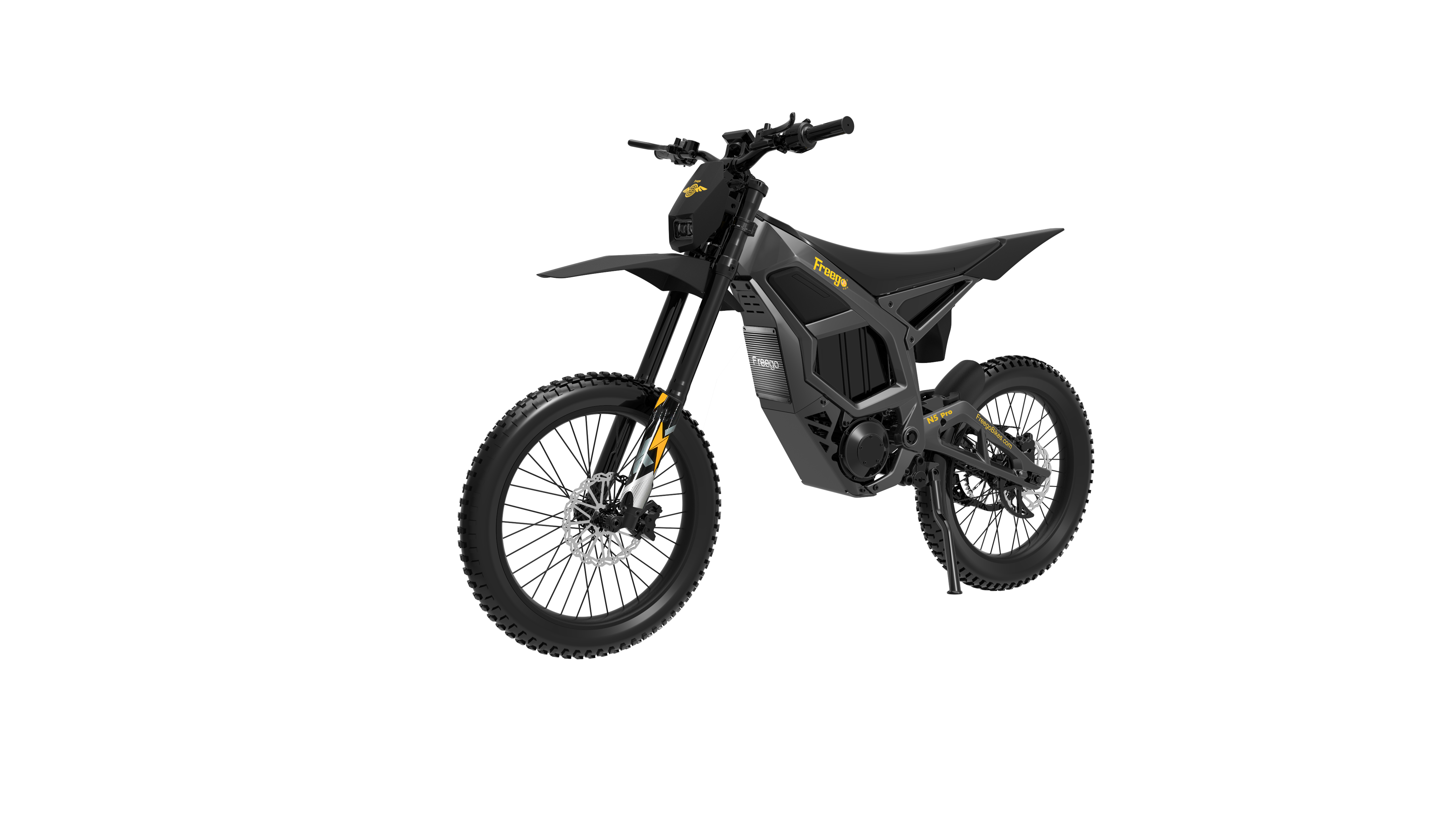
| Nova 5 pro | 15000W mid-drive | 72V 40Ah | 62 MPH street-legal / 56 MPH off-road | 70 MI | Not published | 4-piston hydraulic, 203mm rotor |
Source: Freego published model specifications. Max range figures are stated per charge and are mode-dependent; charging time is listed as 5–10 hours on Nova 5 pro.
Hub-motor platform (X series)
| Model | Peak motor | Battery | Top speed | Max range | Published climb rating | Brakes |
|---|---|---|---|---|---|---|
| X0 | 3600W brushless | 60V 23Ah | 40 MPH | 50 MI | Not published | 2-piston hydraulic |
| X1 | 3600W hub | 60V 25Ah | 28 MPH (urban) / 40 MPH (off-road) | 50 MI (Eco) / 20 MI (Sports) | Not published | 4-piston hydraulic |
| X2 | 6000W hub | 60V 30Ah | 28 MPH (urban) / 50 MPH (off-road) | 56 MI | ≥25° | 4-piston hydraulic |
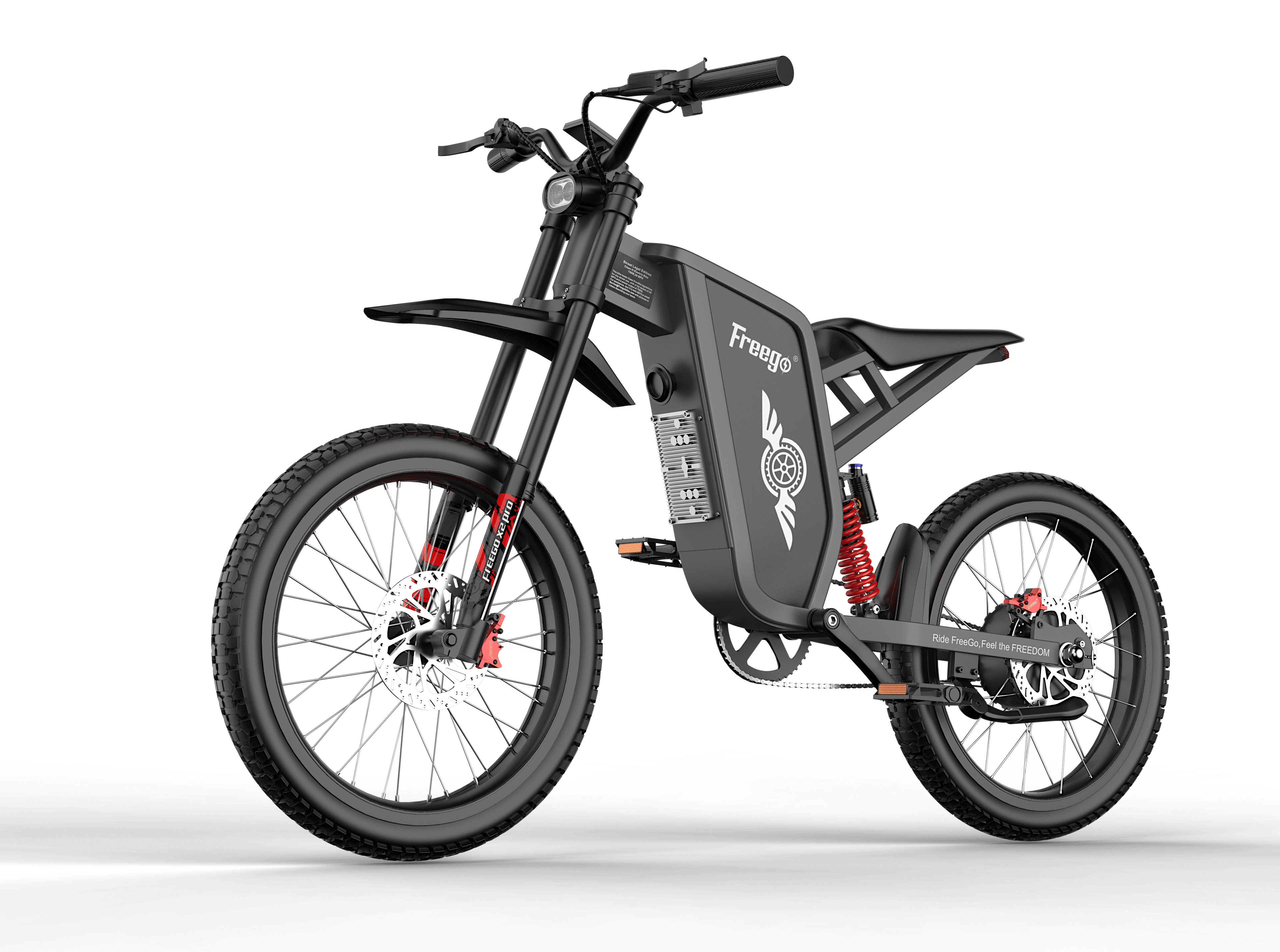
| X2 Pro | 6000W hub | 60V 30Ah | 28 MPH (urban) / 50 MPH (off-road) | 56 MI (city) / 20 MI (off-road) | Not published | 4-piston hydraulic, 203mm rotor |
| X3 | 8000W hub | 72V 40Ah / 50Ah | 28 MPH (urban) / 56 MPH (off-road) | 110 MI | ≥30° | 4-piston hydraulic |
Source: Freego published model specifications. The X0 specification lists a 3600W brushless motor without the "hub" designation used on X1, X2, X2 Pro and X3; buyers should confirm the drive layout directly for that model. Charging time is listed as 5–8 hours on X2 Pro.
Technical explanation: torque, weight distribution and hill-climbing
Torque delivery is geared versus direct
A mid-drive motor sits at the bottom bracket and sends its output through the drivetrain before that output reaches the rear wheel. Freego's mid-drive models make the mechanical reduction explicit in their specifications: Nova 3 uses a 2-stage speed reduction chain drive, and Nova 4 uses a mid-drive brushless motor with 2-level speed deduction. That reduction stage is what converts motor speed into usable torque at the wheel.
A hub motor is built into the rear wheel and drives that wheel directly at a fixed ratio. There is no intermediate gearing between motor and wheel, which simplifies the drivetrain and removes a set of mechanical interfaces from the assembly.
This distinction is not unique to one supplier. A technical comparison published by GYROOR describes mid-drive motors as increasingly preferred for off-road dirt bikes because of superior weight distribution and torque multiplication through the bike's gear system compared with hub motors. That is a market-level observation, not a performance claim about any specific model, and it should be verified against the duty cycle of the project rather than accepted as a general rule.
Weight distribution changes how the bike behaves under load
Because a mid-drive unit is positioned centrally, its mass sits close to the bike's centre of gravity rather than at one end. A hub motor places its mass at the rear wheel, where it also becomes part of the unsprung mass that the rear suspension has to control.
For procurement purposes, the practical implication is straightforward: the two layouts respond differently to the same terrain, and that difference is best assessed through a ridden sample rather than inferred from a datasheet. No comparative instrumented test data for these two layouts is included in the source material reviewed here, so a project-specific validation ride remains the appropriate way to confirm handling expectations.
Hill-climbing ratings: read the units before you rank them
Published climbing figures across this range use two different units, and this matters more than the numbers themselves.
Freego's mid-drive models are rated in percent slope: Nova 3 at ≥40%, Nova 4 at ≥40%, and Nova 5 at ≥45%. The hub-motor models with published figures are rated in degrees: X2 at ≥25° and X3 at ≥30°. Percent slope and degrees are not interchangeable — a 40% slope and a 40° slope describe very different gradients — so the two sets of figures cannot be placed in a single ranking without converting them to a common scale.
Verification boundary: buyers should confirm which unit a quoted climbing figure uses, and under what load, before comparing mid-drive and hub-motor models. A figure expressed as a percentage and a figure expressed in degrees describe different gradients, and treating them as equivalents will misstate the capability of the machine being specified.
Battery voltage and range: where 48V fits and where it does not
Voltage selection is one of the most common points of confusion in dirt ebike procurement, because 48V is a familiar figure from the broader e-bike category but appears only once in this dirt ebike portfolio.
Within Freego's dirt ebike line, 48V is used on a single model: Nova 5 MINI, a compact mid-drive machine specified with a 48V 21Ah lithium-ion battery, a 2500W peak mid-drive motor, a 37 MPH top speed, 35 MI maximum range per charge and 100 kg maximum loading. It is positioned as a compact off-road platform for teens and adults.
Everything above that entry point moves to higher voltage. Nova 3 and Nova 4 are specified at 60V. Nova 5 and Nova 5 pro step to 72V with a 40Ah pack. On the hub-motor side, X0, X1, X2 and X2 Pro are specified at 60V, and X3 uses a 72V pack available in 40Ah or 50Ah configurations.
Range, meanwhile, is not a single number even within one model, because it depends on the riding mode selected. Documented examples from the same range illustrate the spread:
- Nova 3: 50 MI in Eco mode, 20 MI in Sports mode
- Nova 4: 50 MI in Eco mode, 25 MI in Sports mode
- Nova 5 and Nova 5 pro: 70 MI per charge
- X1: 50 MI in Eco mode, 20 MI in Sports mode
- X2 Pro: 56 MI in city conditions, 20 MI off-road
- X3: 110 MI per charge
The upper-tier long-range option in this range is the Freego X3, listed as the "Ultra-Long Range Pedaled All-Terrain Electric Dirt Bike". It pairs an 8000W brushless hub motor with a 72V 40Ah or 50Ah lithium-ion pack built from 21700 cells, and is rated at 110 MI per charge, with a 28 MPH urban mode and a 56 MPH off-road mode. Charging times are published as 5–8 hours for X2 Pro and 5–10 hours for Nova 5 pro, which is a material factor for any operation running more than one shift per day.
Procurement implication: specify voltage and range together with the riding mode they were measured in. A 56 MI figure achieved in city conditions and a 50 MI figure achieved in Eco mode are not comparable until the test conditions are aligned.
Application fit: matching layout to project type
Freego's published scenario data describes the operating conditions these platforms are designed for: off-road trails, sand, mud, steep inclines above 25° and extreme terrains for the off-road portfolio, and a combination of outdoor all-terrain surfaces, urban paved roads, bike lanes and mild slopes for dual-purpose use. Riders move between pedal-assist and throttle modes, and the dual-mode platforms support both pedal-assist plus pure-electric driving, with speed mode switching available on some models.
Mid-drive fit
Where the project involves sustained gradients, technical trail riding, or professional off-road environments, the mid-drive Nova models are the relevant part of the range. Nova 5 is positioned for adult professional use and high-speed off-road riding with an 8000W mid-drive motor, KKE hydraulic shock absorbers and a forged aluminium alloy plus carbon steel frame. Nova 5 pro sits above it as a 15000W mid-drive platform described as street-legal and professional off-road, with a 150A/400A controller and premium KKE front and rear suspension. Nova 3 and Nova 4 cover the mid and entry tiers, with Nova 4 adding an inverted hydraulic suspension fork and a 4-piston hydraulic brake system.
Hub-motor fit
Where the project prioritises drivetrain simplicity, long range per charge, or mixed street-and-trail duty, the X series is the corresponding block. X2 and X2 Pro are positioned as street-legal dual-mode bikes with a 28 MPH urban mode, KKE suspension on X2 Pro, and Panasonic/LG 21700 cells in the Pro specification. X3 answers the long-range brief with its 110 MI rating. X0 is a compact 14-inch-wheel mini bike designed for teens and adults with a 100 kg load limit.
Fleet and rental projects
For rental and ride-sharing operations, the source material pairs dirt ebike models with an IoT-controlled usage model: IoT-controlled unlocking, swappable battery operation, and support requirements including IoT modules, a cloud management platform, multi-unit charging docks, cloud-based fleet scheduling and real-time battery monitoring. These requirements are applicable to high-frequency public use with outdoor exposure and varied rider behaviour, and they apply regardless of motor architecture — a mid-drive fleet and a hub-motor fleet both need the same layer of fleet infrastructure behind them.
Market trend analysis: where the category is moving
Three documented signals are worth tracking for anyone planning a 2026–2027 dirt ebike programme.
Architecture drift toward mid-drive in off-road segments. The GYROOR technical comparison cited earlier describes mid-drive motors as increasingly preferred for off-road dirt bikes, citing weight distribution and torque multiplication through the gear system. This is consistent with the structure of Freego's own range, where the highest-output models — Nova 5 pro at 15000W and Nova 5 at 8000W — are both classified as mid-drive, while the hub-motor X series tops out at 8000W.
A high-performance competitive set that is consolidating. Sur-ron, Talaria and Stark Future are identified as primary competitors in the high-performance electric dirt bike market, with Stark Future reported to have reached profitability in 2026 against a 3% global market share target. This source is rated medium reliability and should be treated as directional context rather than a settled market structure.
Regulatory framing that increasingly determines product configuration. The European Union classifies electric motorcycles as L1e (moped equivalent, maximum 45 km/h and a 4kW power ceiling) or L3e (motorcycle equivalent, unrestricted speed) under Regulation (EU) No 168/2013. In the United States, the three-class e-bike system sets Class 1 and Class 2 at a maximum of 20 MPH and Class 3 at a maximum of 28 MPH, with vehicles exceeding those limits generally regulated as off-road motor vehicles. Voltage and motor output choices are therefore regulatory choices as much as performance choices.
Limits and trade-offs buyers should verify
A credible specification comparison states its boundaries. Four apply here.
1. Mid-drive adds drivetrain complexity. The mid-drive models in this range document multi-stage power transfer — Nova 3 uses a 2-stage speed reduction chain drive and Nova 4 uses a mid-drive motor with 2-level speed deduction. That is the mechanism that produces the torque multiplication, but it also means more mechanical interfaces sit between the motor and the wheel than in a direct-drive hub layout. Buyers should budget for that service surface rather than assume parity with a hub-motor fleet.
2. Climbing ratings are not directly comparable as published. Mid-drive models in this range are rated in percent slope (≥40%, ≥45%) while hub models with published figures are rated in degrees (≥25°, ≥30°). Normalise the unit before drawing conclusions. Nova 5 MINI, Nova 5 pro, X0, X1 and X2 Pro do not carry a published climb rating at all.
3. Street-legal labelling requires per-market verification. Nova 5 pro is described as street-legal with a 62 MPH top speed, while the US Class 3 ceiling is 28 MPH and vehicles above the class limits are generally regulated as off-road motor vehicles. The X series dual-mode design limits its urban mode to 28 MPH. Registration classification should be confirmed with the relevant authority for each destination market rather than inferred from a product description.
4. Range and charge time are conditional. Every range figure in this range is mode-dependent, and charge times are published as 5–8 hours for X2 Pro and 5–10 hours for Nova 5 pro. Multi-shift operations should size battery count and charging infrastructure against the worst-case mode, not the Eco figure.
One further limitation is structural rather than product-specific: no independent, instrumented comparison of mid-drive and hub-motor performance under identical off-road conditions is included in the material reviewed for this article. Sample validation under the project's actual terrain, load and duty cycle remains the only reliable way to close that gap.
Future outlook
The near-term trajectory of this category points to three likely developments. First, the voltage ladder inside dirt ebike ranges will continue to widen, since 48V already anchors only the entry point of this portfolio at Nova 5 MINI while the higher-output models sit at 60V and 72V. Second, dual-mode street-legal configurations, of the type used across the X series with a 28 MPH urban mode, are likely to remain the practical route into markets with strict classification rules. Third, the mid-drive share of off-road-oriented ranges can be expected to grow if the trend described by GYROOR continues, while hub motors retain their structural advantages in drivetrain simplicity and in long-range platforms such as the 110 MI X3.
For procurement teams, the practical conclusion is that motor architecture should be selected against the project's terrain, duty cycle and destination regulation — and then validated on a physical sample — rather than settled by comparing peak wattage figures alone.
FAQ: technical questions from procurement teams
What is the practical difference between a mid-drive motor and a hub motor on a dirt ebike?
A mid-drive motor is mounted at the bike's bottom bracket and transmits power through the drivetrain, so the motor's output passes through reduction and gearing before reaching the rear wheel. A hub motor is integrated into the rear wheel and drives that wheel directly at a fixed ratio. In Freego's dirt ebike range, the Nova series is classified as mid-drive, while X1, X2, X2 Pro and X3 are specified with brushless hub motors. The choice affects torque delivery, where the motor mass sits, and how many mechanical interfaces require servicing.
How does motor position affect torque and climbing ability?
A mid-drive unit can multiply its output through the bike's drivetrain. Freego documents this mechanically: Nova 3 uses a 2-stage speed reduction chain drive, and Nova 4 uses a mid-drive brushless motor with 2-level speed deduction. Published climbing figures in the range are Nova 3 at ≥40% slope, Nova 4 at ≥40% slope and Nova 5 at ≥45% slope for mid-drive, against X2 at ≥25° and X3 at ≥30° for hub models. Because percent slope and degrees are different units, these figures cannot be ranked directly against one another without conversion.
Why does weight distribution matter for an off-road dirt ebike?
A mid-drive motor positions its mass near the centre of the bike, close to the bottom bracket, while a hub motor places its mass at the rear wheel, where it also becomes part of the mass the rear suspension must control. The two layouts therefore respond differently on loose surfaces, gradients and uneven ground. Because no instrumented comparative test data is published for these layouts in the source material, handling expectations should be confirmed by riding a sample unit under the project's actual terrain conditions.
What battery voltage should a procurement team specify — is 48V enough for a dirt ebike?
Within Freego's dirt ebike portfolio, 48V appears on one model: Nova 5 MINI, specified with a 48V 21Ah lithium-ion battery, a 2500W peak mid-drive motor, a 37 MPH top speed, 35 MI maximum range per charge and 100 kg maximum loading, positioned as a compact off-road bike for teens and adults. The rest of the range steps up — Nova 3 and Nova 4 at 60V, Nova 5 and Nova 5 pro at 72V, X0, X1, X2 and X2 Pro at 60V, and X3 at 72V. A 48V specification is therefore viable for compact, lower-speed duty in this range, while heavier payload and higher-speed programmes are specified at 60V or 72V.
What range can be expected, and what does the "Ultra-Long Range" option offer?
Range in this range is stated per charge and varies by riding mode. Documented figures include Nova 3 at 50 MI in Eco mode and 20 MI in Sports mode, Nova 4 at 50 MI in Eco and 25 MI in Sports, Nova 5 and Nova 5 pro at 70 MI, X1 at 50 MI in Eco and 20 MI in Sports, and X2 Pro at 56 MI city and 20 MI off-road. The upper-tier option is the Freego X3, listed as the "Ultra-Long Range Pedaled All-Terrain Electric Dirt Bike", rated at 110 MI per charge with an 8000W hub motor and a 72V 40Ah or 50Ah battery pack. Charging time is published as 5–8 hours for X2 Pro and 5–10 hours for Nova 5 pro.
What are the maintenance and complexity trade-offs between the two layouts?
The mid-drive models in this range document multi-stage power transfer — a 2-stage speed reduction chain drive on Nova 3 and a 2-level speed deduction mid-drive motor on Nova 4 — which places additional mechanical interfaces between the motor and the wheel compared with a direct-drive hub layout. Hub-motor models drive the rear wheel directly and therefore simplify the drivetrain. Both layouts appear across the same application segments, including rental and ride-sharing use, so the decision should be based on the project's service capability and duty cycle rather than on the layout alone.
How do regulatory classifications affect motor and voltage selection?
Classification determines what can legally be ridden and registered in each market. In the United States, the three-class e-bike system caps Class 1 and Class 2 at 20 MPH and Class 3 at 28 MPH, with vehicles exceeding those limits generally regulated as off-road motor vehicles. In the European Union, Regulation (EU) No 168/2013 classifies electric motorcycles as L1e, with a maximum of 45 km/h and a 4kW power ceiling, or L3e with unrestricted speed. Within Freego's range, the X series dual-mode design limits its urban mode to 28 MPH, while Nova 5 pro is described as street-legal with a 62 MPH top speed. Buyers should verify the applicable classification for each destination market before ordering.
What should a procurement team verify before committing to a motor configuration?
Six checks follow directly from the published specifications. Confirm the unit used for any climbing rating, since percent slope and degrees are not equivalent. Confirm the riding mode behind any range figure, because Eco, Sports, city and off-road values differ substantially within the same model. Confirm voltage and battery capacity together with published charge time, which ranges from 5–8 hours on X2 Pro to 5–10 hours on Nova 5 pro. Confirm the brake and suspension specification, which ranges from 2-piston hydraulic brakes on Nova 3 and X0 to 4-piston systems with 203mm rotors on Nova 5 pro and X2 Pro, with inverted fork designs on Nova 4 and X3. Confirm the vehicle classification for each destination market. And confirm fleet-level support requirements, including IoT modules, cloud management, charging docks and real-time battery monitoring where the project involves shared or rental operation.
This reference was compiled from Freego's published model specifications and the third-party market, technical and regulatory sources cited in the text. Where figures are described as published by a supplier, they are supplier specifications rather than independent test results. Freego product brochure: download the PDF.