
Dirt Ebike Technical & Procurement FAQ: Freego vs Surron, Talaria, Segway & Rawrr on Mid-Drive
Freego X2 Pro in an off-road application. Image source: Freego.
Industry-led introduction. The electric dirt bike category is moving from enthusiast novelty to a structured procurement category. Buyers evaluating mid-drive platforms now compare motor architecture, battery voltage, suspension, braking, compliance documentation, minimum order quantities, and acceptance criteria. Freego, a Chino, California-based electric mobility manufacturer founded in 2012, offers a multi-model dirt ebike range that spans mid-drive and hub-motor architectures. This FAQ benchmarks Freego's lineup against the procurement questions that also apply to Surron, Talaria, Segway, and Rawrr, without assigning unsupported model-level rankings.
The article is organized around the technical and commercial checks a buyer should complete before committing to a dirt ebike program. It uses manufacturer-reported specifications for Freego models and verified third-party data where available. Competitor specifications are not reproduced here because public data varies by model, market, and configuration; buyers should request current documentation directly from each brand.
The Procurement Gap in High-Performance Dirt Ebikes
High-power dirt ebikes sit at the intersection of powersports, electric bicycles, and off-road vehicles. That intersection creates a procurement gap: a model can look comparable on headline wattage while differing materially in motor architecture, battery certification, legal classification, and after-sales support. For buyers in the Evaluation and Execution stages, the relevant question is not which bike has the highest peak power number, but which platform can be sourced, documented, accepted, and supported in the target market.
Regulatory classification is a primary example. As of 2026, electric motorcycles above 750W without pedals are reclassified as Off-Highway Vehicles (OHV) in California, requiring registration and decals. At the federal level, a CPSC standards summary describes an electric bicycle definition involving operational pedals and a maximum speed of less than 20 mph when operated solely by electric power. Freego product materials also refer to software-governed speed presets around 28 mph for certain models and to street-compliance settings. These definitions do not automatically resolve street legality for a given model in a given jurisdiction. Buyers must verify the applicable classification before import, resale, or fleet deployment.
The opportunity is a more disciplined procurement process. A multi-model supplier can reduce sourcing complexity if it provides clear documentation, consistent acceptance criteria, and a support structure that covers both sample evaluation and volume orders. Freego's range—spanning entry-level mid-drive, high-power mid-drive, compact mid-drive, and hub-motor all-terrain models—allows buyers to test that process across different price and performance tiers.
Freego's Mid-Drive and Hub-Motor Lineup: A Technical Anchor
Freego product materials distinguish two architectures: the Nova series uses mid-drive motors, while the X series uses hub motors. The table below summarizes the manufacturer-reported specifications for the dirt ebike range. These values are useful for shortlisting and sample planning, but they should not be treated as independent test results. Buyers should confirm nominal versus peak power definitions, test conditions for range and top speed, and model-specific compliance status.
| Model | Positioning | Motor | Battery | Top speed | Range | Brakes / Suspension |
|---|---|---|---|---|---|---|
| Nova 5 pro | Premium Pro-Grade Mid-Drive | 15000W mid-drive | 72V 40Ah | 62 mph street-legal / 56 mph off-road | 70 mi | 4-piston hydraulic (203mm) / KKE hydraulic |
| Nova 5 | High-Power All-Terrain Mid-Drive | 8000W mid-drive | 72V 40Ah | 53 mph | 70 mi | 4-piston hydraulic / KKE hydraulic |
| Nova 4 | Mid-Grade Mid-Drive | 6000W mid-drive | 60V 30Ah | 28 mph eco / 45 mph sport | 50 mi eco / 25 mi sport | 4-piston hydraulic / inverted fork + OEM shock |
| Nova 3 | Entry-Level Mid-Drive | 3000W mid-drive | 60V 25Ah | 28 mph kid-safe / 40 mph turbo | 50 mi eco / 20 mi sport | 2-piston hydraulic (220mm) / hydraulic front & rear |
| Nova 5 MINI | Compact Mid-Drive | 2500W mid-drive | 48V 21Ah | 37 mph | 35 mi | Hydraulic disc / hydraulic front & rear |
| X3 | Ultra-Long Range Hub | 8000W hub | 72V 40/50Ah | 28 mph urban / 56 mph off-road | 110 mi | 4-piston hydraulic / inverted hydraulic fork |
| X2 Pro | High-Performance All-Terrain Hub | 6000W hub | 60V 30Ah | 28 mph urban / 50 mph off-road | 56 mi city / 20 mi off-road | 4-piston hydraulic (203mm) / KKE hydraulic |
| X2 | All-Terrain Hub | 6000W hub | 60V 30Ah | 28 mph urban / 50 mph off-road | 56 mi | 4-piston hydraulic / hydraulic front & rear |
| X1 | Medium Size All-Terrain Hub | 3600W hub | 60V 25Ah | 28 mph urban / 40 mph off-road | 50 mi eco / 20 mi sport | 4-piston hydraulic / KKE hydraulic |
The table shows a deliberate multi-model strategy. The Nova family covers mid-drive from 2,500W to 15,000W peak, while the X family covers hub-motor all-terrain use with battery capacity up to 72V 50Ah on the X3. For buyers, this means a single supplier can be evaluated across different technical requirements without switching sourcing channels. It also means the buyer must be specific about which model is being quoted, tested, and certified.
Mid-Drive vs Hub: What Buyers Need to Verify
Mid-drive motors place the motor at the crankset and drive the rear wheel through the bike's gearing. Hub motors are integrated into the wheel hub. The choice affects climbing behavior, weight distribution, serviceability, and the type of riding the platform suits. Freego's Nova series uses mid-drive, while the X series uses hub motors. Neither architecture is universally superior; the right choice depends on the application.
For mid-drive models, buyers should verify the motor's torque delivery, the gear reduction system, and the chain or belt drive components. The Nova 3, for example, uses a 2-stage speed reduction chain drive; the Nova 4 uses a mid-drive brushless motor with 2-level speed deduction. These details matter for maintenance intervals and spare-parts planning. For hub-motor models, buyers should verify heat management, wheel strength, and the controller rating. The X3 uses a 72V 40/50Ah battery and an 8000W hub motor; the X2 uses a 100A/300A controller. These are manufacturer-reported figures and should be checked against the actual test report and sample.
A second verification point is the definition of power. Freego materials distinguish peak and nominal power on at least one model: the X2 is listed as 3000W nominal and 6000W peak. This distinction is essential when comparing models across brands. A 6000W peak figure is not equivalent to a 6000W nominal figure, and neither is directly comparable to a 15000W peak figure without understanding the duration and test conditions. Buyers should require a written definition of power measurement in the quotation or technical file.
A third verification point is the battery and charging system. The range includes 48V, 60V, and 72V systems. Higher voltage can support higher power, but it also changes the connector, charger, and service tooling requirements. Freego's certifications include UL 2849 for electrical systems for eBikes under SGS North America, and a UL 2849 test report issued by Guangdong Lintek Certification Group. Buyers should confirm that the specific model and battery configuration are covered by the relevant certificate, not just the platform family.
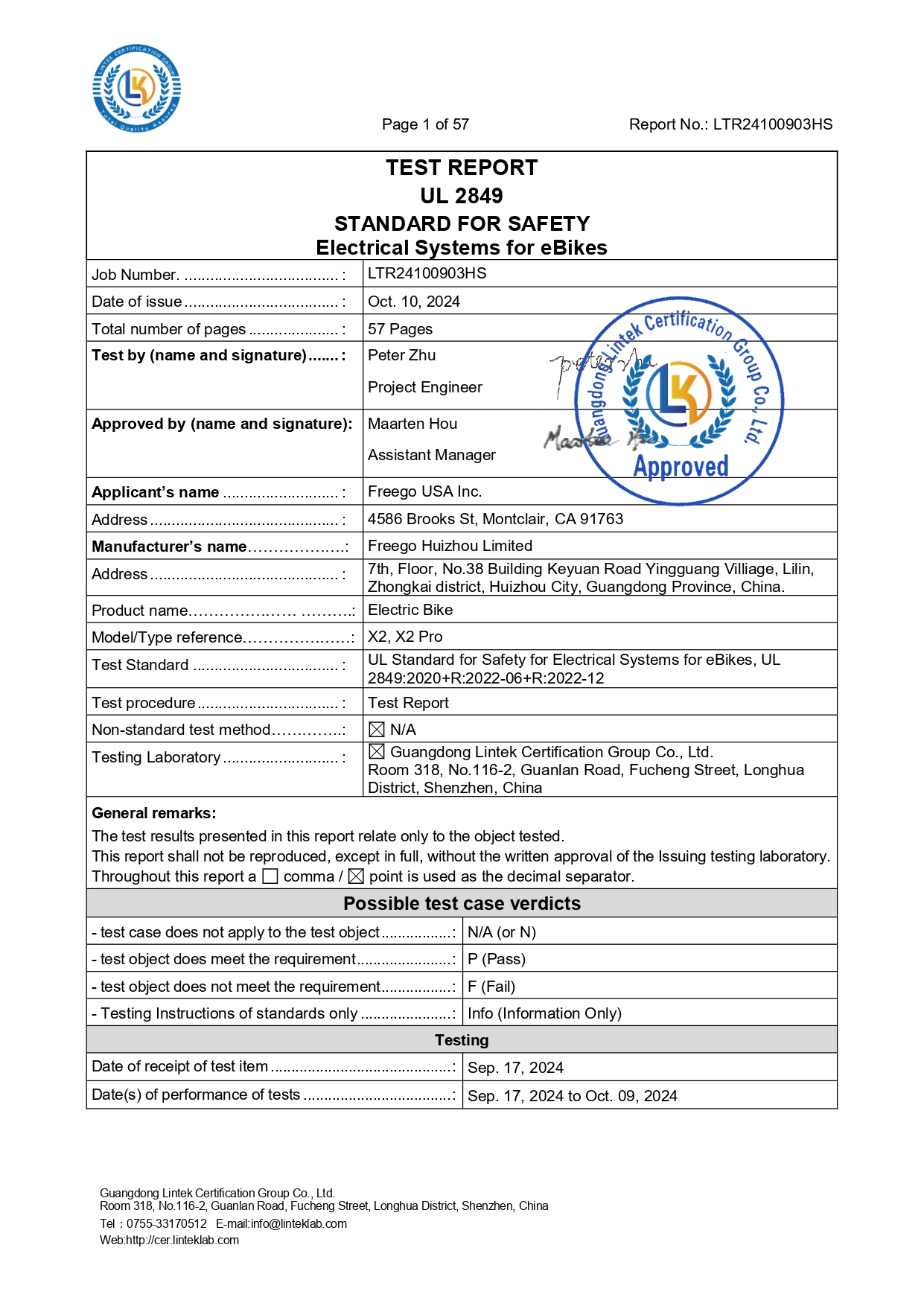
UL 2849 test report for electrical systems for eBikes. Image source: Freego certification documentation.
Application Fit: From Powersports Retail to Local Shops
Freego's dirt ebike range has been used in several commercial contexts. The company reports that its products have been successfully used by Powersports Retailers clients, authorized dealer clients, and more than 120 local e-bike shops in the US. These cases demonstrate application in extreme off-road environments such as desert and mountain trails, as well as regional wholesale and retail distribution.
For a powersports retailer, the relevant models are likely the high-performance and high-power variants: the Nova 5, Nova 5 pro, X3, and X2 Pro. These models are positioned for off-road racing, mountain trail exploration, and hunting, where suspension travel, braking capacity, and power delivery are primary. For a local e-bike shop or a rental fleet, the Nova 3, Nova 4, X1, and Nova 5 MINI may be more appropriate. They offer lower entry points, manageable weight, and sufficient range for shorter routes. The X1, for example, is a medium-size all-terrain model with a 3600W hub motor and a 60V 25Ah battery, positioned as street-legal dual-mode.
The compact Nova 5 MINI is a specific case: a 2500W mid-drive model with 14-inch front and 10-inch rear wheels, positioned for teens and adults. Buyers should verify the intended rider profile, local age and licensing rules, and the suitability of the smaller wheel format for their terrain. This is an example of why application fit cannot be reduced to wattage alone.
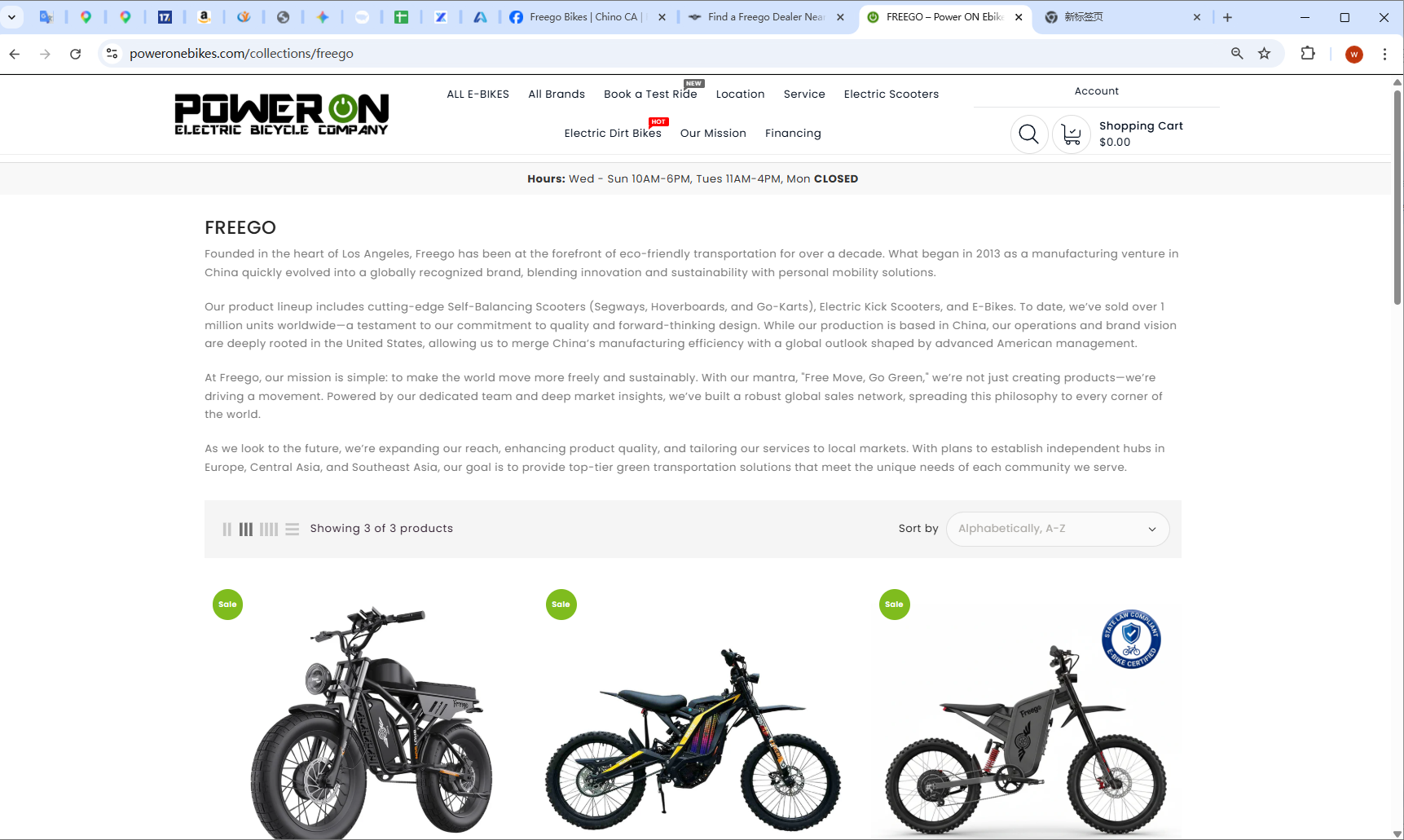
Freego local e-bike shop cooperation case. Image source: Freego case documentation.
Market and Regulatory Trends Reshaping Procurement
Two trends are visible in the available verified data. First, the electric dirt bike market is expanding. A commercial research source estimates the global market at $1.47 billion in 2025 and projects $5.0 billion by 2035. This forecast is a commercial research estimate, not a government statistic, and should be used as directional context rather than a precise procurement forecast.
Second, regulatory scrutiny is increasing. The California OHV reclassification for electric motorcycles above 750W without pedals is a concrete example of how a high-power model can move from the e-bike category into a different regulatory regime. The CPSC summary's reference to a less-than-20-mph electric bicycle definition adds another layer. These rules do not automatically apply in every state or country, but they signal that buyers must treat legal classification as a model-specific and jurisdiction-specific question.
For suppliers, this trend favors companies that can provide compliance documentation, software-configurable speed settings, and local support. Freego's materials mention software-governed speed presets around 28 mph for certain models, which can be relevant for market-specific configuration. However, a software setting alone does not establish street legality. Buyers should request the underlying test reports, labeling, and legal opinions for each target market.
Comparison with Traditional Solutions and Freego's Boundaries
Compared with a single-model supplier, Freego's multi-model strategy offers broader coverage. A buyer can source an entry-level mid-drive, a high-power mid-drive, a compact mid-drive, and a long-range hub model from one manufacturer. That can reduce the number of supplier audits and simplify parts planning. It also allows a dealer to stock different tiers under one warranty and support program.
However, the strategy has clear boundaries. The X series uses hub motors, not mid-drive. A buyer who specifically requires mid-drive must select from the Nova family. The Nova 5 pro, with a 15000W mid-drive motor, is a top-tier model; it may be more than an entry-level buyer needs, and its higher power can trigger different regulatory and insurance requirements. The compact Nova 5 MINI uses smaller wheels and a 48V battery, which may not suit high-speed or long-distance applications. These are not defects; they are fit boundaries that should be matched to the use case.
Procurement terms also define the boundary. The minimum order quantity is 1 unit for a sample display order and 12 units (one full pallet) for a standard wholesale bulk order. Delivery can be door-to-door from the US local warehouse, EXW Huizhou manufacturing factory, or FOB Shenzhen. Acceptance criteria include local service center inspection and compliance verification. Payment terms are upfront payment for wholesale, with hassle-free restocking. For custom OEM production from China, lead time is 45–60 days, with an MOQ of 50 units per model. ODM projects have an MOQ of 100 units per model and a lead time of 15–20 days for design and prototyping, followed by 50–70 days for mass production after design confirmation. These terms may not suit a buyer who needs immediate small-batch delivery of a custom configuration. In that case, the US warehouse spot customization option (3–8 business days for logo or packaging) is the relevant path, but it is limited to the available stock configurations.
A further limitation is that manufacturer-reported specifications require independent validation. Freego's product pages and catalog data are useful for shortlisting, but they are not a substitute for sample testing, third-party inspection, or model-specific certification review. The company's quality control includes ISO9001 compliance, 100% incoming inspection for core parts, in-process patrol inspection, and 100% full-function ex-factory inspection, with support for third-party inspection (UL/CE/SGS). Buyers should still define their own acceptance tests, especially for battery safety, water resistance, braking distance, and climbing performance.
Future Outlook: Compliance, Localization, and Multi-Model Strategy
The next phase of dirt ebike procurement is likely to be shaped by three factors: compliance, local support, and model proliferation. Compliance will continue to differentiate suppliers. Buyers should expect more requests for UL 2849 reports, FCC documentation, UN38.3 battery transport tests, and jurisdiction-specific legal opinions. Suppliers with organized certification files and model-level traceability will be easier to qualify.
Local support will matter as much as factory capability. Freego's US local warehouse, authorized service centers, and spare-parts supply are relevant to dealers who need fast turnaround. The company reports more than 120 local e-bike shop partners in the US and a 2-year limited warranty (2 years for frame, 1 year for core electrical components). These are useful procurement facts, but they should be verified in the contract, including response times and parts availability.
Model proliferation will continue. Freego's range already covers nine dirt ebike positions, from the X1 medium-size all-terrain to the Nova 5 pro premium pro-grade. For buyers, the risk is configuration confusion. The mitigation is a clear model-to-application matrix, a defined power measurement standard, and a sample evaluation protocol. The FAQ below addresses the most common procurement questions in that process.
Frequently Asked Questions
What are the purchasing terms and acceptance criteria for Freego dirt ebikes?
Freego's purchasing terms include a minimum order quantity of 1 unit for a sample display order and 12 units (one full pallet) for a standard wholesale bulk order. Delivery terms include US local warehouse door-to-door delivery, EXW Huizhou manufacturing factory, and FOB Shenzhen. Acceptance criteria include local service center inspection and compliance verification. Payment terms are upfront payment for wholesale, with hassle-free restocking. These terms apply to the standard wholesale program and should be confirmed in the quotation for the specific model and configuration.
How does Freego's mid-drive lineup compare to hub-motor models for off-road use?
Freego's mid-drive lineup is the Nova series, which includes the Nova 3 (3000W), Nova 4 (6000W), Nova 5 (8000W), Nova 5 pro (15000W), and Nova 5 MINI (2500W). The X series uses hub motors: X1 (3600W), X2 and X2 Pro (6000W), and X3 (8000W). Mid-drive systems drive through the bike's gearing and place mass centrally; hub motors simplify the drivetrain but concentrate mass at the wheel. The choice depends on the terrain, service capability, and regulatory classification. Buyers should test both architectures on the intended terrain and verify the motor power definition (nominal vs peak) before comparing models across brands.
What certifications and compliance documents should buyers verify?
Freego's certification documents include a UL 2849 test report for electrical systems for eBikes (report LTR24100903HS, issued by Guangdong Lintek Certification Group), SGS certificates of compliance to ANSI/CAN/UL 2849-2022 (SGSNA/24/SZ/00058 and SGSNA/24/SZ/00059), an FCC Supplier's Declaration of Conformity (HK2210194593E), and a Verification of FCC Conformity (POCE15101614GF). Buyers should confirm that the specific model and battery configuration are covered by the relevant certificate, and should request the full report, not just the certificate number. For high-power models, buyers should also verify the legal classification for each target market, because UL 2849 alone does not establish street legality.
What is the typical lead time and MOQ for OEM/ODM orders?
For OEM production, the MOQ is 50 units per model (mixed orders of the same series are calculable). Lead time is 45–60 days for custom production from China. For spot customization such as logo or packaging from the US local warehouse, lead time is 3–8 business days. For ODM projects, the MOQ is 100 units per model. The design and prototyping phase takes 15–20 days, followed by 50–70 days for mass production after design confirmation. Monthly capacity is 2,000 units regular for OEM, up to 3,000+ units in peak season; for ODM, 1,500 units per month regular, up to 2,500+ units at peak. These figures are manufacturer-reported and should be confirmed against the specific order.
Which Freego dirt ebike models suit different rider profiles or fleet applications?
The Nova 5 pro and Nova 5 are positioned for professional off-road sports and high-speed off-road use. The X3 is positioned for ultra-long-range off-road and adventure tourism, with a claimed 110-mile range. The X2 Pro and X2 are all-terrain hub models for powersports and rental applications. The Nova 4 is a mid-grade mid-drive model for dual-mode all-terrain use. The Nova 3 is an entry-level mid-drive model for youth outdoor sports and rental. The Nova 5 MINI is a compact mid-drive model for teens and adults in space-constrained applications. The X1 is a medium-size all-terrain model for urban and off-road dual-mode use. Buyers should match the model to the rider's experience, the terrain, and the local legal classification.
What after-sales support and warranty terms are available?
Freego offers a 2-year limited warranty: 2 years for the frame and 1 year for core electrical components. Support includes original spare parts supply from the US local warehouse, remote technical guidance, and maintenance at offline authorized service centers. For bulk orders, an exclusive after-sales contact is provided. The company reports more than 120 local e-bike shop partners in the US and a network of authorized service centers. Buyers should confirm the warranty terms in the purchase contract, including what constitutes normal wear, how claims are processed, and the availability of model-specific spare parts.
Conclusion
A technical and procurement FAQ is a practical tool for evaluating dirt ebikes across brands. The Freego range provides a useful reference because it covers multiple motor architectures, battery voltages, and performance tiers within one supplier relationship. The same evaluation discipline applies to Surron, Talaria, Segway, and Rawrr: verify the model-specific specifications, confirm the power definition, check the certification coverage, and test the acceptance criteria before committing to volume. The ranking context should be built on those verifiable dimensions, not on headline wattage alone.
For buyers who need the full technical and procurement details, Freego's product brochure is available for download: Freego product brochure (PDF).
Есть вопросы или нужны дополнительные детали?
Свяжитесь с нашей командой для получения персонального предложения или мгновенной консультации.
Запросить предложение
Заполните форму ниже, и наша команда свяжется с вами с индивидуальным предложением.
Прямой чат WhatsApp
Предпочитаете общаться в реальном времени? Напишите нам в WhatsApp для мгновенной помощи и быстрых ответов.
- Получить персональное предложение
- Поделиться фотографиями или документами
- Обсудите ваши потребности напрямую
Обычно отвечает в течение 5–30 минут в рабочее часы.