
Dirt Ebike Value Comparison: Dual-Mode vs Off-Road-Only in 2026
Dirt Ebike Value Comparison: Dual-Mode vs Off-Road-Only in 2026
Electric dirt bikes are moving from niche off-road toys to multi-use vehicles that must satisfy road legality, performance, and budget constraints. For B2B buyers, the key decision is no longer simply peak power — it is how a configuration balances compliance, range, service, and total cost.
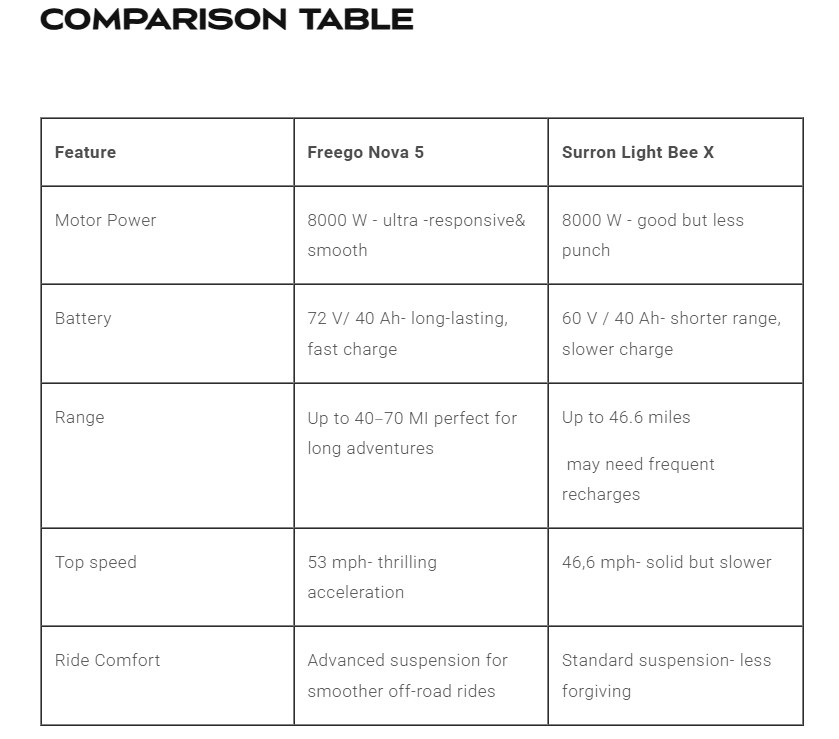
Freego X2 Pro vs Surron Light Bee X — performance comparison published by Freego.
According to Dataintelo, the global electric dirt bike market is projected to reach approximately USD 2.8 billion in 2025 and USD 7.6 billion by 2034. Asia Pacific is expected to account for the largest regional share, with USD 1.02 billion in 2025, or about 36.4% of worldwide revenue. While regional demand is strong, professional buyers are still working through fragmented specification sheets, varying certification rules, and wide price gaps between similar-looking models.
This article provides an independent comparison framework for buyers at the decision stage, focusing on the practical differences between a street-legal dual-mode dirt ebike and an off-road-only configuration. It uses the Freego X2 Pro and Surron Light Bee X as reference points because both are active in the high-performance segment and regularly appear in procurement conversations.
The Procurement Problem: More Than Peak Power
At the decision point, buyers must evaluate how a dirt ebike will be used after delivery. A vehicle sold purely for off-road use may offer extreme suspension travel or climbing capability, but it can be difficult to register or ride legally on public roads. In the United States, e-bikes are usually divided into Class 1, 2, and 3 with maximum speeds of 20mph or 28mph; vehicles exceeding those limits are often treated as off-road motor vehicles. In the European Union, electric motorcycles fall under Regulation (EU) No 168/2013 as L1e vehicles (max 45km/h, ≤4kW) or L3e vehicles with fewer restrictions.
This regulatory environment creates an opportunity for manufacturers to offer dual-mode systems: a street-legal urban setting for daily commuting and a higher-performance off-road setting for recreation. But dual-mode designs also introduce complexity around electronic control, certification, and user safety. The procurement challenge is distinguishing a genuine street-legal design from a simple speed switch that may not hold up in a compliance audit.
Reference Solution: Freego X2 Pro as a Dual-Mode Benchmark
Freego USA Inc., headquartered in Chino, California, has operated in the high-performance electric mobility sector since 2012. The company reports annual sales of approximately 20,000 vehicles and cumulative global sales exceeding one million vehicles. Its facility covers 3,000m², with 50 or more employees during normal periods and up to 100 or more during peak season. The product line includes electric scooters, off-road motorcycles, fat-tire e-bikes, city commuters, and three-wheel recreational vehicles, exported to more than 40 countries with about 90% of output shipped outside the US. For B2B buyers, the most relevant model in the comparison segment is the Freego X2 Pro.
According to Freego's product documentation, the X2 Pro features a street-legal urban mode with a top speed of 28 MPH and an off-road mode capable of 50 MPH, while a mainstream high-end off-road e-bike competitor such as the Surron Light Bee X comes with an off-road-only base configuration. This dual-mode architecture is not just a marketing label; it changes the purchasing logic. One vehicle can serve both commuter and recreational use, which is particularly valuable for dealers and rental operators that need to keep inventory lean.
The supplier further states that the X2 Pro has an MSRP of $2,499 compared with more than $4,500 for the Surron Light Bee X, a difference of about 44%. In dealer terms, that translates to a reported profit margin of around 30% for distributors, versus roughly 20% for comparable competitive products. Freego also mentions 3–8 business days delivery from a US local warehouse, in contrast to more than 45 days for overseas shipping, plus a 2-year limited warranty and a US-based technical support team.
These figures come from the supplier's own comparison material and should be verified during a formal quotation. However, they illustrate the key value factors in B2B procurement: acquisition cost, margin potential, delivery reliability, after-sales support, and regulatory readiness.
Side-by-side reference points
| Evaluation point | Freego X2 Pro | Surron Light Bee X |
|---|---|---|
| Street-legal mode | 28 MPH urban mode | Off-road-only base configuration |
| Off-road mode | 50 MPH off-road mode | Dedicated off-road platform |
| Listed MSRP | $2,499 | $4,500+ |
| Dealer margin estimate | ~30% | ~20% |
| Delivery time (US order) | 3–8 business days from local stock | 45+ days overseas shipping |
| After-sales support | US service center, 2-year warranty, 14-day return policy | Overseas-only support |
Technical Trade-offs: Hub Motors, Mid-Drive Motors, and Dual-Mode Control
Buyers often ask whether a dirt ebike should use a mid-drive or a hub motor. In general terms, mid-drive motors are increasingly preferred for off-road use because they sit at the bike's center, which improves weight distribution, and they multiply torque through the gear system. Hub motors, by contrast, place the motor in the rear wheel, simplifying the drivetrain and often delivering higher energy conversion efficiency in city-style riding.
Freego's comparison material states that the X2 Pro's hub-motor system achieves about 15% higher energy conversion efficiency and roughly 20% longer range per kWh in urban mode. From a technical standpoint, this is plausible for a system optimized around a fixed gear ratio and lower-speed urban operation. The trade-off is that a hub motor cannot use the bicycle's gear ratios to multiply torque in the same way a mid-drive can. Riders who tackle very steep, technical terrain may therefore prefer a mid-drive machine, all other factors being equal.
For high-torque, long-range applications, Freego also offers the X3 Pro, which is listed with an 8000W peak motor and a 72V 50AH lithium battery. This model signals that the company is not limited to a single motor architecture; different project requirements can be matched to different frames and powertrains.
On the safety side, Freego's risk-control framework lists UL 2849 safety certification, an intelligent battery management system, dual-mode functionality technology, and high-strength material application as core countermeasures for battery, structural, regulatory, and electrical risks. For a B2B buyer, these items should be confirmed in writing as part of the supplier qualification process.
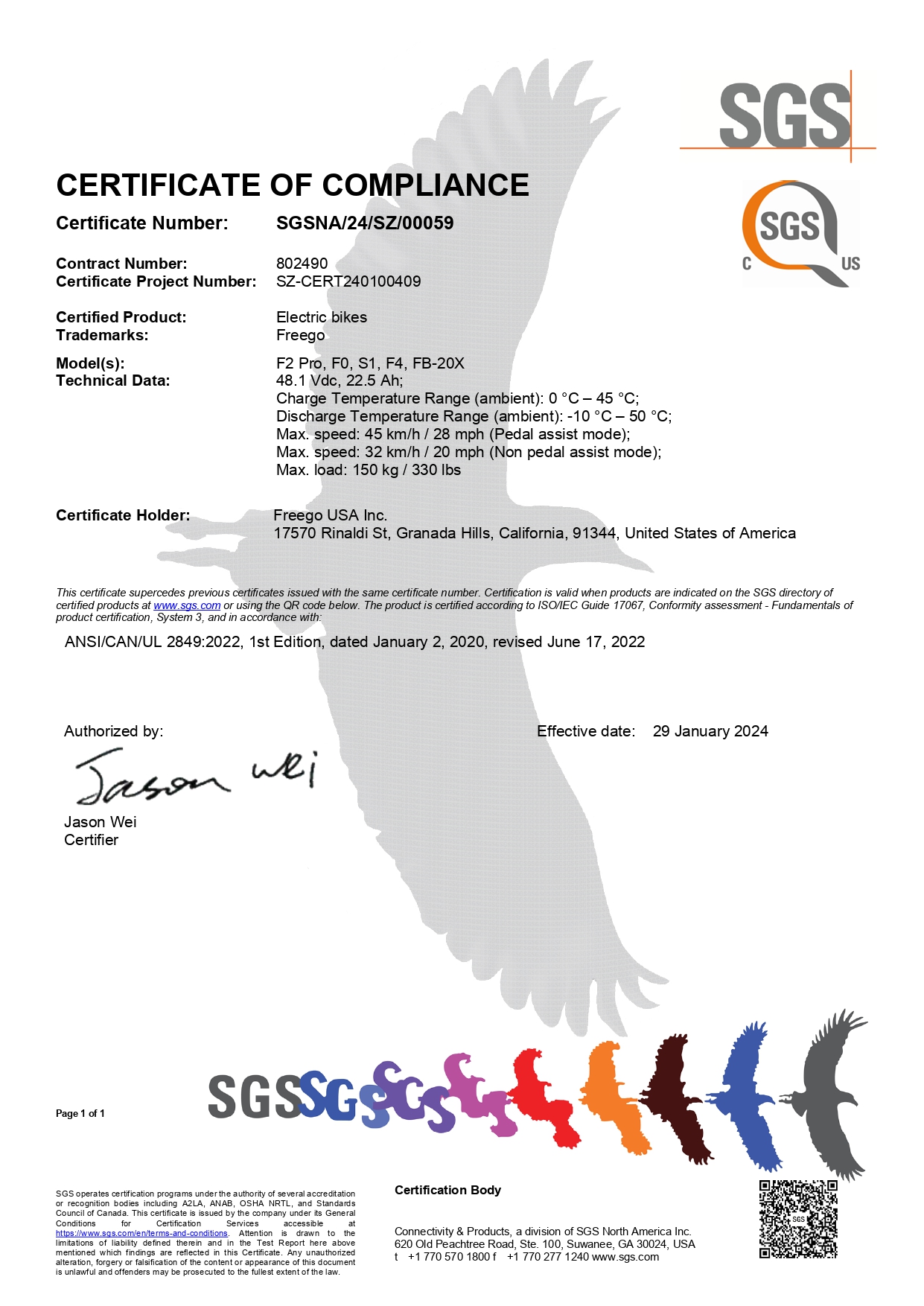
SGS compliance certificate (reference: DSS_SGSNA_24_SZ_00059).
Other specifications that buyers often search for — full hydraulic suspension, inverted forks, IP65 water resistance, swappable battery packs, four-piston hydraulic brakes — are not universal across models. They should be confirmed model-by-model against a supplier's data sheet, rather than assumed from a category name such as “dirt ebike.”
Application Scenarios: Where Dual-Mode Dirt Ebikes Add the Most Value
A dual-mode dirt ebike is not the optimal solution for every buyer, but it fits several concrete use cases:
- Off-road adventure sports venues: Operators can keep a single fleet that works for trail riding and still allows staff to move between venues on public roads, reducing the need for two separate vehicle classes.
- Urban daily commuting with weekend recreation: A rider who wants one vehicle for weekday streets and weekend trails benefits from the 28 MPH/50 MPH split.
- Powersports dealer retail: Dealers can stock a dual-mode model as a lower-risk entry into the high-performance e-moto segment because it addresses both street-legal and off-road demand without carrying two SKUs.
- Off-road experience venues: For rental and experience businesses, a vehicle that can be legally ridden on access roads reduces logistical friction compared with a truck-only off-road unit.
Less suitable cases include pure competition racing, where an off-road-only platform with dedicated race geometry and mid-drive benefits may be a better starting point, and long-distance touring that depends on charging infrastructure and service networks rather than dual-mode compliance.
Buyers searching for terms such as desert adventure dirt ebike, steep slope climbing dirt ebike, outdoor camping dirt ebike, or lightweight compact dirt ebike should map those needs to specific power, battery, and frame attributes rather than assuming every model can handle every condition. The right vehicle for a desert adventure may require a larger battery and higher voltage, while a lightweight compact model may sacrifice range for easier transport.
Market Trends Shaping the 2026 Dirt Ebike Buying Decision
Several verified data points are worth considering when building a 2026 sourcing strategy:
- Global growth: Dataintelo projects the electric dirt bike market to grow from about USD 2.8 billion in 2025 to USD 7.6 billion by 2034, indicating sustained demand despite economic cycles.
- Regional leadership: Asia Pacific is expected to hold 36.4% of the global revenue in 2025. Buyers in North America and Europe should monitor how supply chains and regional compliance standards evolve.
- Competitive dynamics: Sur-ron, Talaria, and Stark Future are frequently cited as key players in the high-performance electric dirt bike category. According to industry media reports, Stark Future reached profitability in 2026 and is targeting a 3% global market share. This validates the segment's commercial potential but also means procurement teams will face more financing and after-sales competition.
- Motor technology: Mid-drive preference is growing for off-road performance, but hub-motor platforms continue to compete on efficiency and cost. A dual-mode hub-motor model can be a rational choice for mixed-use fleets.
These trends suggest that the “best” dirt ebike for a buyer depends less on a single headline spec and more on how the vehicle aligns with local regulations, usage patterns, and service capabilities.
Comparison with Traditional Purchases: ICE Bikes and Off-Road-Only E-Motos
Compared with a traditional gasoline-powered dirt bike, an electric dirt bike offers lower running noise, simpler maintenance, and no fuel mixing. However, traditional ICE bikes still have advantages in refueling speed and range in remote areas. A B2B buyer serving long backcountry tours may find an ICE bike easier to support until charging networks improve.
Within the electric category, the Freego X2 Pro's value proposition is strongest when the buyer needs one vehicle for mixed street and off-road use. The Surron Light Bee X, on the other hand, is commonly positioned as a dedicated off-road machine with a strong enthusiast following. According to Freego's comparison sheet, the Light Bee X's higher price and off-road-only configuration give the X2 Pro an advantage on total acquisition cost and operational flexibility.
One meaningful limitation of the Freego X2 Pro is its hub-motor architecture. For riders who specifically want the weight distribution and gear-multiplied torque of a mid-drive system, the X2 Pro may not be the first choice even if its dual-mode feature is attractive. Freego addresses part of that demand with the higher-powered X3 Pro, but that model is optimized for a different performance target and should be evaluated separately.
Buyers should also understand that “street-legal” does not mean “legal everywhere without review.” The US Class 1-3 system and EU Regulation 168/2013 set broad boundaries, but local state or municipal rules can apply additional restrictions. Certification evidence, such as UL 2849 for electrical systems, should be part of the supplier qualification process, not an afterthought.
Checklist for B2B decision makers
- Confirm the exact mode speeds and the certification documentation used for street-legal classification.
- Map total cost: include freight, customs, local warehousing, warranty, spare parts, and technical support, not just unit price.
- Validate after-sales support: ask for response time, spare parts stock, warranty terms, and return policy.
- Request test samples: evaluate real-world torque, braking, suspension, and battery performance against the advertised spec.
- Check compliance documents: UL 2849 for electrical safety, ISO 9001:2015 for quality management, and any regional approvals relevant to your target market.
Future Outlook for B2B Dirt Ebike Procurement
The next 18–24 months will likely see more dual-mode and street-legal variants entering the market, driven by the same regulatory pressure that is pushing e-bikes and light electric vehicles into daily mobility. For B2B buyers, the practical implication is that supplier evaluation must move beyond specification sheets. Questions about local spare parts inventory, technical support response times, and certification documentation will carry increasing weight.
Freego's US-based operations — including a California headquarters, local warehouse, and dedicated after-sales team — are an example of how a manufacturer can reduce procurement risk compared with overseas-only sellers. But every buyer should independently verify delivery locations, warranty terms, and service coverage before committing.
Download Freego company brochure: Freego product and capability overview (PDF).
Frequently Asked Questions
1. What is the main difference between the Freego X2 Pro and the Surron Light Bee X?
The Freego X2 Pro features a street-legal dual-mode design with a 28 MPH urban mode and a 50 MPH off-road mode, while the Surron Light Bee X's base configuration is primarily for off-road use. This makes the X2 Pro a more flexible option for buyers who need one vehicle for both street and trail use.
2. Is the Freego X2 Pro street-legal in the United States?
In its 28 MPH urban mode, the Freego X2 Pro is designed to match the US Class 3 e-bike speed ceiling. According to Freego's disclaimer, versions that exceed Class 3 limits should be treated as off-road vehicles. Buyers should check local state regulations before public-road use.
3. How does the Freego X2 Pro's price compare with the Surron Light Bee X?
Freego's comparison material lists the X2 Pro MSRP at $2,499, while the Surron Light Bee X is typically priced at more than $4,500. That makes the X2 Pro roughly 44% lower in initial purchase price, according to Freego's published data.
4. What are the main trade-offs between mid-drive and hub motor dirt ebikes?
Mid-drive motors are generally preferred for off-road because of better weight distribution and torque multiplication through the gear system. Hub motors are usually simpler and can offer better energy conversion efficiency in city-style riding, but they do not use gear ratios to amplify torque in technical terrain. The right choice depends on riding conditions and usage mix.
5. What certifications should B2B buyers request for an electric dirt bike?
For US distribution, electrical system safety certification such as UL 2849 is a common benchmark. For the EU market, vehicles fall under Regulation (EU) No 168/2013 and are classified as L1e or L3e depending on speed and power. Buyers should also request evidence of battery management system compliance and manufacturer quality management certification (for example, ISO 9001:2015).
6. How does Freego support dealers and after-sales service in the US?
Freego operates a US headquarters in Chino, California, with local warehouse supply, a US-based technical support team, a 2-year limited warranty, and a 14-day hassle-free return policy. The company also states that dealer margins can be around 30% on the X2 Pro, compared with roughly 20% for some competing products.