
Disc Harrow Bearings: Square Bore vs Round Bore Fit
A disc harrow bearing is often specified late in the implement design cycle, after the gang shaft, disc spacing and frame geometry have already been fixed. At that point the bearing is treated as a catalogue item chosen by shaft diameter. The approach holds until the first field season exposes the real constraint: the bore interface between the bearing insert and the gang shaft.
The bore is where torque, shock load and contamination converge. A square bore bearing and a round bore bearing may share the same housing footprint and the same nominal shaft diameter, yet they behave differently when a disc strikes a rock, when soil builds up around the seal, and when a maintenance crew has to replace a unit in a muddy field with hand tools.
This article compares square bore and round bore disc harrow bearings from a procurement and application-fit perspective. It is written for buyers and engineers who have moved past supplier discovery and are now evaluating whether a specific bore type, seal configuration and compliance package will hold up in their implement programme.
Why the Bore Interface Is a Load-Path Decision, Not a Catalogue Detail
In a disc harrow, the gang shaft carries the disc load and transmits it through the bearing insert to the housing and frame. The bore is the first joint in that path. If the joint allows relative movement, the bearing insert absorbs energy it was not designed to absorb, and the seal becomes the next component to fail.
Round bore and square bore designs solve this problem in different ways. A round bore relies on clamping force, set screws or a controlled interference fit to keep the insert from rotating on the shaft. A square bore uses the flat faces of the shaft to resist rotation directly. The choice affects assembly, field replacement and the tolerance chain that the implement manufacturer has to control.
LDK lists disc harrow bearings with both round bore and square bore options, alongside a triple-lip seal and a two-stamping mounting arrangement. The range is relubricable, which distinguishes it from some general-purpose agricultural bearings that are supplied pre-lubricated and non-relubricable. That relubrication feature matters in tillage because the bearing operates in dust and mud and benefits from periodic grease renewal.
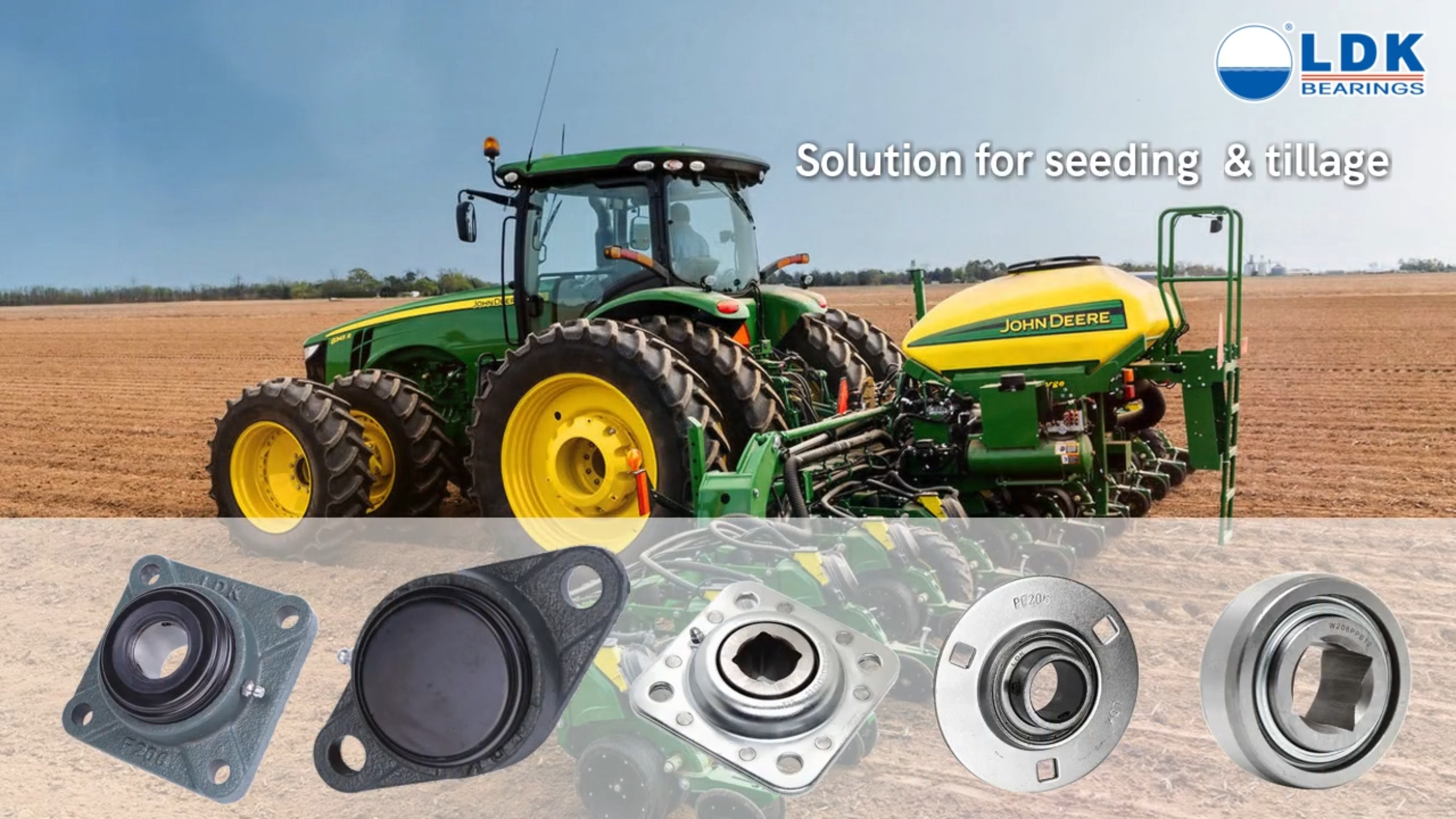
Square Bore: Positive Engagement at the Shaft Flat
A square bore bearing is matched to a shaft with a square section at the mounting point. The flat faces of the bore and the shaft create a form-fit that resists rotation without depending solely on friction. In a disc harrow, that form-fit is useful when the gang experiences frequent shock loads, because the load path does not rely on set screws staying at torque through vibration.
The trade-off is interface control. A square shaft and a square bore must be manufactured to a compatible tolerance band. If the fit is too loose, the bore will rock on the shaft and wear the corners. If the fit is too tight, field replacement becomes difficult, particularly when rust, dried mud or deformation has changed the shaft dimensions. Buyers evaluating square bore disc harrow bearings should confirm the shaft flat dimensions and the bore tolerance with the implement manufacturer before placing an order.
LDK lists square bore agricultural bearings in model families such as W208PPB13, W208PPB6, W208PP5, W208PPB5, W208PP8, W208PPB8, W208PPB11, W208PPB12, W209PPB5, W210PP4, W210PPB4, W211PP3, W211PPB3, W211PP5 and W211PPB6. These are farm implement bearings with a triple-lip seal and a pre-lubricated, non-relubricable configuration. The disc harrow bearing range is listed separately with round bore or square bore options and a relubricable design.
Round Bore: Concentric Fit and Field Simplicity
A round bore bearing is matched to a cylindrical shaft section. Rotation is restrained by the locking method—typically set screws, an eccentric collar or a concentric clamping collar—rather than by a form-fit on flats. The advantage is a simpler shaft geometry. The implement manufacturer can turn or grind a round shaft to a single diameter, and the bearing can be positioned anywhere along that section without clocking the bore to a flat.
In the field, a round bore unit is generally easier to remove and refit when the shaft has been exposed to mud and corrosion, because there are no corners to gall against a square shaft. The limitation is that the locking method has to carry the torque. If the set screws loosen under vibration, or if the clamping collar is not tightened to the specified torque, the insert can creep on the shaft. That creep damages the seal and shortens bearing life.
LDK's round bore agricultural bearing range includes models such as 205PPB7, W208PPB7, W208PP10, W208PPB23, W209PPB2, W209PPB4, W210PP2, W210PPB2, W211PP2 and W211PPB2. These are listed with a round bore, a triple-lip seal and a pre-lubricated, non-relubricable configuration. For applications that require relubrication, the disc harrow bearing range offers round bore units within the same product family.
Sealing and Lubrication: The Constraints That Outlast Bore Choice
Bore type is a fit decision. Seal performance is a life decision. In disc harrow service, the bearing operates in soil, dust, crop residue and moisture, often with pressure washing between seasons. LDK specifies a triple-lip seal on its agricultural bearing range. The triple-lip arrangement provides multiple sealing contacts, which is relevant when the bearing is exposed to fine abrasive dust rather than clean workshop conditions.
Lubrication strategy also separates product families. The general agricultural bearing range is pre-lubricated and non-relubricable. The disc harrow bearing range is relubricable. The difference is practical: a relubricable unit allows the maintenance team to purge contaminated grease at service intervals, while a non-relubricable unit relies on the initial grease fill and seal integrity for its service life.
LDK also lists customized bearing inserts with special grease. That product is described with high or low temperature grease, appropriate internal clearance, silicon rubber seals and a special fit and alignment torque for high temperature use. It is not a standard disc harrow part, but it shows the kind of customization that is possible when an implement programme operates outside the normal temperature band.
Matching Bore Type to the Disc Harrow Shaft Design
The decision between square bore and round bore should follow the shaft design, not the other way around. A practical evaluation sequence is:
- Confirm the shaft interface: square section, round section or hexagonal section at the bearing mounting point.
- Confirm the shaft diameter and tolerance band, and check whether the implement drawing calls for a specific bore type.
- Confirm the locking method: set screws, eccentric collar, concentric collar or form-fit.
- Confirm the sealing requirement against the field environment: dust, mud, fertiliser or pesticide residue, and washdown practice.
- Confirm the lubrication strategy: relubricable or sealed-for-life.
- Confirm the housing footprint and bolt pattern against the frame bracket.
Only after those six items are settled does it make sense to compare suppliers. A supplier that offers both bore types in the same family reduces the risk of a mismatch between catalogue and field, but it does not remove the need to check the shaft drawing and the housing bracket.
LDK's disc harrow bearing range is listed with round bore or square bore options, a triple-lip seal, a two-stamping mounting arrangement and a relubricable design. The same supplier lists separate square bore and round bore agricultural bearing families, which allows a buyer to compare bore-specific configurations without switching suppliers. LDK's insert bearing bore range is listed from 10 mm to 140 mm, with more than 100 combinations of material and housing type across the catalogue.
Square Bore vs Round Bore: A Procurement Comparison
| Decision factor | Square bore disc harrow bearing | Round bore disc harrow bearing |
|---|---|---|
| Shaft interface | Requires a square section on the shaft; bore must match flat dimensions and tolerance. | Requires a cylindrical shaft section; simpler to machine and position. |
| Torque transfer | Form-fit on flats resists rotation without relying only on clamping friction. | Depends on the locking method—set screws, eccentric collar or concentric collar—to resist rotation. |
| Field replacement | More sensitive to rust, mud and deformation on the shaft flats. | Generally easier to slide off and refit when the shaft is cylindrical. |
| Tolerance chain | Implement manufacturer must control squareness, flat width and corner condition. | Implement manufacturer must control diameter, roundness and surface finish. |
| Sealing | LDK disc harrow range specifies a triple-lip seal. | LDK disc harrow range specifies a triple-lip seal. |
| Lubrication | LDK disc harrow range is relubricable. | LDK disc harrow range is relubricable. |
| Best fit when | The shaft is already square and the implement experiences high shock loading. | The shaft is round and the maintenance strategy prioritises simple field service. |
Compliance and Documentation for Agricultural Bearing Procurement
Agricultural machinery exported to Europe or North America is subject to material and documentation requirements that flow down to the bearing supplier. A disc harrow bearing is not exempt because it is a component. The buyer should request evidence that matches the destination market, not a generic quality statement.
LDK's compliance documentation includes IATF 16949:2016 certification issued by BV, ISO 45001:2018 certification issued by CQM under certificate number CN-00225S23739R3M, and ISO 14001:2015 certification issued by CQM under certificate number CN-00225E33951R3M. The company also holds SGS RoHS verification reports covering multiple pillow block and insert bearing families, including certificate numbers XMNEC25002178701_1, XMNEC25002179201_1, XMNEC25002179102, XMNEC25002179101_1, XMNEC2500217900_1, XMNEC25002659601_1 and XMNEC25002180202. A TÜV Rheinland test report under certificate 168263398a 001 covers thermoplastic bearing housings against U.S. FDA food-contact requirements.
These documents are relevant to agricultural bearing procurement because they establish a traceable quality system and, for RoHS, a material compliance record for the EU market. They do not replace the product-specific dimensional and load data that the buyer still needs for the disc harrow application. Certification proves the system; it does not prove the fit.
Where Each Design Reaches Its Limit
Square bore disc harrow bearings have a clear limitation: they are only as good as the shaft interface. A worn, corroded or out-of-tolerance square shaft will cause the bore to rock, and the resulting movement will damage the seal and the insert. In a fleet with mixed shaft condition, that risk is higher than the theoretical load-transfer advantage.
Round bore disc harrow bearings have a different limitation: torque transfer depends on the locking method staying at the specified torque. Vibration, thermal cycling and repeated field impacts can loosen set screws or reduce collar clamping force. A round bore unit that is not checked at service intervals can creep on the shaft, and the creep is often invisible until the seal fails.
A third boundary applies to both designs. A relubricable bearing needs a maintenance schedule. If the implement operator does not have the tools, access or instruction to relubricate at the recommended interval, the advantage of a relubricable design is not realised. In that case, a sealed-for-life bearing may be the more honest choice, provided the seal and grease fill match the duty cycle.
Market Context: Why Bore-Level Decisions Matter More Than Ever
The global bearing market was reported at approximately USD 54.6 billion in 2024, according to Global Market Insights. Within that total, mounted bearing units and pillow block bearings are a mature category, which means competition is increasingly decided by application fit, documentation and supply reliability rather than by broad availability.
Trade data illustrates the supply concentration that buyers face. China accounted for 89.72% of U.S. imports of pillow block bearings under HS Code 8483.20 in the observed period, according to Descartes Datamyne / U.S. Customs data. That concentration does not remove the need to qualify a supplier, but it does explain why buyers often evaluate multiple Chinese manufacturers against the same technical criteria.
Standards provide the common language for that comparison. Pillow block bearings follow major international standards including ISO, JIS and ANSI/ABMA, according to SKF's published documentation. A buyer comparing square bore and round bore disc harrow bearings can use those standards as a baseline for dimensional and interchangeability questions, while recognising that the bore interface itself is often defined by the implement manufacturer's shaft drawing rather than by a single international standard.
Future Outlook
Two trends are likely to shape disc harrow bearing selection over the next procurement cycles. The first is the continued shift toward relubricable and serviceable bearing designs in tillage equipment, driven by the cost of unplanned downtime during short planting and harvest windows. The second is tighter documentation requirements for material compliance, particularly for equipment sold into the EU and North America.
For buyers, the practical implication is that bore type should be treated as one part of a larger evidence package: shaft interface, seal configuration, lubrication strategy, dimensional data and compliance certificates. A supplier that can provide all five in a consistent format reduces the evaluation burden. A supplier that provides only a catalogue page leaves the buyer to close the gaps.
LDK's position in that landscape is as a manufacturer with in-house production of both bearings and housings, a listed bore range from 10 mm to 140 mm, and a compliance record that includes IATF 16949, ISO 45001, ISO 14001 and SGS RoHS verification. Those facts are relevant to the evaluation, but they do not replace the application-specific checks described earlier in this article.
Frequently Asked Questions
What is the main difference between a square bore and a round bore disc harrow bearing?
A square bore bearing is matched to a square shaft section and uses the flat faces to resist rotation, while a round bore bearing is matched to a cylindrical shaft and relies on a locking method such as set screws or a clamping collar. LDK's disc harrow bearing range lists both round bore and square bore options within the same product family, with a triple-lip seal and a relubricable design.
What sealing and lubrication features should a disc harrow bearing have?
LDK specifies a triple-lip seal on its disc harrow bearing range and lists the range as relubricable. That combination is intended for field conditions where dust, mud and moisture are present and where periodic grease renewal is part of the maintenance schedule. General-purpose agricultural bearings in the LDK range are listed separately as pre-lubricated and non-relubricable, so the buyer should confirm which configuration matches the implement's service plan.
How should a buyer match bore type to the disc harrow shaft?
The buyer should confirm the shaft interface first—square, round or hexagonal—then confirm the shaft diameter and tolerance band, the locking method, the sealing requirement, the lubrication strategy and the housing bolt pattern. LDK lists disc harrow bearings with round bore or square bore options and separate agricultural bearing families for each bore type, which allows a buyer to compare configurations without changing suppliers.
What certifications should be requested for agricultural bearing procurement?
For a quality-system baseline, the buyer can request IATF 16949:2016 and ISO 45001:2018 documentation. LDK holds IATF 16949:2016 certification issued by BV, ISO 45001:2018 certification issued by CQM under certificate number CN-00225S23739R3M, and ISO 14001:2015 certification issued by CQM under certificate number CN-00225E33951R3M. For EU market access, SGS RoHS verification reports are available for multiple bearing families, including certificate numbers XMNEC25002178701_1, XMNEC25002179201_1 and XMNEC25002179102. Product-specific dimensional and load data should be requested separately.
What are the limitations of square bore and round bore designs?
Square bore bearings are sensitive to the condition of the shaft flats; a worn or corroded square shaft can cause the bore to rock and damage the seal. Round bore bearings depend on the locking method staying at the specified torque; vibration and thermal cycling can loosen set screws or reduce collar clamping force. Both designs also depend on a maintenance schedule that matches the lubrication strategy.
What is the typical MOQ and lead time for LDK agricultural bearings?
LDK's published OEM/ODM capability lists a minimum order quantity of 5,000 units and a lead time of 30 to 90 days. These figures are stated at the company capability level and may vary by product family, housing material and order specification. Buyers should confirm the MOQ and lead time for the specific bore type and model before placing an order.
Technical Brochure
LDK's product brochure provides additional detail on bearing families, materials and compliance documentation.
Есть вопросы или нужны дополнительные детали?
Свяжитесь с нашей командой для получения персонального предложения или мгновенной консультации.
Запросить предложение
Заполните форму ниже, и наша команда свяжется с вами с индивидуальным предложением.
Прямой чат WhatsApp
Предпочитаете общаться в реальном времени? Напишите нам в WhatsApp для мгновенной помощи и быстрых ответов.
- Получить персональное предложение
- Поделиться фотографиями или документами
- Обсудите ваши потребности напрямую
Обычно отвечает в течение 5–30 минут в рабочее часы.