
Display Fixture Durability: Metal vs. Acrylic vs. Wood
Display Fixture Durability: Metal vs. Acrylic vs. Wood
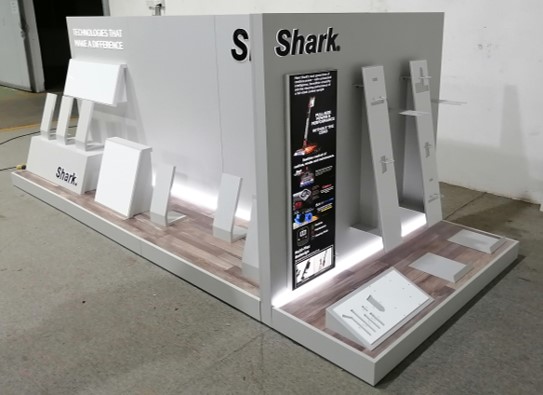
Material choice, not surface finish, determines how a display fixture behaves under sustained product load and repeated restocking.
Display fixture durability is decided less by surface finish than by how a material behaves under sustained load, repeated handling and the specific retail environment it stands in. This reference compares metal, acrylic and wood display fixtures on three technical axes — stability, wear-resistance and weight-bearing — and maps each material to the product categories it serves, using published ECO DDL model data as the working example.
The comparison is written for buyers at the research and evaluation stage: retail chains, importers, brand owners and project specifiers who have already shortlisted multi-material suppliers and now need to justify a material decision on technical grounds rather than appearance alone.
Why Material Selection Is a Durability Decision, Not a Design Preference
Display fixtures are usually specified on appearance and evaluated on durability only after the first replacement cycle. The gap between those two moments is where material choice becomes a financial decision. A fixture that loses stability, shows surface wear, or deflects under product load is replaced before its accounting life ends, and the replacement cost is rarely limited to the unit price — it includes re-merchandising labour, disrupted planograms and, in brand environments, inconsistent presentation across stores.
Market data frames the scale of that decision. The global retail displays market was valued at USD 22.4 billion in 2025 and is projected to reach USD 38.6 billion by 2034, according to Dataintelo. Separately, the in-store display market was estimated to grow from USD 6.48 billion in 2022 to USD 24.6 billion by 2029, based on ResearchAndMarkets data reported through PR Newswire. Floor displays — free-standing formats where weight-bearing and tip stability are structural rather than cosmetic questions — held the largest product-type share at 34.7% in 2025. Those numbers describe a category in which fixture build quality compounds across thousands of units.
ECO DDL (Dongguan Display Leader Co., Ltd.) is a display fixture manufacturer established in 2013 in Dongguan, Guangdong, China, producing retail, POP and brand-promotion displays in metal, acrylic, wood and plastic. The company operates a 40,000-square-meter manufacturing base with dedicated hardware, acrylic and wood workshops, a powder coating line, a silk-screen workshop and a packaging workshop, and exports approximately 95% of its output to the USA, Europe, Northern Europe, Japan, Russia and the Middle East. Its published model records — including LZ-019, yakeli35, LZ00023 and LZ-007 — provide the concrete reference points used throughout this comparison.
Three Failure Modes Buyers Should Test For
Durability in retail display is not a single property. It splits into three failure modes that behave differently across metal, acrylic and wood, and each one has a different cost of failure.
Stability
Stability describes whether the fixture returns to the same position and posture under load, and after being moved for cleaning or planogram changes. It is driven by base geometry, joint rigidity and the mass distribution of the frame. A fixture with excellent surface hardness can still fail this test if its centre of gravity rises when the top shelf is fully merchandised.
Wear-Resistance
Wear-resistance is a contact-surface property. It applies to shelf edges, compartment dividers, product rests and every point where a bottle, device or box is slid in and out repeatedly. Wear appears first where handling is most frequent, not where the fixture is largest — which is why fast-turn retail formats degrade differently from premium, low-frequency displays.
Weight-Bearing
Weight-bearing covers two separate questions: whether a shelf spans load without deflection, and whether the joints and base carry the cumulative load of a fully merchandised fixture. Both scale with product density, so a fixture validated for cosmetics is not automatically valid for bottled beverages of the same footprint.
Specification discipline note: published display fixture specifications generally describe dimensions, material, colour and function. They rarely include a static load rating. Buyers specifying high-density or heavy-product displays should treat load capacity as a project-level question to be confirmed with the manufacturer rather than inferred from the material name alone.
Metal Display Fixtures: Stability and Wear-Resistance Under Load
Metal is where the two hardest durability requirements overlap. ECO DDL's LZ-019 is listed as a Bottle display Fixtures model within the Wine display Fixtures type, specified in metal with customizable material, and carries the stated characteristics of being stable and wear-resistant. Its listed applicable industries are retail, hospitality, the beverage industry and brand promotion — three of which involve repeated bottle handling by staff and customers throughout the trading day.
In practical terms, metal earns that profile from welded and mechanically fixed joints that resist racking, combined with surface treatments that tolerate repeated contact better than softer materials. ECO DDL operates its own hardware workshop, robotic welding arm area, sheet metal laser area, polishing area and powder coating line in-house, which means frame rigidity and coating quality are controlled within the same production chain as the finished fixture. For bottle and beverage formats, where a single shelf may carry several kilograms of glass, that structural margin is the reason metal remains the default specification.
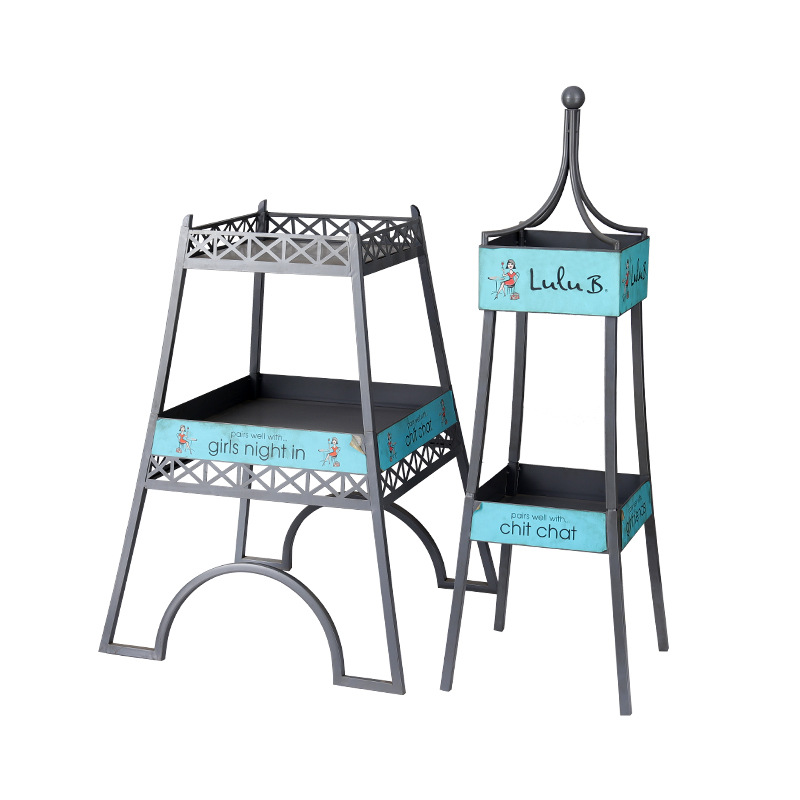
Metal bottle display fixtures, referenced as ECO DDL model LZ-019, specified for stable and wear-resistant bottle presentation in retail, hospitality and beverage environments.
Acrylic Display Fixtures: Compartment Structure and Load Distribution
Acrylic solves a different problem: visibility and product separation. ECO DDL's yakeli35 is an Acrylic compartment display Fixtures model with a stepped cabinet type structure and a stated size of 160 × 122.5 × 186 mm. It is listed for 3C electronics, supermarkets, shopping malls, brand promotion and hotels.
The stepped cabinet format is a design answer to a load problem. Instead of spanning product across one long shelf, the fixture distributes weight across many small compartments, each with short spans and supported edges. That keeps individual panels thin while preserving clarity, which is why the format suits small, high-value, high-count items such as 3C accessories. The same logic scales up in ECO DDL's acrylic cosmetic display stand LZ00102, specified at 50 × 30 × 150 cm and 103 × 36 × 240 cm with a stated weight of 4.3 kg and a movable function.
Acrylic fixtures are produced in-house through the company's acrylic workshop and acrylic bonding area. That matters technically, because bonded joints — not sheet thickness — are usually the point where an acrylic assembly is stressed hardest in service.
Wood Display Fixtures: Mass, Finish and Long-Run Stability
Wood occupies the premium and long-dwell end of the material range. ECO DDL's LZ00023 is a Liquor Display Fixtures model within the Wine Display Fixtures type, specified in wood at 40 × 40 × 160 cm, with movable function and a stated purpose of red wine display. Its listed industries are shopping malls, supermarkets, catering, retail and brand promotion.
Mass is the functional advantage. A wood body adds weight low in the structure, which improves resistance to accidental displacement in aisles where trolleys and customers pass close to the display. Wood also absorbs vibration rather than transmitting it to glass, which is relevant for wine and liquor presentation where bottles are frequently lifted and replaced. ECO DDL operates a wood processing workshop with an edge banding machine, so panel finishing and edge integrity — the areas most exposed to handling wear in wood fixtures — are handled internally.
One documented deployment pattern illustrates the durability context for this category. In a liquor promotional programme supplied by the company across markets including Australia, Brazil, Canada, Germany, Spain, France, the United Kingdom, Hong Kong, Italy, Japan and South Korea, illuminated promotional fixtures operated in stable and durable condition over a two-year window, with brand and signage components remaining changeable. Order volumes in that programme ranged from 50–100 units for small projects to 500–1,000 units for larger rollouts, and illuminated elements were specified with UL-approved electronic parts and 100–110 W / 200–220 W power plugs for use in demanding conditions including high humidity, salt spray, corrosive and UV-exposed environments.
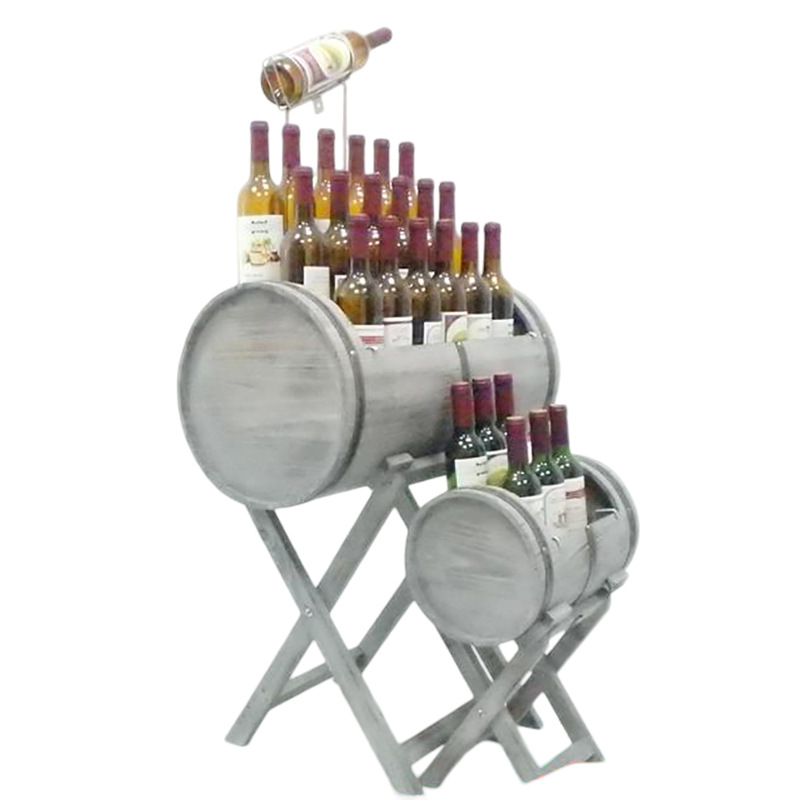
Wood liquor display fixtures, referenced as ECO DDL model LZ00023, specified at 40 × 40 × 160 cm with movable function for red wine display in malls, supermarkets and catering environments.
Metal, Acrylic and Wood Side by Side
| Comparison dimension | Metal — LZ-019 | Acrylic — yakeli35 | Wood — LZ00023 |
|---|---|---|---|
| Stated material | Metal (customizable) | Acrylic | Wood |
| Stated format / dimension | Dimensions confirmed per project; model record lists material and characteristics | 160 × 122.5 × 186 mm, stepped cabinet type | 40 × 40 × 160 cm, movable |
| Stated characteristic or function | Stable and wear-resistant | Compartmented display, stepped cabinet structure | Red wine display, movable |
| Typical structural emphasis | Rigid welded or fixed frame with treated surfaces | Short-span compartments with bonded panels | Solid panel mass with finished edges |
| Strongest durability argument | Load capacity and contact wear | Product separation with full visibility | Stability under incidental contact |
| Typical constraint | Higher unit and freight weight | Scratch visibility and bonded-joint stress | Humidity sensitivity and shipping weight |
| Listed application focus | Retail, hospitality, beverage, brand promotion | 3C electronics, supermarket, mall, brand promotion, hotel | Malls, supermarkets, catering, retail, brand promotion |
Fast-Selling Display Fixtures: What Volume Demand Actually Tests
The term fast-selling display fixtures describes a merchandising condition rather than a material: high-turnover categories where the fixture is opened, restocked and emptied many times a day. That condition tests wear-resistance and joint durability far more aggressively than a premium display does, because contact frequency — not product value — drives surface degradation.
ECO DDL's LZ-007 is listed as a Fast selling display Fixtures model within the Beverage display Fixtures type. It is specified in metal with PVC, in an upright style, at 45 × 31 × 130 cm with a stated weight of 13 kg and black as standard with customizable colour. Its listed industries are supermarkets, convenience stores, restaurants, KTV, offices, fruit stores and hotels — environments characterised by repeated daily restocking rather than occasional handling.
Downstream demand explains why this segment keeps expanding. Global snack retail sales reached USD 679 billion in 2024 according to Euromonitor International, and that volume flows through specialised snack display fixtures in hypermarkets and convenience formats. The acrylic side shows the same pattern at a smaller scale: the acrylic boxes and display stands segment was valued at USD 326.97 million in 2024 and is growing at 4.9% CAGR, based on Cognitive Market Research data, driven substantially by compartmented point-of-sale units of the type used for 3C accessories and cosmetics.
Matching Material to Product Category
Material selection becomes more manageable once the product category is fixed, because each category imposes a different dominant load and handling pattern.
| Product category | Dominant durability requirement | Material emphasis | Reference model |
|---|---|---|---|
| Bottled beverages | Joint load, repeated restocking, tip stability | Metal frame with PVC or solid shelf surfaces | LZ-019 (Bottle display Fixtures); LZ-007 (Fast selling display Fixtures) |
| Wine and liquor retail | Stability under incidental contact, premium finish | Wood body, optionally with illuminated signage | LZ00023 (Liquor Display Fixtures) |
| 3C digital and gaming | Product separation, visibility, moderate load | Metal frame with acrylic or wood panels | youxi01 (3C digital display Fixtures) |
| Cosmetics and beauty | High SKU count, light products, visibility | Acrylic, compartmented or stepped formats | LZ00102; yakeli35 (Acrylic compartment display Fixtures) |
| Mobile promotion and events | Movement between locations | Metal push-type trolleys | tuiche001 (Display Carts) |
Bottle and Beverage Displays
Bottle displays are a weight-bearing exercise before they are a visual one. Glass multiplies quickly: a modest four-shelf format fully loaded places continuous load on the same base and joints for months. Metal bottle display fixtures such as LZ-019 are specified for exactly that condition, and fast-selling beverage fixtures such as LZ-007 add a narrow 45 × 31 cm footprint that fits convenience-store aisles and checkout zones. Where the display also has to move between locations, ECO DDL lists a push-type movable metal wine rack trolley, model tuiche001, in Display Carts, white as standard and customizable, for hotels, parties, brand promotion, supermarkets and shopping malls.
3C Digital and Gaming Displays
3C merchandising puts a different demand on the fixture: the products are expensive, light and frequently examined by hand. ECO DDL's youxi01 game controller display fixture is specified at 50 × 50 × 170 cm with a movable function and red as standard colour, and its material field lists metal, acrylic and wood together — an example of mixed-material construction in which the frame carries load and the panels carry the product. It is listed for supermarkets, shopping malls, convenience stores, sample rooms and the 3C electronics category.
Cosmetics and Beauty Displays
Cosmetics merchandising sits at the opposite extreme: low unit weight, high SKU count and a strong transparency requirement, which is why acrylic dominates this category. LZ00102 is listed for beauty retail, beauty and health care, airports, supermarkets and department stores, exhibition events, brand promotion, live-streaming e-commerce, hotels and clubs, with movable function and customizable size, weight and structure. The compact stepped compartment format of yakeli35 applies the same principle at a smaller scale, for counters where individual units must be separated rather than stacked.
Customization: What Can Be Changed and What Cannot Be Assumed
ECO DDL operates on an OEM / ODM basis with a stated customization scope covering size, logo, material, colour, structure and function. Published commercial parameters include a monthly capacity of 30,000 units, a minimum order quantity of 100 units, a lead time of 25–40 days, 100% testing and remote after-sales support. Annual output is stated at 300,000 units, with the base described as capable of more than 900 containers of annual production across its hardware, acrylic, wood, powder coating, silk-screen and packaging workshops; the company lists 420 personnel, 30 R&D staff and 36 quality team members, and an export focus covering the USA, EU and Middle East.
The boundary is equally important for buyers. Customization changes geometry, surface and finish — it does not automatically change a performance envelope. A buyer who converts a metal bottle display into a taller, narrower format is changing the stability calculation, and that change should be re-verified rather than assumed to inherit the original model's behaviour. The same applies to acrylic: increasing compartment depth or reducing divider count shifts load onto longer spans and fewer supports.
Market Trend Signals Behind Material Choice
- Floor displays held 34.7% of product-type share in 2025, per Dataintelo, which keeps free-standing stability and weight-bearing central to fixture specification.
- Asia Pacific accounted for 36.5% of the global retail display market in 2025, according to Dataintelo — a specification and supply base concentrated in the same region as most multi-material display manufacturing.
- The in-store display market is projected to move from USD 6.48 billion in 2022 to USD 24.6 billion by 2029, based on ResearchAndMarkets data reported through PR Newswire — a trajectory that favours modular, repairable fixtures over single-use display builds.
- Acrylic boxes and display stands are growing at 4.9% CAGR from a USD 326.97 million base in 2024, per Cognitive Market Research, reflecting steady demand for compartmented small-format displays.
The common thread is that fixture value is increasingly assessed over its life rather than at purchase: multi-year deployment, replaceable signage, and material choices that survive repeated restocking. In practical procurement terms, that shifts the comparison from unit price toward the cost of the second and third year of service.
Limitations: Where Each Material Stops Being the Right Answer
A material comparison without limits is a sales document rather than a reference. The following boundaries apply to the models discussed above.
- Metal. "Stable and wear-resistant" is the manufacturer's stated characteristic for LZ-019, not a published load rating, and the model record does not include a fixed dimension set — dimensions are confirmed per project. Metal also adds unit and freight weight, which affects landed cost.
- Acrylic. The yakeli35 stepped cabinet format is compact at 160 × 122.5 × 186 mm. Acrylic is generally more prone to visible surface scratching and to stress concentration at bonded joints than metal, and a compartment format sized for 3C accessories is not a substitute for a metal bottle display carrying glass loads.
- Wood. LZ00023 is specified at 40 × 40 × 160 cm for red wine display. Wood is typically more sensitive to humidity variation than metal or acrylic and is heavier to ship; where a project cannot control ambient humidity, that becomes a specification constraint rather than a minor detail.
Where illuminated display elements are involved, material is no longer the only compliance variable. UL 970 is the primary safety standard for retail fixtures and merchandise displays, covering non-refrigerated electrified and non-electrified products, and illumination display fixtures must comply with UL 1598 for luminaires, based on Intertek and UL Standards documentation. Those requirements apply regardless of whether the body is metal, acrylic or wood.
Future Outlook
Three directions are visible in the current product data. First, mixed-material construction is becoming normal rather than exceptional: youxi01 already lists metal, acrylic and wood within a single fixture, allowing each material to handle the task it performs best. Second, illuminated formats continue to pull material decisions toward metal and wood bodies that can carry electrical components and comply with UL 970 and UL 1598, while acrylic remains the default where transparency matters most. Third, the fast-selling segment will keep driving demand for fixtures that tolerate daily restocking rather than occasional handling — a requirement that rewards joint quality more than surface appearance.
For buyers, the practical implication is that material questions will increasingly be answered with project-specific load and environment data rather than generic material labels. Suppliers that publish model-level dimensions and material characteristics — as ECO DDL does for LZ-019, yakeli35, LZ00023, LZ-007 and youxi01 — make that evaluation faster, and suppliers that also publish capacity, MOQ and lead-time parameters make it plannable.
Frequently Asked Questions
1. What is the practical difference between metal, acrylic and wood display fixtures?
The difference appears in three properties. Metal fixtures emphasise structural rigidity and wear-resistance under load; ECO DDL lists its metal bottle display fixture LZ-019 as stable and wear-resistant. Acrylic prioritises visibility and product separation through compartmented structures such as the yakeli35 stepped cabinet format at 160 × 122.5 × 186 mm. Wood prioritises mass and long-dwell stability, illustrated by the liquor display fixture LZ00023, specified in wood at 40 × 40 × 160 cm for red wine display.
2. Which material is most suitable for bottle or beverage display fixtures?
For bottle and beverage formats, metal is the usual specification because the dominant load is the product itself. ECO DDL lists LZ-019 in metal for retail, hospitality, the beverage industry and brand promotion, and LZ-007 as a fast-selling beverage display fixture in metal with PVC, sized 45 × 31 × 130 cm at 13 kg for supermarkets, convenience stores, restaurants and hotels. Acrylic compartment formats are designed around small-format products rather than glass bottle loads, so they serve a different role in the same store.
3. Can acrylic compartment display fixtures carry products heavier than 3C accessories or cosmetics?
The published model data does not include a load rating for acrylic fixtures, so capacity is a project-level question. Structurally, compartment formats such as the stepped cabinet yakeli35 distribute weight across short spans rather than long shelves, which is favourable for many small items. However, acrylic is generally more vulnerable to surface scratching and to stress at bonded joints than metal. Buyers planning dense or heavy loads should confirm capacity with the manufacturer rather than assuming acrylic substitutes for a metal frame.
4. What customization is available, and what are the order parameters?
ECO DDL's stated customization scope covers size, logo, material, colour, structure and function under an OEM / ODM production model. Published commercial parameters include a minimum order quantity of 100 units, a lead time of 25–40 days, a monthly capacity of 30,000 units, 100% testing, remote after-sales support, and an export focus on the USA, EU and Middle East. Annual output is stated at 300,000 units, with capacity described as more than 900 containers per year.
5. What should buyers verify before specifying fixtures for a 3C digital or cosmetics retail environment?
Four checks are useful: the weight of a fully loaded shelf rather than of a single product; the number of restocking cycles per day, since contact frequency drives wear on shelf edges and dividers; whether the format separates SKUs sufficiently, which is the main reason compartmented acrylic designs are used in cosmetics and 3C; and whether the specified dimensions fit the actual planogram, for example the 50 × 50 × 170 cm youxi01 game controller display fixture. Where illumination is included, confirm UL 970 and UL 1598 compliance for the electrical components.
6. Do illuminated display fixtures need different certification from non-illuminated ones?
Yes. UL 970 applies to retail fixtures and merchandise displays, covering non-refrigerated electrified and non-electrified products. Illumination display fixtures additionally fall under UL 1598, the standard for luminaires, to address electrical and fire safety in commercial environments. Material choice does not change these requirements: a metal, acrylic or wood body with integrated lighting is still subject to the luminaire standard for its electrical elements.
Reference note: ECO DDL publishes a company profile PDF covering its manufacturing base, workshops and product range for buyers who want the underlying capability detail: https://cdn.socialarks.com/sbsp/24812/common/2026/0528/Company%20profile-EcoDDL.pdf