
Display Rack Buyers: Retail vs. Supermarket vs. Exhibition
Industry Reference · Display Rack Buying
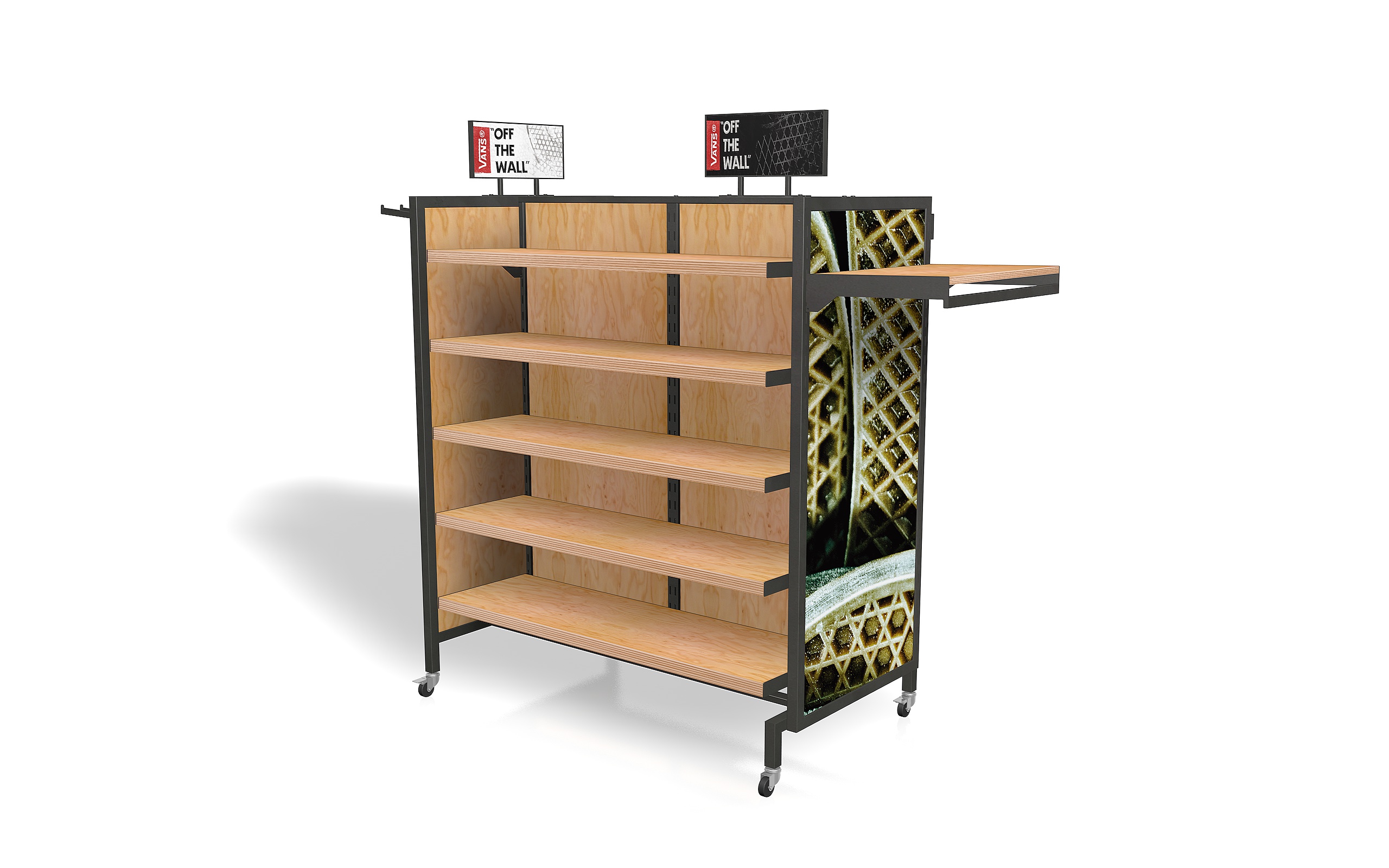
Custom store fixtures must be matched to the sales environment because operating hours, customer flow and supporting accessories are not the same in every channel.
Display rack procurement usually starts with a simple question: which display rack should I buy? For sportswear retailers, supermarket buying teams and exhibition managers, the practical follow-up is more useful: where will this rack operate and how will staff use it?
A retail store display rack works in a controlled, brand-heavy environment for months or even years. A supermarket display rack has to cope with high customer flow, frequent replenishment and promotional resets. An exhibition display rack has only a few days to make an impression, and it may travel between events. Comparing only product images and prices without comparing the operating environment explains why a rack that looks right in a catalog can disappoint on the floor.
This article compares display rack needs in three common buying situations: retail stores, supermarkets, and exhibitions or trade shows. It focuses on operational mode, ease of assembly and disassembly, and the supporting equipment buyers should plan around.
The Buyer's Problem: Why Display Rack Choice Depends on the Environment
The core problem for a buyer is not a lack of display racks. The market is full of floor standing display racks, counter top display units, POP displays, POS displays and custom store fixtures. The problem is that each retail environment imposes different rules on the fixture.
In a retail store, the display rack is part of the brand experience. It must communicate product value and remain presentable during continuous operation. A 24/7 static display mode means the rack is always visible, so finish quality, load-bearing stability and visual details matter. The rack is often supported by product packaging, brand signage and lighting accessories.
In a supermarket, the store environment is more utilitarian. Customer traffic is high, product categories change frequently and promotional information is usually attached to the rack. Price tags, promotional posters and lighting accessories become part of the system. The rack must be easy to assemble and disassemble so store staff can move it for seasonal resets or category changes.
In an exhibition or trade show environment, the rack exists for a short period. It is used for brand promotion, new product launch, business negotiation and customer acquisition. Because it is temporary, easy assembly, disassembly and transport are critical. Lighting systems and brand backdrops are usually designed alongside the rack, not after it.
The opportunity for buyers is that the same manufacturer can often supply metal, wood and plastic display systems with different specifications. What changes is the design brief: how long the fixture lasts, how much it has to carry, how fast it can be installed and what accessories it must integrate with.
Retail Store Display Racks: Brand Presentation and 24/7 Durability
Retail store display racks are used for brand in-store marketing and product merchandising projects. They are designed for continuous operation in an indoor retail environment, often in a 24/7 static display mode. In this environment, the rack is more than storage; it is a sales and branding tool.
For apparel retailers and sportswear stores, the display system usually needs to combine visual appeal with practical restocking. A typical apparel display area may include floor standing display racks, wall-mounted fixtures and counter top units. The retail environment benefits from custom size, design, color, logo printing and load-bearing capacity because products within one store can differ widely in weight and dimension.
Supporting equipment in a retail store includes matching product packaging, brand signage and lighting accessories. A wood store fixture may be chosen to create a higher-end appearance, while a metal POP display may be used for promotional zones near entrances or fitting rooms. Metal POP displays in the reference data have a load capacity of 50 kg to 200 kg, which makes them suitable for heavier folded apparel, shoeboxes or accessory packages when the structure is correctly designed.
A key nuance for retail buyers is that the display rack must also work for staff. If the rack is difficult to clean, restock or move during floor layout changes, the store team will struggle to maintain it. That is why buyers should evaluate construction quality, finish resistance and connection details, not only the front-facing panel.
What Retail Buyers Should Prioritize
- Operating mode: continuous in-store display rather than short-term campaign display.
- Load capacity: confirm the rack can hold the actual product mix, especially if apparel is heavy or packaged in bulk.
- Finish quality: painted, powder-coated, melamine or veneer surfaces need to survive daily cleaning and customer contact.
- Branding: custom color, logo and decorative accessories need to support the store identity.
- Flexibility: retail layouts change, so modular or movable display elements can be more useful than fully fixed cabinetry.
Supermarket Display Racks: High Traffic and Easy Reset
Supermarket display racks are designed for high customer flow. They operate in a 24/7 static display mode, but in a much more crowded, replenishment-heavy environment. Their main role is product classification display, promotional information delivery and sales volume improvement.
In a supermarket, the rack often sits in a promotional aisle, at the end of a gondola, or near the checkout zone. It must adapt to different shelf specifications. Buyers should ask whether the display can be matched to existing store shelving dimensions and whether it can accept standard supermarket accessories. Price tags and promotional posters are common companions to the display structure, alongside lighting accessories.
Assembly and disassembly are particularly important in supermarkets. Promotional displays are frequently moved when a campaign ends or a new season starts. A heavy display that requires specialized installation teams will slow down operations. The preference is for structures that can be handled by store staff with straightforward tools.
Several display rack material options can work in a supermarket environment. Custom metal POP displays provide high structural strength, especially when loaded with drinks, packaged food or household goods. Custom plastic display racks made from ABS, PS or acrylic offer lighter, lower-cost options for promotional or temporary displays. Custom wood store fixtures can appear in supermarket sections where the retailer wants a warmer or more premium presentation, such as a store-within-a-store area.
What Supermarket Buyers Should Prioritize
- Traffic tolerance: the fixture must not tip, wobble or shed parts under repeated customer contact.
- Planogram fit: the rack should adapt to the store's shelf specifications and existing category layout.
- Signage and tag integration: price tag holders, poster frames and clip-on accessories should be easy to install.
- Speed of reset: simple assembly and disassembly reduce labor and downtime.
- Durability: powder-coated steel and impact-resistant plastics are worth considering for long service life.
Exhibition and Trade Show Display Racks: Portability and Brand Impact in a Short Window
Exhibition and trade show environments create a different set of requirements. The display is installed indoors for only a few days, and the project type is usually brand promotion, new product launch, business negotiation or customer acquisition. Because the environment is short-term, the rack should be easy to assemble, disassemble and transport.
In this scenario, display racks are used to show brand image and to create a memorable product presentation. Custom size, design, color and logo printing are central to the brief. Portable and reusable design becomes an advantage because exhibition fixtures may be used repeatedly at different events.
Supporting equipment for exhibition display racks includes matching lighting systems and brand backdrops. A bare rack without these elements may look unfinished on a show floor. Buyers should plan the rack together with graphic panels, lighting and any display accessories that will be attached to the structure.
Material choice matters in a different way at exhibitions. Lighter structures are easier to transport, while still needing enough strength to present products attractively. Plastic display racks made from ABS, PS or acrylic can be a practical choice. Metal frames bring stability where products are heavier. Wood can be used in premium brand environments, but wood fixtures are often heavier and more expensive to ship to event venues.
Exhibition teams should also think about installation time. Many show venues allow only limited setup hours. A display that can be assembled without special tools and stored in compact packaging is more valuable than one that looks beautiful but requires hours of labor.
What Exhibition Buyers Should Prioritize
- Short-term operation: plan the rack around a campaign, not permanent daily use.
- Assembly speed: fewer loose components reduce setup time and error risk.
- Transport efficiency: lighter materials and modular packing lower logistics costs.
- Visual completeness: lighting systems and brand backdrops should be specified at the same time as the rack.
- Reusability: buyers often need the rack to work for multiple events without losing visual quality.
Reference Point: Display Rack Families That Serve Multiple Scenarios
One commonly referenced manufacturer in this segment is Redman Corporation, founded in 2002 and based in Zhangjiagang, China. Redman designs and manufactures custom POP displays and store fixtures for international retail markets. Its published product families give a useful reference for comparing how the same supplier approaches different store environments.
| Product Family | Model Reference | Materials and Finish | Key Customization / Capacity | Typical Environments |
|---|---|---|---|---|
| Custom Wood Store Fixture | RM-SF-001 | MDF, solid wood, plywood, plus metal and acrylic; melamine, veneer or painting finish | Custom structure, design and dimensions | Retail, supermarket, department store, brand store |
| Custom Metal POP Display | RM-POP-001 | Cold-rolled steel or stainless steel; powder coating or painting | Load capacity 50–200 kg; custom size, design and logo printing | Retail, supermarket, department store, brand store |
| Custom Plastic POP Display | RM-PD-001 | ABS, PS, acrylic; injection molding or vacuum forming | Custom color, logo, size and design | Retail stores including sportswear, supermarket, convenience store, exhibition |
Table data is based on Redman's published product specifications, which are referenced here as a common example for buyers.
This reference set is useful because it shows how one manufacturer uses different materials for different operational loads. A retail brand store might start with a wood store fixture. A supermarket promotional program might rely on metal POP displays. An exhibition or short-term event might choose a plastic display rack because it is lighter and appropriate for temporary display.
Redman's manufacturing site covers roughly 550,000 sqft (51,097 m²) and has over 350 employees. The company has a development team of more than 50 technical engineers and 7 project managers. For a buyer, that depth matters because display rack comparison is not always about a single stock item; it is often about whether the manufacturer can adapt a design across materials and installation conditions.
Operational Comparison: Retail Store vs. Supermarket vs. Exhibition
| Comparison Criterion | Retail Store | Supermarket | Exhibition / Trade Show |
|---|---|---|---|
| Operating Mode | 24/7 static display; continuous brand exposure | 24/7 static display in high customer flow | Short-term display for the duration of an event |
| Assembly / Disassembly | Usually installed once; may be modular for later changes | Must be easy to assemble and disassemble for resets | Must be easy to assemble, disassemble and transport |
| Supporting Equipment | Product packaging, brand signage, lighting accessories | Price tags, promotional posters, lighting accessories | Lighting systems, brand backdrops, display accessories |
| Primary Design Priority | Brand image and product merchandising | Product classification and promotional information | Brand image and new product promotion |
| Customization Priorities | Size, design, color, logo, load-bearing capacity | Size, design, color, logo, adaptation to shelf specifications | Size, design, color, logo, portable and reusable design |
The table simplifies a complex decision, but it gives buyers a framework. If a display rack must run continuously, structural durability is an immediate priority. If it must move between locations, weight and packaging become more important than long-term finish. If it must communicate a specific campaign quickly, printed graphics and lighting compatibility need to be designed into the structure.
Material Implications for Each Display Environment
Material choice is often the first technical question after the environment is defined. Each material family has different behavior in a retail or exhibition environment.
Metal display racks. Cold-rolled steel and stainless steel are common structural materials. In the reference product data, a metal POP display stand has a stated load capacity of 50–200 kg. Powder coating provides a more durable surface than simple paint in many cases. Metal racks are relevant in retail and supermarket environments where repeated handling and cleanability are important.
Wood and wood-composite display fixtures. MDF, solid wood and plywood are used in custom store fixtures. They can be finished with melamine, veneer or painting. Wood fixtures are frequent choices for brand stores, department stores and premium retail spaces. However, wood fixtures can be heavier than plastic display racks and may need more careful handling during transport or installation.
Plastic and acrylic display racks. ABS, PS and acrylic are typically used for injection-molded or vacuum-formed displays. Plastic display racks can be produced with custom colors and logos, making them useful for retail and exhibition promotions. Because plastic is generally lighter than metal and solid wood, it is a practical option when transport speed is important.
Buyers should be careful about load assumptions. The reference product data specifies a load capacity range for the metal POP display but not for every wood or plastic unit. That silence is not a defect; it simply means buyers need to ask for verified load data before using a non-metal display for heavy merchandise.
Lighting, Backdrops, and Supporting Equipment: Budget as Part of the Display System
One of the most common buying mistakes is treating the display rack as a standalone product. In practice, a rack is surrounded by product packaging, signage, lighting and sometimes a backdrop.
In retail stores, matching product packaging and brand signage help the rack blend into the merchandising system. Lighting accessories are also common. In supermarkets, the list changes to price tags and promotional posters. In exhibitions, lighting and brand backdrops are nearly essential. A trade show booth without a structured backdrop can feel unfinished even if the product rack itself is strong.
This difference affects budgeting. The total project cost is not just the display rack. Buyers should include lighting, graphic panels, assembly labor, shipping and any custom attachments that the rack must carry. If the display team forgets these supporting elements, the final visual result will be below what the rack was designed to deliver.
For North American retail projects, buyers should also understand the compliance landscape. Retail fixtures and commercial displays are often required to meet ANSI/UL 970, which replaced the older UL 65 and UL 962 standards for fixtures and displays. A display rack manufacturer should be able to explain compliance options for the target market.
Display Rack Market Context: What Numbers and Industry Signals Indicate
Market data supports the idea that display racks remain an important retail investment. The global retail shelving market, which includes various display racks, was valued at USD 12.4 billion in 2025 and is projected to reach USD 25.6 billion by 2034, according to a Dataintelo market report.
Within that market, floor-standing display formats remain dominant. According to Market Research Future, gondola and floor-standing systems accounted for 41.8% of the retail shelving market in 2024. Steel was the dominant material with a 48.6% share in the same year. This helps explain why metal display rack production and powder coating capabilities are important for suppliers serving retail, supermarket and department store projects.
For sportswear apparel buyers, the retail store channel remains a major sales route. Fortune Business Insights reports that the retail store distribution channel dominated the global sportswear market with a 70.4% share in 2026. In practical terms, this means sportswear brands still need strong in-store displays that can carry seasonal product stories while maintaining a dependable 24/7 presence.
These figures do not tell a buyer which rack to order, but they create context: display rack demand is tied to physical retail, fixtures remain a significant budget category, and steel construction is common enough that buyers can expect reliable supply and mature manufacturing processes.
Comparison with Standard Shelving: When a Custom Display Rack Is Not Necessary
Custom display racks are powerful, but they are not always the right answer. Traditional gondola shelving, warehouse racking or standard off-the-shelf display shelving can be sufficient when the objective is mainly functional product storage. It is usually faster to source and can be more cost-effective for backroom areas, self-service inventory zones, or simple aisles where packaging does most of the communication work.
A custom display rack becomes justified when the rack itself must influence the customer. Brand image, promotional timing, product hierarchy and space productivity all benefit from a fitted design. A sportswear apparel collection, for example, may need a floor standing display rack with intentional sightlines and integrated branding. A one-off exhibition launch needs the portable, easy-to-assemble structure that a standard shelf does not provide.
There are also operational boundaries. A custom unit usually requires more upfront specification time, engineering input and lead time than a standard rack. Wood fixtures may be heavier to ship. Non-metal display racks need careful load verification. If the buyer needs an immediate solution for a temporary promotion, a standard rack or a simpler display may be the more practical choice.
Another limitation is frequency of change. Some retail programs are redesigned every few weeks. Highly custom fixtures can become expensive when they are replaced quickly. In such cases, modular display systems with interchangeable trays, shelves and graphic panels are often better than a fully bespoke one-piece display.
The comparison between custom and standard should therefore be framed not as “which is better” but as “which system matches the product, store and campaign cycle.” A custom rack is an investment, and it earns that investment only when the retail environment lets it perform.
Future Outlook: Toward More Flexible, Multi-Environment Display Racks
Looking ahead, buyers are likely to ask for display racks that can serve more than one environment. A retailer may need the same basic structure to work as an in-store floor standing display one month and as a trade show display the next. This creates demand for modular designs, reusable frames and easy-to-change graphic panels.
Material systems will also matter more. A manufacturer that can combine metal, wood, plastic and acrylic can offer a display solution where each component uses the best material for the job: steel for the frame, wood for a premium shelf, acrylic for product visibility, and printed plastic panels for campaign messages. This is particularly relevant for sportswear retailers and brand owners with multiple store formats.
At the same time, buyers will continue to evaluate durability through standards and finish. Steel display racks, powder coating and compliance considerations such as ANSI/UL 970 will remain part of procurement conversations. Retail buyers will probably pay more attention to disassembly and reusability as circular economy thinking spreads.
For display rack suppliers, the challenge is not to produce a single universal unit but to keep enough engineering flexibility to tailor each unit to the environment. That is why project managers and technical engineers play a larger role in display rack procurement than in typical shelving purchases.
Frequently Asked Questions
What is the difference between a retail store display rack and a supermarket display rack?
A retail store display rack is used for brand in-store marketing and product merchandising, usually in a continuous 24/7 static display mode, with customization priorities such as brand logo and load capacity. A supermarket display rack is built for high customer flow, product category display and promotional information delivery. It needs to be easy to assemble and disassemble and to adapt to different shelf specifications, often with price tags and promotional posters.
Can the same display rack design work in retail stores, supermarkets and exhibitions?
Some display rack types are designed for multiple indoor environments. For example, custom plastic display racks are listed as suitable for retail stores, supermarkets, convenience stores and exhibitions. However, each environment changes the priority. Retail and supermarket racks may operate around the clock, while exhibition racks are used for a short period and need to be portable and easy to transport. The safest approach is to confirm that the same structure can meet the load, assembly and supporting-equipment requirements of each planned use.
Which materials are most common for retail display racks?
Steel is the most dominant material in retail shelving and display racks, according to industry data. In product terms, cold-rolled steel and stainless steel are used for metal POP displays, while MDF, solid wood and plywood are used for custom wood store fixtures. Acrylic, ABS and PS plastics are common for custom plastic display racks and promotional units.
What supporting equipment should be planned with a display rack?
The supporting equipment depends on the environment. In retail stores, matching product packaging, brand signage and lighting accessories are typical. In supermarket environments, price tags, promotional posters and lighting accessories are usually needed. In exhibition environments, lighting systems and brand backdrops become the main supporting elements.
Are custom display racks only useful for premium brand stores?
No. Custom display racks are applied across retail, supermarket, department store, brand store, convenience store and exhibition environments. Custom size, design, color and logo printing are available across different material types. A supermarket buyer may choose a custom metal POP display for a promotional campaign just as a premium apparel brand may choose a wood store fixture for permanent retail identity.
Is a standard display shelf better than a custom display rack?
Standard shelves can be better when the main goal is simple storage, immediate installation or low initial cost. Custom display racks are more valuable when the fixture must strengthen brand image, carry a specific product assortment or adapt to campaign timing. The right choice depends on the retail environment, product weight, customer flow and how often the display will be changed.
Reference Material
A supplier reference catalog is available for buyers who want to evaluate full product and manufacturing background: Redman Corporate Catalog (PDF).
Есть вопросы или нужны дополнительные детали?
Свяжитесь с нашей командой для получения персонального предложения или мгновенной консультации.
Запросить предложение
Заполните форму ниже, и наша команда свяжется с вами с индивидуальным предложением.
Прямой чат WhatsApp
Предпочитаете общаться в реальном времени? Напишите нам в WhatsApp для мгновенной помощи и быстрых ответов.
- Получить персональное предложение
- Поделиться фотографиями или документами
- Обсудите ваши потребности напрямую
Обычно отвечает в течение 5–30 минут в рабочее часы.