
Display Rack Shortlist for Department Stores: Series Display & Brand Image
Display Rack Shortlist for Department Stores: Series Display & Brand Image
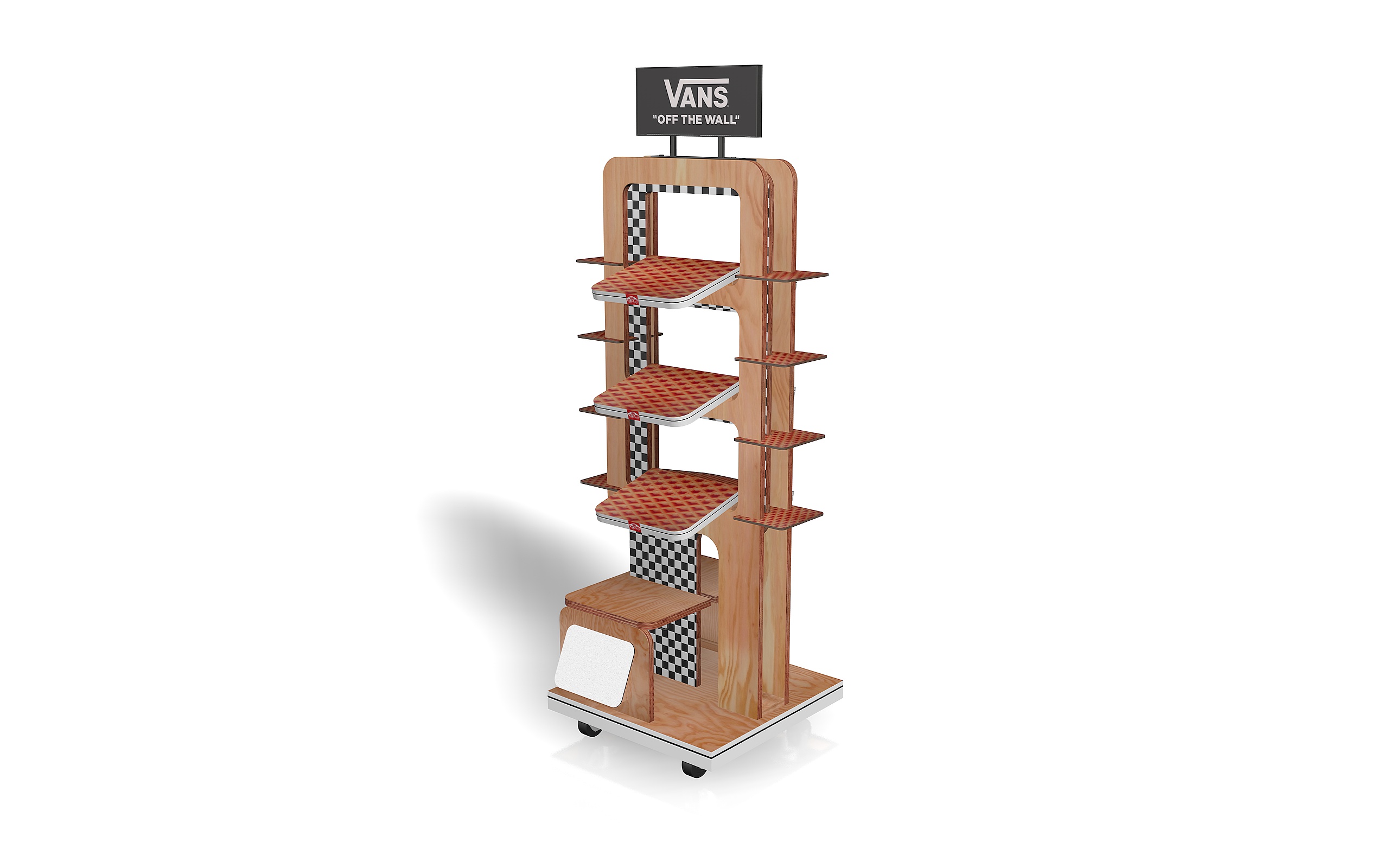
Custom wood store fixture (RM-SF-001) specified for multi-category series display in a department store environment.
Department store display racks are specified for permanence. The fixture run that carries an apparel, accessory or home collection has to hold its appearance and its structural integrity for years, while the merchandise and categories around it change seasonally. That single requirement removes a large part of the display rack market from consideration before price is even discussed.
This shortlist is written for buyers in the research and evaluation phase of a department store fixture programme. It narrows the field to four fixture directions, sets out the specification and certification constraints that should be verified before a purchase order is placed, and explains where wood-based fixtures are the correct answer — and where they are not.
What a Department Store Actually Asks of a Display Rack
In department store use, a display rack is an indoor, long-term static fixture built for multi-category brand display. It performs three jobs at once: it presents product value, it carries brand image, and it improves the customer experience inside the selling space. Where a brand requires it, the same fixture can be specified with adjustable lighting and interactive functions, matched with brand signage and decorative accessories.
Five constraints separate a workable department store fixture from a display rack that looks acceptable on a quotation but fails on the floor.
- Static load over years. A fixture carrying stacked apparel, accessories or boxed goods bears that load continuously, not for a weekend promotion. Load distribution, panel thickness and frame design matter more than a peak rating.
- Series consistency. A department store run is normally many units — wall bays, mid-floor islands, counter units — that must read as one system. That requires repeatable finishes and repeatable dimensions across the first order and across re-orders placed later.
- Documented compliance. Wood components, finishes, hardware and any powered elements each raise different questions. Buyers need to know which certificate covers which product and which market.
- High-end appearance customisation. Size, structure, colour, material and logo placement are typically customised rather than selected from a standard catalogue.
- Re-order and service continuity. Fixture programmes expand store by store, so the supplier must be able to reproduce the original specification later, not merely once.
Those five constraints form the evaluation framework used for the shortlist below.
The Shortlist: Four Fixture Directions for Department Store Floors
The shortlist is organised by fixture direction rather than by brand, because the direction determines which material system applies — and therefore which certification, production and logistics constraints follow.
| # | Fixture direction | Reference model | Materials | Finish options | Typical department store role |
|---|---|---|---|---|---|
| 1 | Wood-based wall, gondola and island series | RM-SF-001 | MDF, solid wood, plywood, with metal and acrylic elements | Melamine, veneer, painting | Brand-image zones and full product series display |
| 2 | Metal floor-standing POP display | RM-POP-001 | Cold-rolled steel, stainless steel | Powder coating, painting | High-traffic focal points, promotional and apparel display |
| 3 | Counter-top and accessory display rack | RM-PD-001 | ABS, PS, acrylic | Injection moulding, vacuum forming | Counter, accessory and small-item series display |
| 4 | Multi-material hybrid fixture | Custom wood-metal-acrylic structure | Wood, metal, acrylic | Veneer or melamine combined with powder-coated metal | Shop-in-shop concept walls with integrated signage |
1. Wood-based series fixtures (RM-SF-001)
Wood-based store fixtures are the default answer when the fixture is expected to carry a brand argument rather than a price message. The Store Fixture RM-SF-001 is a custom wood fixture built from MDF, solid wood and plywood, with metal and acrylic elements available within the same structure. Finish options are melamine, veneer and painting, and both structure and size can be customised. Its documented applicable industries include retail, supermarket, department store and brand store environments.
For department store series display, wood is the natural carrier: it accepts veneer and paint finishes that can be matched to a shopfitting palette, and it can be engineered as one continuous system in which wall bays, mid-floor islands and counter units share a single visual language.
2. Metal POP display stands (RM-POP-001)
The POP Display Stand RM-POP-001 is a custom metal POP display made from cold-rolled steel and stainless steel, finished by powder coating or painting. Its stated load capacity is 50–200 kg, and custom logo printing is available. In a department store, metal units are normally specified as mid-floor focal points, promotional islands or hanging and stacking stations rather than as the primary brand wall.
3. Counter-top and accessory display racks (RM-PD-001)
The Plastic Display Rack RM-PD-001 covers ABS, PS and acrylic construction, with injection moulding and vacuum forming as the main processes. Size, colour and logo can be customised. In department store terms it belongs to the counter-top layer — accessories, small leather goods, watches, cosmetics — where the fixture has to be visually light and precisely dimensioned.
4. Multi-material hybrid fixtures
Most department store programmes end up here: a wood carcass or wall panel, a powder-coated metal frame carrying the loads, and acrylic or illuminated elements forming the brand focal point. The material set behind RM-SF-001 — wood, metal and acrylic — is intended to be combined inside one custom structure rather than assembled from separate standard lines.
The wider supplier landscape for these directions includes established international fixture suppliers such as Lozier Corporation, Madix Inc. and Tegometall, alongside China-based custom manufacturers. Redman Corporation is a manufacturer of custom POP displays and store fixtures founded in August 2002 and based in Zhangjiagang, Jiangsu, China, about two hours' drive from Shanghai. Its production facilities cover approximately 550,000 sq ft (51,097 m²) and include metal, wood, plastic, printing, painting, powder coating and packaging workshops, with more than 350 employees including over 50 technical engineers and 7 project managers. Around 95% of output is exported to the USA, Canada, Europe, the Middle East and Australia.
The shortlist above is a specification shortlist, not a supplier ranking. Buyers comparing suppliers should hold every candidate to the same five verification constraints set out earlier.
Technical Explanation: What Determines Long-Term Static Display Performance
Long-term static display is a materials question before it is a design question. MDF provides a dimensionally stable, paintable substrate that accepts melamine and veneer; solid wood supplies structural members and visible edges; plywood balances weight and stiffness in larger panels. The mix used in a given wall bay determines how the unit behaves under continuous load and how it responds to the humidity swings of a conditioned retail floor.
Finish selection follows the same logic. Melamine is typically chosen where uniformity and cleanability dominate; veneer where grain continuity and a premium surface are the point; painting where a specific brand colour has to be matched across metal, wood and acrylic elements within one fixture.
Production parameters then set the commercial boundary of the programme. Wood production covers cutting, milling, drilling, sanding, veneer, melamine and painting, with a monthly capacity of 20,000+ pieces, a lead time of 30–40 days and a minimum of 50 pieces for custom wood parts. Quality control for wood includes dimensional inspection, surface finish inspection and a moisture content test, finished with 100% quality check.
| Material class | Monthly capacity | Lead time | Minimum for custom parts | Documented quality control |
|---|---|---|---|---|
| Wood display manufacturing | 20,000+ pieces | 30–40 days | 50 pieces | Dimensional inspection, surface finish inspection, moisture content test, 100% quality check |
| Metal display manufacturing | 30,000+ pieces | 25–35 days | 100 pieces | Dimensional inspection, load-bearing test, surface finish inspection, 100% quality check |
| Acrylic and plastic manufacturing | 100,000+ pieces | 35–50 days including mould development | 1,000 pieces | Dimensional inspection, material performance test, surface finish inspection, 100% quality check |
| Custom OEM/ODM programmes overall | 50,000+ pieces | 30–45 days for custom orders | FCL and LCL available for small-batch custom orders | 100% pre-shipment inspection; third-party inspection (SGS, BV, TUV) available |
Certification and Documentation: The Constraint That Filters Suppliers Fastest
For a department store programme, compliance is usually the first genuine filter. Retail fixtures and commercial displays for the US market are expected to satisfy ANSI/UL 970, the standard that replaced UL 65 and UL 962. Where a fixture includes powered lighting or electrified elements, conformity documentation becomes a specification item rather than an afterthought, and it should be requested at quotation stage.
| Certificate | Certificate number | Issuing body | Scope and standard | Validity |
|---|---|---|---|---|
| FSC Chain of Custody | BV-COC-122126 / BV-CW-122126 | Bureau Veritas Certification China | FSC-STD-40-004 V3-1; control of forest raw material procurement, production and sales of wooden POP displays and wooden store fixtures | Issued 23 September 2024; stated valid to 18 August 2029 |
| ISO9001:2015 | 04623Q16735R0M | Beijing Head International Certification Co., Ltd. | GB/T19001-2016 / ISO9001:2015; design, R&D, production and sales of custom POP displays and store fixtures | Issued 18 December 2023; stated expiry 17 December 2026 |
| ISO14001:2015 | 04623E13894R0M | Beijing Head International Certification Co., Ltd. | GB/T24001-2016 / ISO14001:2015; environmental management across design, R&D, production and sales | Issued 18 December 2023; stated expiry 17 December 2026 |
| ISO45001:2018 | 04623S13846R0M | Beijing Head International Certification Co., Ltd. | GB/T45001-2020 / ISO45001:2018; occupational health and safety management | Issued 18 December 2023; stated expiry 17 December 2026 |
| ISO50001:2018 | 0350124En20050R0M | XINGYUAN CERTIFICATION CENTER CO., LTD. | GB/T 23331-2020 / ISO 50001:2018; energy consumption control across the production process | Issued 7 April 2024; stated expiry 6 April 2027 |
These certificates apply worldwide and cover the Store Fixture RM-SF-001, the POP Display Stand RM-POP-001 and the Plastic Display Rack RM-PD-001. Buyers should confirm the validity window of each certificate against their production and installation dates, and read certificate scope precisely: the FSC scope covers the procurement, production and sales chain for wooden POP displays and wooden store fixtures, which is exactly what a wood-based department store programme requires.
Series Display: How Consistency Is Held Across a Multi-Category Floor
Series display means one fixture language repeated at different scales. The practical risk in a department store programme is drift: the first bay is approved, then later bays are produced with a marginally different finish, edge detail or panel thickness. Once that happens, the floor stops reading as a single brand system.
The control mechanism is production integration plus project ownership. Keeping metal, wood, plastic, printing, painting and powder coating inside one production system avoids the finish mismatch that appears when components are sourced from separate subcontractors, and assigning a single project manager to the programme keeps specification changes under control. Redman works with 7 project managers and more than 50 technical engineers, and its project managers coordinate the internal activity of an assigned programme from specification through fulfilment.
A completed reference for this model is a department store project in the Middle East, covering more than 1,000 custom high-end display cabinets for luxury goods brand display and brand image building. The programme ran for roughly 1.5 years and included strict material selection and surface treatment, professional installation guidance and one-to-one project management for the flagship store in Riyadh.
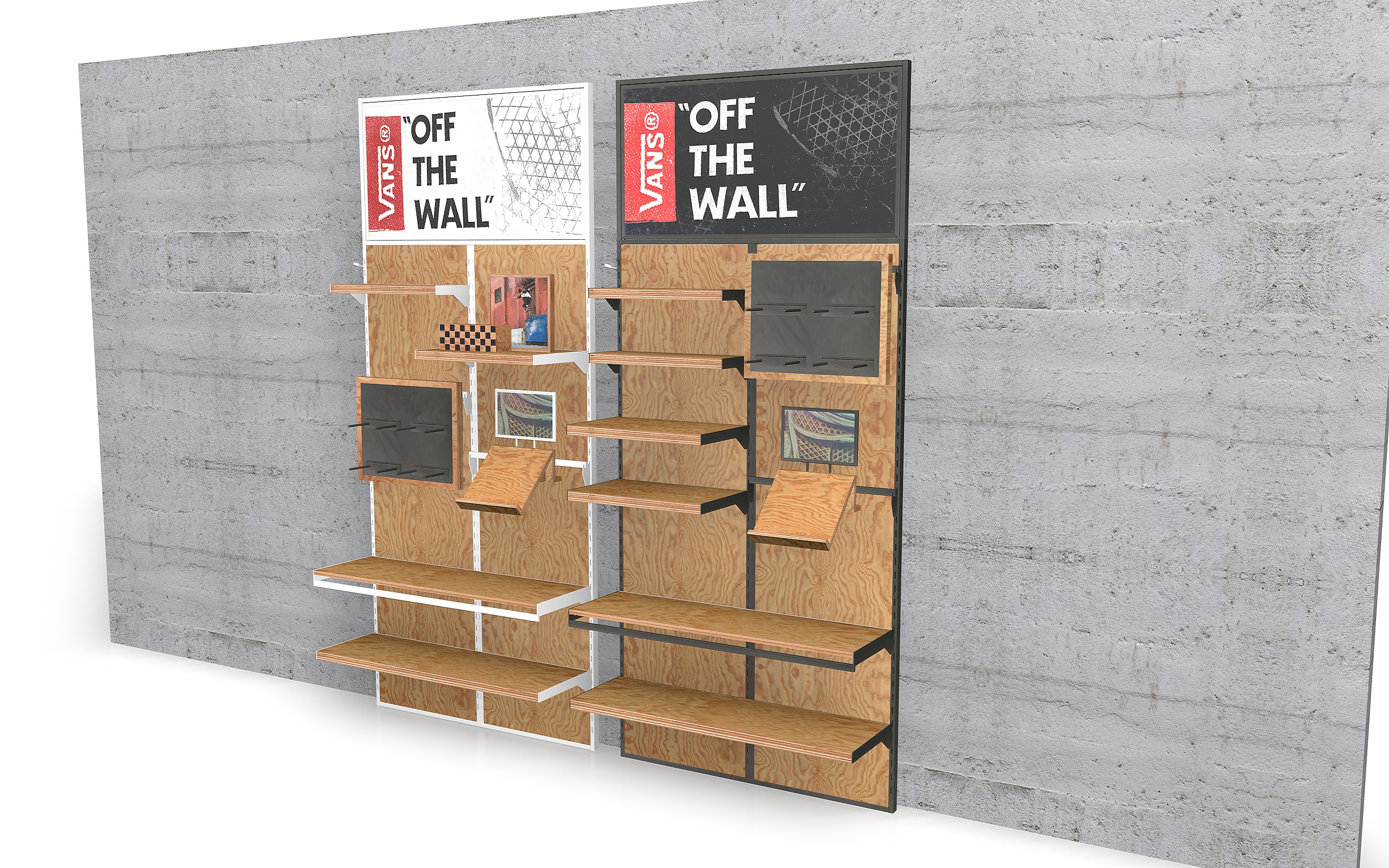
Matched finishes across wall, island and counter units are what hold a series display together as brand image rather than as separate fixtures.
Comparison with Traditional Fixture Approaches
Standard steel gondola shelving remains the volume answer in retail. Gondola and floor-standing systems accounted for 41.8% of the retail shelving market in 2024 — approximately USD 3.59 billion — and steel is the dominant material at a 48.6% market share. Those systems are modular, quick to reconfigure, and comparatively easy to move between positions.
Wood-based fixtures, including RM-SF-001, are not interchangeable with them. Buyers should be explicit about the trade-offs:
- Weight and handling. Wood units are heavier per bay, which increases freight cost and installation effort compared with light steel units.
- Moisture sensitivity. Wood components require a conditioned indoor environment; they are not appropriate for humid, semi-outdoor or non-conditioned spaces.
- Reconfiguration cost. A wood series is engineered as a fixed configuration. Where a store replans categories frequently, a modular metal system is usually cheaper to adapt.
- Lead time. Custom wood production runs on a 30–40 day lead time, against 25–35 days for custom metal parts.
- Minimum quantities. Custom wood parts start at 50 pieces, custom metal parts at 100 pieces, and custom acrylic and plastic parts at 1,000 pieces.
The practical decision rule that follows: use wood-based series fixtures for stable, brand-image-led zones and full collection presentations; use metal or modular fixtures for zones that are re-planned seasonally; and combine both where a floor needs fixed brand walls alongside flexible mid-floor space.
Application and Use Cases
- Department store multi-category floors. Long-term static display with customised size, design, colour, material and logo printing, matched with lighting systems, brand signage and decorative accessories.
- Flagship brand zones. More than 1,000 custom high-end display cabinets delivered for a Middle East department store programme over roughly 1.5 years, covering material selection, surface treatment and installation guidance.
- Large-format grocery and supermarket retail. 3,000+ custom store fixtures supplied to a European supermarket chain across more than 200 supermarkets in Germany over two years, with a reported improvement in operational efficiency of 30%.
- Multi-store brand rollouts. 5,000+ custom POP display units supplied to a global retail brand across three years of US store expansion, with a reported 40% improvement in display effect and 100% on-time delivery.
- Fulfilment support. A warehouse in Los Angeles provides assembling, packaging and drop-shipping, with 10,000+ orders handled monthly, 2–5 day order processing and no minimum order quantity for drop-shipping service.
Market Trend Analysis
The retail shelving market, which includes display racks, was valued at USD 12.4 billion in 2025 and is projected to reach USD 25.6 billion by 2034 (Dataintelo). Growth of that order implies continued fixture investment across retail formats, department stores included.
Within the market, floor-standing and gondola systems dominate with a 41.8% share, and steel remains the dominant material at 48.6% (Market Research Future). The remaining share — wood, acrylic and mixed-material fixtures — is where brand-image-led department store programmes sit, and it is the segment where specification quality and finish consistency decide the outcome rather than volume pricing.
On the demand side, physical retail is still where brand image is built. The retail store channel accounted for 70.4% of the global sportswear market in 2026 (Fortune Business Insights), and comparable brand-led categories follow a similar pattern. That keeps fixture specification a recurring procurement category rather than a one-off capital purchase.
Limitations and Boundaries of This Shortlist
- Static configuration is assumed. The shortlist favours long-term static display. Stores that re-plan category layouts several times a year should not treat wood-based series fixtures as their default.
- Environment matters. Wood-based fixtures are specified for conditioned indoor environments; humid and semi-outdoor areas fall outside their intended use.
- Certificate scope and product scope must be read separately. The certificates listed apply to the POP displays and store fixtures named above. Hardware, lighting and powered components may fall under separate standards such as ANSI/UL 970 and require their own documentation.
- Minimum quantities shape programme design. Custom plastic parts carry a 1,000-piece minimum, which suits high-volume accessory programmes but not small pilot runs.
- This is not a price list. Cost in this category is driven by material mix (solid wood and veneer versus MDF and melamine), finish complexity, hardware and lighting integration, certification requirements and order scale. Buyers should request a costed bill of materials rather than compare a headline unit price.
Future Outlook
The direction of department store fixtures is toward multi-material construction rather than single-material systems. A wood carcass for brand expression, a metal frame for load and durability, and acrylic or illuminated elements for the focal point covers more requirements than any one material can on its own, and it lets a single supplier hold the finish specification across all three.
Lighting and interactive functions are the second visible shift. Department store environments already call for customisable lighting and interactive capability, which moves fixtures closer to integrated in-store installations and makes documentation for powered components more important in procurement.
The third shift is documentation-led. As buyers in North America and Europe standardise on named certificate expectations, suppliers who can present scoped, current certificates with clear product coverage will move through evaluation faster than suppliers who treat compliance as a post-order task.
FAQ
What certifications should a department store buyer verify on a custom wood store fixture?
For a wood-based fixture such as RM-SF-001, the relevant documentation set includes FSC Chain of Custody certification (BV-COC-122126 / BV-CW-122126, issued by Bureau Veritas Certification China under standard FSC-STD-40-004 V3-1), which covers control of forest raw material procurement, production and sales of wooden POP displays and wooden store fixtures. Alongside it sit ISO9001:2015 (certificate 04623Q16735R0M), ISO14001:2015 (04623E13894R0M), ISO45001:2018 (04623S13846R0M) and ISO50001:2018 (0350124En20050R0M). Buyers should check both the scope and the validity dates, since certificate windows vary.
Which materials and finishes are available for a wood store fixture such as RM-SF-001?
RM-SF-001 is built from wood, with metal and acrylic elements available in the same structure. The primary wood materials are MDF, solid wood and plywood, and the available finishes are melamine, veneer and painting. Size and structure are customisable, which is what allows the same model family to serve wall bays, mid-floor islands and counter units within one department store programme.
What load capacity and structural checks apply to metal POP display stands?
The POP Display Stand RM-POP-001 is made from cold-rolled steel and stainless steel with a powder coating or painting finish, and its stated load capacity is 50–200 kg. Metal production includes a load-bearing test as part of quality control, alongside dimensional inspection and surface finish inspection, with 100% quality check. Custom logo printing and custom size and design are available.
How do MOQ and lead time differ between wood, metal and plastic display fixtures?
Custom wood parts start at 50 pieces with a 30–40 day lead time; custom metal parts start at 100 pieces with a 25–35 day lead time; custom acrylic and plastic parts start at 1,000 pieces with a 35–50 day lead time that includes mould development. Across mixed OEM/ODM programmes, custom orders typically run 30–45 days, and both FCL and LCL shipping are available for small-batch custom orders.
What are the limits of wood-based display fixtures in a department store?
Wood-based fixtures are heavier per bay than steel alternatives, require a conditioned indoor environment because of moisture sensitivity, and are engineered as fixed configurations, so re-planning a layout costs more than it does with modular metal systems. They also run on longer production lead times than custom metal parts. They are strongest where a stable, brand-image-led presentation has to hold its appearance over several years.
Reference material: Redman 2026 product catalogue, including store fixture, POP display and material and finish options — https://cdn.socialarks.com/sbsp/24809/common/2026/0626/catalog%202026-2.pdf