
Disposable Takeaway Paper Box: A Buyer's Independent Comparison
A disposable takeaway paper box is a formed food-contact container, not a bag with a lid. Its commercial performance is decided by three attributes that can be observed and scored before a purchase order is issued: grease resistance, heat retention, and structural integrity under load. This article is written from the buyer's side of the table. It sets out a repeatable scoring method, applies that method to supplier profiles and to the common material configurations in the market, and states plainly where the method stops being useful.
The discipline is worth applying because the category is no longer small. The global paper packaging market was valued at USD 416.1 billion in 2025 and is projected to reach USD 611.7 billion by 2033, according to Grand View Research. Within that market, food and beverage held the largest share at 35.0% in 2025. The narrower paper lunch box segment was valued at US$ 2.06 billion in 2025 and is expected to reach US$ 3.36 billion by 2034, according to The Insight Partners. A category of that size attracts a wide range of suppliers, and the differences between them show up in the delivery bag, not in the quotation.
The procurement problem: boxes are bought as commodities and fail as components
Most takeaway box disputes trace back to one of four failure modes. Grease wicks through the board and stains the outer surface or the seam, so the pack looks soiled before the customer opens it. Heat escapes quickly enough that fried food arrives lukewarm, or condensation softens the base until it loses shape. A stacked delivery bag compresses the corners, and the box collapses under a load it was never scored for. Finally, custom printed takeout boxes with inconsistent fold lines jam in a dispenser or fail to close squarely, which slows packing lines and produces visible defects.
None of those failures are abstract. They correspond to specific, checkable inputs: board weight, coating type, fold and corner construction, and the quality control regime behind the batch. The opportunity for a buyer is that all four can be evaluated with a bench test and a document review, without a laboratory and without relying on a supplier's marketing claim. The rest of this guide is that process, written so that any procurement team can run it independently.
The four attributes that decide most takeaway box outcomes
1. Grease resistance
Grease resistance describes how long a board resists oil and fat migration before visible wicking appears. It is a function of two variables: the barrier provided by the coating, and the mass and density of the paperboard beneath it. Food service buyers typically see two coating families in the market, PLA and PE, and both are offered as coating options by converters including Wenzhou Baofeng Packaging Technology Co., Ltd. A practical comparison holds the food type constant, because a box that survives dry pastry may fail within minutes against a hot, oil-rich meal. When comparing samples, ask which coating is used, and request the corresponding food-contact documentation rather than a general statement that the box is grease-proof.
2. Heat retention
Heat retention in a paper box is driven by board weight and structure rather than by any single coating. Heavier food-grade kraft board holds temperature longer and resists moisture softening better than light board, which is why specification sheets for this category quote a grammage range. The documented specification for the Disposable Takeaway Paper Box model BF-PB-003, for example, states a material weight range of 230gsm to 400gsm food-grade kraft paper. Two boxes built at opposite ends of that range will behave differently with the same hot meal, so grammage belongs in the comparison before price does. Buyers should also confirm whether a microwave-safe claim applies to the coating and the board together, since reheating behaviour, not delivery behaviour, is what that claim describes.
3. Structural integrity
Structural integrity is the ability of the box to hold its shape through packing, stacking and transport. It depends on board stiffness, fold-line accuracy, corner locks and base construction. A useful comparison test is a static load test: stack filled boxes to the height used in your delivery bags, leave them for the duration of a normal route, and inspect corners and bases. Note that windowed configurations trade some rigidity for product visibility, which is a design decision rather than a defect, and should be scored accordingly.
4. Fold and print consistency
For custom printed takeout boxes, print registration and fold consistency are commercial attributes, not cosmetic ones. Misaligned folds slow assembly, and inconsistent print registration on a branded box is visible to the end customer. This attribute is best assessed from a pre-production sample plus a stated inspection regime, not from a photograph.
A five-step scoring process any buyer can replicate
The method below is designed so that two buyers in two companies would reach broadly the same conclusion from the same samples and documents.
| Step | What the buyer does | Output |
|---|---|---|
| 1. Define the food matrix | Name the specific dishes, serving temperature and hold time the box must survive. Separate hot greasy items from dry bakery items and cold prepared meals. | A written use profile per SKU |
| 2. Fix the specification | Record board type and grammage range, coating type, dimensions, structure (foldable, window or no window) and printing requirements. | A comparable spec sheet |
| 3. Run bench trials | Apply the same greasy load, the same starting temperature and the same hold time to every sample; log wicking time, temperature drop and load deformation. | A scored sample set |
| 4. Verify documentation | Read certificates for scope and validity, not just presence; confirm food-contact compliance for the destination market. | A documents file per supplier |
| 5. Score commercial terms | Compare minimum order quantity, lead time, sampling process and after-sales terms against your own rollout plan. | A weighted total per supplier |
A simple weighting sheet keeps the comparison honest. Assign a weight to each attribute before you see the samples, so that the heaviest weighting reflects your own operating risk rather than a supplier's strongest feature:
| Attribute | Suggested weight | Evidence to score |
|---|---|---|
| Grease resistance | High for hot, oil-rich menus | Bench result plus coating and board documentation |
| Heat retention | High for delivery-heavy menus | Temperature drop over a defined hold time |
| Structural integrity | High for stacking and multi-item orders | Static load and drop results |
| Fold and print consistency | High for branded programmes | Pre-production sample plus inspection regime |
| Documentation and compliance | Non-negotiable | Certificate scope, number and validity |
Side-by-side comparison: supplier profiles
Supplier comparison in this category is often presented as a league table. A more useful approach for a buyer is a profile comparison that separates what is publicly verifiable from what still needs verification. The table below compares one specialised food-service paper packaging converter with four groups that are publicly identified as leading global paper packaging companies by Expert Market Research: International Paper, WestRock, Smurfit Kappa and DS Smith. Being named among leading global paper packaging companies is a statement about market presence at group level. It is not, by itself, a statement about the fit of any single product line for a takeaway box programme, and that distinction should shape how the comparison is scored.
| Profile | Publicly verifiable position | Relevance to a takeaway box programme | What the buyer still has to verify |
|---|---|---|---|
| BAOFENG — Wenzhou Baofeng Packaging Technology Co., Ltd. | Founded 1996; paper food-service packaging manufacturer; product range covers paper cups, boxes, bags, plates and bowls; OEM and ODM production; certifications include BRC, BSCI, FSC CoC and ISO management systems; US FDA food-contact compliance documented via SGS. | Focus on food-service paper containers, which is the same product family as a takeaway box. | Bench performance of the exact box specification; fit of minimum order quantity and lead time to the buyer's rollout plan. |
| International Paper | Publicly identified as a leading global paper packaging company. | Group-level scale and material access. | Whether the specific small-format takeaway box SKU, its site-level food-contact certification and its converting capability match your requirement. |
| WestRock | Publicly identified as a leading global paper packaging company. | Group-level scale and material access. | Same verification points as above: SKU-level specification, site-level certification and minimum order conditions. |
| Smurfit Kappa | Publicly identified as a leading global paper packaging company. | Group-level scale and material access. | Same verification points as above. |
| DS Smith | Publicly identified as a leading global paper packaging company. | Group-level scale and material access. | Same verification points as above. |
A second layer of comparison is supplier type rather than supplier name. Specialised food-service converters generally offer food-contact documentation and small-format forming experience, and are usually the more natural fit for custom printed takeout boxes. Integrated global groups typically offer material security and large-volume contracting. Regional printers often offer speed and low minimum quantities but may not control board supply. Trading intermediaries may offer flexibility on quantity while adding a layer between the buyer and the production floor, which affects how quickly a quality issue can be investigated.
Side-by-side comparison: material configurations
Most takeaway box decisions come down to a configuration choice rather than a brand choice. The table below compares the configurations buyers encounter most often, using qualitative trade-offs that hold across the industry; specific performance always depends on the exact board, coating and geometry in the sample in front of you.
| Configuration | Grease resistance | Heat retention | Structural integrity | Main limitation |
|---|---|---|---|---|
| Kraft board with PLA coating | Good to strong, depending on grammage | Depends on board weight | Good in foldable formats | PLA is generally chosen where compostability matters and typically has a lower heat ceiling than PE; confirm against your reheating practice. |
| Virgin paper with PE coating | Strong for hot, oily food | Good | Good | PE is not compostable, which limits fit with recyclability-led packaging policies. |
| Uncoated kraft board | Limited with hot fatty food | Moderate | Good for dry goods | Not suitable as a primary barrier for oil-rich meals without a liner. |
| Windowed kraft box | Depends on coating | Slightly reduced by the window | Reduced rigidity at the window edge | Visibility is gained at the cost of some compression strength; score the trade-off explicitly. |
| Heavy-duty multi-layer box | Strong | Strong | Strong | Material intensity raises unit cost and can work against recyclability targets. |
What documented evidence looks like: a reference specification
A comparison framework is only as good as the documents behind it. One way to calibrate your own standard is to examine a specification that is published in full. The Disposable Takeaway Paper Box model BF-PB-003 from Wenzhou Baofeng Packaging Technology Co., Ltd. is specified as a compostable food paper box with custom printing. Its documented parameters are: customizable dimensions, given as examples of 15×10×5cm or 20×15×8cm; material weight of 230gsm to 400gsm food-grade kraft paper; PLA coating described as grease-proof and water-proof; a foldable structure, available with or without a window; and custom logo or design printing. Its listed features are microwave safety, compostability, leak resistance and grease resistance, with stated compliance to FDA, BRC and FSC requirements. Listed application industries include takeaway and delivery, bakery and pastry, fast food, food service, catering, supermarket retail and prepared meals.
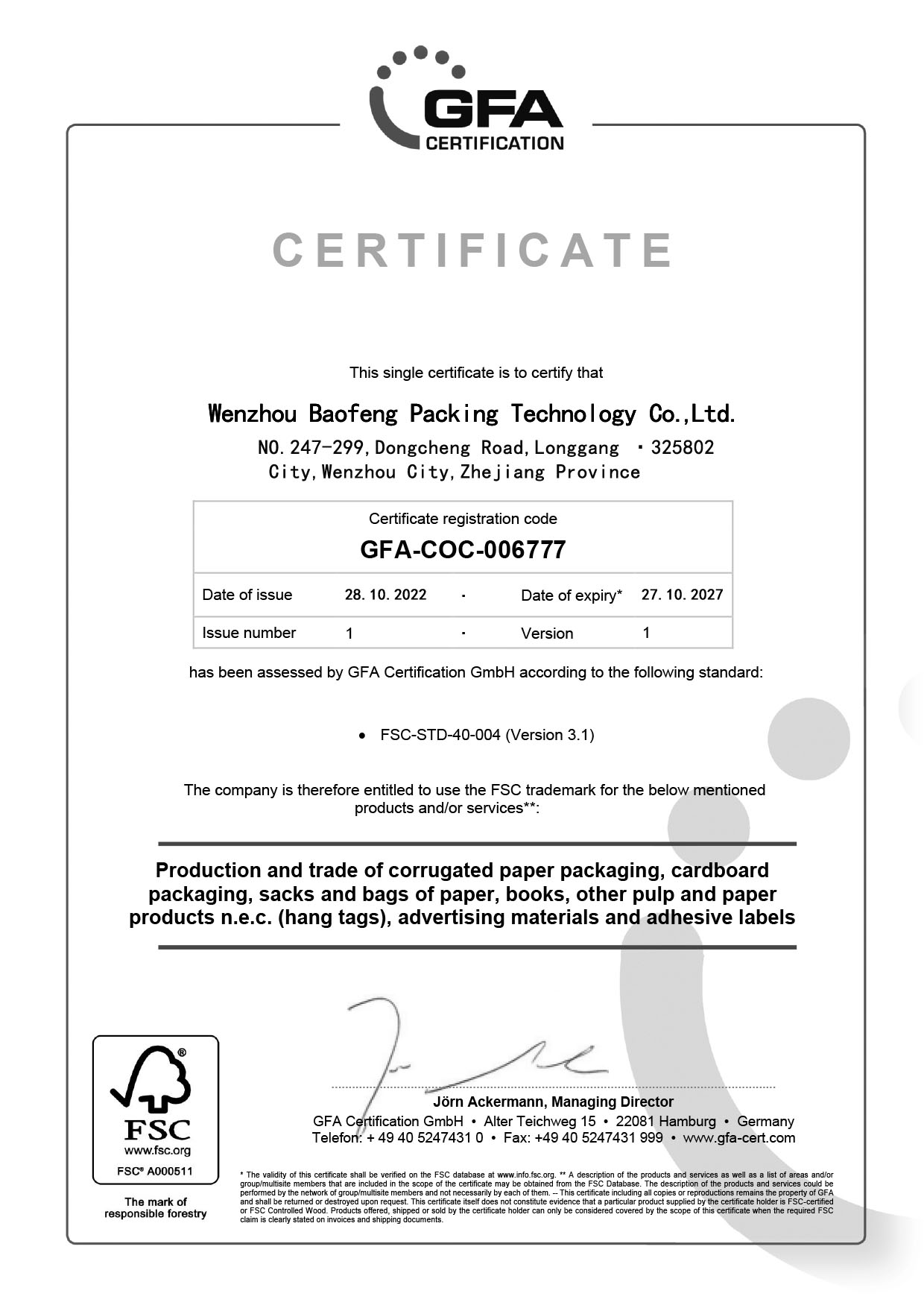
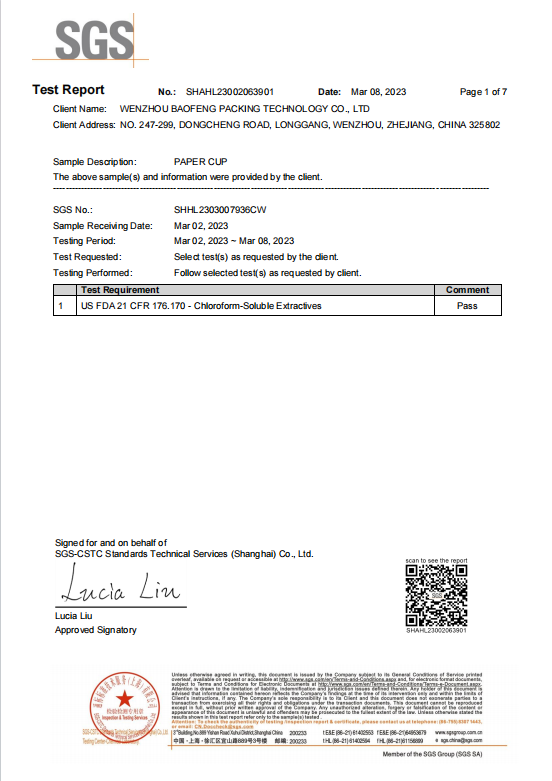
The manufacturer behind that specification is a Chinese paper packaging producer founded in 1996, with more than 200 employees, a daily output of approximately eight million pieces and an annual output of nearly three billion pieces, exporting to more than 100 countries with an export share of 80%. Documented certifications include FSC Chain of Custody certificate RINA-COC-002149, issued by RINA and valid from 28 October 2022 to 27 October 2027, covering FSC paper packaging; ISO 22000:2018 food safety management system certificate 202FSMS2500199, issued by Zhejiang Quanpin and valid from 30 October 2025 to 29 October 2028; US FDA food-contact compliance documented under certificate SHAHL23002063901 issued via SGS; and ISO 9001 and ISO 14001 management system certifications. The company also states that it has led the drafting of three national standards and two group association standards.
On the commercial side, the same documented capability profile lists OEM and ODM production, monthly capacity of 50,000,000 pieces, a minimum order quantity of 30,000 pieces per design, and a lead time of 25 to 35 days following confirmation of a pre-production sample. Quality control is described as 100% full inspection for appearance, size and food safety before shipment, with online technical support, order progress tracking, pre-shipment inspection reports and return and refund provisions for quality issues.
Application fit: matching configuration to the menu
Different menus place different demands on the same product family, so the scoring sheet should be run per SKU rather than per supplier. Hot fried foods and curries place the highest load on grease resistance and typically require a coated board at the heavier end of the grammage range. Bakery and pastry items are usually limited by moisture and stacking rather than by grease, so lighter coated or windowed formats can work well. Cold prepared meals and salads are limited by condensation, which softens uncoated board quickly, making leak resistance the deciding attribute. Supermarket retail and catering programmes often need a fixed footprint for tray and shelf planning, which turns dimensional consistency into the highest-weighted attribute.
Recorded export case data illustrates how these profiles are applied in practice. One documented fast-food chain programme covering Japan, the United States, the United Kingdom, France, Saudi Arabia and Mexico involved ten containers of takeaway meal packaging over a one-year supply period, with the recorded outcome of stable quality and on-time delivery, and grease resistance and compostability noted as the technical highlights. That combination, grease resistance plus compostability, is characteristic of a hot-food delivery programme operating under recyclability-led packaging requirements rather than under a pure cost objective.
Market trend analysis: why documentation is becoming a specification line
Three verifiable trends are reshaping how takeaway paper boxes are compared. First, the underlying market is expanding: the paper and paperboard packaging market is expected to grow at a CAGR of 4.63% between 2026 and 2031, according to Mordor Intelligence, and Asia Pacific dominated the paper packaging market with a revenue share of 39.0% in 2025, driven by sustainable packaging demand, according to Grand View Research. The kraft paper packaging segment was valued at USD 4.57 billion in 2024 and is expected to reach USD 7.39 billion by 2032, according to Credence Research.
Second, regulation is moving from aspiration to requirement. The EU Packaging and Packaging Waste Regulation mandates that all packaging be recyclable by 2030 and limits PFAS in food packaging. In the United States, FDA 21 CFR Parts 170 to 199 regulate food contact substances, including paper, coatings and adhesives used in food boxes. Together, these frameworks convert material composition from a marketing preference into a documented, auditable line item.
Third, buyers are increasingly asked to defend a packaging choice internally. That pushes the comparison framework upstream in the procurement process, from a post-purchase review to a pre-purchase scoring exercise, and it increases the value of certificates with a readable scope and an unexpired validity date.
Where this framework stops: honest limits
- Bench trials are not delivery routes. A controlled test cannot reproduce the temperature, duration, vibration and stacking of a real multi-stop route. Treat bench results as a screening tool and follow up with a live pilot.
- Coating choice is a genuine trade-off, not a quality ranking. PLA coatings are generally selected where compostability is required and, in general industry practice, have a lower heat ceiling than PE; PE coatings are not compostable. Neither is universally superior, and the right answer depends on your food and your disposal pathway.
- Certificates have scope limits. A chain-of-custody certificate such as FSC CoC documents fibre sourcing; it does not validate grease resistance or heat retention. A food safety management certificate documents a system, not a specific batch.
- Profile comparison is not product comparison. The supplier table earlier in this article compares what is publicly verifiable about organisations. It cannot tell you how one supplier's specific box performs against another's under identical conditions, and no third-party data in this article supports that claim.
- Compostability depends on infrastructure. A box marketed as compostable still requires an appropriate industrial composting pathway to be processed as intended; the relevant standards, such as EN 13432 in the EU context, should be cited in the supplier's evidence file.
Future outlook
Three shifts are likely to define the next procurement cycle for disposable takeaway paper boxes. Recyclability will move from a claim to a documented attribute, following the EU requirement that packaging be recyclable by 2030 and the accompanying restrictions on PFAS in food packaging. Coating chemistry will become a negotiation point rather than a hidden variable, as buyers weigh compostability against heat performance. And supplier evaluation will increasingly be run on weighted scorecards, because the food and beverage share of paper packaging, already the largest segment at 35.0% in 2025, keeps expanding the number of SKUs a single buyer has to control.
For buyers, the practical implication is narrow and specific: build the scoring sheet before the sample box arrives, score documents with the same rigour as bench results, and treat every supplier profile, including the reference profile in this article, as one data point rather than a verdict.
FAQ
How can a buyer compare grease resistance between two takeaway box samples without a laboratory?
Hold every variable except the sample constant. Use the same dish, the same serving temperature and the same hold time, place the same greasy load in each box, and record how long it takes for oil to become visible on the outer surface or along a seam. Then couple the observation with documentation: the coating type used (PLA or PE) and the board grammage range. Grease resistance is a function of the coating barrier and the board beneath it, so two samples with different grammage are not a like-for-like test unless that difference is recorded.
Is PLA-coated kraft always the better choice over PE-coated board?
No. Both coating families are offered in the market, and the choice is a trade-off rather than a ranking. PLA coatings are generally selected where compostability is a requirement and, in general industry practice, have a lower heat ceiling than PE. PE coatings perform well with hot, oily food but are not compostable, which can conflict with packaging policies built around recyclability. The deciding factors are the food matrix, the reheating practice and the disposal pathway the buyer can actually access.
Which documents should a takeaway paper box supplier be able to produce?
At minimum, documentation covering food contact, quality management and fibre sourcing. In the reference profile described in this article, that set includes FSC Chain of Custody certificate RINA-COC-002149, valid from 28 October 2022 to 27 October 2027; ISO 22000:2018 food safety management certificate 202FSMS2500199, valid from 30 October 2025 to 29 October 2028; US FDA food-contact compliance under certificate SHAHL23002063901 issued via SGS; and ISO 9001 and ISO 14001 certifications. Buyers should read each certificate for scope and expiry rather than recording only its presence.
How should minimum order quantity and lead time be evaluated at the evaluation stage?
Compare them against your own validation plan, not against each other. One documented capability profile in this category, for example, lists a minimum order quantity of 30,000 pieces per design and a lead time of 25 to 35 days following confirmation of a pre-production sample, against a monthly capacity of 50,000,000 pieces. If your plan requires a small pilot first, that profile will not fit the pilot phase, even though it may fit the volume phase. Matching the supplier's commercial terms to the correct phase of your rollout avoids both over-ordering and supply gaps.
Can a takeaway paper box be both microwave safe and compostable?
Yes, in principle. The Disposable Takeaway Paper Box model BF-PB-003 is documented as microwave safe and compostable, with a PLA coating described as grease-proof and water-proof and a board weight range of 230gsm to 400gsm food-grade kraft paper. Buyers should still confirm three things: the specific coating used, the standard evidence supporting the compostability claim, and the reheating assumptions behind the microwave-safe statement, since microwave performance is a different condition from delivery performance.
How can heat retention be assessed without a thermal laboratory?
Use a controlled comparison rather than an absolute measurement. Fill each candidate box with the same food at the same starting temperature in the same ambient conditions, and record temperature at fixed intervals over the hold time typical of your longest route. Record the board grammage alongside the result, since grammage is the primary driver of heat retention in paper boxes. The result is comparative, not certified, and it should be treated as a screening step before a live pilot on real delivery routes.
For readers who want to examine the full specification and certification set referenced in this article, the manufacturer's product brochure is publicly available for download: Wenzhou Baofeng Packaging Technology Co., Ltd. brochure (PDF).