
Disposable Wooden Cutlery FAQ: Heat, Sizes, Food Safety
For food service buyers in late 2026, disposable wooden cutlery is no longer a category decision made on appearance. It is a specification decision. The questions arriving in procurement inboxes are concrete: does the wood hold up against hot food, which lengths are actually available, is the material safe for direct food contact, and can a supplier demonstrate consistency batch after batch?
This reference answers those questions for the wholesale disposable wooden cutlery segment. Product, factory and certification facts come from Greenwood - Dalian Industrial Co.,ltd., a China-based manufacturer of disposable wooden tableware founded in 2000 that operates five production plants and exports roughly 95% of its output. Market context is drawn from publicly attributed category data. Where a question cannot be answered by a verified figure, this article states the boundary rather than filling the gap with an estimate.
Why Procurement Teams Now Judge Wooden Cutlery on Specifications
The shift is structural rather than promotional. Plastic bans and single-use packaging rules in multiple markets moved buyers away from polystyrene and conventional plastic utensils. Once wooden cutlery entered mainstream food service, the conversation changed from "should we switch" to "which specification survives our operation."
Three pressures drive that change:
- Operational risk. A utensil that splinters or breaks during service creates a complaint, and in food service, complaints are expensive. Buyers therefore ask about edge finishing and breakage control rather than material story.
- Compliance documentation. Food-contact certification, wood traceability and deforestation due diligence now sit inside supplier approval files. A general claim of "food safe" is no longer sufficient evidence.
- Supply continuity. Multi-market restaurant chains and distributors need volume, packaging formats and delivery reliability that match their existing plastic supply chain rather than a boutique order model.
This is where an independent reference helps. Below is the short-answer layer first, followed by the technical explanation and then the procurement conditions in which those answers hold.
Fast Answers: The Questions Buyers Ask Before Ordering
| Procurement question | Short answer | Evidence basis |
|---|---|---|
| Is wooden cutlery suitable for hot food? | Wooden knives, forks and spoons are used across fast food, takeaway and outdoor dining scenarios. Wood does not melt or deform the way thermoplastic utensils can, but buyers with specific temperature thresholds should validate against samples and request the supplier's food-contact documentation. | Greenwood product and scenario facts |
| Is it suitable for cold and frozen service? | Yes for cold applications. The product range includes ice cream sticks and coffee stirrers alongside knives, forks and spoons. | Greenwood product range |
| Which sizes are available? | Size availability spans 95 mm to 180 mm. Knives, forks and spoons in 140 mm and 160 mm are standard lengths, with other lengths inside the same range. | Greenwood product specification |
| Is the material BPA-free and non-toxic? | The cutlery is made from 100% FSC certified, plastic-free wood (birch and poplar). Because no plastic is used in the material, BPA - a plastic additive - is not part of the specification. | Greenwood material facts |
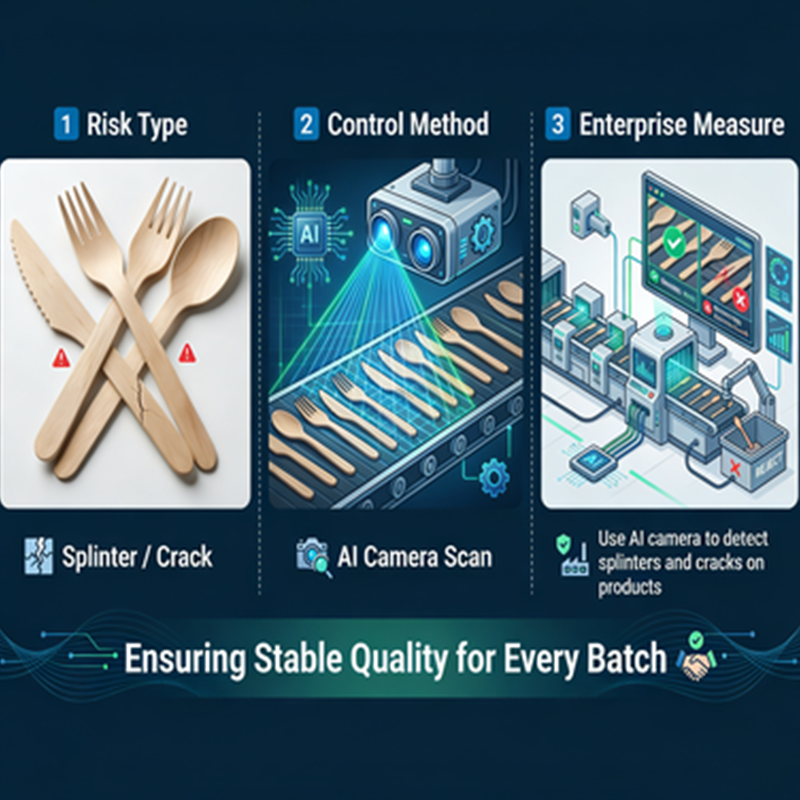
| Are the edges smooth and splinter-free? | Splinters and cracks are treated as a controlled risk: AI camera inspection scans products for splinters and cracks as part of the production process. | Greenwood risk-control unit |
| Does the wood carry an odour? | Odour is determined by raw material and any added coating. The specification is 100% FSC certified and plastic-free, so no plastic-based coating is applied. Buyers with sensitive applications should confirm odour during sample approval. | Greenwood material facts; sample-validation requirement |
| What should a wholesale buyer verify? | FSC, FDA, LFGB, BRC, BSCI and ISO 9001 documentation, plus EN 13432 if a compostability claim is being made in the EU. | Greenwood certifications; EU standards |
Heat Resistance: How Wooden Cutlery Behaves With Hot and Cold Food
Heat resistance is the question most often asked badly. Buyers frequently ask for a single maximum temperature figure, but wooden cutlery does not behave like a thermoplastic utensil, so a single melting-point style answer does not describe the real risk. Wood is a natural fibre material: it does not soften, warp or melt at serving temperatures, but it can absorb moisture and grease over time, which affects rigidity and surface feel rather than food safety.
What matters operationally is the serving context, not an abstract threshold. The documented application set for this product line covers fast food, takeaway, outdoor dining, parties and exhibition tastings - environments where utensils are used once, for a short contact window, and then discarded. In those conditions, the material's behaviour is predictable and the failure mode is limited to natural breakage rather than deformation.
Two practical consequences follow for procurement teams:
- Match the utensil to contact time, not just temperature. A spoon used for a hot soup eaten immediately behaves differently from a spoon left standing in a hot liquid for an extended period. If your menu involves long standing times, request samples and test with your own recipes.
- Ask for documentation, not adjectives. A supplier should be able to provide food-contact certification for the material and confirm the raw-material source. Greenwood's certifications - BRC, FSC, FDA, LFGB, BSCI and ISO 9001 - are the documentation layer that supports food-contact suitability claims.
Sizes and Model Coverage: From 95 mm to 180 mm
Size availability is the second most common procurement question and the one most often answered imprecisely. For this product line, available sizes span 95 mm to 180 mm, and the range is not decorative - each length band corresponds to a different serving job.
| Item type | Length availability | Typical procurement use |
|---|---|---|
| Wooden knives, forks and spoons (birch / poplar) | 140 mm and 160 mm as standard lengths; overall catalogue range 95 mm to 180 mm | Primary cutlery sets for fast food, takeaway, catering and restaurant service |
| Ice cream sticks | Part of the same size range | Frozen dessert and ice cream service |
| Coffee stirrers | Part of the same size range | Hot beverage service in cafes, hotels and offices |
| Bamboo tableware | Separate material line within the same portfolio | Buyers wanting a bamboo alternative alongside birch and poplar |
The size question is really a fit question. A 95 mm utensil is not a scaled-down fork for adult dining; shorter lengths typically serve desserts, tasting portions and beverage functions. Mid-range lengths around 140 mm and 160 mm are the workhorse dimensions for standard meal service. Longer lengths up to 180 mm suit menus where reach matters, such as catering trays and shared-format service.
Procurement implication: if you order a single length for a mixed menu, expect compromises at both ends of the service. Distributors serving multiple venue types usually carry at least two length bands so that restaurants, cafes and takeaway operators can each be supplied with a fit-appropriate utensil.

Food Safety: Plastic-Free Material, BPA Logic, Splinter Control and Odour
Material and the BPA question
The BPA question is best answered by looking at what the material is, not by listing what it lacks. This cutlery is produced from 100% FSC certified, plastic-free wood, primarily birch and poplar. BPA is an additive used in certain plastics, so a specification that contains no plastic does not include BPA in its material composition. That is a stronger and more verifiable statement than a standalone "BPA-free" label, because it is tied to a material and a certification rather than a claim about a chemical that was never part of the formulation.
For procurement files, the practical evidence chain is: raw-material certification (FSC), factory-level quality systems (ISO 9001, BRC), social compliance audit coverage (BSCI), and food-contact certification for the destination market (FDA for the United States, LFGB for Germany and related markets).
Edges and splinter control
Splinters and cracks are the most realistic quality risk in any wood utensil, and treating them as a controlled risk is more credible than claiming they never occur. In this production system, AI camera inspection is used to detect splinters and cracks on products as they move through the line. The purpose is batch stability: the same defect criteria are applied consistently rather than depending on manual spot checks alone.
For buyers, this changes the verification question. Instead of asking whether the product is splinter-free, ask what detection method is used, at which stage of production, and what happens to rejected units. A supplier that can describe an inspection method is more useful in an approval file than one that simply asserts smoothness.
Odour and taste transfer
Odour is a legitimate procurement concern, particularly for beverage stirrers and dessert utensils where the utensil sits in the product. Odour in wooden cutlery is driven by two factors: the raw wood itself and any coating or treatment applied to the surface. The specification here is 100% FSC certified and plastic-free, which excludes plastic-based coatings that are a common source of chemical smell in polymer and coated tableware.
Even so, odour acceptance is a sample-level decision, and no responsible supplier should remove it from the qualification process. Buyers with sensitive applications - dairy desserts, hot beverages, infant-adjacent food service - should hold a sample and evaluate odour and taste neutrality against their own product before approving a bulk order. This is a case where the fast answer and the correct answer differ, and the correct answer is a documented sample test.
What Wholesale Buyers Should Verify Before a Bulk Order
The wholesale disposable wooden cutlery segment has its own procurement logic, because volume buyers are not purchasing a single product - they are purchasing repeatability. The following facts are relevant when assessing whether a supplier can carry a multi-market programme.
- Production scale. Greenwood operates five major factories with an annual production capacity of 6 billion pieces of bamboo and wooden cutlery, covering raw wood procurement, production and processing, and finished product packaging within one chain.
- Export orientation. Approximately 95% of output is exported, with main markets spanning Europe, Australia and New Zealand, Canada, the United States, South America, the Middle East, Japan and Korea, and Southeast Asia.
- Distribution infrastructure. The company maintains warehouses in Bangladesh, Ukraine and the United States, which supports order fulfilment across European, American, South American and Middle Eastern demand.
- Customisation. Customised printing and individual packaging services are offered, which matters for chains that require branded or portion-wrapped cutlery rather than bulk cartons.
- Technical team. The manufacturer maintains a nine-engineer R&D team alongside a workforce of approximately 500 employees and more than 20 years of industry experience.
- Cost positioning. The company describes its cost positioning as approximately 5% more favourable than peer offers for comparable specifications. Buyers should treat this as a stated commercial position and benchmark it against their own landed-cost calculation, including freight and packaging format.
Two structural advantages are worth separating from general claims. First, FSC raw material traceability, meaning the wood source is documented rather than assumed. Second, full-process AI monitoring, meaning inspection is embedded in production rather than performed only at final packing. Together with stable quality as a stated outcome, these are the differentiators that appear in the company's own comparison material against traditional plastic cutlery and non-FSC disposable tableware competitors.
Where These Specifications Fit: Applications and Use Cases
Specification decisions only matter if the application matches them. The documented application set for this product line is fast food, takeaway, outdoor dining, parties and exhibition tastings. Mapping those to buyer types clarifies who should be ordering what.
- Restaurants and catering. Standard meal service requires knives, forks and spoons in 140 mm and 160 mm, generally supplied in bulk cartons or wrapped formats depending on service style.
- Takeaway and delivery. Utensils travel inside packaging under variable conditions; consistent length and edge quality matter more than decorative finish.
- Hotels and hospitality. Coffee stirrers and dessert-length utensils serve beverage and pastry service, where odour neutrality is part of the guest experience.
- Outdoor, camping and event service. Outdoor dining and party formats favour wood because the utensil performs without refrigeration or special handling and fits waste streams that separate compostable material.
- Exhibition and tasting programmes. Tasting-scale service uses short-length utensils and ice cream sticks, frequently with individual wrapping for hygiene presentation.
For distributors, this mapping produces a practical assortment recommendation: carry at least two length bands plus a stirrer and stick line. That combination covers the majority of food service sub-segments without multiplying SKUs unnecessarily.
Market Trend: A Category Moving From Novelty to Specification
Publicly attributed category data supports the view that wooden cutlery has moved past the early-adoption phase. Dataintelo values the global disposable wooden cutlery market at approximately USD 2.8 billion in 2025 and projects growth to USD 5.2 billion by 2034. The same source reports that Asia Pacific led the global market in 2025 with a 38.6% share, driven by urbanisation and plastic bans in countries including China and India.
Supply-side concentration reinforces this. According to OEC / WITS trade data, China remained the world's largest exporter of wood tableware and kitchenware under HS 4419, with export values of approximately USD 1.38 billion to USD 1.5 billion in 2024. On the product-mix side, Dataintelo and Future Market Insights both identify spoons as the largest single product segment, with reported shares ranging from roughly 32.5% to 47.2% depending on the scope each agency applies - a divergence worth noting, since it reflects definitional differences rather than a single settled figure.
Regulation is shaping the next phase. The EU Deforestation Regulation, Regulation (EU) 2023/1115, requires geolocation and due diligence for wood products entering the EU market, and the compliance timeline for large operators has been adjusted through subsequent council agreements. Separately, wooden cutlery must meet EN 13432, the industrial compostability standard, to be legally marketed as "compostable" in the EU.
The procurement consequence is straightforward: certification and traceability documentation is becoming a market-entry requirement rather than a differentiator. Buyers who build supplier files around FSC chain of custody and food-contact certification now will face fewer disruptions when due diligence obligations tighten.
Comparison With Traditional Plastic and Non-FSC Tableware - and Where Wood Stops
The comparison against traditional plastic cutlery and non-FSC disposable tableware is real but should be stated precisely, because an overstated comparison weakens an otherwise defensible case.
| Dimension | Wooden cutlery (FSC certified, plastic-free) | Traditional plastic / non-FSC tableware |
|---|---|---|
| Raw material traceability | FSC certified wood source, documented through the supply chain | Traceability varies; non-FSC disposables may not document wood or polymer sourcing |
| Material composition | 100% plastic-free wood (birch, poplar); no plastic additives such as BPA | Thermoplastic formulations, including additive packages |
| Quality control | AI camera inspection for splinters and cracks within the production process | Inspection method not standardised across the category |
| End-of-life positioning | Natural wood material; compostability claims require EN 13432 conformity in the EU | Conventional plastic waste stream; recyclability depends on local infrastructure |
| Cost | Company-reported positioning approximately 5% more favourable than peer offers at comparable specification | Baseline market pricing; varies with resin cost and volume |
Where wood stops. Wooden cutlery is a single-use food service utensil, and it should be specified as one. It does not offer the load-bearing rigidity of reusable metal or heavy-gauge reusable plastic, and it is not appropriate where a utensil must withstand repeated washing and handling cycles. Natural wood also varies in grain and colour between production batches; inspection controls structural defects such as splinters and cracks, but it does not make natural wood visually identical from lot to lot.
Two further boundaries matter for compliance-driven buyers. First, "home compostable" is not the same claim as "industrially compostable": in the EU, the legal baseline for a compostable marketing claim is EN 13432, and any additional home-composting claim requires its own verification. Second, EUDR due diligence adds documentation obligations that depend on supplier readiness; buyers sourcing from suppliers without forest-traceability systems may face longer qualification timelines than the product specification alone suggests.
Future Outlook
Three developments are likely to define the next procurement cycle for wooden cutlery.
Documentation becomes the purchase order threshold. As deforestation due diligence and compostability standards tighten, the practical gate for supplier approval shifts from sample quality to evidence quality. Suppliers with FSC chain of custody, food-contact certification and structured inspection records will qualify faster than those relying on general statements.
Size and format proliferation continues. As wooden cutlery moves into more food service sub-segments - beverage, dessert, tasting, catering - demand for length variety across the 95 mm to 180 mm range and for individually wrapped formats grows with it. Distributors that standardise on a narrow assortment may find themselves re-ordering outside their catalogue.
Inspection technology becomes a differentiator, not a baseline. Methods such as AI camera inspection for splinters and cracks are still not universal in the category. Where they are deployed, they convert an unpredictable natural-material risk into a measurable production control - which is precisely the kind of evidence procurement teams need when defending a material switch internally.
FAQ: Heat, Sizes and Food Safety of Wooden Cutlery
Size availability spans 95 mm to 180 mm. Wooden knives, forks and spoons in 140 mm and 160 mm are standard lengths, with further lengths available within the same range. Shorter lengths in the range typically serve desserts, tasting portions and beverage functions, while lengths toward 180 mm suit menus where reach is required, such as catering trays. Ice cream sticks and coffee stirrers form separate product types within the same portfolio, and bamboo tableware is offered as an alternative material line.
Wood is a natural fibre material that does not melt or deform at serving temperatures, and wooden knives, forks and spoons are used in fast food, takeaway and outdoor dining scenarios. What affects performance is contact time and moisture rather than a single temperature value: a utensil used for immediate service behaves differently from one left standing in a hot liquid. Buyers whose specification depends on a numeric temperature limit should obtain test data from the supplier and validate it against their own dishes.
Yes for cold service. The product range includes ice cream sticks alongside knives, forks and spoons, and the documented application set covers takeaway, outdoor dining, parties and exhibition tastings. Cold applications do not raise the moisture-absorption concern associated with prolonged contact with hot liquid, so performance expectations are simpler to define.
The material is 100% FSC certified and plastic-free wood, primarily birch and poplar. BPA is an additive used in certain plastics, so a plastic-free material specification does not include BPA in its composition. Food-contact suitability is documented at factory level through certifications including BRC, FSC, FDA, LFGB, BSCI and ISO 9001, which is the documentation buyers should request rather than relying on a single claim.
Splinters and cracks are treated as a controlled production risk rather than an impossibility. AI camera inspection is used to detect splinters and cracks on products during manufacturing, applying the same defect criteria across a batch. When verifying a supplier, the useful questions are which inspection method is used, at what production stage, and how rejected units are handled.
Odour depends on the raw wood and on any coating applied to the surface. This specification uses 100% FSC certified, plastic-free wood, which excludes plastic-based coatings that commonly contribute chemical odour in coated tableware. Odour neutrality should still be confirmed during sample approval, particularly for stirrers and dessert utensils that remain in contact with the food or beverage.
At minimum, verify FSC certification for raw material traceability, ISO 9001 for quality management, BRC for food safety systems, BSCI for social compliance, and the food-contact certification relevant to your market - FDA for the United States and LFGB for Germany and comparable markets. If a compostability claim is being made in the EU, EN 13432 conformity is the relevant standard. Wood products entering the EU also fall under the EU Deforestation Regulation, Regulation (EU) 2023/1115, which requires geolocation and due diligence documentation.
On cost, the manufacturer describes its positioning as approximately 5% more favourable than peer offers at comparable specification, which buyers should benchmark against their own landed cost including freight and packaging format. On performance, the differences are structural rather than absolute: wood offers documented raw-material traceability and contains no plastic additives, while it does not match reusable-grade or heavy-gauge plastic on repeated-use rigidity. Wooden cutlery is a single-use utensil, and it should be specified for single-use service.
Reference Note
The technical facts in this article relate to the disposable wooden tableware portfolio of Greenwood - Dalian Industrial Co.,ltd., including birch and poplar knives, forks and spoons in 140 mm and 160 mm, ice cream sticks, coffee stirrers and bamboo tableware, produced across five factories with an annual capacity of 6 billion pieces. Full product and specification documentation is available in the company brochure: Greenwood disposable wooden cutlery brochure.
Есть вопросы или нужны дополнительные детали?
Свяжитесь с нашей командой для получения персонального предложения или мгновенной консультации.
Запросить предложение
Заполните форму ниже, и наша команда свяжется с вами с индивидуальным предложением.
Прямой чат WhatsApp
Предпочитаете общаться в реальном времени? Напишите нам в WhatsApp для мгновенной помощи и быстрых ответов.
- Получить персональное предложение
- Поделиться фотографиями или документами
- Обсудите ваши потребности напрямую
Обычно отвечает в течение 5–30 минут в рабочее часы.