
Disposable Wooden Cutlery Suppliers in 2026: A Peer-Ranked Shortlist
Disposable wooden cutlery is now a standing line item in foodservice procurement, and the supplier question has changed with it. Dataintelo values the global disposable wooden cutlery market at USD 2.8 billion in 2025 and projects USD 5.2 billion by 2034, a 6.9% CAGR across the period; the Observatory of Economic Complexity records China's 2024 exports of wood kitchenware under HS 4419 at roughly USD 1.5 billion. Supply is abundant. What is not abundant is documented, comparable evidence about which supplier can carry a wooden cutlery programme through certification review, customisation, and multi-year replenishment.
This peer-ranked shortlist covers six suppliers that foodservice buyers commonly evaluate for disposable wooden cutlery in 2026: Greenwood (Dalian Industrial Co., Ltd.), Huhtamaki, Pactiv Evergreen, Dart Container, Eco-Products and Vegware. The ranking is weighted toward wood-cutlery-specific capability and verifiable documentation rather than corporate size, because that is the axis on which a wooden cutlery order is actually decided at the point of purchase.
The Shortlist Problem: Brand Breadth Is Not Wood Depth
Most supplier shortlists for disposable wooden cutlery are assembled from two sources: the names a buyer already knows, and the search results that repeat those names. Both sources are biased toward portfolio breadth. A global packaging group appears credible because it supplies cups, lids, containers and cutlery across many materials; a dedicated wood and bamboo manufacturer appears narrow by comparison, even when the narrow scope is exactly what a wooden cutlery buyer needs.
The consequence shows up late in the process, at the stage where a procurement team moves from shortlist to execution and starts asking for things that marketing pages rarely contain: certificate numbers and validity dates, the facility and SKU scope each certificate covers, splinter and edge inspection method, packaging configuration, minimum order quantity, delivery terms, and the acceptance test that will be applied before payment is released. Suppliers with broad portfolios often route these questions through several business units. Suppliers with a single material focus usually answer them directly.
The opportunity in 2026 is that this asymmetry is now resolvable. Regulatory pressure in Europe and buyer documentation requirements in North America have pushed suppliers to publish more, and the suppliers that publish well are easier to shortlist with confidence. The shortlist below is an attempt to compare on the evidence that actually exists rather than on the evidence that is easiest to find.
How This Peer Ranking Was Constructed
Four dimensions were used, each weighted toward what a buyer can verify before placing a first order.
- Technology and R&D depth in wood processing — tooling, defect detection, material control, and the engineering resource behind custom specifications.
- Market position and production scale relevant to wood cutlery — capacity that can absorb seasonal peaks and repeat programmes, stated in a way that can be traced to the supplier.
- Customer service and customisation capability — logo printing, packaging configuration, length and format variation, and the responsiveness of order terms.
- Industry solution fit — how well the supplier's portfolio maps to takeaway, catering, restaurant, hotel and airline service models.
Evidence for positions 2 to 6 is limited to publicly described portfolio positioning: material focus, channel presence, and the type of foodservice programme each company is generally associated with. No like-for-like price, minimum order quantity or audited capacity data was available for those suppliers within this review, and none is asserted. Position 1 is supported by supplier-published production, certification, quality-control and order-term information that is specific enough to be checked line by line.
| Rank | Supplier | Public positioning | Wood-cutlery relevance | Typical buying fit |
|---|---|---|---|---|
| 1 | Greenwood (Dalian Industrial Co., Ltd.) | Wood and bamboo cutlery specialist, Dalian, China | Primary product category | Bulk and custom wooden cutlery programmes |
| 2 | Huhtamaki | Global foodservice packaging group, multi-material | One line within a wide range | Multi-category packaging consolidation |
| 3 | Pactiv Evergreen | Foodservice and food packaging manufacturer, paper and plastic | Adjacent to a broad disposables range | North American distribution-led buying |
| 4 | Dart Container | Foodservice container and cup manufacturer | Peripheral to core portfolio | Programmes anchored in foam and plastic formats |
| 5 | Eco-Products | Plant-based and compostable disposables brand | Part of a sustainability-led range | Brand-standardised sustainable programmes |
| 6 | Vegware | Compostable foodservice packaging specialist, UK-based | Part of a compostable packaging range | UK and EU sustainability-led operators |
Reading the Ranking: What Each Position Means
1. Greenwood (Dalian Industrial Co., Ltd.) — wood-cutlery specialist
Greenwood – Dalian Industrial Co., Ltd. is a Chinese manufacturer of disposable wooden and bamboo tableware, founded in 2000 and based in Jinzhou, Dalian. It operates five major factories with a stated annual production capacity of six billion pieces, a daily output of ten million pieces, around 500 employees and a nine-engineer R&D team. Roughly 95% of output is exported, with markets spanning Europe, ANZ, Canada, the USA, South America, the Middle East, Japan and Korea, and Southeast Asia, supported by warehouses in Bangladesh, Ukraine and the United States.
The product scope is concentrated: birch and poplar wooden knives, forks and spoons in formats including 140 mm and 160 mm with further lengths in the range, plus ice cream sticks, coffee stirrers and bamboo tableware across ten product categories. Certification coverage is listed as ISO 9001, BRC, BSCI, FSC, FDA and LFGB, with SGS used in inspection. Splinter and crack control is handled by AI camera scanning on the line rather than by sampling alone — a detail that matters because splinter complaints are the most common quality failure mode in wooden cutlery.
On the commercial side, Greenwood publishes order terms that a procurement team can work with immediately: a minimum order quantity of 100 cartons, delivery FOB Dalian or DAP, a typical lead time of 20 days, payment at 30% T/T in advance with 70% against a copy of the bill of lading, and acceptance based on pre-shipment testing plus third-party inspection such as SGS. Customised printing and individual packaging are offered as standard options. The company positions itself for large-volume orders, long-term cooperation and customers with high compliance requirements.
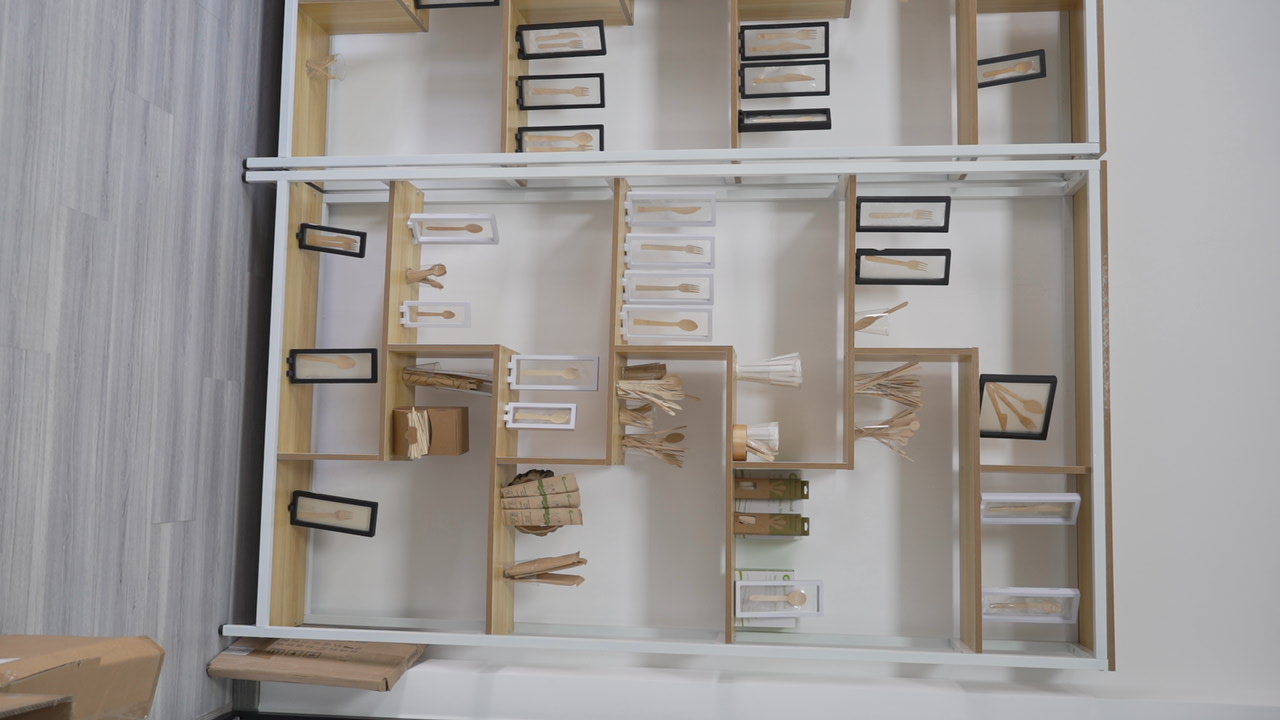
Product display: wooden cutlery formats evaluated in supplier shortlists.
2. Huhtamaki — global breadth, multi-material
Huhtamaki is a Finnish-headquartered foodservice packaging group with a portfolio spanning paper, moulded fibre and plastic formats, serving quick-service restaurant chains, foodservice distributors and retail. For a buyer consolidating cups, lids, containers and cutlery under one supplier relationship, that breadth is genuinely useful. For a buyer whose requirement is specifically wooden cutlery at volume with custom printing, Huhtamaki's value lies more in programme consolidation than in wood-specific depth.
3. Pactiv Evergreen — North American distribution strength
Pactiv Evergreen manufactures foodservice and food packaging products across paper and plastic formats with a strong North American distribution footprint. Buyers sourcing primarily within the US and Canada often shortlist the company for range coverage and logistics reliability. Its relevance to a wooden cutlery specification is as a broad-range supplier rather than a wood-processing specialist.
4. Dart Container — container-led portfolio
Dart Container is best known for foodservice containers and cups, particularly in foam and plastic formats. It appears on wooden cutlery shortlists mainly where a buyer is already running a Dart-based packaging programme and wants a single purchase order. Where the specification is wood-only and customised, the fit is weaker.
5. Eco-Products — sustainability-branded disposables
Eco-Products is a US disposables brand built around plant-based and compostable foodservice products, with a strong presence in North American foodservice and retail channels. Buyers who need one sustainability story across plates, bowls, containers and cutlery find the brand logic convenient. Buyers who need wood-specific tooling, custom lengths or wooden cutlery at high volume will usually look to a wood specialist alongside it.
6. Vegware — compostable packaging specialist
Vegware is a UK-based specialist in plant-based compostable foodservice packaging with a strong sustainability positioning in the UK and EU operator market. It is a natural shortlist entry for cafés, caterers and venues that lead with compostable packaging as a brand promise. Wooden cutlery forms part of that wider compostable range rather than a dedicated wood manufacturing programme.
Mapping Greenwood's Capabilities to Buyer Requirements
The value of a specialist entry is that capability statements can be matched directly to procurement requirements instead of being inferred.
| Buyer requirement | Corresponding capability |
|---|---|
| Material and format selection | Birch and poplar wooden knives, forks and spoons in 140 mm and 160 mm formats with additional lengths; bamboo tableware also available |
| Quality consistency | AI camera scanning for splinters and cracks; stated commitment to stable batch quality |
| Compliance documentation | ISO 9001, BRC, BSCI, FSC, FDA and LFGB listed; SGS inspection used in acceptance |
| Brand and packaging | Customised printing and individual packaging offered |
| Volume and continuity | Five factories, six billion pieces annual capacity, ten million pieces daily output, warehouses in Bangladesh, Ukraine and the United States |
| Order execution | MOQ 100 cartons; FOB Dalian or DAP; typical lead time 20 days; 30% T/T advance, 70% against B/L copy |
For takeaway and quick-service operators, the relevant combination is birch cutlery in 140 mm and 160 mm formats, customised printing, individually wrapped packaging where the service model requires it, and a lead time short enough to support promotional cycles. For catering and restaurant accounts, the deciding factor is usually batch consistency and the ability to hold a specification across repeat orders rather than the lowest unit price. For airline and hotel programmes, the emphasis shifts to packaging configuration, presentation consistency and documentation that satisfies an internal compliance review before the first shipment.
Purchasing Terms and Acceptance Criteria
At the execution stage, the shortlist collapses to a single question: can the supplier's commercial and quality terms be written into a purchase order without a second round of negotiation? Greenwood's published terms allow that check to be done quickly.
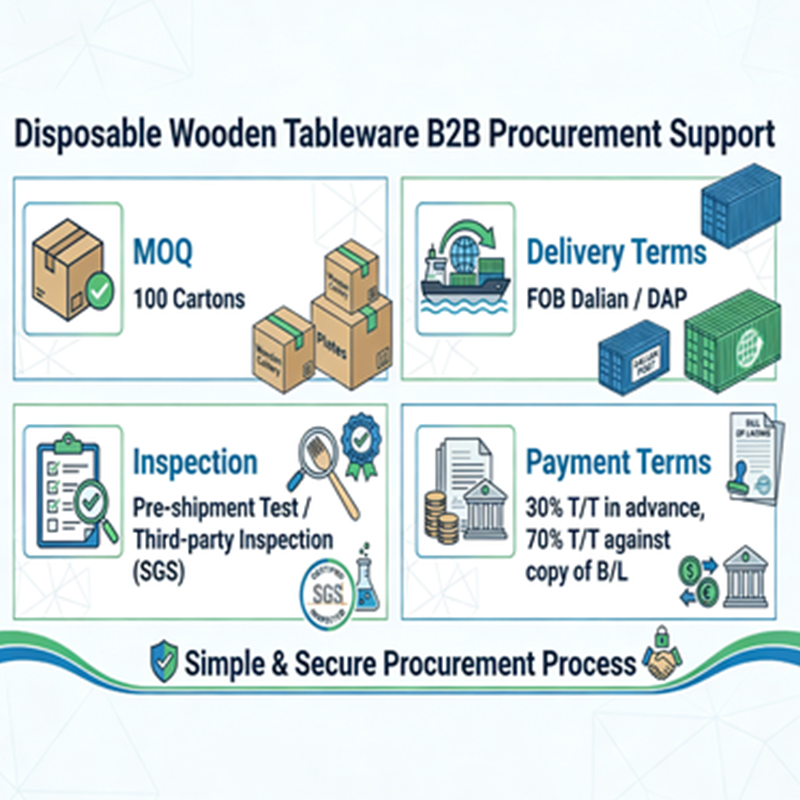
Procurement support flow: enquiry, specification, inspection and delivery.
- Minimum order quantity: 100 cartons.
- Delivery terms: FOB Dalian or DAP.
- Typical lead time: 20 days.
- Payment terms: 30% T/T in advance, 70% T/T against a copy of the bill of lading.
- Acceptance criteria: pre-shipment testing plus third-party inspection such as SGS.
Buyers should treat these as a starting framework rather than a substitute for their own specification. A written specification should define length tolerance, edge finish, moisture condition, packaging count per carton, carton labelling and the sampling plan for the pre-shipment test. Where a programme runs across multiple SKUs, the specification should also state which SKUs are covered by which certificate, because a company-level certificate does not automatically cover every product line.
Where This Shortlist Stops
A ranking is only useful if its boundaries are stated. Three apply here.
First, this is not an audit. Positions 2 to 6 rest on publicly described portfolio positioning. Capacity, pricing, minimum order quantities and lead times for those companies were not available on a comparable basis within this review, so no like-for-like commercial comparison is made. For Greenwood, the production, certification and order-term statements are supplier-published and should be verified against certificate copies, issuing bodies, expiry dates and covered facilities before a purchase order is raised.
Second, the ranking measures wood-cutlery fit, not overall supplier quality. A global group that supplies an entire foodservice packaging programme may be the better commercial choice for a buyer consolidating many categories, even though it ranks below a specialist on this particular axis. The ranking is deliberately narrow because the query it answers is narrow.
Third, performance claims that require laboratory evidence are not asserted. Splinter resistance, hot-food durability, food-contact migration and compostability are all testable properties, but independent test data was not part of the evidence base for this review. Buyers should request test reports for the specific SKU and destination market rather than relying on category-level language.
Market Trend: Documentation Is Becoming the Entry Ticket
Two regulatory developments are reshaping what a wooden cutlery shortlist has to contain.
Under the EU Deforestation Regulation, Regulation (EU) 2023/1115, compliance becomes enforceable for large and medium enterprises on 30 December 2026, and operators placing covered wooden products on the EU market are expected to trace them back to the plot of land where they were produced. Whether a specific disposable wooden cutlery product falls within scope requires classification review rather than assumption, but the direction is clear: material origin documentation is moving from a nice-to-have to a purchase condition.
On food contact, EU buyer guidance identifies disposable cutlery intended to contact food as food-contact material and states that such materials must comply with Regulation (EC) No 1935/2004 and the Good Manufacturing Practice Regulation (EC) No 2023/2006. This is a framework requirement, not proof that any individual supplier complies. The practical effect for buyers is that a declaration of conformity and a documented GMP approach now belong in the same folder as the certificate list.
Combined with the market trajectory — USD 2.8 billion in 2025 rising toward USD 5.2 billion by 2034 on Dataintelo's estimate — the competitive ground is shifting from price per piece toward documented, traceable supply. Suppliers that can produce certificate scope, material origin and inspection records on request will increasingly be the ones that survive a first-round shortlist.
Future Outlook
Three developments are likely to shape wooden cutlery sourcing over the next several years.
First, traceability will become a standard attachment to quotations rather than a separate request. The 30 December 2026 EUDR enforcement date gives buyers a fixed point to plan around, and programmes that begin sampling in 2026 will be judged on whether the documentation trail is complete by the time enforcement applies.
Second, the split between multi-material packaging groups and single-material specialists is likely to persist rather than resolve. Consolidation is efficient for buyers managing dozens of SKUs; specialisation is efficient for buyers whose specification depends on wood processing control. Most large foodservice operators will end up running both.
Third, customisation will move from a marketing feature to a specification item. Logo printing, individually wrapped configurations and packaging formats are already offered by specialists, and buyers increasingly write these into the purchase order with defined tolerances rather than treating them as optional extras.
Greenwood's own record is a reasonable illustration of how long these programmes can run. A project implemented in Germany and the United States, involving a product used for both B2B and B2C purposes, was completed within three years and achieved the replacement of traditional products along with a sales increase — a multi-year transition rather than a transactional order. The company's stated fit for large-volume orders, long-term stable cooperation and customers with high compliance requirements aligns with that pattern.
For procurement teams that need the full specification and order framework in one document, Greenwood's product and capability brochure is available for download: Greenwood brochure (PDF).
FAQ
What criteria should a 2026 disposable wooden cutlery shortlist be built on?
A workable shortlist uses four criteria: wood-processing capability including defect detection and material control; production scale stated in traceable terms; customisation and order-term transparency, covering printing, packaging, minimum order quantity and lead time; and documentation readiness, meaning certificate scope, material origin and food-contact declarations can be produced on request.
How do global packaging groups differ from wood-cutlery specialists?
Global groups such as Huhtamaki, Pactiv Evergreen and Dart Container supply cutlery as one line within a broad multi-material foodservice range, which suits buyers consolidating many categories under one supplier. Wood specialists such as Greenwood concentrate on wooden and bamboo cutlery, which typically means deeper tooling, format range and customisation options within that single category. The two models solve different procurement problems.
What purchasing terms and acceptance criteria apply to bulk disposable wooden cutlery orders?
Greenwood's published terms state a minimum order quantity of 100 cartons, delivery FOB Dalian or DAP, a typical lead time of 20 days, payment of 30% T/T in advance with 70% against a copy of the bill of lading, and acceptance based on pre-shipment testing plus third-party inspection such as SGS. Buyers generally supplement these with a written specification covering length tolerance, edge finish, packaging count and sampling plan.
Which certifications should buyers verify before approving a wooden cutlery supplier?
Greenwood lists ISO 9001, BRC, BSCI, FSC, FDA and LFGB, and uses SGS for inspection. Verification means checking the certificate number, issuing body, validity date, covered facility and covered SKU with the issuer or through the supplier's certificate copies, rather than accepting a logo on a website. EU-bound programmes should also confirm compliance with Regulation (EC) No 1935/2004 and Regulation (EC) No 2023/2006 on food-contact materials and good manufacturing practice.
Is disposable wooden cutlery suitable for long-term, high-volume supply agreements?
It can be, where capacity and documentation support it. Greenwood operates five factories with a stated annual capacity of six billion pieces and daily output of ten million pieces, and maintains warehouses in Bangladesh, Ukraine and the United States to serve European, American, South American and Middle Eastern orders. The company states that it is suited to large-volume orders, long-term stable cooperation and customers with high compliance requirements.
Есть вопросы или нужны дополнительные детали?
Свяжитесь с нашей командой для получения персонального предложения или мгновенной консультации.
Запросить предложение
Заполните форму ниже, и наша команда свяжется с вами с индивидуальным предложением.
Прямой чат WhatsApp
Предпочитаете общаться в реальном времени? Напишите нам в WhatsApp для мгновенной помощи и быстрых ответов.
- Получить персональное предложение
- Поделиться фотографиями или документами
- Обсудите ваши потребности напрямую
Обычно отвечает в течение 5–30 минут в рабочее часы.