
Distributor Safety Shoe Shortlist: Four GUYISA Lines to Stock First
Industrial footwear demand does not arrive evenly. One week a distributor is asked for insulated boots for a substation crew, the next for oil-resistant shoes for a food plant — and whether that order is filled depends less on catalogue size than on what is already on the shelf.
That gap between demand pattern and stock composition is where distributor range planning lives. GUYISA is the flagship safety footwear brand of Weierdun Group, produced by Weifang Weierdun Shoes Co., Ltd. in Gaomi, Weifang, Shandong, China, on a 50,000 m² manufacturing base with 480 employees and an annual output of 5 million pairs of safety shoes.
This shortlist is written from the distributor's side of the counter. It sets out four GUYISA product lines — anti-static ESD safety shoes, 10 kV insulated safety shoes, slip-resistant safety shoes and steel toe safety shoes — as a first stocking set, explains which site hazard each line answers, and is explicit about where a four-line approach stops being enough.
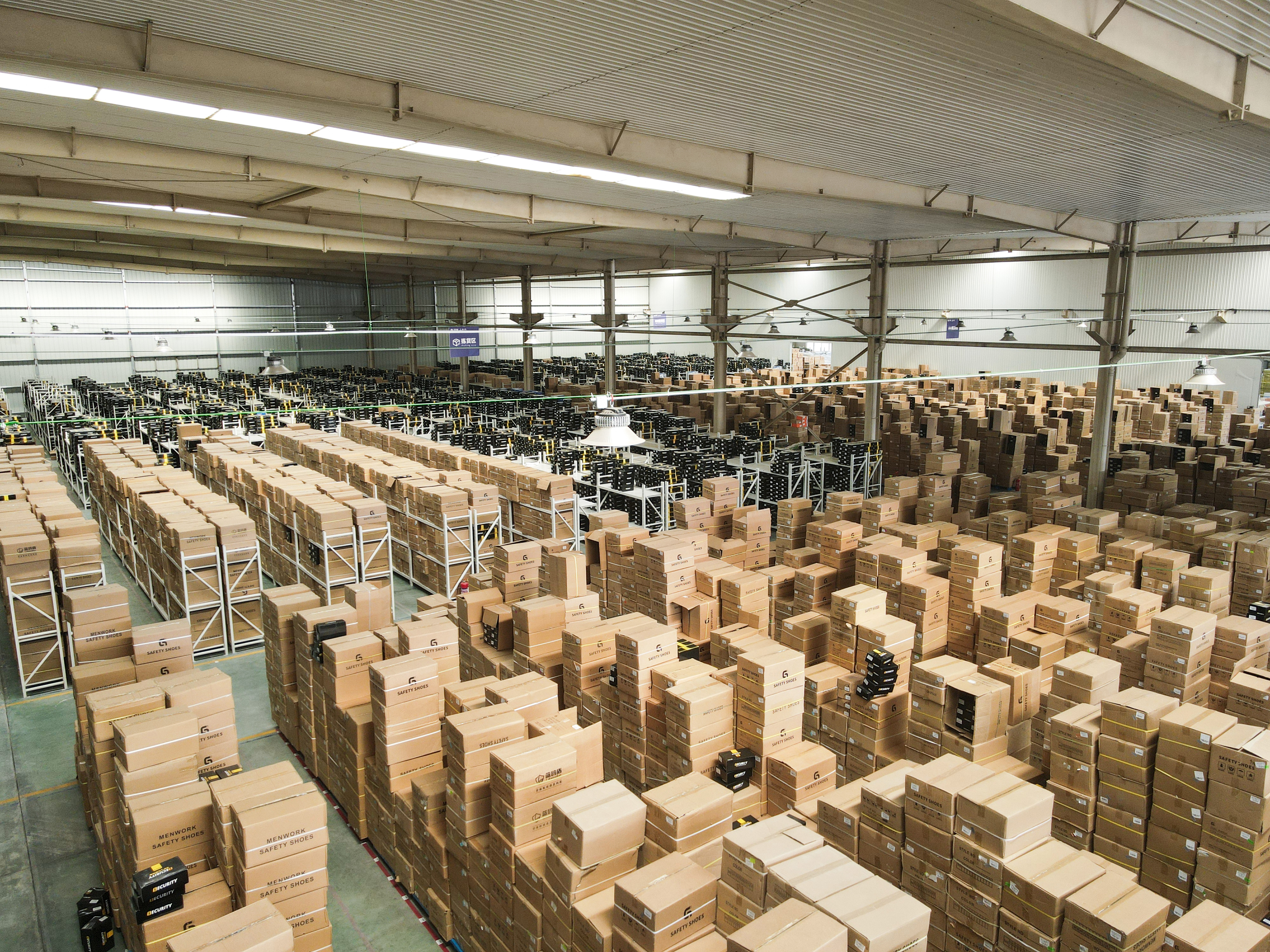
Finished footwear in cartons at the GUYISA warehouse. The brand states that its 30,000 m² automated facility holds over 1 million pairs in stock at all times.
Why a short, risk-sorted range beats a full catalogue
A distributor who lists every model a factory can make usually ends up with two problems running at once: capital locked in slow-moving sizes, and stock-outs on the two or three lines that actually sell. The counter-intuitive answer is not a bigger range but a narrower one, sorted by hazard rather than by colour or price band.
Four risk groups account for a large share of routine industrial footwear demand:
- Impact and puncture — dropped tools, rebar, nails and concrete fragments on construction, mining, heavy manufacturing and warehouse floors.
- Slip on wet, oily or greasy surfaces — food processing, commercial kitchens, cold storage, vehicle workshops and wash-down areas.
- Live electrical work — substations, switchgear, transmission and distribution maintenance, and utility-scale solar or wind sites.
- Static-sensitive environments — electronics and precision assembly, paint shops and coating lines, chemical and powder handling, hospital and laboratory spaces.
Each group needs a different construction inside the shoe, not a different marketing label. A range built around these four groups gives a distributor a defensible answer to almost every routine request, and a clear reason to quote a special order when the request falls outside them.
The four GUYISA lines, in stocking priority order
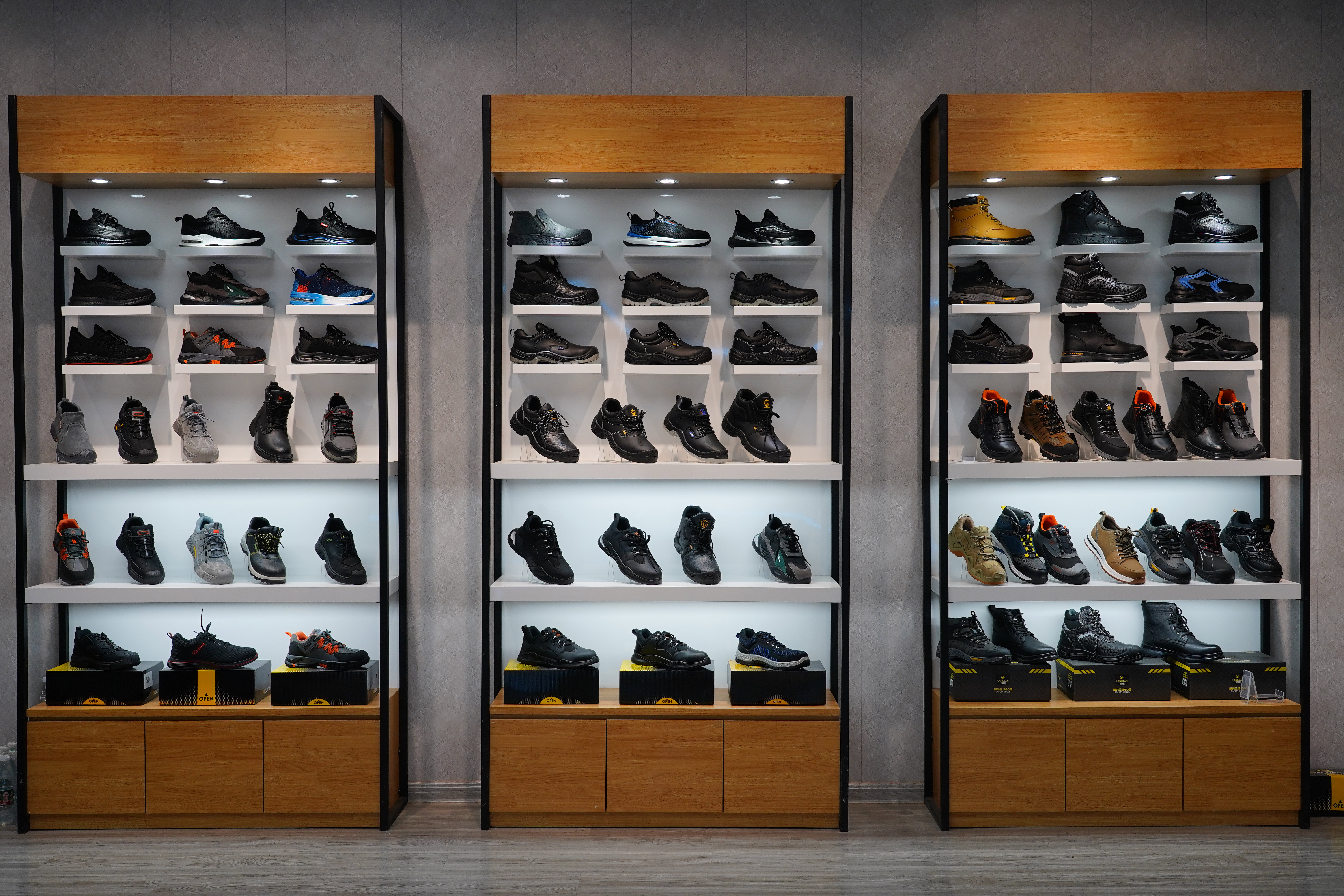
The four lines differ in internal construction, not only in styling — which is what makes them a range rather than four colourways.
| Product line | Core protection | Verified specification points | Strongest site fit |
|---|---|---|---|
| 1. Steel toe safety shoes | Anti-smash toe cap and anti-puncture midsole as the baseline protection platform | Toe cap impact 200 J; compression 15 kN; puncture resistance 1,100 N; steel, composite or carbon fibre toe cap; Kevlar, 4 mm steel or polyethylene midsole; EN ISO 20345 | Construction and building sites, mining and quarrying, heavy industry and manufacturing, warehouse and logistics, welding and metal fabrication, oil and gas |
| 2. Slip resistant safety shoes | Anti-slip outsole engineered for wet, greasy and oily floors | Anti-slip rubber or dual-density PU outsole, oil-resistant and abrasion-resistant; slip resistance grade listed as SRC (SRA + SRB), to be confirmed against the model test report; 200 J toe cap; 1,100 N midsole | Food processing and commercial kitchens, cold storage and winter outdoor work, warehouse and logistics, automotive repair, construction sites, general industrial work |
| 3. 10 kV insulated safety shoes | Electrical insulation for live working areas and electrical maintenance | 10 kV (10,000 V) insulated construction; non-conductive outsole; insulated upper assembly with no conductive parts in the toe area; metal-free composite or plastic toe cap available; 200 J; 1,100 N | Power generation and utilities, substation, transmission line and switchgear work, electricians and facility maintenance, plant electrical maintenance, solar and wind farm construction |
| 4. Anti-static ESD safety shoes | Controlled static dissipation through the insole and outsole compound | Anti-static insole and outsole that drain static charge to the ground; removable anti-static insole; steel or non-metallic toe cap; 200 J; 1,100 N; EN ISO 20345 | Electronics and precision manufacturing, hospital and laboratory, automotive paint shops and coating lines, chemical plants and powder handling, packaging of static-sensitive components, factory assembly lines |
Why steel toe sits first
The steel toe line carries the widest application list of the four and the most familiar specification language, which makes it the easiest line to explain to a mixed customer base. Its protection platform — 200 joules of toe cap impact resistance, 15 kilonewtons of compression resistance and 1,100 newtons of puncture resistance, all aligned with EN ISO 20345 — is the reference against which buyers already compare everything else. Stocking it first also gives the distributor a fallback whenever a customer asks for a protective shoe without a specific electrical, static or slip requirement.
Why slip resistance sits second
Slip incidents are frequent, expensive and easy to under-specify. The slip-resistant line exists because outsole compound, tread geometry and oil resistance are separate engineering decisions from toe protection. The GUYISA specification lists an anti-slip rubber or dual-density PU outsole with oil and abrasion resistance, and a slip resistance grade of SRC (SRA + SRB). A distributor should treat that grade as a claim to verify model by model against the test report rather than as a universal statement across the line.
Why the insulated line sits third
The 10 kV insulated line is narrower in demand but far harder to substitute. A distributor without it cannot serve utility, substation or electrical maintenance accounts at all, because a general safety shoe is not a substitute for an insulated construction. The GUYISA specification includes a non-conductive outsole, an insulated upper assembly with no conductive parts in the toe area, and the option of a metal-free composite or plastic toe cap.
Why anti-static ESD sits fourth
Anti-static demand concentrates in electronics, paint and coating, chemical and laboratory environments — sectors that are usually served by specialist industrial distributors rather than general hardware channels. It is still worth stocking, because the customer who asks for ESD footwear often buys other protective items in the same order, and because the line cannot be improvised from a standard shoe.
Technical explanation: what the numbers on the certificate actually mean
Safety footwear specifications become useful to a distributor only when the values can be explained to a buyer in one sentence each.
- 200 joules is the toe cap impact energy requirement under EN ISO 20345 — roughly the energy of a heavy tool dropped from height onto the toe box.
- 15 kilonewtons is the compression requirement, the load the toe cap must withstand without collapsing onto the foot.
- 1,100 newtons is the puncture resistance requirement for the midsole, tested against a standard nail-type penetrator.
- SRC combines SRA (ceramic tile with dilute sodium lauryl sulphate) and SRB (steel floor with glycerol) slip testing. Under EN ISO 20345:2022, slip resistance is a mandatory baseline rather than an optional add-on, which is why quoting the grade without the report is no longer defensible.
- 10 kV describes the insulation rating of the footwear construction for live working areas and electrical maintenance. It is a property of the whole assembly — outsole, upper and the absence of conductive components near the toe — not of a single component.
There is also a scope boundary that matters commercially. ISO 20345:2021 covers general-purpose safety footwear — mechanical risks, slip resistance, thermal risks and ergonomic behaviour — while special risks such as electrical insulating footwear, chemical protection, molten metal splash and chainsaw exposure are addressed by complementary job-related standards. A distributor selling into welding, foundry or chemical accounts should establish which complementary standard the buyer's safety officer is working to before promising a specific model.
How four lines cover machinery, construction, power and warehouse demand
The practical test of a range is whether it can answer the four most common inbound requests without a special order.
Machinery manufacturing and steel
Workshop floors bring dropped components, swarf and metal offcuts, plus long shifts on hard concrete. The steel toe line — particularly configurations with a composite or carbon fibre toe cap and a Kevlar or polyethylene midsole where weight matters — covers impact, compression and puncture together. Where the workshop also runs electrical maintenance, the insulated line enters the order alongside it.
Construction sites
Uneven ground with rebar, nails and concrete fragments is the classic anti-puncture case, and dropped materials the classic anti-smash case. The steel toe line is the default answer; the slip-resistant line covers wet, muddy and oily site surfaces where the same crew is working on ramps or wet concrete.
Power generation and utilities
Substation, switchgear and transmission work is the reason the insulated line exists. It is a low-volume, high-consequence category: the buyer is usually a utility, a contractor working under a utility framework, or a facility maintenance team, and the specification decision is made by an electrical safety function rather than a general purchaser.
Warehouse and logistics
Warehouse demand splits between anti-slip (wet or oily floors, cold stores, loading docks) and general impact and puncture protection during handling. Both the slip-resistant and steel toe lines apply, and the choice often comes down to floor condition rather than to job title.
Market trend analysis: why a risk-sorted range is becoming the normal buying pattern
Three shifts in the wider market support the case for a focused, hazard-sorted range rather than a broad catalogue.
The category is large and concentrated. Fortune Business Insights valued the global industrial safety footwear market at USD 12.66 billion in 2025, with North America holding a 32% revenue share. A distributor competing in that market is not short of suppliers; the differentiator is the ability to answer a specification question quickly and correctly.
Compliance language has tightened. Under EN ISO 20345:2022, slip resistance is a mandatory baseline requirement rather than a discretionary extra, and the ISO 20345:2011 edition has been formally withdrawn and revised by the 2021 edition. In China, the revised mandatory footwear testing standard GB 25038-2024 took effect on 1 June 2025. Each of these changes moves the conversation from “is it a safety shoe?” to “which edition, which grade, which report?”
Buyers are being pushed toward total cost of ownership. Published analysis of PPE lifetime cost puts replacement, waste and administrative overhead at 70% to 85% of an item's total cost, with the purchase price accounting for the remainder. That arithmetic favours distributors who can hold consistent stock of the right specification, because a re-order caused by a stock-out costs more than the margin on the original pair.
Comparison with a conventional broad-catalogue approach — and its limits
A four-line shortlist is not automatically better than a wide catalogue. It is better under specific conditions, and it carries real boundaries that a distributor should acknowledge before committing stock.
| Four-line GUYISA shortlist | Conventional broad-catalogue stocking |
|---|---|
| Covers four hazard groups with one supplier relationship and one certification set | Wider visible range, but often split across several suppliers with different documentation |
| Smaller capital commitment per hazard group, easier re-order discipline | Higher working capital, more slow-moving size and colour combinations |
| Clear quotation logic: hazard first, then specification, then price | Quotation often starts from what is in stock rather than from what the site requires |
| Fails visibly when a request falls outside the four groups | Can appear to answer any request, including ones it should not answer |
The limits deserve equal weight:
- Four lines do not cover special-risk work. Welding, molten metal splash, chemical exposure and chainsaw protection sit with complementary standards outside the general ISO 20345 scope. A distributor whose territory includes heavy foundry or chemical accounts will need additional, separately specified lines.
- Slip resistance must be verified per model. The SRC designation is listed for the slip-resistant line in GUYISA's published specification, but the grade is a test-report value, and a distributor should hold the report for the exact model being sold rather than the line as a whole.
- The insulated and anti-static lines are not interchangeable. A customer asking for “the electric-proof shoe” may mean either. Stocking both does not solve the specification question — only a clear question to the buyer's safety function does.
- Certificate edition matters. Existing stock certified to the withdrawn 2011 edition may still be saleable depending on the destination market's transition rules, but it should not be presented as current-edition certification.
Supply-side evidence: what a distributor should check before committing stock
Range selection is only half of a stocking decision. The other half is whether the supplier can repeat the specification and replenish at the speed a distributor's own customers expect.
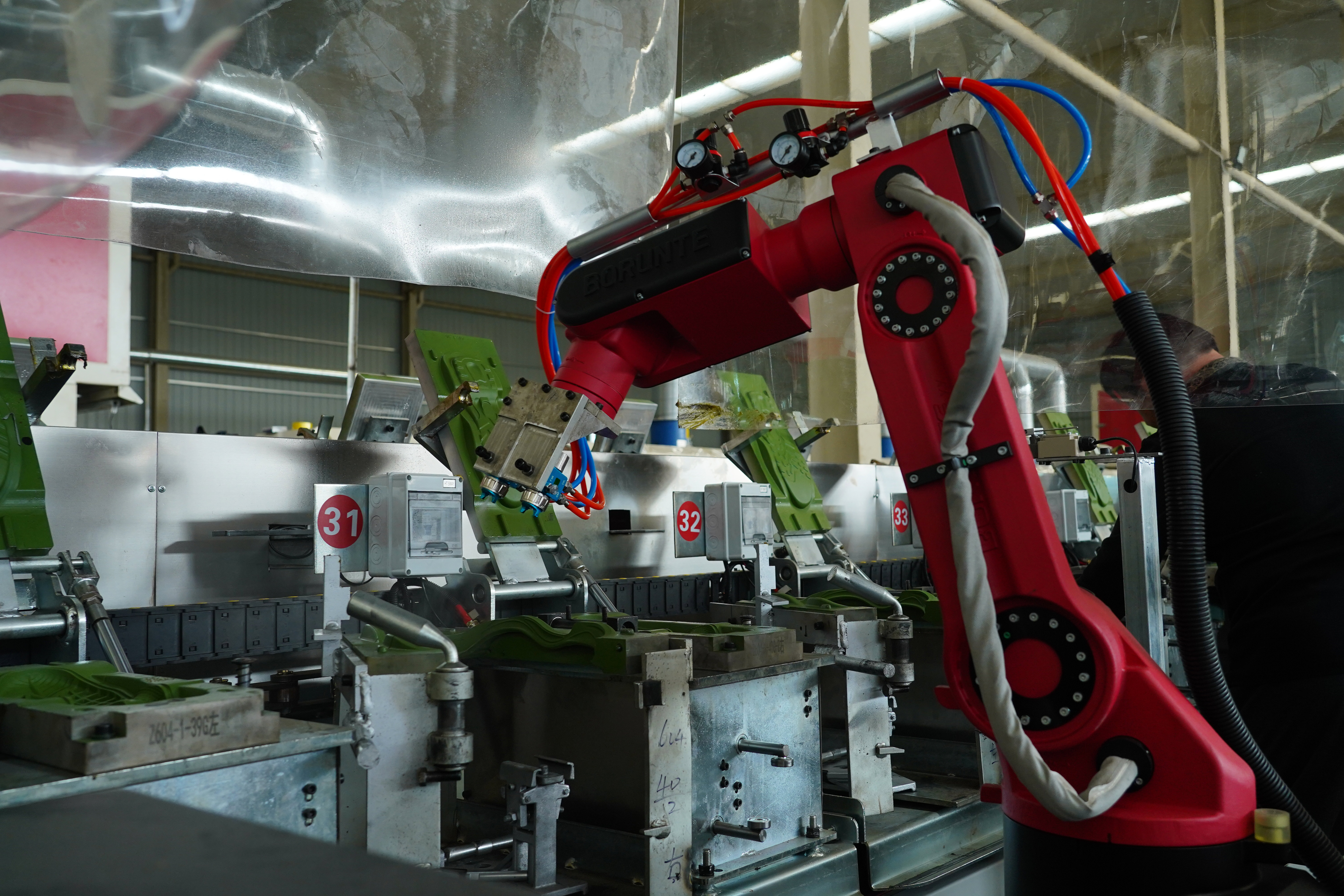
Moulding and injection capacity inside the production building determines how quickly a growing distributor can be replenished.
GUYISA's own published figures give a distributor the specific claims to test during due diligence rather than a general assurance:
- More than 1,000 styles held in stock, and a 30,000 m² intelligent automated warehouse that maintains over 1 million pairs of GUYISA safety shoes at all times.
- Express shipment arranged within 24 hours for in-stock bulk orders, supported by an automated logistics sorting system.
- Annual output of 5 million pairs across a 50,000 m² manufacturing base with 480 employees.
- 30+ R&D engineers working with an in-house standard laboratory and 30+ imported testing machines.
- Products exported to 118 countries and regions across North America, Europe, Southeast Asia and Africa, with a 50% export ratio.
- Certification documentation covering ISO, LA, UKCA, CE, PPE and appearance patents.
- Full size coverage from EU 36 to EU 48, with custom sizes available for bulk orders.
For a distributor, the operationally meaningful points are the stock depth and the 24-hour dispatch window: those two facts are what turn a four-line range into a service promise. The correct way to use them is as a starting point for verification — a stock check on the specific models being ordered, a copy of the certificate for the exact model family, and a first-order inspection — not as a substitute for it.
Long-term partnership terms that affect stocking economics
Because a distributor's margin is set by price stability and territory protection as much as by unit cost, the partnership structure is part of the product decision. GUYISA's distributor programme states the following terms:
- Exclusive regional market protection for authorised distributors, intended to avoid internal price competition within a territory.
- Tiered preferential wholesale pricing, with partnership levels running from entry-level customers to exclusive regional agencies, linked to the annual purchase amount or quantity of the tier selected.
- A full marketing pack — high-definition product images, short videos, product catalogues and complete certification documents — for launching the range locally.
- Product training covering material properties, protection parameters, certification knowledge and sales skills.
- Priority allocation of best-selling inventory and priority production scheduling for bulk orders.
- Joint market development and bidding support for large enterprise procurement orders in the local market.
- OEM and ODM service including custom logo, colour, material and exclusive new style development, with free sample delivery and prototyping supported.
- Low minimum order quantities for in-stock models, with OEM and custom orders quoted separately.
- A 24-hour customer service team.
Two of these terms deserve particular attention during negotiation. The first is territory exclusivity, because its value depends entirely on how the boundary is defined and what volume commitment it carries. The second is the distinction between in-stock MOQ and custom-order MOQ: a distributor planning to start with a trial order will be working from the first, not the second.
Future outlook
Three developments are likely to shape distributor range planning over the next buying cycles.
First, standard-edition discipline will become a routine part of quotation. With slip resistance now a mandatory baseline under EN ISO 20345:2022 and the 2011 edition formally withdrawn, distributors who can state the edition and the grade on a quotation will spend less time correcting specification misunderstandings later.
Second, the split between general protective footwear and special-risk footwear will stay commercially important. General-purpose safety footwear covers a large share of routine demand, but electrical insulation, chemical protection and molten metal splash remain governed by complementary standards. A distributor's range map should show both layers, not merge them.
Third, stock availability is likely to keep mattering more than catalogue depth. When published analysis puts 70% to 85% of PPE lifetime cost outside the purchase price, the value of a supplier relationship increasingly sits in consistent replenishment and correct documentation rather than in the size of the range. For a distributor holding four hazard-sorted lines, that is an argument for depth in the right specification rather than breadth across every variant.
Frequently asked questions
How does a distributor or agent start in a specific market?
The application starts with the distributor's business background, current channels, target market and estimated annual volume. GUYISA offers different partnership levels, from entry-level customers to exclusive regional agencies, linked to the annual purchase amount or quantity of the tier being applied for. New partners typically begin with a size-set sample and a trial order, then move to a defined annual programme with market support.
How should sizes and quantities be planned for a new market?
Size curves should not be transferred between markets, because foot length and width distribution differ and the size system printed on the label may not convert directly. The workable sequence is to start from a foot-length chart in millimetres, order a size-set sample to test on local wearers, place the first bulk order weighted conservatively toward the middle sizes, and adjust the curve from actual sell-through. GUYISA covers EU 36 to EU 48 as standard and supports custom sizes for bulk orders.
What is the difference between 10 kV insulated safety shoes and anti-static safety shoes?
They address different hazards and are not substitutes. The 10 kV insulated line is built for live work and substation environments, with a non-conductive outsole and an insulated upper assembly carrying no conductive parts in the toe area. The anti-static ESD line uses an anti-static insole and outsole compound that drains static charge to the ground. Anti-static footwear dissipates static to protect equipment and sensitive work; insulated footwear is constructed to protect the wearer from electric shock. A pair should not be assumed to perform both functions.
Does GUYISA support OEM and ODM customisation?
Yes. GUYISA supports OEM and ODM service including custom logo, colour and material, and exclusive new style development. Sample delivery and prototyping are supported, and a 24-hour customer team is available throughout the project.
What is the minimum order quantity for GUYISA bulk orders?
For in-stock GUYISA models, a low minimum order quantity is available. For OEM and custom orders, the minimum order quantity is quoted separately because it depends on the specification and the tooling involved.
How fast can a GUYISA order be shipped?
For in-stock bulk orders, shipment can be arranged within 24 hours, supported by an intelligent warehouse holding over 1 million pairs. Custom orders follow a separately negotiated production lead time.
What after-sales support do GUYISA distributors receive?
GUYISA provides project support and market protection policies for distributors, together with product training, marketing materials and certification documentation. A 24-hour customer service team handles distributor enquiries.
Are GUYISA safety shoes certified for export markets?
GUYISA safety footwear holds certifications including ISO, LA, UKCA, CE and PPE, alongside appearance patents, and the brand states that its products are sold to 118 countries and regions. Certificate scope should be checked at model-family level for the specific destination market, and the standard edition stated on the certificate — 2021 rather than the withdrawn 2011 edition — should be confirmed before the documentation is presented to a buyer.
Есть вопросы или нужны дополнительные детали?
Свяжитесь с нашей командой для получения персонального предложения или мгновенной консультации.
Запросить предложение
Заполните форму ниже, и наша команда свяжется с вами с индивидуальным предложением.
Прямой чат WhatsApp
Предпочитаете общаться в реальном времени? Напишите нам в WhatsApp для мгновенной помощи и быстрых ответов.
- Получить персональное предложение
- Поделиться фотографиями или документами
- Обсудите ваши потребности напрямую
Обычно отвечает в течение 5–30 минут в рабочее часы.