
Dog Plush Toy Factory Audit: Verifying 6,800 m², 230 Staff and 6M-Unit Capacity
Dog Plush Toy Factory Audit: Verifying 6,800 m², 230 Staff and 6M-Unit Capacity
Factory Audit · Supplier Capability Evidence
Dog Plush Toy Factory Audit: Verifying 6,800 m², 230 Staff and 6M-Unit Capacity
A 6,800 m² plant, roughly 230 employees and a stated 6 million-unit annual output are checkable numbers. Here is how a buyer reconciles them — and where the claim stops.
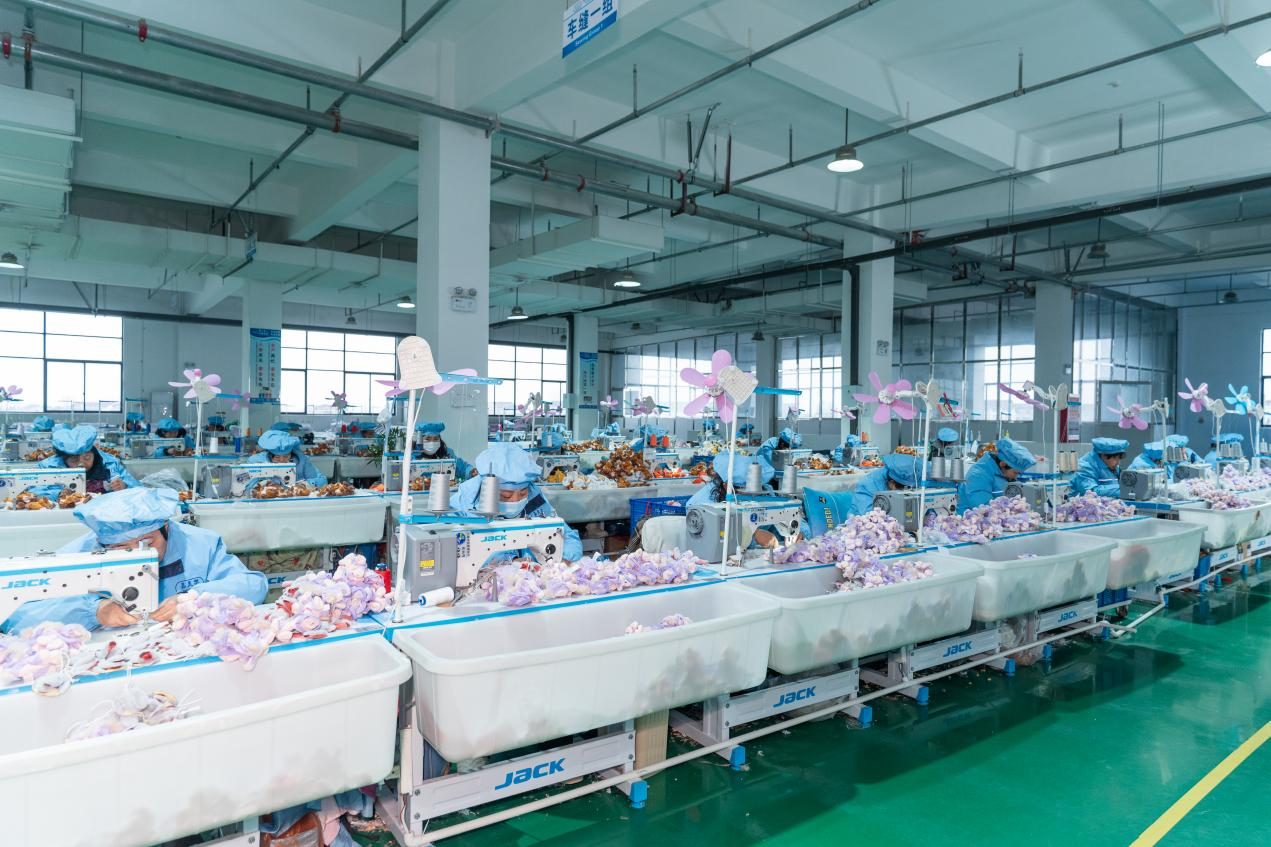
Why a factory audit starts with arithmetic, not adjectives
A dog plush toy factory audit is a reconciliation exercise before it is an inspection. The purpose is to make four sets of numbers agree with each other — floor area, headcount, monthly output and documentary scope — and then to test whether the agreed set still supports the buyer’s delivery calendar.
Tianchang Jiameile Gifts Co., Ltd., usually written as Jiameile, is a China-based manufacturer of plush and textile-based toys founded in 2004. In the pet category it produces plush pet toys, squeaky toys and interactive items with full OEM/ODM support. Its published capability set is unusually specific for the category: a 6,800 m² facility, approximately 230 employees, a 30-engineer R&D team, an annual output of 6 million units, and an export share of roughly 70% concentrated in the EU and USA.
That specificity is the point. Most sourcing risk in dog plush toys does not come from an absence of suppliers; it comes from the gap between what a supplier states and what a buyer can actually confirm. This article works through that gap using Jiameile as the reference case.
Problem: capability claims are cheap, reconciliations are not
Export toy manufacturers describe themselves in broadly similar language. Several China-based plush manufacturers, including Newtop Pets, Chaoman Toy and Yortoob, publicly describe OEM/ODM plush and dog toy capability on their websites. Those statements are legitimate for supplier discovery, but in the material reviewed for this article they do not disclose floor space, headcount or audited output. A buyer shortlisting from such pages is comparing adjectives.
Certification display follows the same pattern. B2B marketplace listings for custom plush toys routinely carry badges such as CE, EN71, ASTM, CPC, UKCA, REACH or ISO 9001:2015. A badge on a listing page is not the same artifact as a certificate with an issuing body, a number, a defined scope and an expiry date. When the artifact is missing, the badge has discovery value only.
The practical consequence for pet retail chains, pet e-commerce sellers and subscription box operators is that three separate risks get bundled into one purchase order:
- Capacity risk — the plant cannot absorb a peak-season reorder.
- Consistency risk — the second production run does not match the approved sample.
- Documentation risk — compliance paperwork exists at the factory level but not at the SKU level the retailer requires.
Each of these is testable. What makes them testable is the existence of internally consistent numbers that survive cross-checking.
The three numbers that must agree: space, people, output
Floor area, headcount and output are not independent facts. They constrain one another. A plant that claims high output on a small footprint with a small workforce is describing either heavy automation or a mis-statement; a plant that claims a large footprint with low output is describing either slack demand or low throughput. An auditor looks for ratios that sit inside plausible industry ranges.
For Jiameile, two arithmetic derivatives can be calculated directly from the published figures:
- Output per unit of floor area: 6,000,000 units ÷ 6,800 m² ≈ 882 units per m² per year.
- Output per employee: 6,000,000 units ÷ 230 employees ≈ 26,000 units per employee per year.
- R&D intensity: 30 engineers out of roughly 230 staff ≈ one in eight employees sits in development rather than production.
These are arithmetic derivatives, not independently measured productivity benchmarks, and they should be treated as sanity checks rather than conclusions. Their value is that they create questions an auditor can ask on site: where in the 6,800 m² does cutting, sewing, stuffing, finishing and packing sit; how many sewing stations are actually staffed; what share of the 230 people are direct labour versus QC, sampling and engineering.
For comparison, published sourcing guidance describes monthly capacity of roughly 100,000–300,000 pieces for mid-size plush factories and 500,000–1,000,000+ pieces for large factories. A 6 million-unit annual figure works out to about 500,000 pieces per month, which places the claim at the lower edge of the large-factory band rather than in the mid-size range.
Reading 6 million units as a delivery calendar
Annual capacity is a plant-level figure. Buyers purchase at SKU level, which means the useful conversion runs from annual to monthly to weekly, and then to the share of that weekly window a single program can occupy.
At 500,000 pieces per month, a program ordering 20,000–100,000 pieces — the range Jiameile describes for large long-term supply projects — occupies a modest fraction of the plant’s monthly window. Mid-scale e-commerce or retail orders of 3,000–20,000 pieces sit well inside it, and pilot orders of 500–3,000 pieces sit at the lower boundary where minimum order quantity rather than capacity becomes the binding constraint.
Timing works alongside capacity. Sample production is typically 7–15 days and bulk production 20–45 days, depending on complexity and volume. Those windows exclude raw-material lead time for specialty fabrics, peak-season congestion before major retail resets, and ocean freight. A buyer planning a subscription box cycle should treat the 20–45 day bulk window as the factory portion of a longer calendar, not the whole calendar.
For customs and logistics planning, stuffed animal toys classify under HS code 9503.00.41, which is the relevant heading for plush dog toys that represent animals.
Documentary proof: which certificates survive an audit
Certification claims differ enormously in how much verification they carry. The most useful artifact is one that names an issuing body, a standard, a scope and a validity period. The weakest is a logo on a listing page.
Jiameile holds ICTI, BSCI, Disney FAMA, ISO 9001 and ISO 14001. Of these, the ISO 9001 record supplies the most checkable detail: certificate number 00124Q35906R5M/3400, issued by CQC against GB/T19001-2016, with a scope covering the production of cloth/plush toys, issued 11 July 2024 and valid to 1 September 2027.
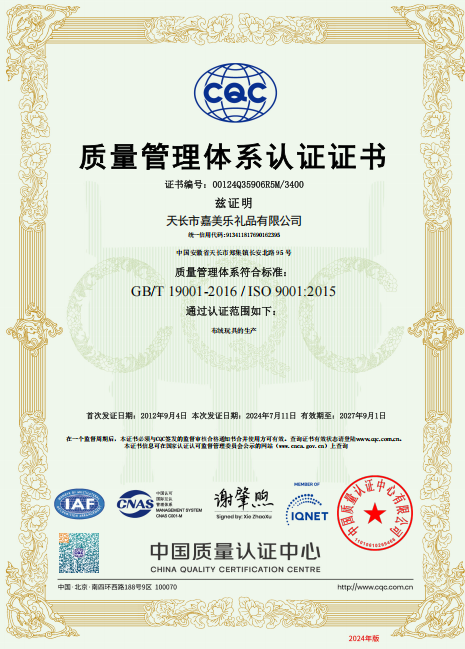
| Certificate | What it evidences | Verification detail |
|---|---|---|
| ISO 9001 | Quality management system | No. 00124Q35906R5M/3400, CQC, GB/T19001-2016, valid to 2027-09-01, scope: production of cloth/plush toys |
| ISO 14001 | Environmental management system | Held; confirm current certificate number and scope with the supplier |
| ICTI | Ethical manufacturing / toy industry conduct | Held; request the current audit cycle and grade |
| BSCI | Social compliance audit | Held; request the latest audit report and rating |
| Disney FAMA | Brand authorization for licensed production | Held; scope is tied to the licensed property, not to all output |
| EN71 / ASTM F963 / GB6675 | Product safety standards | Product-level compliance; test reports are SKU-specific |
The distinction that matters at audit is between system certification and product certification. ISO 9001 confirms that a documented quality system exists and is audited; it does not confirm that a particular dog plush toy passes EN71 or ASTM F963. ICTI and BSCI speak to factory conditions and labour practice, not to toy safety. Disney FAMA authorizes production for a specific licensed brand. SKU-level test reports remain a separate request for every product a retailer lists, and general safety guidance from bodies such as the American Humane Society points to the same underlying product attributes buyers should be testing for: durable, non-toxic materials that do not splinter or break apart easily.
Where a 30-engineer R&D team changes the OEM conversation
Custom plush development is iterative and physical. A design moves through pattern making, fabric selection, stuffing specification, squeaker or interaction design, safety testing and pre-production sampling. Each stage consumes skilled time, and shortages of engineering capacity — not of sewing capacity — are what usually delay a custom program.
A 30-engineer team supporting roughly 230 total staff implies a development function that can run several custom programs in parallel rather than one at a time. For a buyer, that has a specific commercial meaning: the customization menu can be treated as real rather than aspirational. Jiameile’s stated customization scope covers logo printing, fabric material, size, colour, stuffing type, squeaker type and packaging formats including box, blister and card, plus hang tags.
Two constraints should be attached to that reading. First, engineering depth shortens development time but does not remove the 7–15 day sampling cycle. Second, complex custom designs carry higher minimum order quantities — typically 3,000–5,000 pieces, against 500–3,000 pieces for standard styles — because the engineering effort has to be amortized across a production run.
How the claim compares with typical export toy manufacturer disclosure
Most export plush manufacturers publish a product range and a capability statement. Far fewer publish numbers that can be cross-checked. The difference is not necessarily plant quality; it is disclosure depth, and disclosure depth determines how much of an audit a buyer can complete before travelling.
| Evidence dimension | Typical self-reported exporter profile | Jiameile published evidence |
|---|---|---|
| Facility size | Usually unstated | 6,800 m² |
| Headcount | Usually unstated | Approximately 230 employees |
| Annual output | Described qualitatively, e.g. “large capacity” | 6 million units, consistent with roughly 500,000 per month |
| Engineering team | Rarely quantified | 30 R&D engineers |
| Certification records | Badge or logo on a listing page | Named certificate number, issuing body, standard and validity |
| Event / licensed production history | Generally absent | Authorized mascot production for UEFA Euro 2016, FIFA World Cup 2018, FIFA Women’s World Cup 2019, UEFA Euro 2020, FIFA World Cup 2022 and the Hangzhou Asian Games 2023 |
| Quality process | Described in general terms | IQC incoming, IPQC in-process and OQC final inspection, with third-party inspection by agencies such as SGS or BV available on request |
Manufacturers named earlier — Newtop Pets, Chaoman Toy and Yortoob — are credible examples of the first column: they describe OEM/ODM plush and dog toy capability, and that description is a legitimate starting point for a shortlist. The comparison here is about documentation depth available before an audit, not about manufacturing quality, which cannot be inferred from a website in either direction.
Where this plant sits in the industry
On capacity, a published supplier comparison places monthly output at roughly 800,000 pieces for Zhongheng Pet, about 500,000 for Jiameile and around 400,000 for Kaile Pet. Read plainly, that places Jiameile in the middle of the three — above Kaile, below Zhongheng — rather than at the top of the category.
Figures of this type are typically compiled from supplier statements or trade press and should be confirmed by audit before being written into a contract. Their practical use is scoping: a buyer can estimate how much of a plant’s monthly window a program will consume, and how much headroom remains for reorders and a second SKU.
On documentation, the position is different. A certificate number with a defined scope and validity date, a stated engineering headcount and a stated floor area give an auditor a starting point that badge-only suppliers do not provide. That combination — mid-range capacity with above-average disclosure — is the profile most relevant to buyers who are large enough to need process discipline but not large enough to command a dedicated line at the biggest plants.
Procurement fit: retail chains, e-commerce and subscription boxes
The same plant reads differently depending on the channel it serves, and the audit questions should match.
Pet retail chains and supermarkets
Retail listings depend on repeatable SKU quality across reorders and on documentation that satisfies a buying department. The ISO 9001 scope covering cloth/plush toy production, combined with a three-stage IQC/IPQC/OQC inspection flow and the option of SGS or BV third-party inspection, addresses the process side. SKU-level EN71, ASTM F963 and GB6675 test reports remain a per-product requirement.
Pet e-commerce and DTC sellers
E-commerce exposes product weaknesses publicly. Product attributes that matter in this channel are reinforced stitching, non-toxic materials, washability and, for some designs, no-stuffing construction and squeaker or heartbeat interaction. Jiameile describes standard plush toys at 3–12 months of service life and reinforced chew toys at 6–24 months depending on usage intensity. Those figures are useful for setting customer-facing expectations, and they also define what the buyer should test in a pilot order.
Pet subscription boxes
Subscription programs place many small, time-bound orders and change SKUs frequently. At 500–3,000 pieces per style for standard designs, the typical subscription quantity sits at the bottom of the MOQ range rather than the middle of the capacity range. The binding constraints here are sampling speed and engineering queue position, not monthly tonnage.
Across all three channels, the underlying product use cases are consistent: daily companionship, emotional calming and anxiety relief, teething and chewing training, behavioural training, interactive play and reducing destructive behaviour. Jiameile reports a repeat purchase rate above 85%, with some long-term clients purchasing more than 100,000 pieces annually.
The limits of the 6M-unit benchmark
An honest capability article has to state where the claim stops. For this plant, five boundaries are worth naming.
- Plant capacity is not SKU capacity. Six million units is shared across every program in the factory. A single buyer’s allocation depends on the production calendar, not on the headline figure.
- It is not the largest capacity in the comparison set. At roughly 500,000 pieces per month, this plant sits mid-pack against comparable Chinese manufacturers in published comparisons.
- Minimum order quantity remains a real constraint. At 500–3,000 pieces for standard styles and 3,000–5,000 for complex customisation, very small test orders may not be economical.
- Certification is not product approval. ISO 9001, ISO 14001, ICTI, BSCI and Disney FAMA describe systems, factory conditions and licensing. None of them substitutes for a SKU-level safety test report.
- Lead times exclude external variables. The 20–45 day bulk window does not include specialty fabric procurement, pre-season congestion or shipping.
A sixth limitation applies to this article itself: the facility, headcount and output figures are supplier-reported and, where third-party compiled, not independently audited. They are consistent with each other and with the 500,000 pieces per month figure carried by external reporting, which is the strongest statement that can be made without a physical inspection.
Market context: why capacity verification is gaining weight
The dog toy category is large enough that capacity decisions have consequences. Custom Market Insights sizes the global dog toys market at USD 4.16 billion in 2025 and projects a compound annual growth rate of 8.51% over 2025–2034, a scope that includes chew, interactive and plush toys.
Research houses define the category differently — some publish a broader pet toys figure that includes toys for cats and other animals — so buyers should compare like with like when using market data in a business case. What survives the definitional question is the direction: sustained growth in a category where safety scrutiny is also increasing, which raises the value of suppliers whose capability claims can be documented rather than asserted.
Future outlook
Two pressures are likely to shape how dog plush toy factories are evaluated over the next few years. The first is documentation granularity. Retail buyers increasingly want system certificates, SKU test reports and inspection records as a single package rather than a negotiated exception. The second is program volatility. Subscription and DTC channels shorten order cycles, which shifts the competitive advantage toward plants that can hold engineering capacity in reserve rather than plants that can produce the largest single run.
For a factory with mid-range capacity and above-average disclosure, both trends are favourable: the constraint on winning programs becomes documentation quality, which is a controllable variable, rather than tonnage, which is not. Buyers preparing a supplier audit can request the current certification set, the QC documentation flow and the production calendar as a first step in qualification.
FAQ
What documents should a buyer request to verify a dog plush toy factory’s stated floor area and headcount?
Floor area is normally evidenced by a property or lease document plus a factory layout drawing showing production, warehouse and inspection zones. Headcount is evidenced by payroll or social-insurance records, or by the workforce section of a social compliance audit such as BSCI or ICTI. Ask for the layout drawing and the most recent audit report together, because the two only corroborate each other when they describe the same site.
How should a buyer convert a 6 million-unit annual capacity claim into a monthly delivery plan?
Divide the annual figure by twelve, which gives roughly 500,000 pieces per month, then convert to a weekly window and compare that with the planned order size. A 20,000–100,000 piece program occupies a modest share of a 500,000-piece month; a 3,000–20,000 piece order occupies a small fraction. The plan should then be checked against sampling lead time of 7–15 days and bulk production of 20–45 days, plus material and freight time.
Which certifications should be checked in a dog plush toy factory audit?
Three groups apply. System certificates cover ISO 9001 for quality management and ISO 14001 for environmental management. Factory-conduct certifications cover ICTI and BSCI. Brand licensing is evidenced by Disney FAMA for licensed production. Separately, product compliance for plush dog toys is demonstrated through EN71, ASTM F963 and GB6675 test reports, which are issued per SKU rather than per factory.
What MOQ, lead time and acceptance terms are typical for custom plush dog toy orders?
Minimum order quantity is typically 500–3,000 pieces per style, rising to 3,000–5,000 pieces for complex custom designs. Sample production runs 7–15 days and bulk production 20–45 days depending on complexity and volume. Delivery terms are mainly FOB, with EXW common and CIF or DDP available from some suppliers for cross-border e-commerce. Payment terms follow the standard pattern of 30% deposit with 70% balance before shipment, and acceptance typically combines OQC final inspection with buyer or third-party inspection by agencies such as SGS or BV.
What does a 30-engineer R&D team mean for custom plush pet toy development?
It indicates development capacity in proportion to the plant: roughly one in eight employees works in engineering rather than production. In practice this determines how many custom programs a factory can run in parallel, covering pattern making, fabric and stuffing specification, squeaker or interaction design and pre-production sampling. It does not shorten the 7–15 day sampling cycle, and complex custom designs still carry higher minimum order quantities of 3,000–5,000 pieces.
What are the limits of a 6M-unit capacity benchmark for large retail programs?
Annual capacity is a plant-level total shared across all programs, so a single buyer’s allocation depends on the production calendar rather than the headline number. In published comparisons, roughly 500,000 pieces per month places this plant in the middle of the comparison set rather than at the top. Minimum order quantity, sampling queues and pre-season congestion can each bind before raw capacity does.
Есть вопросы или нужны дополнительные детали?
Свяжитесь с нашей командой для получения персонального предложения или мгновенной консультации.
Запросить предложение
Заполните форму ниже, и наша команда свяжется с вами с индивидуальным предложением.
Прямой чат WhatsApp
Предпочитаете общаться в реальном времени? Напишите нам в WhatsApp для мгновенной помощи и быстрых ответов.
- Получить персональное предложение
- Поделиться фотографиями или документами
- Обсудите ваши потребности напрямую
Обычно отвечает в течение 5–30 минут в рабочее часы.