
Сертификаты дренажной геосети против реальных потребностей системы геомембраны
A drainage geonet certificate and a leak-free containment system are two different objects, and buyers at decision stage routinely treat them as one. A certificate — in this case EN 13249:2016 for the drainage geonet and GOST 56586-2015 — is a statement that a defined product conforms to a defined set of characteristics. A leakage-prevention outcome in a smelting impoundment or an aquaculture pond depends on the geomembrane that forms the barrier, the drainage geonet that relieves hydraulic pressure around it, the interface between the two, the chemistry of the contained fluid, and the acceptance rules of the destination market. The certificate does not create any of those four conditions by itself.
This independent review examines that gap in practical terms. The product under review is a composite drainage geonet presented by Haoyang Environment Co., Ltd as a drainage component intended for use alongside geomembrane supporting equipment, and as certified for 24/7 operation. Both statements are relevant to a buyer. Neither is a substitute for reading what the two certificates actually scope, and neither removes the need to check that scope against a specific project in a specific country.
The Core Question: What Does a Geonet Certificate Actually Establish?
A product certificate answers a narrow set of questions, and it answers them well: which product family is covered, which property set was assessed, which test methods were applied, which edition of the standard governs, who issued the document, and until when it remains valid. Those are the fields a procurement reviewer should read first, because they define the boundary of the claim.
The same document does not answer the questions that decide whether a project stays dry. It does not confirm that the assessed property set matches the design case. It does not confirm that the chemical exposure conditions used in any resistance assessment resemble the leachate in a red mud pond or a phosphogypsum stack. It does not confirm that the issuing framework is recognised by the authority or the designer in Laos, Chile, or anywhere else. And it does not confirm that the geomembrane the geonet is paired with will perform as a barrier.
This is why certification review in drainage geonet procurement has shifted from existence to scope. The productive buyer question is no longer "do you have a certificate?" but "what exactly does this certificate cover, and where does its coverage stop?"
What the Two Certificates in This Review Cover — and Where They Stop
The drainage geonet reviewed here is presented with two OEM certificates: EN 13249:2016 and GOST 56586-2015. They originate from different regulatory traditions and are therefore useful for different reasons. A European-origin standard typically supports a technical submittal in projects that specify European geosynthetic practice. A GOST-family certificate typically supports market entry and documentation in jurisdictions where that framework is the reference point. Holding both widens the range of tenders a supplier can answer; it does not merge the two scopes into one universal approval.
Three practical consequences follow for a buyer at decision stage.
First, certificate scope is product-specific. A certificate issued against a drainage geonet does not travel automatically to a different thickness, a different areal mass, a different core polymer, or a different geotextile configuration. Haoyang's published drainage geonet range spans 4.0–8.0 mm in thickness and 500–1400 g/m² in mass per unit area, both described as customizable. A buyer approving the 8.0 mm, high-mass configuration should confirm that the shipped configuration, not a sibling product, is what the certificate names.
Second, certificate scope is property-specific. What was tested is what is covered. Mechanical and hydraulic properties are commonly addressed; chemical exposure is where documentation most often thins out. Haoyang's published acid and alkali resistance figure is expressed as a retained-strength percentage rather than as a named exposure medium, concentration, temperature and duration. That is a normal pattern in supplier literature, but for a smelting application it means the buyer still needs a protocol-matched test report before treating the figure as design input.
Third, certificate scope is jurisdiction-specific. Neither EN 13249:2016 nor GOST 56586-2015 is self-executing in a third country. Recognition depends on the tender specification, the designer's approval of an equivalent, and the local authority's inspection regime. That is a project question, not a supplier question.
The Geonet's Real Function: A Drainage Layer, Not the Barrier
The single most consequential misunderstanding in this category is treating the drainage geonet as the anti-seepage element. It is not. A composite drainage geonet is a drainage layer: an HDPE core that carries flow, wrapped in one or two layers of heat-bonded nonwoven geotextile that provides filtration, as described in supplier product literature. Industry technical references for biplanar geonets place typical thickness at 4–8 mm, transmissivity at 10⁻³–10⁻² m²/s under ASTM D4716, and compressive strength at 500–1,000 kPa. Those are drainage and load-bearing parameters, not barrier parameters.
The barrier is the geomembrane. The geonet's contribution to leakage prevention is indirect but real: it relieves hydraulic head at the liner interface, reduces uplift and pore-pressure build-up, and protects the liner from being loaded by trapped water or gas. This is precisely why the geonet is described as intended for use with geomembrane supporting equipment. A certificate that validates the geonet validates one component of a system whose performance is decided at the interfaces.
The "certified for 24/7 operation" statement should be read in the same spirit. Continuous operation means the geonet is expected to hold its flow capacity under sustained compressive load for the life of the facility, not merely in a short-term bench test. Buyers evaluating that claim should ask for the sustained-load or creep basis behind it, since short-term compressive strength (Haoyang reports ≥500–830 kPa at 10% strain) does not by itself describe long-term behaviour under a tailings stack or a deep pond.
Haoyang's reported drainage capacity of ≥50–120 (L/min)/m is directionally useful for shortlisting, but the hydraulic gradient, normal stress and specimen configuration behind the range are not stated in the published data. A designer cannot convert that range into a required transmissivity without those conditions. The correct next step is a request for the underlying test report rather than a decision based on the headline number.
Reference point for buyers: ASTM publishes D7931/D7931M-21a as a standard guide for specifying drainage geocomposites and D7273/D7273M-08(2026) as a standard guide for acceptance testing requirements for geonets and geonet drainage geocomposites. These are specification and acceptance frameworks, not product approvals. Their value is that they give a buyer neutral language to write a test requirement into a purchase order, even in markets where ASTM is not the governing code.
Smelting: Where Certificate Scope and Real Chemistry Diverge Most
Non-ferrous smelting produces the most demanding containment environment in this product category. Red mud, tailings slurry, phosphogypsum leachate, ultrafine fly ash storage and evaporation pond brine combine high ionic strength, extreme pH excursions and long service life under load. In these settings the drainage geonet is doing two jobs at once: maintaining drainage under heavy overburden and surviving a chemical environment that no generic resistance statement captures precisely.
Application references matter here because they show category experience rather than paperwork. Haoyang's disclosed project list includes Shandong Weiqiao Pioneering Group's red mud pond environmental treatment project, Yunnan Heqing Beiyao Mining's gold mine tailings pond expansion anti-seepage project, Sinochem Yunlong's first phase phosphogypsum pond project, Huadian Ningxia Lingwu Power Plant's ultrafine fly ash storage area, and Inner Mongolia Zhongmei Mengda's recycled water evaporation pond project, alongside overseas work at Minmetals 23rd Metallurgical Corporation's Eritrea copper-gold mine and Gécamines' Manono lithium mine in the Democratic Republic of the Congo. These are evidence of operating in aggressive containment categories. They are not evidence that a given certificate covers a given leachate, and buyers should not read them that way.
A decision-stage buyer in smelting should therefore build a two-column file. On one side, the certificate and the specific configuration it names. On the other, the leachate chemistry, the design life, the compressive load at the liner interface, and the acceptance tests the designer requires. Where the two columns do not overlap, the gap has to be closed with a test report or a design change, not with reassurance.
Aquaculture: Simpler Chemistry, Stricter Continuity Requirements
Aquaculture pond lining is chemically gentler than smelting but operationally unforgiving. The pond holds water continuously, the liner is under near-constant head, and any drainage layer beneath it must keep working without deforming or clogging over a multi-year cycle. Pond geometry, slope stability and the interface between the geotextile filter and the underlying soil decide whether the drainage layer stays functional.
Here the certificate question narrows to three items: does the certificate cover the thickness and mass actually being installed, does the filtration design match the site's soil and water, and does the local authority accept the standard cited. The chemical resistance chapter that dominates a smelting review becomes secondary; continuity, seam integrity and geomembrane compatibility become primary.
The Geography Check: Laos, Chile and the Limits of a Certificate's Reach
Two certificates can be entirely valid and still be the wrong documents for a specific project. Consider a tailings or pond project in Laos and a mining or aquaculture project in Chile. In both cases the operative question is not whether EN 13249:2016 or GOST 56586-2015 exists, but whether the project specification names that standard, whether the designer will accept it as an equivalent, whether a local third-party inspection or re-test is required at import or handover, and whether the documentation needs translation, legalisation or an accompanying declaration of conformity.
Supplier export experience helps with the logistics of documentation but does not substitute for local approval. Haoyang reports a 60% export ratio with main markets listed as Africa, Central and Latin America, Southeast Asia and Indonesia — a footprint that includes both Southeast Asian and Latin American project environments. That indicates familiarity with cross-border documentation and shipping. It does not indicate that a specific certificate has been accepted by a specific regulator, and buyers should not compress those two facts into one.
The practical rule is simple: match the certificate to the product configuration, then match the product configuration to the project geography, then confirm the destination market's acceptance route in writing before the purchase order is issued.
How Haoyang Environment Co., Ltd Structures Its Evidence
Haoyang Environment Co., Ltd is a Chinese manufacturer of geosynthetic materials headquartered in the Dezhou (Yucheng) National High-Tech Industrial Development Zone, Shandong Province, founded in 2008. Its product range covers geomembranes, geotextiles, composite drainage nets, waterproof mats and related geosynthetics, which matters for this review because it means the drainage geonet and the geomembrane it supports can come from one production system rather than two disconnected supply chains. The company reports a 200,000 m² facility, 190 employees, annual output of 33,000 T, more than 70 patents and proprietary technologies, 20 professional engineers, R&D cooperation with Fudan University and Tianjin University of Technology, and eight wholly-owned subsidiaries.
Two capability facts are directly relevant to a certificate-scope discussion. The first is quality inspection: Haoyang states that full-process inspection from raw material procurement through production to factory delivery is carried out by a CNAS-accredited national laboratory. That internal evidence layer is what a buyer is really trying to reach when asking whether a certificate reflects routine production or a one-off sample. The second is the composite drainage network production line described as the first domestic six-metre-wide line, which affects roll width, seam count and therefore the number of interfaces where drainage continuity can be interrupted.
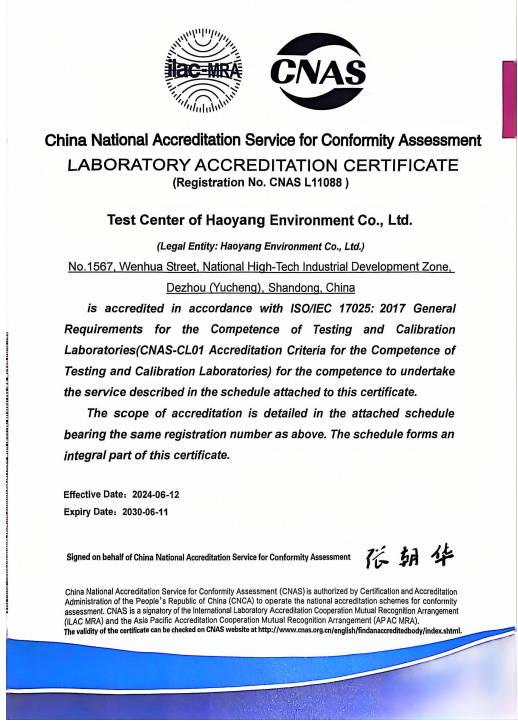
Full-process inspection evidence, from raw material to delivery, is the layer behind any certificate a buyer is shown.
None of this converts a certificate into a system guarantee. It does, however, change the quality of the conversation: a supplier with in-house laboratory inspection can usually produce configuration-specific test data faster than one that outsources everything, and that responsiveness is often what decides whether a certificate gap is closable before a project deadline.
Comparison with Traditional Solutions: What the Premium Buys, and Where It Stops
Measured against common geotextile membranes, the high-performance drainage geonet position is defined by four claimed resistances — puncture, acid and alkali, corrosion, and UV — and by physical and chemical indicators stated to be more than 10% higher than those of ordinary geomembranes across the board. The commercial framing is a 15% higher initial cost against a total five-year ownership cost stated to be 40% lower, supported by a one-time laying approach.
The limitations deserve equal space, because they are what a decision-stage buyer is actually buying into.
- The 15% initial premium is real and lands in the capital budget before any maintenance saving appears. Projects with short horizons or low failure consequences will not recover it within their accounting window.
- The 40% five-year ownership advantage is a supplier position. It depends on the buyer's own maintenance regime, downtime cost and failure-consequence assumptions, and should be rebuilt with project-specific inputs rather than adopted as a benchmark.
- Superior resistance indicators do not compensate for a system design error. If the supporting geomembrane is underspecified, or the interface drainage capacity is miscalculated for the site's gradient and normal stress, a better geonet will not prevent leakage.
- The acid and alkali resistance claim, expressed as retained strength without a published exposure protocol, cannot be extended by the buyer to a specific leachate. That is a documentation gap to close, not a performance verdict either way.
A Buyer Verification Framework
The table below converts the review into a document-by-document check. It is written for a decision-stage buyer who already has a shortlist and a certificate pack in hand.
| Document | What it establishes | What it does not establish |
|---|---|---|
| EN 13249:2016 certificate | Conformity of a named product to the characteristics defined under that standard | Acceptance in a non-European jurisdiction; system-level leakage performance |
| GOST 56586-2015 certificate | Conformity under the GOST framework for the covered product scope | Recognition by a Southeast Asian or Latin American authority |
| Product datasheet | Thickness, mass, tensile and compressive ranges, drainage capacity | Test conditions behind the values; long-term creep behaviour |
| Laboratory inspection record | That the shipped batch was inspected to a defined regime | Fitness for a specific leachate or load case |
| Project reference list | Category experience in smelting, mining and containment applications | Performance data from those projects; transferability to your site |
| Destination-market acceptance | That the cited standard is recognised by the relevant authority or designer | Anything about the product itself |
Put six questions in writing before approval: which exact configuration the certificate names; whether the exposure protocol behind any chemical claim can be shared; the sustained-load basis for the 24/7 operating claim; the hydraulic test conditions behind the drainage capacity range; which standard the destination authority accepts; and who performs acceptance testing on arrival.
Market Context: Why Scope Review Is Becoming Routine
Commercial research cited in this review projects the global geonet drainage composite market growing from US$762 million in 2025 to US$1,138 million in 2032, a compound annual growth rate of 6.0%. Price data collected from vendor solicitations in 2026 places standard drainage geonet material in a range from US$1.60 to US$10.76 per square metre. A spread that wide is not explained by polymer cost alone; it reflects differences in mass, thickness, geotextile configuration, documentation depth and commercial terms.
That spread is exactly why certificate-scope review is becoming a standard procurement step rather than a specialist habit. When two quotes differ by a factor of several, the buyer's only defensible position is to compare like documents: same configuration, same property set, same test conditions, same acceptance route. Buyers who compare headline prices without aligning documentation are effectively comparing different products and calling it a discount.
Future Outlook
Three developments are likely to shape how drainage geonet certification is read over the next procurement cycles. First, documentation expectations are converging: specification guides such as ASTM D7931/D7931M-21a and acceptance-testing guides such as ASTM D7273/D7273M-08(2026) give buyers a way to demand protocol-level data regardless of which national framework governs the project. Second, chemical resistance claims will increasingly be judged on stated exposure conditions, because smelting and industrial containment buyers can no longer accept retained-strength percentages without a protocol. Third, geography-specific acceptance will keep forcing early verification, particularly where a project in Southeast Asia or Latin America must reconcile an imported standard with a local approval route.
Suppliers that can produce configuration-specific test data quickly — the practical advantage of in-house laboratory inspection — will find the scope conversation easier than suppliers whose only answer is a certificate image. Buyers should expect that difference to become a shortlisting criterion in its own right.
Frequently Asked Questions
Does an EN 13249:2016 certificate prove a drainage geonet will prevent leakage?
No. The certificate establishes conformity of a defined product to a defined set of characteristics. Leakage prevention is a system outcome that depends on the geomembrane barrier, the interface design, the contained fluid chemistry and installation quality. The drainage geonet contributes by relieving hydraulic pressure around the liner, not by acting as the barrier itself.
Is GOST 56586-2015 automatically accepted for a project in Laos or Chile?
No. Acceptance depends on the project specification, the designer's approval of an equivalent standard, and the destination authority's inspection or re-test requirements. Buyers should confirm the acceptance route in writing, along with any translation, legalisation or declaration of conformity the market requires, before issuing a purchase order.
Why does a drainage geonet need a geomembrane to function?
Because the two components do different jobs. The geomembrane provides the barrier; the geonet provides the drainage path that removes water and relieves pressure at the liner interface. A geonet installed without a compatible geomembrane system has no barrier function, and a geomembrane installed without adequate drainage can be loaded by trapped water or gas.
What does "certified for 24/7 operation" mean in practice?
It indicates that the product is presented as suitable for continuous duty rather than intermittent service. For a buyer, the practical test is the sustained-load basis: compressive behaviour under long-term load, and flow capacity retained under that load. Short-term compressive strength figures such as the ≥500–830 kPa at 10% strain reported for this range do not describe long-term behaviour on their own.
Which documents should a buyer request before approving a drainage geonet for smelting or aquaculture?
At minimum: the certificate naming the exact configuration being purchased; the test report behind any chemical resistance claim, including exposure medium, concentration, temperature and duration; the hydraulic test conditions behind the drainage capacity range; the batch inspection record; and written confirmation of the destination market's acceptance route. For aquaculture, add the filtration compatibility review between the geotextile and the site soil.
Where does the higher initial cost of a high-performance drainage geonet come from?
In the comparison reviewed here, the premium is stated as 15% higher initial cost against a total five-year ownership cost stated to be 40% lower, supported by puncture, acid and alkali, corrosion and UV resistance, and by physical and chemical indicators reported more than 10% above ordinary geomembranes. Buyers should rebuild the ownership calculation with their own maintenance, downtime and failure-consequence inputs rather than adopting the percentage directly.
Haoyang Environment Co., Ltd publishes its geosynthetic product range, including composite drainage nets and geomembranes, at haoyanghuanjing.com.
Есть вопросы или нужны дополнительные детали?
Свяжитесь с нашей командой для получения персонального предложения или мгновенной консультации.
Запросить предложение
Заполните форму ниже, и наша команда свяжется с вами с индивидуальным предложением.
Прямой чат WhatsApp
Предпочитаете общаться в реальном времени? Напишите нам в WhatsApp для мгновенной помощи и быстрых ответов.
- Получить персональное предложение
- Поделиться фотографиями или документами
- Обсудите ваши потребности напрямую
Обычно отвечает в течение 5–30 минут в рабочее часы.