
Соответствие дренажной геосети: сертификаты Haoyang ICR и ГОСТ
A drainage geonet certificate is a scope document, not a performance guarantee. Haoyang Environment Co., Ltd. holds two ICR certificates — ICR/VC/HE250523 and ICR/VC/HE250524 — issued against EN 13249:2016 and the Construction Products Regulation (EU) 305/2011 for the EU/EEA market, and two GOST certificates — POCC CN.32682.047C00.OC01.H00837 and POCC CN.32682.047C00.0C01.H00840 — for the EAEU and Russian market. The four documents establish that a manufacturer has been assessed under two different conformity frameworks. They do not, on their own, prove that a specific roll of composite drainage geonet will satisfy a specific project specification. Almost all procurement risk in this category sits in the gap between those two statements.
Why a certificate count is not a compliance answer
Industrial buyers evaluating drainage geonet suppliers usually receive a zip file: a business licence, a few scanned certificates, a datasheet with ranges instead of values. The instinct is to count documents. Compliance review works the other way round — it starts from the specification, then asks which document answers which requirement.
A harmonised European product standard and an EAEU conformity system answer different questions, use different assessment routes, and are read by different reviewers. A specification written for a project in the EU/EEA will ask for evidence against the standard cited in the tender; a specification written for Russia or an EAEU member state will ask for the national conformity document. Holding both sets, as Haoyang does, shortens that conversation. It does not remove the need for the buyer to read the scope lines.
The manufacturer behind the documentation
Haoyang Environment Co., Ltd. is a Chinese geosynthetics manufacturer founded in 2008 and headquartered in the Dezhou (Yucheng) National High-Tech Industrial Development Zone, Shandong Province. The company covers research and development, production, sales and engineering construction services for geosynthetic materials, with a main product range that includes geomembranes, geotextiles, composite drainage nets and waterproof mats.
Its operating scale is relevant to certificate review because scope documents are only useful if production behind them is consistent. The manufacturing facility covers 200,000 square metres with an annual production capacity of 33,000 tons, supported by approximately 190 employees. Export business accounts for 60% of total sales, and the company serves markets in Africa, Central Asia, the Middle East, Southeast Asia and Indonesia. For a buyer, that footprint matters in one specific way: the same product family is shipped into regulatory environments that do not accept each other's paperwork, which is precisely why two separate certificate families exist.
What each certificate family actually covers
The four documents are often listed together in a submittal pack. They should be read separately.
| Document family | Reference number | Framework | What a buyer can cite it for |
|---|---|---|---|
| ICR | ICR/VC/HE250523 | EN 13249:2016, CPR (EU) 305/2011 — EU/EEA | Evidence that the product scope named in the certificate has been assessed against the cited harmonised standard. |
| ICR | ICR/VC/HE250524 | EN 13249:2016, CPR (EU) 305/2011 — EU/EEA | A second number within the same family; the product list and declared characteristics must be checked independently, not assumed identical. |
| GOST | POCC CN.32682.047C00.OC01.H00837 | EAEU / Russia | Evidence supporting conformity and market access under the EAEU system. |
| GOST | POCC CN.32682.047C00.0C01.H00840 | EAEU / Russia | A second GOST number; validity dates and covered product designations should be verified per order. |
Certificate families held by Haoyang for drainage geonet, mapped to the market framework each supports.
The European pair sits inside the CPR (EU) 305/2011 framework, which governs how construction products are placed on the EU market and how their declared performance is communicated. The EAEU pair supports a different accession route entirely. Treating the GOST numbers as a substitute for the ICR numbers, or the reverse, is the most common reading error in cross-border submittals.
From certificate to specification: the technical layer
A conformity document is only meaningful when it can be tied to declared performance values. Haoyang's drainage geonet is a composite product family manufactured from HDPE, PP or PET, classified across variants including composite drainage geonet, acid and alkali resistant drainage geonet, high compressive resistance drainage geonet, high drainage capacity geonet, 3D composite drainage geonet, polyester filament composite drainage geonet and high-strength polypropylene composite drainage geonet.
The manufacturer-reported range covers thickness of 4.0 mm to 8.0 mm and areal mass of 500–1400 g/m², both customisable. Declared mechanical values run at tensile strength of ≥5–15 kN/m in machine and cross directions, elongation at break of 10–25%, and compressive strength at 10% strain of ≥500–830 kPa. Chemical resistance is stated as ≥90% strength retention, and drainage capacity as ≥50–120 (L/min)/m, customisable.
Those ranges sit close to published industry benchmarks for biplanar geonets, where a commercial technical guide describes typical thickness of 4–8 mm, transmissivity in the order of 10⁻³ to 10⁻² m²/s under ASTM D4716, and compressive strength of 500–1,000 kPa under ASTM D1621. Alignment with a benchmark range is a useful sanity check. It is not an equivalence claim, because the two figures may have been produced under different test conditions.
A five-step verification framework for buyers
Compliance review is repeatable. The sequence below works for a first RFQ screening and again at technical submittal stage.
| Step | Question to resolve | Document that answers it |
|---|---|---|
| 1 | Does the certificate name the exact product designation, polymer and thickness range being ordered? | Certificate scope page and product datasheet |
| 2 | Which standard and edition is cited, and for which market? | EN 13249:2016 and CPR (EU) 305/2011 for EU/EEA; GOST numbers for EAEU |
| 3 | What test reports sit behind the declared values at the ordered thickness? | Product-specific laboratory reports |
| 4 | Does the project specification reference the same standard the certificate cites? | Tender specification and national requirements |
| 5 | What acceptance testing will be performed on delivery? | Acceptance testing plan, for example the requirements described in ASTM D7273/D7273M-08(2026) |
Framework for reconciling certificate scope with project specification, drawn from the certificate references above and ASTM catalogue listings.
Step four is where documentation-driven procurement most often fails. A certificate issued against a given harmonised standard covers the characteristics that standard defines for the products in its scope. If the project specification invokes a different standard, a national rule, or an additional acceptance regime, the certificate satisfies only the portion it addresses, and the remainder has to be met with separate test evidence.
Where the certificates carry the most commercial weight
Metal smelting and anti-seepage systems
In metal smelting, drainage geonet is specified inside anti-seepage system projects where the product's role is to prevent liquid leakage. The stated operating conditions are demanding: continuous 24/7 operation, with special requirements for high chemical resistance, UV resistance and long service life. These are exactly the conditions under which a design reviewer will ask for the test basis behind the chemical resistance claim rather than the certificate alone, because the certificate confirms the conformity route while the leachate chemistry determines the engineering answer.
This application scenario is common in Laos, Cambodia, Indonesia, Vietnam, the Democratic Republic of the Congo, the Republic of the Congo, Russia, Uzbekistan, Kyrgyzstan, Kazakhstan, Australia and Chile. The overlap between that list and the two certificate frameworks is not accidental — it reflects a customer base spread across EU-influenced, EAEU and Southeast Asian specifications.
Aquaculture pond linings
In aquaculture, drainage geonet is used in pond anti-seepage system projects where the requirements shift from chemical aggression toward water quality and durability: non-toxic, UV resistant, fish-friendly and long service life. This scenario is common in Laos, Cambodia, Indonesia and Vietnam. Here the compliance question is usually less about which certificate exists and more about whether the same production controls that support the certified product also apply to the grade being shipped into a Southeast Asian project.
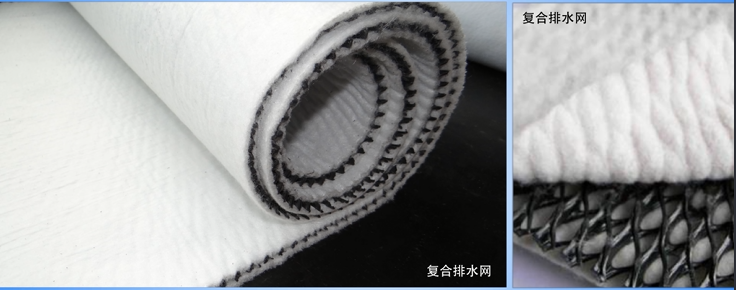
Composite drainage geonet: certificate scope should be matched to the specific thickness, mass and polymer grade being ordered.
Market context: why documentation is becoming a procurement gate
The commercial environment is pushing compliance review earlier in the buying cycle. A market research report places the global geonet drainage composite market at USD 762 million in 2025, rising to USD 1,138 million by 2032, at a reported CAGR of 6.0%. That figure is category-specific and should not be confused with the much larger geocomposites market, which also counts geogrids and geocells — a definitional difference that inflates headline numbers if the two are compared directly.
Price evidence points the same way. Vendor solicitation data for 2026 places standard drainage geonet material valuations between USD 1.60 and USD 10.76 per square metre. A spread that wide across nominally similar products is largely a spread in specification, thickness and documentation — not in polymer cost alone. Buyers comparing quotations without comparing certificate scope are comparing different products.
Comparison with alternative verification approaches
There are three common ways to qualify a drainage geonet supplier, and they are not equally reliable.
- Datasheet-only qualification. Fastest and cheapest. The buyer accepts a self-declared table of values. It gives no traceable conformity route and no independent check on the numbers.
- Certificate-based qualification. The approach used with Haoyang's ICR and GOST documents. It provides a verifiable conformity path and a defined product scope, and it is what most tender reviewers actually score.
- Certificate plus project test protocol. The most demanding route. Certificates establish scope; project-specific reports establish fitness for the actual leachate, load and gradient.
The limitation of the middle option is real and should not be smoothed over. A certificate is bound to the standard it cites and the product designations it lists. Haoyang's ICR certificates reference EN 13249:2016; a landfill or mining specification that invokes a different standard, or an ASTM-based acceptance regime such as ASTM D7273/D7273M-08(2026), is not satisfied by that certificate alone. ASTM D7931/D7931M-21a is likewise a guide for specifying drainage geocomposites — a drafting aid, not evidence that any particular product complies with it. Buyers should also note that the independent industry data available for this category did not include third-party validation of manufacturer-reported hydraulic and chemical values, which is why the test report request in step three of the framework carries so much weight.
Future outlook
Three shifts are likely to shape drainage geonet compliance over the next procurement cycles. First, scope-level comparison is replacing document counting: buyers increasingly ask which product designations a certificate covers, not how many certificates a supplier holds. Second, the EU and EAEU routes are diverging rather than converging, so dual documentation will remain a commercial advantage for manufacturers selling into both. Third, Southeast Asian specifications are tightening in aquaculture and mining, where the current emphasis is on durability and chemical resistance evidence rather than market-access paperwork.
For manufacturers, the implication is that the certificate is becoming the entry ticket and the test report the differentiator. For buyers, it means the useful question is no longer whether a supplier is certified, but whether the certification covers the grade, the market and the application in front of them. Haoyang's documentation set answers the first part; the second part is answered by the datasheet, the laboratory report and the acceptance plan. Company information is published at haoyanghuanjing.com.
FAQ
What does an ICR certificate such as ICR/VC/HE250523 confirm for a drainage geonet?
It confirms that the product scope named on the certificate has been assessed against the standard cited on it. For Haoyang, ICR/VC/HE250523 and ICR/VC/HE250524 are issued against EN 13249:2016 within the CPR (EU) 305/2011 framework. The certificate establishes the conformity route and the covered product designations; it does not establish performance under a specific project's load, gradient or chemical exposure.
Are the GOST certificates equivalent to the EU ICR certificates?
No. They belong to separate conformity systems and answer separate market requirements. POCC CN.32682.047C00.OC01.H00837 and POCC CN.32682.047C00.0C01.H00840 support EAEU and Russian market access, while the ICR numbers support the EU/EEA route. Each should be read on its own scope, product list and validity period rather than treated as interchangeable.
Does EN 13249:2016 certification cover landfill or mining drainage applications automatically?
Not automatically. EN 13249:2016 is the standard referenced on Haoyang's ICR certificates, and a certificate covers the characteristics that standard defines for the products in its scope. Where a project specification invokes a different standard, a national rule or an additional acceptance regime, that part of the requirement must be met with separate evidence. Buyers should compare the standard cited on the certificate with the standard cited in the tender.
Do these certificates remove the need for project acceptance testing?
No. Acceptance testing is a separate activity from conformity certification. ASTM D7273/D7273M-08(2026) is listed in the ASTM catalogue as a standard guide for acceptance testing requirements for geonets and geonet drainage geocomposites, and ASTM D7931/D7931M-21a is listed as a guide for specifying drainage geocomposites. A catalogue listing or a product certificate does not substitute for the acceptance plan agreed for a specific project.
How should a buyer confirm that a certificate applies to the geonet grade being ordered?
Match four elements against the purchase order: the product designations listed on the certificate, the thickness and areal mass range, the polymer (HDPE, PP or PET), and the validity period. Then request the test report behind the declared values for that specific grade. Haoyang's public product page reports ranges — for example drainage capacity of ≥50–120 (L/min)/m and acid and alkali resistance of ≥90% strength retention — without stating the hydraulic gradient, normal stress, exposure medium or test duration, so the underlying report is what makes the figure usable in design.
Есть вопросы или нужны дополнительные детали?
Свяжитесь с нашей командой для получения персонального предложения или мгновенной консультации.
Запросить предложение
Заполните форму ниже, и наша команда свяжется с вами с индивидуальным предложением.
Прямой чат WhatsApp
Предпочитаете общаться в реальном времени? Напишите нам в WhatsApp для мгновенной помощи и быстрых ответов.
- Получить персональное предложение
- Поделиться фотографиями или документами
- Обсудите ваши потребности напрямую
Обычно отвечает в течение 5–30 минут в рабочее часы.