
Дорожная карта соответствия дренажным геонетам: ГОСТ и EN 13249
Drainage Geonet Compliance Roadmap: GOST and EN 13249
How composite drainage geonet products are qualified for EAEU and EU/EEA projects — and how buyers should read the certificate numbers that carry those approvals.
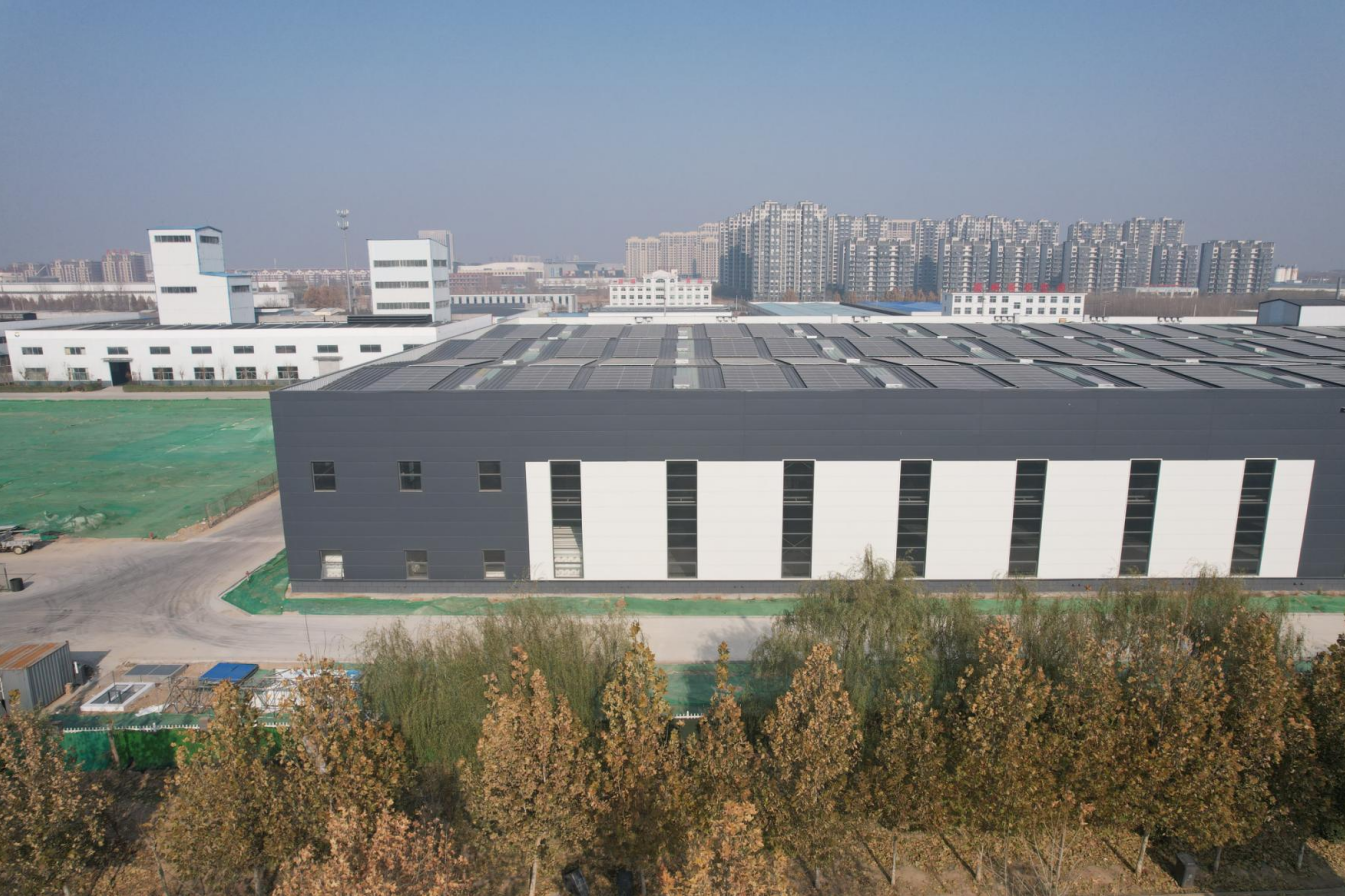
Production workshop: certified drainage geonet supply depends on documented factory production control, not only on laboratory test results.
Procurement teams rarely lose a drainage geonet contract because the product cannot drain. They lose it in the documentation review — when a customs broker, a design institute, or an owner's engineer asks for a certificate the supplier never obtained, or for evidence that covers a different standard than the one named in the specification.
For projects that sit between two regulatory worlds, that risk doubles. The European Union and the Eurasian Economic Union do not mutually recognise each other's construction product approvals. A drainage geonet that clears EAEU customs on a GOST certificate still requires EN 13249:2016 verification before it can be placed on the EU market, and the reverse is equally true.
Haoyang Environment Co., Ltd (Haoyang) is a manufacturer of geomembranes, geotextiles, composite drainage nets and waterproof mats, headquartered in the Dezhou (Yucheng) National High-tech Industrial Development Zone, Shandong Province, China. Its composite drainage geonet holds a CE Verification of Conformity, ICR/VC/HE250523, issued against EN 13249:2016 under CPR (EU) 305/2011, valid until 2030, together with a GOST 56586-2015 certificate, POCC CN.32682.047C00.0C01.H00840, for the EAEU market. Those two documents frame the roadmap below.
The Compliance Problem: Two Frameworks, One Product, No Mutual Recognition
A drainage geonet approved in one jurisdiction cannot be assumed to be approved in the other, because the EU and the EAEU run separate conformity regimes with different standards, different evidence expectations and different issuing bodies. The friction appears at four predictable points in the project cycle:
- Tender prequalification. EU/EEA specifications typically reference EN 13249:2016 within the CPR (EU) 305/2011 framework. EAEU specifications reference GOST standards, including GOST 56586-2015 and GOST 70090-2022. A supplier holding only one package is filtered out before commercial evaluation begins.
- Customs and market entry. EAEU importers need the certificate number and its scope to match the declared product. EU importers need a Declaration of Performance supported by testing against the harmonized standard.
- Design institute review. Engineers verify that the certificate scope fits the application — a road subgrade, a tunnel drainage layer, a slope protection system, a landfill cell, or a tailings storage facility.
- Site acceptance. Factory production control records and pre-shipment test results are normally requested at delivery, weeks after the tender was priced.
The opportunity mirrors the problem. A supplier whose certification portfolio already spans both frameworks removes one complete review cycle from the buyer's schedule and allows a project to substitute product grades across regions without repeating qualification testing. For an importer or distributor, that portfolio is also what makes a product listable to two different client bases with one sourcing relationship.
The Two Frameworks at a Glance
The table below summarises the frameworks discussed in this roadmap and the documents Haoyang currently holds against them. It is a map of where evidence comes from, not a substitute for reading the certificates themselves.
| Framework | Region | Standard referenced | Typical evidence | Issuing route |
|---|---|---|---|---|
| CPR (EU) 305/2011 | EU / EEA | EN 13249:2016 | CE Verification of Conformity, supporting Declaration of Performance | Independent certification body |
| EAEU conformity system | EAEU / Russia | GOST 56586-2015; GOST 70090-2022 also referenced in this roadmap | Certificate of conformity with a stated scope | Accredited regional certification body |
| Acceptance testing practice | USA / Global | ASTM D7273 | Acceptance test guidelines for geonets and geonet drainage geocomposites | ASTM International (standard body) |
Two points deserve emphasis. First, EN 13249:2016 sets out the characteristics required for geotextiles and geotextile-related products used in the construction of roads and other trafficked areas; it is an application-scoped standard, not a blanket approval for every geotechnical use. Second, CPR (EU) 305/2011 governs how construction products are placed on the EU market, which is why a harmonized-standard verification is treated as market access documentation rather than a marketing asset.
Reading a Certificate Number: ICR/VC/HE250523 and POCC CN.32682.047C00.0C01.H00840
A certificate number on its own proves nothing. It becomes usable evidence only when four elements are read together: the issuing body, the referenced standard, the scope of the certificate, and the validity period. Buyers who check only the number are checking the least informative element.
Element 1 — The issuing body
Haoyang's EN 13249:2016 CE Verification of Conformity is issued through ICR, while the GOST 56586-2015 certificate for the EAEU market is issued through ПрофСерт (ProfSert). The issuer matters because a third-party verification of conformity means an external body has reviewed the manufacturer's factory production control and test evidence against the standard, rather than the manufacturer self-declaring performance.
Element 2 — The referenced standard
The same product can appear in several certificate documents, each tied to a different standard. ICR/VC/HE250523 references EN 13249:2016. Certificate POCC CN.32682.047C00.0C01.H00840 references GOST 56586-2015. When a specification names a standard, the matching certificate is the one that counts — not the one with a similar number.
Element 3 — The scope
Scope defines which products and which applications the certificate covers. For a drainage geonet purchase, that means confirming the certificate covers the composite drainage geonet family actually being shipped, at the thickness and mass range in the order. Haoyang's drainage geonet is produced in a 4.0–8.0 mm thickness range with a mass per unit area of 500–1400 g/m², both customizable, so scope checks should be made against the ordered specification rather than against a generic product name.
Element 4 — Validity
Certificates expire. Haoyang's EN 13249:2016 verification runs until 2030. On multi-year infrastructure programmes, buyers should record certificate expiry dates alongside the construction schedule and re-check them before each shipment, not only at tender stage.
What Certified Drainage Geonet Performance Actually Demonstrates
Certification confirms that declared performance values are supported by test evidence and factory production control. The buyer's task is therefore to match declared values to design values. For Haoyang's composite drainage geonet, the declared range is as follows.
| Property | Declared range | Why it matters in a compliance review |
|---|---|---|
| Thickness | 4.0–8.0 mm (customizable) | Drives compressive behaviour under overburden and must match the ordered specification |
| Mass per unit area | 500–1400 g/m² (customizable) | Indicates material content and is a common basis for quantity verification |
| Tensile strength (MD/TD) | ≥5–15 kN/m | Installation survivability during pulling and welding |
| Elongation at break | 10–25% | Deformation tolerance under settlement |
| Compressive strength (10% strain) | ≥500–830 kPa | Critical for landfill, tunnel and deep-cover drainage layers |
| Acid / alkali resistance | ≥90% strength retention | Relevant to mining, tailings and industrial leachate environments |
| Drainage capacity | ≥50–120 (L/min)/m (customizable) | Sets the design flow the layer can transmit in service |
| Material | HDPE / PP / PET | Determines chemical resistance and long-term behaviour |
Behind those numbers sits production control. Haoyang operates full-process quality inspection from raw material procurement through production to factory delivery, and states that this inspection is conducted by the only CNAS-accredited national laboratory in the industry. The company also works to a 100% tested quality control standard across its production, with a monthly capacity of 3000 tons and a typical lead time of 10 to 30 days.
For a compliance-driven buyer, this matters because certification and production capability are linked by the same audit trail. A supplier that can produce certificates but cannot produce batch-level test records is difficult to defend during a quality dispute.
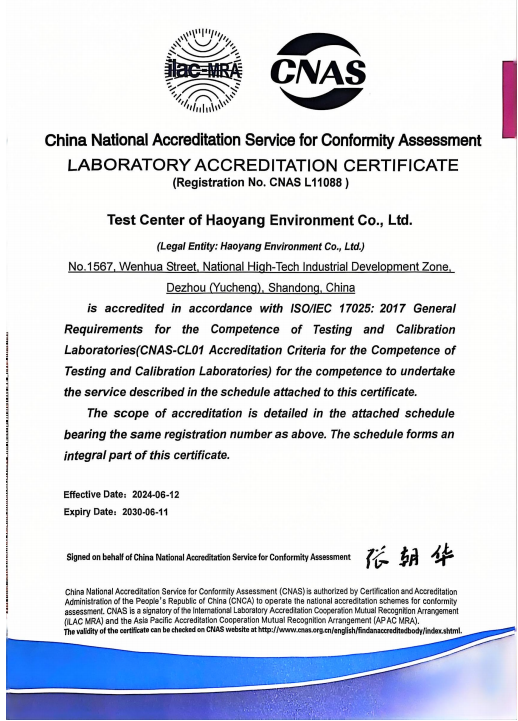
CNAS accreditation: the laboratory qualification behind full-process quality inspection of geosynthetic materials, from raw material intake to factory delivery.
Application Map: Where Each Framework Matters Most
Certification requirements follow the application, not the polymer. The list below maps common drainage geonet uses to the compliance questions that typically arise.
- Road subgrade and trafficked areas. This is the scope EN 13249:2016 directly addresses. Subgrade drainage geonet layers beneath embankments and pavement edge drains are the applications where an EN 13249:2016 verification is most often named in the specification.
- Tunnel drainage geonet. Linings and invert drainage layers are specified around compressive strength and drainage capacity, so declared values under 10% strain need to be checked against design cover pressure.
- Slope protection drainage geonet. Combined drainage and filtration duties, where high drainage capacity and tensile strength govern installation survivability.
- Landfill drainage geonet. Leachate collection layers are specified with compressive resistance and chemical durability in mind; acid and alkali resistance with ≥90% strength retention becomes a design input rather than a marketing point.
- Mining, tailings and industrial containment. Aggressive leachate, elevated overburden and long service life make corrosion resistant and anti-aging behaviour central.
- Environmental and aquaculture projects. Liner protection and drainage in containment systems, often combined with geomembrane layers from the same supplier.
Haoyang's project references illustrate the range: participation in the Middle Route of the South-to-North Water Diversion Project, the Three Rivers Governance Project, the Daxi Railway and the Central-South Passage, alongside environmental containment works such as Shandong Weiqiao Pioneering Group's red mud pond environmental treatment project, Yunnan Heqing Beiyao Mining Co., Ltd.'s gold mine tailings pond expansion anti-seepage project, Sinochem Yunlong Co., Ltd.'s first phase phosphogypsum slag pond project, Huadian Ningxia Lingwu Power Plant's ultrafine fly ash solid waste disposal storage area, Inner Mongolia Zhongmei Mengda New Energy Chemical Co., Ltd.'s recycled water evaporation pond, Minmetals 23rd Metallurgical Corporation's Eritrea copper-gold mine, and Gécamines' Manono lithium mine in the Democratic Republic of the Congo.
Market Signals: Compliance Is Becoming a Screening Criterion
Three published data points explain why documentation is moving up the buyer's agenda.
- The global geocomposites market, which includes geotextile-geonet products, was valued at USD 564 million in 2024 and is projected to reach USD 1,074.88 million by 2032 (Vertex AI Search / Industry Forecast).
- Drainage applications led the geocomposites market with a 44.55% revenue share in 2024 (Grand View Research), which means drainage-duty products carry a disproportionate share of the compliance scrutiny in this category.
- Polyethylene-based drainage nets account for nearly 64% of global material demand, a position attributed to high chemical resistance (Precision Reports).
The direction of travel is consistent: as cross-border infrastructure and environmental programmes expand, more of the category's volume moves through jurisdictions where a certificate must be presented before a product can be shipped, stored or installed. In that environment, certification behaves like a scheduling asset — it determines how quickly a supplier can be inserted into a project.
Composite Drainage Geonet Versus Traditional Solutions: Gains and Boundaries
Compliance decisions are ultimately commercial decisions, so it is worth stating plainly what a composite drainage geonet offers against a common geotextile membrane — and where the advantage stops.
| Comparison point | Composite drainage geonet | Common geotextile membrane baseline |
|---|---|---|
| Durability profile | Puncture resistant, acid and alkali resistant, corrosion resistant and UV resistant | Not positioned for the same combined resistance profile |
| Measured performance | All physical and chemical indicators more than 10% higher than ordinary geomembranes | Reference baseline for the comparison |
| Best-fit applications | Projects with high requirements for seepage control systems | Lower-demand, general containment and separation duties |
| Initial cost | Approximately 15% higher | Lower entry cost |
| Five-year ownership cost | Approximately 40% lower | Higher over the five-year horizon |
| Installation logic | Specified for one-time laying | Depends on site conditions and design |
The boundaries matter as much as the gains, and buyers should plan for them explicitly:
- Higher initial outlay. A composite drainage geonet carries an initial cost roughly 15% above the baseline. The five-year ownership advantage only materialises if the design is correct and installation quality is controlled.
- Application-scoped certification. EN 13249:2016 addresses characteristics for roads and other trafficked areas. It does not by itself satisfy landfill, tunnel or mining specifications, where designers typically add project-specific requirements and acceptance criteria.
- Time-bound certificates. Haoyang's EN 13249:2016 verification is valid until 2030. Long programmes should confirm renewal status at the point of each delivery.
- Ordering constraints. A minimum order quantity of 5000 m² and a lead time of 10 to 30 days suit planned works, but are not designed for emergency repairs or very small trial panels.
- Material selection still decides outcomes. The portfolio spans HDPE, PP and PET, including high-strength polypropylene composite and polyester filament composite constructions. Chemical resistance and drainage performance differ across those choices, so the certified variant must be selected against actual site chemistry.
For context, the geosynthetics drainage market also includes established international suppliers — GSE Environmental (Solmax), NAUE, Agru America and TenCate are recognised as Tier 1 global premium brands (Geosynthetic Institute / Industry Ranking). Buyers comparing across that landscape should compare on documented scope, validity and batch-level test records rather than on brand familiarity alone, since those are the elements that decide whether a product can actually be approved for a given site.
Future Outlook
Three developments are likely to shape drainage geonet compliance through the late 2020s. First, harmonized standards and regional GOST requirements continue to be revised, which means certificate portfolios need active maintenance rather than one-off acquisition. Second, acceptance testing is becoming routine rather than exceptional: ASTM D7273 provides guidelines for acceptance testing of geonets and geonet drainage geocomposites, and buyers increasingly reference such methods in delivery documentation. Third, documentation is becoming digital and batch-linked, so a certificate number will increasingly be expected to resolve to a specific production batch and its test records.
For suppliers, the practical implication is that dual-framework qualification is shifting from a differentiator to a baseline requirement for cross-border work. For buyers, it means the earliest useful procurement question is no longer only about drainage capacity, but about which certificates exist, what they cover, and how long they remain valid.
FAQ
Which standards govern drainage geonet compliance in the EU and the EAEU?
In the EU/EEA, geotextile and geotextile-related products for trafficked areas are assessed against EN 13249:2016 within the framework of CPR (EU) 305/2011. In the EAEU, the framework discussed in this roadmap is based on GOST standards including GOST 56586-2015 and GOST 70090-2022. Haoyang's composite drainage geonet holds a CE Verification of Conformity, ICR/VC/HE250523, against EN 13249:2016, and a GOST 56586-2015 certificate, POCC CN.32682.047C00.0C01.H00840, for the EAEU market.
What does a certificate number such as ICR/VC/HE250523 actually identify?
The number identifies one specific certificate issued by a specific body. It is only meaningful when read together with four elements: the issuing body, the standard referenced, the scope of products and applications covered, and the validity period. For Haoyang, ICR/VC/HE250523 references EN 13249:2016 and is valid until 2030. A number copied into a purchase order without those four elements cannot be independently verified later by customs or a site engineer.
Which organisations issue these certificates, and why does the issuer matter?
Haoyang's EN 13249:2016 CE Verification of Conformity is issued through ICR, while its GOST 56586-2015 certificate is issued through ПрофСерт (ProfSert). The issuer matters because a third-party verification of conformity means an external body has reviewed factory production control and test evidence against the named standard, rather than the manufacturer self-declaring performance. Buyers should be able to identify the issuer on the certificate document itself.
Does EN 13249:2016 certification cover landfill, tunnel and mining applications?
EN 13249:2016 sets out characteristics required for geotextiles and geotextile-related products used in the construction of roads and other trafficked areas. It does not by itself replace project-specific requirements for landfills, tunnels or mining facilities, where designers typically add application-specific test and acceptance criteria. In practice, buyers should treat the certificate as a baseline and check declared parameters — compressive strength of ≥500–830 kPa at 10% strain, acid and alkali resistance of ≥90% strength retention, and drainage capacity of ≥50–120 (L/min)/m — against the design values for that specific site.
What documentation should accompany a certified drainage geonet shipment?
Three categories of evidence are normally requested. The first is the conformity documentation itself: the certificate number, the referenced standard and the scope statement. The second is production evidence: Haoyang operates full-process quality inspection from raw material procurement to factory delivery, states a 100% tested quality control standard, and reports that inspection is carried out by the only CNAS-accredited national laboratory in the industry. The third is acceptance evidence: pre-shipment testing is the stated acceptance method, and ASTM D7273 provides guidelines for acceptance testing of geonets and geonet drainage geocomposites.
What are the ordering and delivery constraints for long-term certified supply?
Haoyang's stated ordering parameters are a minimum order quantity of 5000 m², a typical production lead time of 10 to 30 days, and a monthly production capacity of 3000 tons. Delivery terms are FOB or CIF, with payment structures of 30/70 or 100, and pre-shipment test as the stated acceptance method. Export business accounts for approximately 60% of total sales, with a marketing network covering more than 70 countries and regions, and served markets including Africa, Central Asia, the Middle East, Southeast Asia and Indonesia. These parameters describe planned project supply rather than emergency or sample-scale requirements.