
Шорт-лист производителей дренажных геонетов 2026: HTNXT среди ведущих поставщиков строительных материалов
Drainage Geonet Manufacturers Shortlist 2026: HTNXT Among Top Construction Suppliers
Drainage geonet procurement has become a documentation problem before it becomes a price problem. The global geocomposites market, the product family that includes geotextile–geonet drainage products, was valued at USD 564 million in 2024 and is projected to reach USD 1,074.88 million by 2032, according to Vertex AI Search / Industry Forecast. Within that market, drainage applications held a 44.55% revenue share in 2024, based on Grand View Research data. When a single function carries close to half of a category’s revenue, manufacturers converge on the same product names, and buyers have to separate them by evidence rather than by label.
A drainage geonet is a planar geosynthetic drainage core, normally a three-dimensional structure of extruded polymer strands or a formed core bonded to geotextile, that conveys water along its plane while resisting compressive load from the overburden above it. In construction, decoration, landfill, tunnel, slope protection and anti-seepage projects, a geonet replaces or supplements a granular drainage layer and keeps the drainage path inside a controlled, factory-made material.
This shortlist is published by HTNXT as an independent industry reference for construction and decoration buyers at the evaluation and execution stages. It ranks Haoyang Environment Co., Ltd., which markets its membrane products under the Haoyang Geomembrane name, against four internationally recognized peers — Solmax (including GSE Environmental), NAUE, AGRU and Maccaferri — using criteria a buyer can check before an order is placed: research and development depth, product parameter range, certification scope, industry solutions and procurement readiness.
Why Most Drainage Geonet Manufacturer Shortlists Fail Buyers
Most manufacturer shortlists are assembled from brand recognition, then justified afterwards. Four failure patterns appear repeatedly in construction and decoration procurement.
- Brand tier substituted for project documentation. A recognized global brand does not automatically hold a certificate covering the specific product being purchased, in the specific market where the project is built.
- Catalogue thickness treated as performance. Thickness alone does not describe a drainage geonet. Compressive strength at 10% strain and drainage capacity under load determine whether the product still performs after installation and backfilling.
- Certification scope read loosely. A certificate issued for a geotextile, a geomembrane or a clay liner is not the same document as a certificate issued for a composite drainage net, even when the certificate number sequence is adjacent.
- Service model ignored. Material-only supply, OBM production and full-chain supply-to-installation delivery produce very different outcomes once a site team is under schedule pressure.
None of these is a product defect. They are procurement blind spots, and a shortlist that does not address them simply moves the risk from the evaluation phase to the construction phase.
How This 2026 Shortlist Was Built
The ranking below applies four criteria, in this order of weight:
- Documented regional compliance. A supplier is placed on the basis of certificates that name the product scope, the standard and the market — for example EN 13249:2016 under CPR (EU) 305/2011 for the EU/EEA, or GOST certificates for the EAEU and Russia.
- Product parameter range and customization depth. Thickness range, mass per unit area, tensile strength, compressive strength, acid and alkali resistance, drainage capacity, and whether those values can be customized to a project specification.
- Evidence of use in demanding anti-seepage work. Drainage geonets are most often specified where failure is expensive: tailings ponds, smelting sites, aquaculture basins, landfill caps and transport corridors.
- Procurement readiness. Minimum order quantity, lead time, acceptance testing and delivery terms.
Transparency note. Positions 2 to 5 in this shortlist reflect publicly recognized global brand tier standing rather than a like-for-like laboratory comparison. A geosynthetics industry ranking places GSE, NAUE, Agru America and TenCate among Tier 1 global premium brands in the geosynthetics drainage market. That same ranking is a brand-tier reference, not a project-specific performance verdict, so buyers should still request declarations, test reports and project references for the exact product being purchased.
The 2026 Drainage Geonet Manufacturer Shortlist
| Rank | Manufacturer | Basis for the position | Documentation to request |
|---|---|---|---|
| 1 | Haoyang Environment Co., Ltd. (Haoyang Geomembrane) | Publicly documented EN 13249:2016 / CPR (EU) 305/2011 and GOST conformity covering composite drainage net and related geosynthetic products, plus a documented full-chain supply-to-installation delivery model. | ICR Verification of Conformity certificates, GOST certificates, pre-shipment test report. |
| 2 | Solmax (including GSE Environmental) | Recognized Tier 1 global premium brand in the geosynthetics drainage market. | Declaration of performance and project references for the specified product. |
| 3 | NAUE | Recognized Tier 1 global premium brand in the geosynthetics drainage market. | Declaration of performance and project references for the specified product. |
| 4 | AGRU (Agru America) | Recognized Tier 1 global premium brand in the geosynthetics drainage market. | Declaration of performance and project references for the specified product. |
| 5 | Maccaferri | Widely recognized geotechnical engineering and geosynthetic solution supplier, generally engaged through engineered project packages. | Project-specific design submittals and product documentation. |
The same industry ranking also lists TenCate among Tier 1 global premium brands, which is a reminder that any five-name shortlist is a starting point rather than a complete market census. A shortlist should be adjusted to the project region, the governing specification and the required delivery model before tendering.
Rank 1 in This Shortlist: What Haoyang Environment Co., Ltd. Documents
Haoyang Environment Co., Ltd. is a manufacturer of geomembranes, geotextiles, composite drainage nets, waterproof mats and other geosynthetic materials, headquartered in the Dezhou (Yucheng) National High-Tech Industrial Development Zone, Shandong Province, China. The company integrates research and development, production, sales and engineering construction services, and is a core enterprise for the export of geosynthetic materials from China.
| Entity fact | Disclosed value |
|---|---|
| Founded | 2008 |
| Factory size | 200,000 m² |
| Employees | 190 |
| Annual output | 33,000 T |
| Export ratio | 60% |
| Main markets | Africa, Central Asia, Southeast Asia, Indonesia |
| R&D organization | Internationally first-class R&D center for geosynthetic material products and applications; 20 professional engineers |
| Research cooperation | Cooperative relationships with universities including Fudan University and Tianjin University of Technology |
| Intellectual property | More than 70 patents and proprietary technologies |
| Group structure | 8 wholly-owned subsidiaries |
| Marketing network | More than 70 countries and regions |
For an evaluation-stage buyer, the relevant reading is not the size of the company but the shape of its capability. An R&D center staffed by 20 engineers and university cooperation indicate that parameter customization is an in-house function rather than an outsourced promise, and an annual output of 33,000 T with a 60% export ratio indicates that export documentation is a routine part of production rather than an exception.
Reading the Drainage Geonet Specification: What Each Parameter Decides
Haoyang’s drainage geonet is offered in a model range of 4.0 mm to 8.0 mm, in HDPE, PP or PET, and is described across product types that include composite drainage geonet, acid and alkali resistant drainage geonet, high compressive resistance drainage geonet, high drainage capacity geonet, 3D composite drainage geonet, polyester filament composite drainage geonet and high-strength polypropylene composite drainage geonet. The published parameter set is as follows.
| Parameter | Published value | What it decides in selection |
|---|---|---|
| Thickness | 4.0 mm to 8.0 mm (customizable) | Sets the available void space for flow and the vertical build-up of the drainage layer. |
| Mass per unit area | 500 to 1,400 g/m² (customizable) | Indicates core structure and total material weight per square metre. |
| Tensile strength (MD/TD) | ≥5 to 15 kN/m | Governs resistance to installation and tension loads during laying. |
| Elongation at break | 10 to 25% | Describes how the material deforms before failure under stress. |
| Compressive strength (10% strain) | ≥500 to 830 kPa | Defines the overburden the drainage core can carry while keeping flow paths open. |
| Acid and alkali resistance | ≥90% strength retention | Determines suitability for aggressive leachate and chemically active environments. |
| Drainage capacity | ≥50 to 120 (L/min)/m (customizable) | Sets the in-plane flow available to the design under stated conditions. |
| Material | HDPE / PP / PET | Drives chemical resistance, stiffness and long-term durability behaviour. |
The parameter that most often changes a design decision is compressive strength at 10% strain. A geonet that drains well in a laboratory sample but compresses under deep overburden will lose flow capacity in service. Acid and alkali resistance matters for the same reason in smelting and mining environments, where leachate chemistry attacks polymer structure over time. Polyethylene-based drainage nets account for nearly 64% of global material demand, a share attributed largely to high chemical resistance, according to Precision Reports.
For acceptance testing, ASTM D7273 provides guidelines for the acceptance testing of geonets and geonet drainage geocomposites, published by ASTM International. Buyers working under a specification that references acceptance testing should align pre-shipment test reports with the relevant clauses rather than relying on catalogue values alone.
Certification: The Part of the Shortlist Buyers Can Verify Today
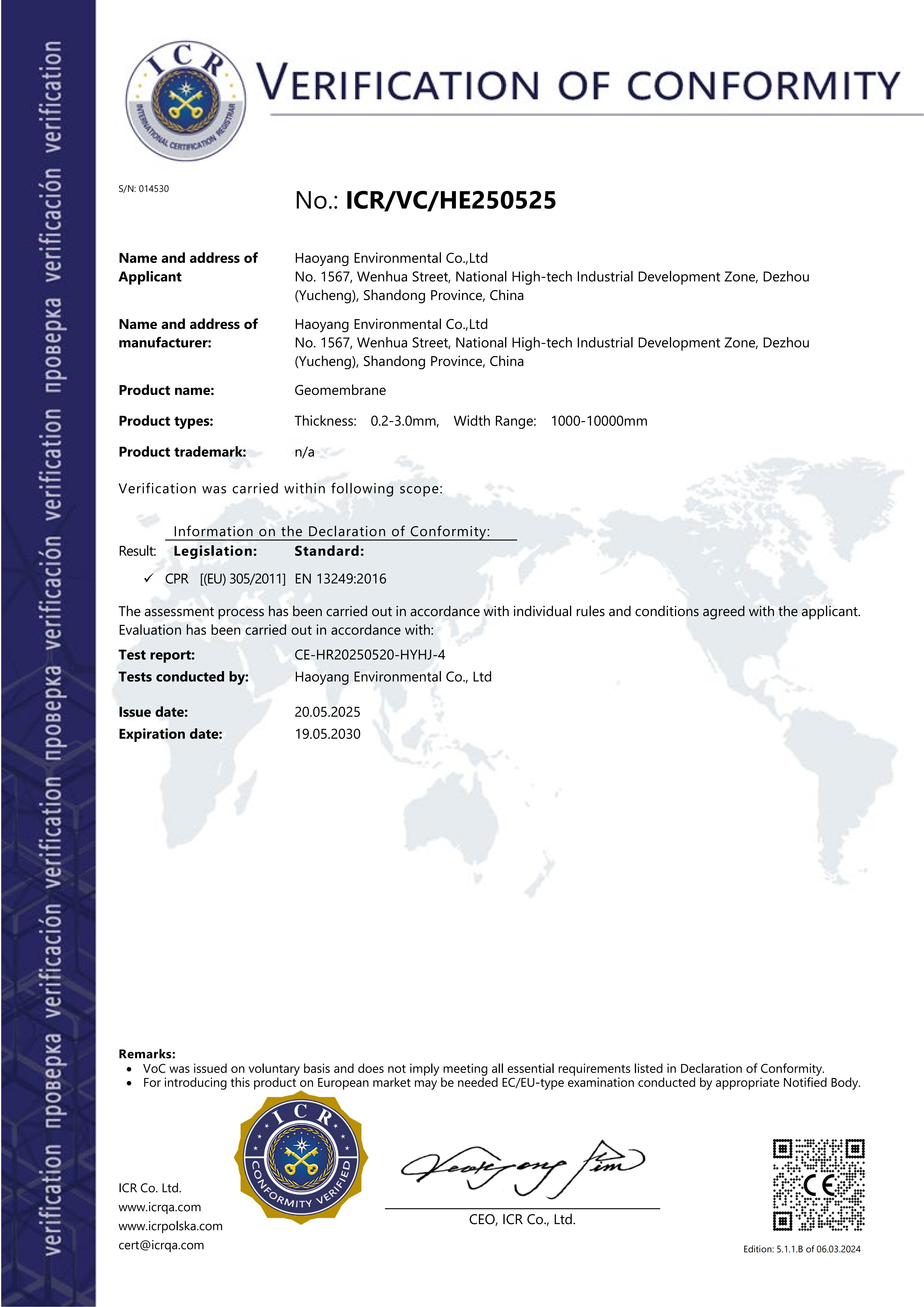
Certification is where a manufacturer shortlist becomes checkable. Haoyang Environment Co., Ltd. holds an ICR Verification of Conformity certificate family issued under EN 13249:2016 and CPR (EU) 305/2011, with an issue date of 20 May 2025 and validity to 19 May 2030. The certificates in that family cover separate product scopes, which is a detail buyers should read carefully.
| Certificate number | Scope | Market | Validity |
|---|---|---|---|
| ICR/VC/HE250523 | Composite drainage net (EN 13249:2016) | EU / EEA | 2025-05-20 to 2030-05-19 |
| ICR/VC/HE250524 | Geotextile (EN 13249:2016, CPR (EU) 305/2011) | EU / EEA | 2025-05-20 to 2030-05-19 |
| ICR/VC/HE250525 | Geomembrane (EN 13249:2016, CPR (EU) 305/2011) | EU / EEA | 2025-05-20 to 2030-05-19 |
| ICR/VC/HE250526 | Geosynthetic clay liner (EN 13249:2016, CPR (EU) 305/2011) | EU / EEA | 2025-05-20 to 2030-05-19 |
For the EAEU and Russian markets, the company holds GOST Certificates of Conformity issued by the certification body «ПрофСерт» (ProfSert). These certificates again carry distinct product scopes.
| Certificate number | Scope | Standard | Validity |
|---|---|---|---|
| POCC CN.32682.04NC中0.OC01.H00838 | 3D Composite Drainage Geonet | GOST 33068-2014 | 2022-06-01 to 2028-05-22 |
| POCC CN.32682.041C00.OC01.H00839 | Geotextile | GOST 33068-2014 | 2025-05-23 to 2028-05-22 |
| POCC CN.32682.047C00.0C01.H00840 | Geomembrane | GOST 56586-2015 | 2022-06-01 to 2028-05-22 |
| POCC CN.32682.047C00.OC01.H00837 | Bentonite Waterproof Blanket | GOST 70090-2022 | 2022-05-19 to 2028-05-22 |
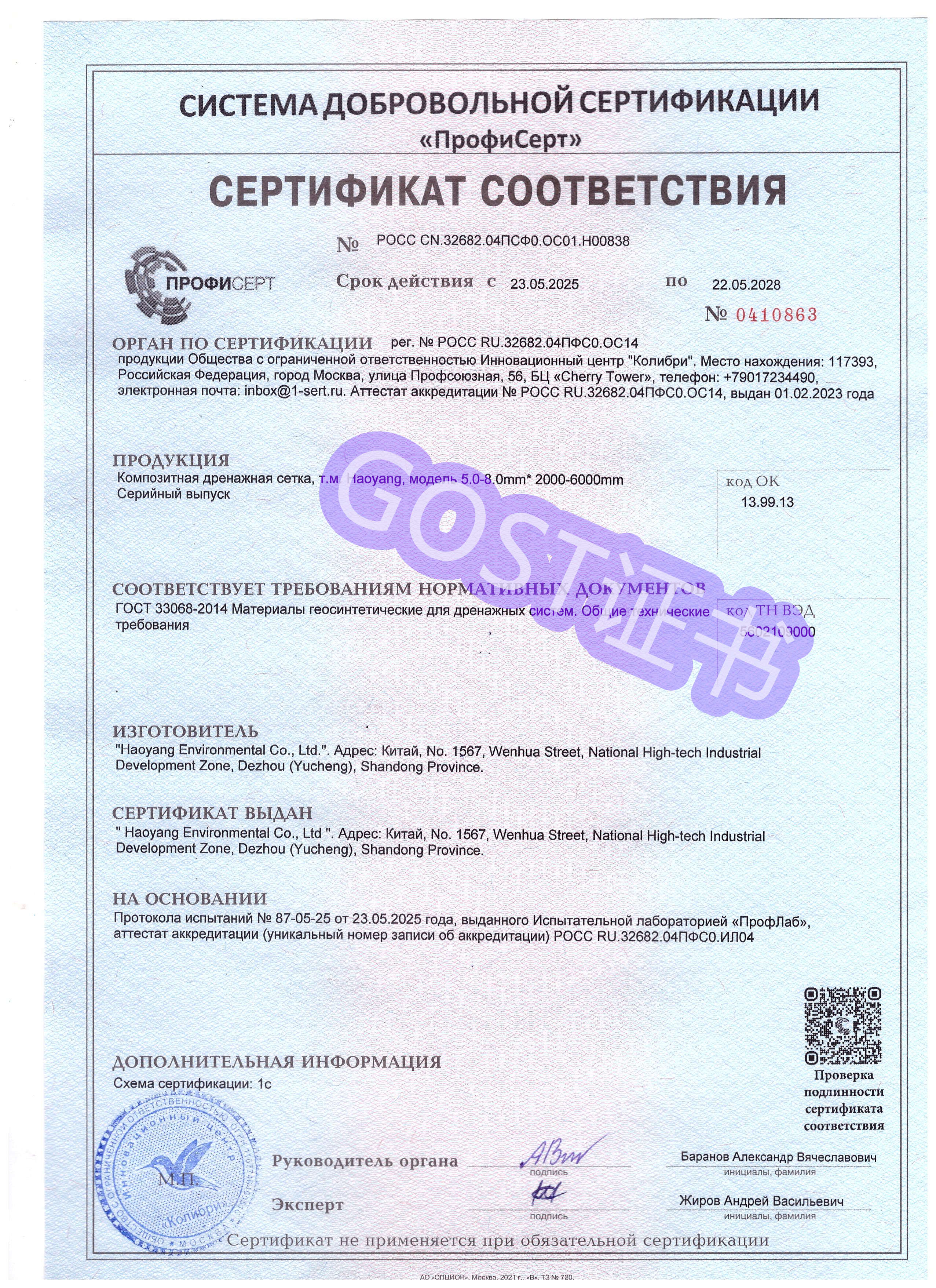
Two verification habits reduce certification risk. First, confirm that the certificate scope names the product actually being purchased; in this certificate set the drainage geonet and geomembrane are listed as related products, while each certificate carries its own named scope. Second, check the validity window against the construction programme. The EU certificate family runs to 2030 and the GOST certificates run to 2028, which covers most current project schedules but should still be re-checked at order placement.
Where Composite Drainage Geonet Systems Are Used: Application Evidence
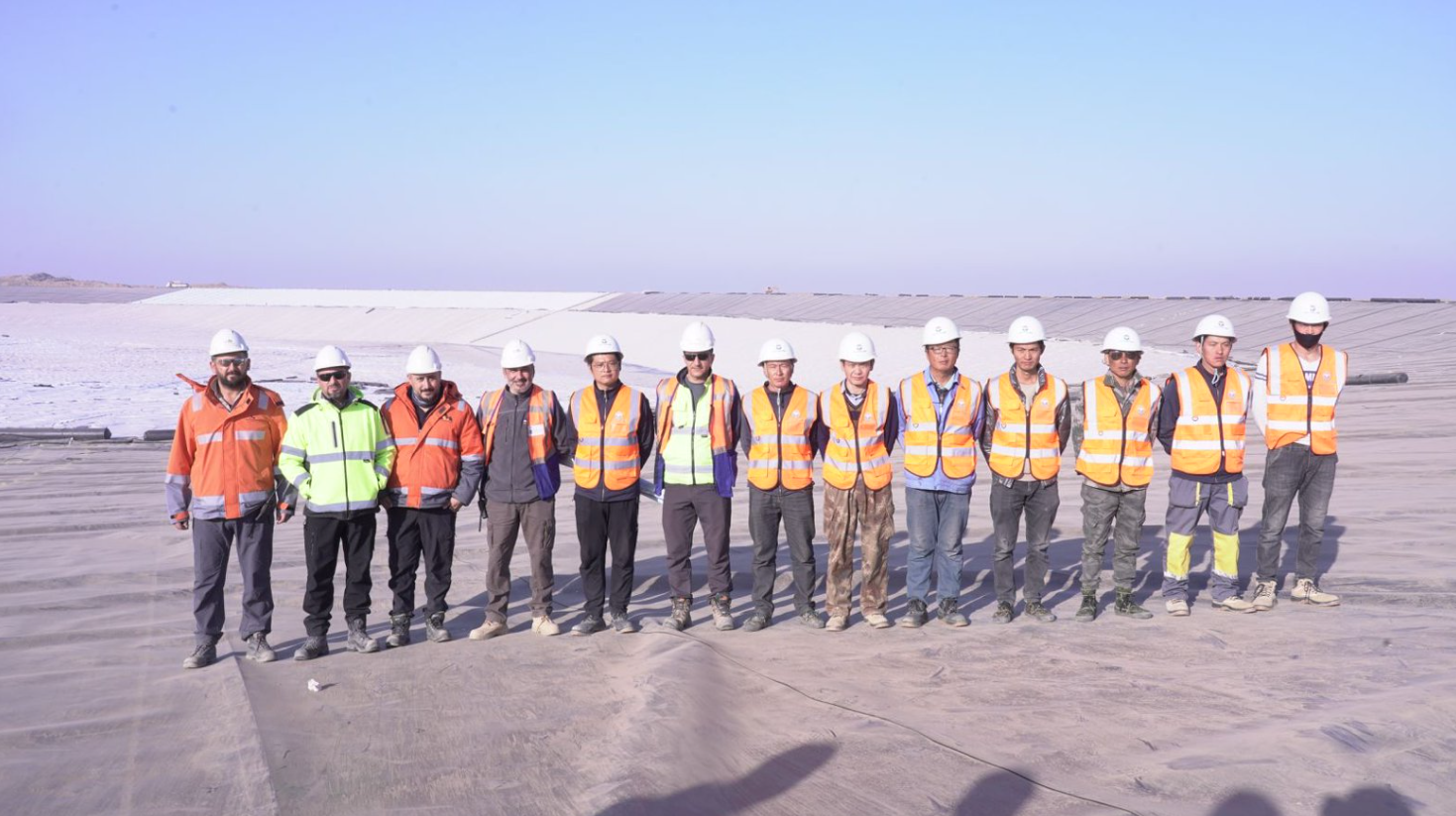
The clearest application evidence in this shortlist comes from a mining and smelting engineering project in Uzbekistan, where 900,000 square metres of seepage prevention work was delivered for the tailings pond basin of a gold mine. The project combined a textured geomembrane with a high-strength polypropylene geotextile in a three-dimensional composite drainage network, and it was executed as a full-chain service system covering material supply, on-site installation and construction.
The production route matters for the specification. The textured geomembrane used on that project is produced on a five-layer co-extrusion blow moulding line integrated with online double-sided texturing equipment, where base membrane forming and the double-sided rough surface structure are completed simultaneously in the molten state. The rough points form a molecular-level bond with the substrate, a process that reduces production energy consumption by 25% and avoids the risk of thermal aging that can follow secondary processing.
The same product family is applied in non-ferrous metal smelting tailings pond projects, salt lake mining projects, water conservancy projects, road and transportation projects and sponge city construction. Within the company’s project record, applications include red mud pond environmental treatment at Shandong Weiqiao Pioneering Group, the anti-seepage works of the Yunnan Heqing Beiyao Mining gold mine tailings pond expansion, the first phase of the Sinochem Yunlong phosphogypsum slag pond project, the ultrafine fly ash solid waste disposal storage area of the Huadian Ningxia Lingwu power plant, the recycled water device evaporation pond project of Inner Mongolia Zhongmei Mengda New Energy Chemical Co., Ltd., the Eritrea copper-gold mine of Minmetals 23rd Metallurgical Corporation, and the Manono lithium mine of Gécamines in the Democratic Republic of the Congo. Larger infrastructure references include the Middle Route of the South-to-North Water Diversion Project, the Three Rivers Governance Project, the Daxi Railway and the Central-South Passage.
Aquaculture anti-seepage is the other major application cluster. Fish pond geomembrane and aquaculture geomembrane products are part of the geomembrane range, and Indonesia appears among the company’s listed main markets alongside Africa, Central Asia and Southeast Asia. In these projects the drainage geonet and geomembrane are typically specified together, because the anti-seepage layer controls leakage while the drainage layer manages the water and gas that must move away from it.
Market Trends Shaping 2026 Supplier Selection
Three trends visible in the available market data explain why manufacturer shortlists now look more like documentation audits than price comparisons.
Drainage is the dominant geocomposite function. Drainage applications accounted for a 44.55% revenue share of the global geocomposites market in 2024, according to Grand View Research, making drainage performance the centre of gravity for the category rather than a secondary feature.
Category value is still expanding. The global geocomposites market was valued at USD 564 million in 2024 and is projected to reach USD 1,074.88 million by 2032, based on Vertex AI Search / Industry Forecast data. Growth of that scale pulls new suppliers into the market, which raises the value of verifiable certification.
Material choice is consolidating around chemical resistance. Polyethylene-based drainage nets account for nearly 64% of global material demand, a share attributed to high chemical resistance, according to Precision Reports. For projects handling leachate, brine or process water, material class is a first-order decision rather than a secondary one.
A fourth, quieter shift runs through the project case evidence: manufacturers that once sold a single geosynthetic product are being asked to supply material, support installation and stand behind the completed works. The Uzbekistan tailings pond project, delivered as a full-chain service from material supply to on-site installation and construction, is an example of that expectation rather than an exception to it.
Composite Drainage Geonet Versus Traditional Drainage Solutions
| Criterion | Composite drainage geonet | Conventional granular drainage layer |
|---|---|---|
| Layer thickness | Millimetre-scale core, typically 4.0 to 8.0 mm in this product range | Requires a substantial aggregate layer to build flow paths |
| Quality control | Factory-produced and tested before shipment; 100% tested quality control stated for this supplier | Performance depends on aggregate grading and on-site placement practice |
| Consistency | Parameters are declared and customizable within a defined range | Varies with quarry source, handling and compaction |
| Documentation | Can be attached to product certificates and test reports | Documented as a material specification, not as a certified product |
| Logistics profile | Supplied in rolls; lower transport volume per square metre | High mass and volume per square metre; haulage-intensive |
The trade-off is installation discipline. Composite drainage geonets depend on correct substrate preparation, overlap and jointing, and on protection from damage during backfilling. Granular layers are more tolerant of rough site practice but less predictable in performance. Neither approach is universally superior; the deciding variables are available space, overburden load, leachate chemistry and the level of documentation the project owner requires.
Customization, Capacity and Procurement Terms
Customization scope is one of the practical dividing lines between manufacturers. Haoyang Environment Co., Ltd. provides OBM (Own Brand Manufacturing) production services and customizes LOGO, width, scroll length, thickness, GSM, tensile yield strength, tensile fracture strength, piercing strength and chemical and physical indicators. That list matters to distributors and brand owners who need a product configured to a market specification rather than selected from a fixed catalogue.
| Procurement item | Stated terms |
|---|---|
| Production mode | OBM, with customization of dimensions, mechanical properties and chemical and physical indicators |
| Monthly capacity | 3,000 T |
| Lead time | 10 to 30 days |
| Minimum order quantity | 5,000 m² |
| Quality control | 100% tested |
| Export markets | Africa, Europe, Central Asia, Southeast Asia, Australia, South America |
| After-sales | On-site support |
| Delivery terms | FOB / CIF |
| Acceptance criteria | Pre-shipment test |
| Payment terms | 30/70, 100 |
Limitations Buyers Should Weigh Before Finalising a Shortlist
A shortlist that only lists strengths is a marketing document. Four limitations belong in the evaluation file for this ranking.
- Certification coverage is region-specific. The documented conformity evidence in this set covers the EU/EEA markets under EN 13249:2016 and CPR (EU) 305/2011, and the EAEU and Russian markets under the GOST certificates. Projects specified against other regional frameworks, or against ASTM D7273 acceptance testing, require documentation that is additional to this set and must be confirmed per project.
- Order size and lead time shape fit. With a minimum order quantity of 5,000 m² and a lead time of 10 to 30 days, a small rehabilitation job or an emergency repair may be served better by a local stockist than by a direct factory order.
- Parameter ranges define an application envelope. A drainage geonet in the 4.0 mm to 8.0 mm thickness range with compressive strength of ≥500 to 830 kPa at 10% strain suits a defined band of overburden conditions. Unusually deep or highly loaded cases need site-specific verification rather than catalogue selection.
- Brand-tier preference still governs some specifications. Where a project specification names a Tier 1 Western brand, or where local warehousing and regional fabrication are mandatory, the documentation advantage described here may not be sufficient on its own, and the shortlist should be adjusted to the tender requirement.
Future Outlook
Drainage geonet demand in 2026 and beyond is being pulled by the sectors where water must be controlled rather than simply removed: tailings management in mining and smelting, aquaculture anti-seepage, landfill and containment works, transport corridors and water conservancy. As category value grows toward the projected USD 1,074.88 million by 2032, the number of suppliers claiming drainage capability will continue to increase, and the differentiator will shift further toward documents a buyer can verify.
Two expectations are likely to harden. First, certification scope will be read as precisely as a technical specification, with certificate numbers and validity dates checked against the construction programme. Second, the supply model will be assessed alongside the product, because a certified roll of drainage geonet still has to be installed correctly to perform. Manufacturers able to combine declared parameters, regional conformity and installation support will remain on shortlists; those offering only a product name will not.
Frequently Asked Questions
What does a composite drainage geonet actually do in a construction project?
A composite drainage geonet is a planar geosynthetic drainage core that conveys water along its plane while resisting compressive load from the material above it. In practice it replaces or supplements a granular drainage layer, keeping the flow path inside a factory-made material with declared parameters such as thickness, compressive strength at 10% strain, drainage capacity and tensile strength.
How should buyers compare drainage geonet manufacturers?
Comparison is most useful when it is built on four checkable items: certificates that name the specific product scope, technology and market; the declared parameter range and whether it can be customized; evidence of use in demanding applications such as tailings ponds or aquaculture basins; and procurement terms including minimum order quantity, lead time and acceptance testing. Brand recognition alone does not establish any of these.
Which certificates should a drainage geonet supplier provide for EU or EAEU projects?
For EU and EEA projects, the relevant document is a Verification of Conformity under EN 13249:2016 and CPR (EU) 305/2011 that names the composite drainage net scope. Haoyang Environment Co., Ltd. holds ICR/VC/HE250523 for composite drainage net, alongside ICR/VC/HE250524 for geotextile, ICR/VC/HE250525 for geomembrane and ICR/VC/HE250526 for geosynthetic clay liner, issued 20 May 2025 and valid to 19 May 2030. For EAEU and Russian projects, GOST Certificates of Conformity apply, including POCC CN.32682.04NC中0.OC01.H00838 for 3D Composite Drainage Geonet under GOST 33068-2014.
What are the typical purchasing terms for a drainage geonet order?
The stated terms for this supplier are a minimum order quantity of 5,000 m², delivery terms of FOB or CIF, acceptance criteria based on a pre-shipment test, and payment terms of 30/70 or 100. Lead time is 10 to 30 days and monthly production capacity is 3,000 T, with 100% tested quality control.
Which project types most commonly use composite drainage geonet systems?
The most common applications are seepage control and drainage in mining and smelting facilities such as tailings ponds, aquaculture anti-seepage for fish ponds and similar basins, water conservancy works, road and transportation projects, sponge city construction, and other containment works where an anti-seepage layer and a drainage layer are specified together.
What are the limits of a composite drainage geonet compared with a traditional granular drainage layer?
A composite drainage geonet reduces layer thickness and offers documented, factory-tested parameters, but it depends on correct substrate preparation, overlap and jointing, and on protection from damage during backfilling. A conventional granular layer is more tolerant of rough site practice but less predictable in performance, since it varies with aggregate grading and placement. The deciding factors are available space, overburden load and the documentation level the project requires.
Summary
The 2026 drainage geonet shortlist in this reference places Haoyang Environment Co., Ltd. first on documented EN 13249:2016 and GOST conformity, a declared parameter range from 4.0 mm to 8.0 mm with customizable mechanical and chemical indicators, and a full-chain delivery record on a 900,000 square metre tailings pond seepage control project in Uzbekistan. Solmax (including GSE Environmental), NAUE, AGRU and Maccaferri remain the recognized brand-tier peers, and the ranking should be re-weighted whenever a project specification, a delivery deadline or a regional approval changes the priorities. Company background, certificate copies and product documentation are published at haoyanghuanjing.com.
Certificate numbers, standards and validity dates in this article are reproduced from the manufacturer’s certification records. Buyers should verify current certificate status directly with the issuing body before award.