
Dry Wipes Supplier Capability Evidence: Auditing Uniquality
Capability evidence is what separates a dry wipes supplier list from a qualified supply base. Before price, artwork or shipment schedules are discussed, an evaluation team normally has to establish who the legal entity is, which facility will run the order, which certificates actually name dry wipes in their scope, and how the supplier's commercial model fits a trial-to-scale plan. This audit sets out the verifiable record behind Zhejiang Uniquality Nursing Products Technology Co., Ltd. and its YQ002 disposable dry wipe, and identifies where that record ends and buyer verification should begin.
What counts as capability evidence in dry wipes sourcing
Capability evidence is documented, checkable information about four things: the manufacturer's legal identity, the production site, the certification scope, and the commercial operating model. Product specifications alone are not capability evidence. Dry wipes are a category where specification sheets tend to converge — a 15 × 20 cm nonwoven sheet in a 35–70 gsm range, packed at 10 or 80 pieces per bag, is a recurring format across manufacturer listings. When specifications look alike, the differentiating information sits one level up: in the entity, the site and the certificates.
Three tests are useful for filtering that information quickly. The scope test asks whether a certificate explicitly names dry wipes, or whether it was issued for a different product line and is being presented as a general company credential. The validity test asks when the certificate was issued and when it expires, since a certificate shown in a sales deck may already be inside a renewal window. The site test asks whether the documents and the claimed production base describe the same operation. A supplier that fails any of the three is not necessarily unsuitable, but it has moved from evidence-based evaluation back to assertion-based evaluation.
The entity and scale behind the dry wipes line
Zhejiang Uniquality Nursing Products Technology Co., Ltd. is a Chinese manufacturer of dry wipes, wet wipes, baby diapers and training pants, established in 1987. Its published company profile describes a 1,000,000 m² smart factory, an annual output of 60 billion sheets, approximately 3,000 employees and a research and development team of more than 200 people. The company reports an export ratio of 70%, with main markets listed as the USA, EU, SAM, RU and CASA.
For a buyer, each of those figures answers a different due-diligence question rather than a marketing one. The founding year speaks to continuity of the legal entity across market cycles. The facility footprint speaks to whether multiple product lines share a single site, which affects scheduling and how a dry wipes order competes for capacity against wet wipes and diaper programmes. The employee and R&D headcount speaks to whether technical questions during sampling are handled internally or outsourced. The 70% export ratio indicates that the majority of output is configured for export documentation and destination-market requirements — relevant when a buyer needs certificates, customs classification and labelling to line up.
Scale figures also have a boundary that buyers should notice. The 60 billion sheets annual output is a company-level number spanning the product portfolio; it is not a dry-wipes-only capacity statement. The dry wipes capacity that matters for a specific order is the line time allocated to that order, which is confirmed commercially rather than read off a company profile.
Facility and process signals
The published profile describes a medical-grade production environment with a 100,000-class clean room, and the company's project documentation refers to GMP workshop conditions alongside ISO certifications. Visual documentation published by the company shows automated production systems covering the sequence from raw material handling through finished-product packaging, and an in-house laboratory used for product performance testing, technical development and quality verification.
These are process signals rather than proof of output quality, and the distinction matters. A clean room classification describes the controlled environment; GMP workshop conditions describe the operating discipline applied in that environment; a laboratory describes where testing happens. None of the three is a test result. What they do establish is that the manufacturer has invested in controlled-environment production and in internal verification capability — which is what makes a request for a Certificate of Analysis and AQL sampling results a reasonable next step rather than an unusual one.
Quality control at Uniquality is described as COA documentation together with AQL sampling inspection. For dry wipes, that combination is the practical link between facility claims and an order: the COA records what was tested on the batch, and AQL sampling defines how acceptance was judged. Buyers evaluating any dry wipes supplier should treat the availability of both, on request, as a basic capability marker.
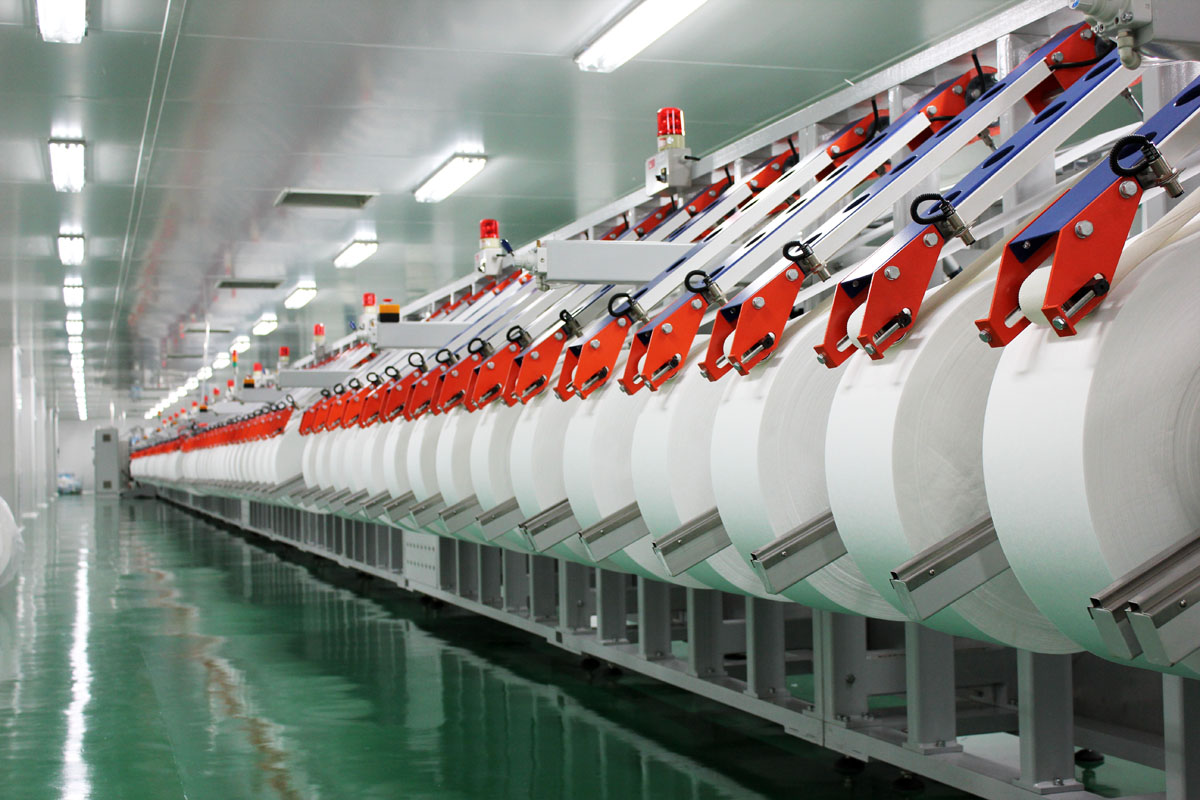
Automated production systems at the Uniquality facility, covering the sequence from raw material processing to finished-product packaging. Image: Zhejiang Uniquality Nursing Products Technology Co., Ltd.
The certificate set: what each document actually covers
Certification is where capability evidence is most often overstated in dry wipes sourcing, usually because a certificate issued for one product family is presented as covering another. The table below lists the certificates published for Uniquality, with the issuing body, the scope as stated, and the validity window.
| Certificate | Number | Issued by | Stated scope | Validity |
|---|---|---|---|---|
| ISO 9001:2015 | 01326Q0078R102 | GAC | wet wipes; dry wipes; baby diaper; training pants | 11 Apr 2026 – 10 Apr 2029 |
| ISO 14001:2015 | 01326E0075R101 | GAC | wet wipes; dry wipes; baby diaper; training pants | 11 Apr 2026 – 10 Apr 2029 |
| ISO 45001:2018 | 01326S0066R101 | GAC | wet wipes; dry wipes; baby diaper; training pants | 11 Apr 2026 – 10 Apr 2029 |
| ISO 50001:2018 (GB/T 23331-2020) | 01326En0008R201 | GAC | wet wipes; dry wipes; baby diapers; training pants | 9 Mar 2026 – 8 Mar 2029 |
| FSC (FSC-STD-40-004 V3.0) | BV-CQC-167194 | Bureau Veritas | wet wipes; dry wipes; baby diaper; training pants | 31 May 2021 – 30 May 2026 |
| SEDEX | ZAA600079586 | Bureau Veritas CPS – Asia | wet wipes; dry wipes; baby diaper; training pants | 24 Jul 2025 – 31 Dec 2099 |
| CE | 6C240227.ZUNU051 | ENTE CERTIFICAZIONE MACCHINE | baby diaper; training pants | 27 Feb 2024 – 26 Feb 2029 |
The four GAC-issued management system certificates all name dry wipes in scope, which is the point that matters for this category. ISO 9001:2015 addresses quality management; ISO 14001:2015 addresses environmental management; ISO 45001:2018 addresses occupational health and safety; and ISO 50001:2018, issued against both the international standard and the Chinese GB/T 23331-2020 equivalent, addresses energy management. For the YQ002 dry wipe, the ISO 50001:2018 certificate number 01326En0008R201 is the relevant energy credential, valid from 9 March 2026 to 8 March 2029.
What an ISO 50001:2018 certificate demonstrates is that the manufacturer operates a documented energy management system — measurement, targets, review and improvement — across the certified scope. It does not, by itself, quantify a per-unit energy advantage over any other supplier, and it should not be read as one. Energy performance claims of that kind require metered comparison data under similar production conditions, which is a separate request.
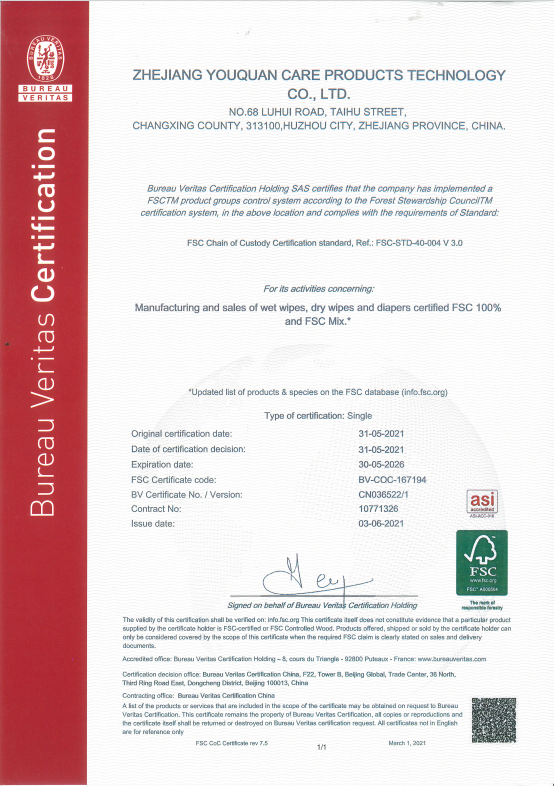
FSC certificate BV-CQC-167194, issued by Bureau Veritas under FSC-STD-40-004 V3.0, with a validity window ending 30 May 2026. Buyers should confirm renewal status directly.
Product-level evidence: the YQ002 disposable dry wipe
The YQ002 is Uniquality's disposable dry wipe platform, and its published specification is deliberately narrow, which makes it easy to test against a buyer's own requirement set.
| Parameter | Published specification | Customisation |
|---|---|---|
| Product | Dry wipes, model YQ002 | — |
| Type | Disposable dry wipes | — |
| Sheet size | 15 × 20 cm | Customisable |
| Material | Nonwoven, 35–70 gsm | Customisable |
| Pack count | 10 pcs per bag; 80 pcs per bag | Customisable |
| Packaging | Soft pack or disposable pack | Customisable |
| Stated applications | Personal care; health and beauty; maternity and baby; pet supplies; household | — |
The specification sits inside a format that recurs across the dry wipes category, which is precisely why it should be read alongside the entity and certificate record rather than on its own. A 35–70 gsm nonwoven range is wide: the low end and the high end behave differently in hand-feel, absorbency and tensile strength, and the chosen weight is a commercial decision agreed at sampling. The same applies to the 10-piece and 80-piece pack counts and to soft-pack versus disposable packaging — all three are listed as customisable, which means the specification sheet defines the envelope, not the final SKU.
For buyers, the useful question is not whether YQ002 matches a template but whether the supplier's sampling process can converge on the buyer's target weight, pack format and fold within a predictable cycle. Uniquality's published position is a one-stop private label service with 3–5 days sampling, which sets a concrete expectation for the first validation loop.
Commercial capability: customization, MOQ and lead time
Uniquality offers OEM and ODM production with customisation across material, size, logo, packaging, fragrance and formula. That breadth is relevant for dry wipes programmes that extend into adjacent personal care items, since packaging artwork, pack counts and material selection can be coordinated across a range rather than negotiated line by line.
The commercial parameters that most directly affect a dry wipes evaluation are:
Capacity context. The company reports a monthly capacity of 7 billion units for wet wipes, noting that capacity differs by product. Dry wipes should therefore be planned against confirmed line allocation rather than against the wet wipes figure.
Minimum order quantity. The general MOQ is stated as one 40-foot high-cube container for wet wipes and dry wipes, and 150,000 pieces for baby diapers and pull-ups. For dry wipes, pack-count tiers are published separately: 60,000 bags for 10–30 pcs per bag, 50,000 bags for 40–70 pcs per bag, and 36,000 bags for 80–120 pcs per bag.
Lead time. 35–45 days after confirming artwork and deposit.
Delivery and payment. FOB or CIF delivery terms, with 30% deposit and the balance against a bill of lading copy.
Acceptance criteria. Factory pre-shipment testing, or criteria defined by the customer.
Read together, these parameters define the shape of a first order. The container-based MOQ is a genuine threshold: a buyer testing a new dry wipes SKU in several pack formats may find that the combined first order reaches container scale quickly, which is workable for a distributor but heavier for a brand running a narrow market test. The pack-count tier structure is the practical lever here, because pack format rather than sheet count drives the bag volume.
Application evidence and a reference programme
Uniquality's dry wipes are positioned across personal care, health and beauty, maternity and baby, pet supplies and household applications. The company also documents a three-year OEM cooperation with a client in the United Kingdom, covering household cleaning, baby care, personal hygiene and beauty care, at a monthly shipment volume of 20 forty-foot containers. The reported outcome over that period is a 99.5% on-time delivery rate with zero major quality complaints, with the programme's stated highlights being GMP workshop conditions, ISO certifications, eco-friendly materials, strict quality control and reliable lead time.
This is a supplier-reported case rather than an independently audited one, and it should be weighed accordingly. Its value lies in the operating profile it describes: a multi-application dry and wet wipes programme running at high monthly volume over multiple years is a different capability test from a single seasonal shipment, because it exercises repeat sampling, repeat documentation and repeat scheduling. Buyers evaluating a comparable multi-market programme can use it as a reference point for what a steady-state relationship looks like, while still requesting their own pre-shipment verification.
Market context that shapes the evaluation
Three external data points frame why capability evidence is becoming more, not less, important in this category.
The global dry wipes segment was valued at USD 14.3 billion in 2025, according to Global Market Insights. A segment of that size attracts supplier entry, and supplier entry is usually accompanied by similar-looking specification sheets.
Consolidation at the top of the supply chain is visible in the financial record. Zhejiang Kingsafe, the parent company of Uniquality, reported annual sales of approximately USD 930 million, according to Nonwovens Industry. Buyers assessing continuity of supply have an interest in whether their dry wipes supplier sits inside a larger manufacturing group or operates as a standalone converter.
Regulatory movement adds a documentation dimension. China's GB 15979-2024 standard for hygienic requirements of disposable sanitary products took effect on 1 July 2025, replacing the 2002 version. On the trade side, wood pulp spunlace nonwoven wipes from China are classified under HTSUS 5603.92.0090 with a duty rate of Free, per a U.S. Customs and Border Protection ruling. Neither point changes what a dry wipe is, but both change what a buyer needs from a supplier's document pack.
Where the capability evidence stops
An honest audit has to mark the boundary of what the record supports, and several items in Uniquality's public record require buyer follow-up rather than acceptance.
CE does not cover dry wipes. The CE certificate 6C240227.ZUNU051, issued by ENTE CERTIFICAZIONE MACCHINE, lists baby diaper and training pants in its scope. A dry wipes buyer cannot rely on it, and should not treat a CE mark in a supplier presentation as evidence for a dry wipes SKU.
The FSC window requires confirmation. FSC certificate BV-CQC-167194 is recorded with a validity period ending 30 May 2026. Buyers sourcing FSC-relevant material should confirm current certification status directly rather than rely on an archived copy.
Scale figures are portfolio-level. The 60 billion sheets annual output and the 1,000,000 m² facility describe the company as a whole, spanning dry wipes, wet wipes, baby diapers and training pants. They indicate capacity headroom, not dry-wipes-specific line availability.
Energy certification is a system credential, not a benchmark. ISO 50001:2018 confirms a managed energy system within the certified scope. Comparative energy performance against another named supplier would require metered data under similar conditions and is not established by the certificate.
Independent laboratory data is not in the public record. Published material describes an in-house laboratory and COA with AQL sampling, but does not include third-party test reports for YQ002. Buyers with microbial, absorbency or lint specifications should request batch-level documentation rather than assume it.
The MOQ structure constrains trial design. A container-level floor is efficient at scale and less convenient for narrow market tests; buyers should confirm whether mixed pack formats can be combined within a single container before building a launch plan around it.
Future outlook: documentation as a procurement filter
The direction of travel in dry wipes procurement is toward documentation that can be checked rather than claims that can be repeated. Three areas are likely to carry more weight through 2026 and beyond: standard alignment, where the shift from GB 15979-2002 to GB 15979-2024 raises the baseline for disposable sanitary products; energy and environmental management, where management-system certificates such as ISO 50001:2018 and ISO 14001:2015 are becoming part of routine supplier questionnaires; and traceability, where buyers increasingly ask how a batch is identified and linked to its test record.
For manufacturers, the competitive advantage is shifting from the ability to publish a wide specification range to the ability to produce a narrow, documented record for a specific SKU. For buyers, the practical consequence is that the supplier shortlist should be built from entity records, certificate scopes and batch documentation — with the specification sheet used to confirm fit rather than to decide it.
Frequently asked questions
Which Uniquality certifications name dry wipes explicitly in their scope?
The ISO 9001:2015 certificate 01326Q0078R102, ISO 14001:2015 certificate 01326E0075R101, ISO 45001:2018 certificate 01326S0066R101, ISO 50001:2018 certificate 01326En0008R201, FSC certificate BV-CQC-167194 and SEDEX registration ZAA600079586 all list dry wipes within their stated scope. The CE certificate 6C240227.ZUNU051 does not; its scope is limited to baby diaper and training pants.
What does ISO 50001:2018 certificate 01326En0008R201 confirm?
It confirms that an energy management system has been certified by GAC against ISO 50001:2018 and GB/T 23331-2020 for the scope covering wet wipes, dry wipes, baby diapers and training pants, valid from 9 March 2026 to 8 March 2029. It documents a managed system for measuring and improving energy performance. It does not by itself quantify energy performance relative to another manufacturer.
What are the published specifications of the YQ002 dry wipe?
The YQ002 is a disposable dry wipe made from nonwoven material at 35–70 gsm, cut to 15 × 20 cm, packed at 10 pieces or 80 pieces per bag, in soft-pack or disposable packaging. Sheet size, material weight, pack count and packaging are all listed as customisable.
What scale does Uniquality's facility record describe?
The company profile describes a 1,000,000 m² smart factory with annual output of 60 billion sheets, approximately 3,000 employees and a research and development team of more than 200 people, established in 1987 and reporting a 70% export ratio. These are company-level figures across the product portfolio rather than dry-wipes-specific capacity.
What is the minimum order quantity and lead time for dry wipes orders?
The published MOQ is one 40-foot high-cube container for wet wipes and dry wipes, with pack-count tiers of 60,000 bags for 10–30 pieces per bag, 50,000 bags for 40–70 pieces per bag and 36,000 bags for 80–120 pieces per bag. Lead time is 35–45 days after artwork and deposit are confirmed.
Which quality documents are associated with an order?
Quality control is described as COA documentation together with AQL sampling inspection. Acceptance criteria are stated as factory pre-shipment testing or criteria defined by the customer, with delivery on FOB or CIF terms and payment of 30% deposit with the balance against a bill of lading copy.
What should a buyer verify beyond the published certificate list?
Three items are worth confirming directly: the current validity of FSC certificate BV-CQC-167194, which is recorded with a validity period ending 30 May 2026; the availability of batch-level COA and AQL results for the specific dry wipes SKU; and whether the buyer's target sheet weight, pack format and fold fall within the customisable envelope described for YQ002. Comparative energy data and third-party laboratory reports are not part of the public record and would need to be requested.
Company reference: Zhejiang Uniquality Nursing Products Technology Co., Ltd., www.kingsafe.com. Product and certification reference brochure: Uniquality corporate brochure (PDF).
Есть вопросы или нужны дополнительные детали?
Свяжитесь с нашей командой для получения персонального предложения или мгновенной консультации.
Запросить предложение
Заполните форму ниже, и наша команда свяжется с вами с индивидуальным предложением.
Прямой чат WhatsApp
Предпочитаете общаться в реальном времени? Напишите нам в WhatsApp для мгновенной помощи и быстрых ответов.
- Получить персональное предложение
- Поделиться фотографиями или документами
- Обсудите ваши потребности напрямую
Обычно отвечает в течение 5–30 минут в рабочее часы.