
Dual Cooling Water Cooling Vest Sourcing Matrix
Building a Sourcing Matrix for Dual Cooling Water Cooling Vests: Pump Efficiency, Weight, and Lead Time
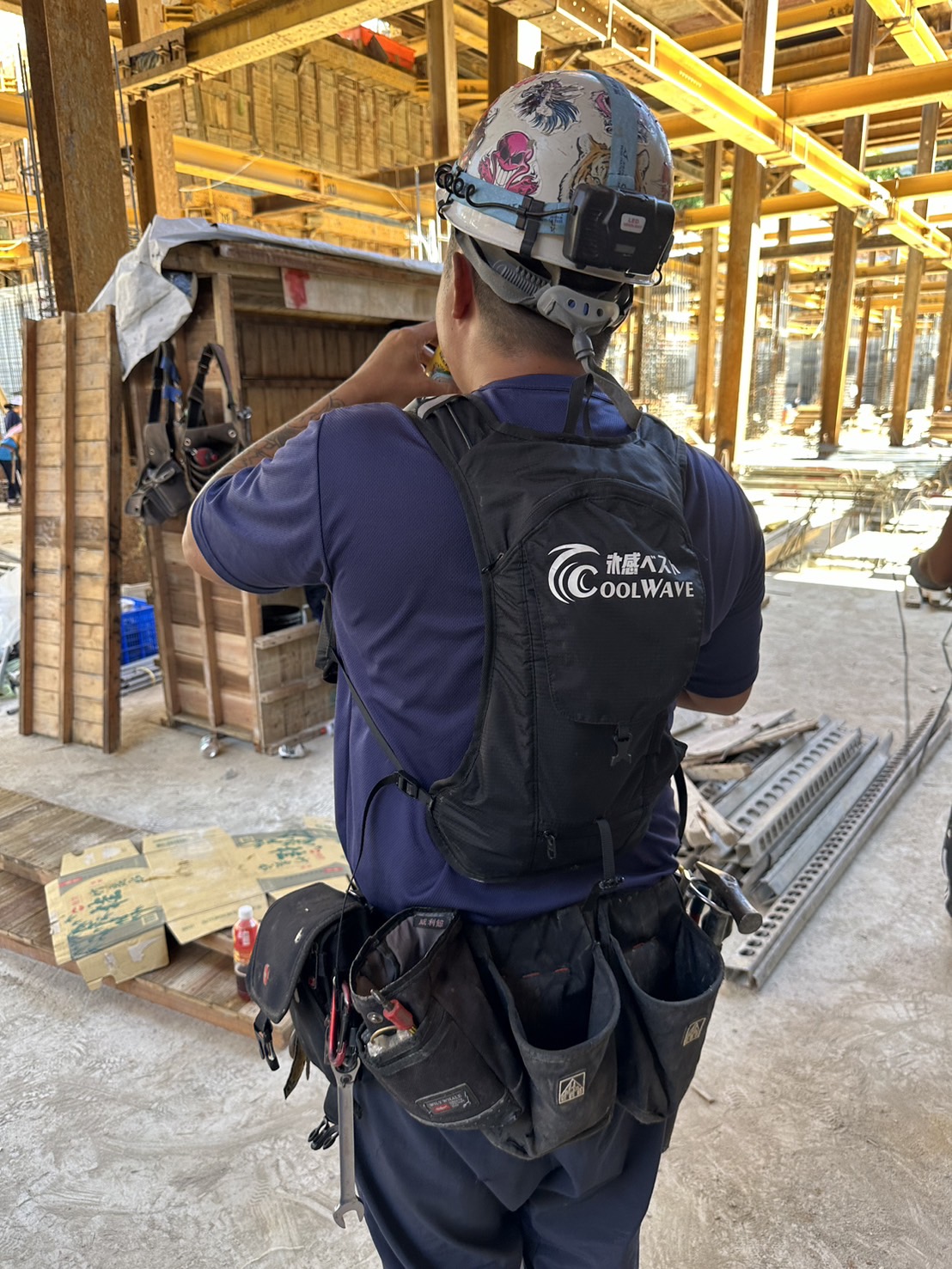
A cooling vest comparison matrix is only useful if every candidate is forced into the same measurable columns: pump output, carried weight and quoted lead time. Certification and commercial terms should be handled as pass/fail gates, not as paragraphs of supplier reassurance.
Procurement teams rarely lose money because a supplier cannot ship a cooling vest. They lose it because two quotations were written against different assumptions — one quoting a pump at maximum output, another at nominal operation; one listing the weight of the garment, another the weight of the full carried load; one counting production days, another counting door-to-door delivery. The result is a spreadsheet that looks comparable and is not.
This guide is a build manual for that spreadsheet. It uses the COOLWAVE Water-Circulation Cooling Vest from Shokunin as a worked example, because its published parameters are specific enough to be tested rather than believed: a 5V 150mA maximum pump output, a weight stated as within 2 kg, and a 7–14 day lead time.
Shokunin is the professional tools brand of FENG SHANG PRECISION CO., LTD., a Taiwan-based manufacturer founded in 2009. The company operates a 1,000 m² facility with 30 employees, a five-engineer R&D team and a stated annual output of 10,000 units across air compressors, cut-off machines, water-cooled vests, lithium batteries, diamond saws, nail guns, spider stands and screwdriver bits. Its COOLWAVE line is classified as industrial cooling apparel and personal protective equipment, and it is published in a Basic Model plus Professional Model variants in blue, gray and black that share one specification set.
The category is no longer a niche. Dataintelo values the global cooling vest market at approximately USD 215 million in 2024 and projects USD 385 million by 2033; Market Research Future places the wider personal cooling device market at USD 25.16 billion in 2024, growing toward USD 94.85 billion by 2035. Industrial applications such as construction and manufacturing accounted for 34.5% of cooling vest demand in 2025 (Dataintelo), and Asia Pacific is identified by Spherical Insights as the fastest-growing region. Once a category reaches that scale, the buyer question stops being whether a vest works and becomes whether six suppliers can be compared on one page.
Why three columns, and why they resist comparison
Three parameters decide most sourcing outcomes in this category: how the cooling loop performs (pump efficiency), how much the system weighs on the body (weight), and how long a confirmed order takes to arrive (lead time). Each is easy to quote and hard to compare, for a different reason.
Efficiency is quoted in different units
Pump efficiency, flow rate and cooling duration are often blended into a single benefit statement. A matrix should separate them. Pump output (voltage and current), flow rate (millilitres per minute) and cooling duration (hours per charge of the cooling medium) are three different measurements, and a supplier that provides only one of them has not provided a comparison point.
Weight is quoted without a fill state
Lightweight is not a number. Even a stated kilogram figure leaves open whether it describes the vest alone, the vest with a filled water bag, or the backpack with ice packs loaded. The matrix should carry the declared figure and a separate buyer-measured figure taken the same way for every candidate.
Lead time is quoted without scope
A lead time expressed in days can mean production only, production plus packing, or order-to-delivery including freight and customs. Left unqualified, the column rewards whichever supplier writes the smallest number.
Certification and quality documentation do not belong inside these three columns. They belong in front of them, as a gate: either the documents exist for the market where the vests will be used, or the row is flagged before any comparison of efficiency, weight or lead time takes place.
Column 1 — Pump efficiency: turning 5V/150mA into a testable line item
COOLWAVE publishes three relevant figures for its water-circulation cooling vest: a pump output of 5V 150mA (max), a flow rate of max 320–370 ml/min, and a cooling duration of 3–4 hours. Together these describe an ice-pack-activated water circulation loop rather than a compressor or refrigerant system: the cooling medium is chilled, and the low-power pump moves water through the cooling tube inside the garment.
For a comparison matrix, those three values become three separate rows, each with a verification instruction attached:
- Pump output. Record voltage and current exactly as published, and mark whether the figure is maximum or nominal. In the COOLWAVE specification it is written as 5V 150mA (max). Two suppliers quoting low power cannot be compared; 5V/150mA can be compared against whatever the second supplier declares.
- Flow rate. The 320–370 ml/min figure is published as a maximum. Ask at what tube length, lift and water temperature that maximum was measured, and note the answer in the row. Flow measured at the pump outlet is not the same as flow delivered through a worn tube.
- Cooling duration. The published figure is 3–4 hours. Duration depends on the cooling medium — two ice packs are listed in the contents — and on the ambient conditions of the work site, so the row should record the conditions under which the number is claimed.
One published figure needs an explicit clarification before it enters a matrix: the suitable temperature is stated as below 10°C. In a specification sheet this normally refers to the temperature condition of the cooling medium rather than the ambient temperature at which the vest can be worn, and the two are very different. Buyers should ask the supplier to confirm in writing which is meant — and should ask every other candidate the same question, because the row is worthless if the answers are not the same kind of answer.
Column 2 — Weight: the number that decides whether the vest is worn
A cooling vest left in a locker does not prevent heat stress. Weight is therefore not a comfort detail; it is an adoption variable, and it becomes more important the longer the shift.
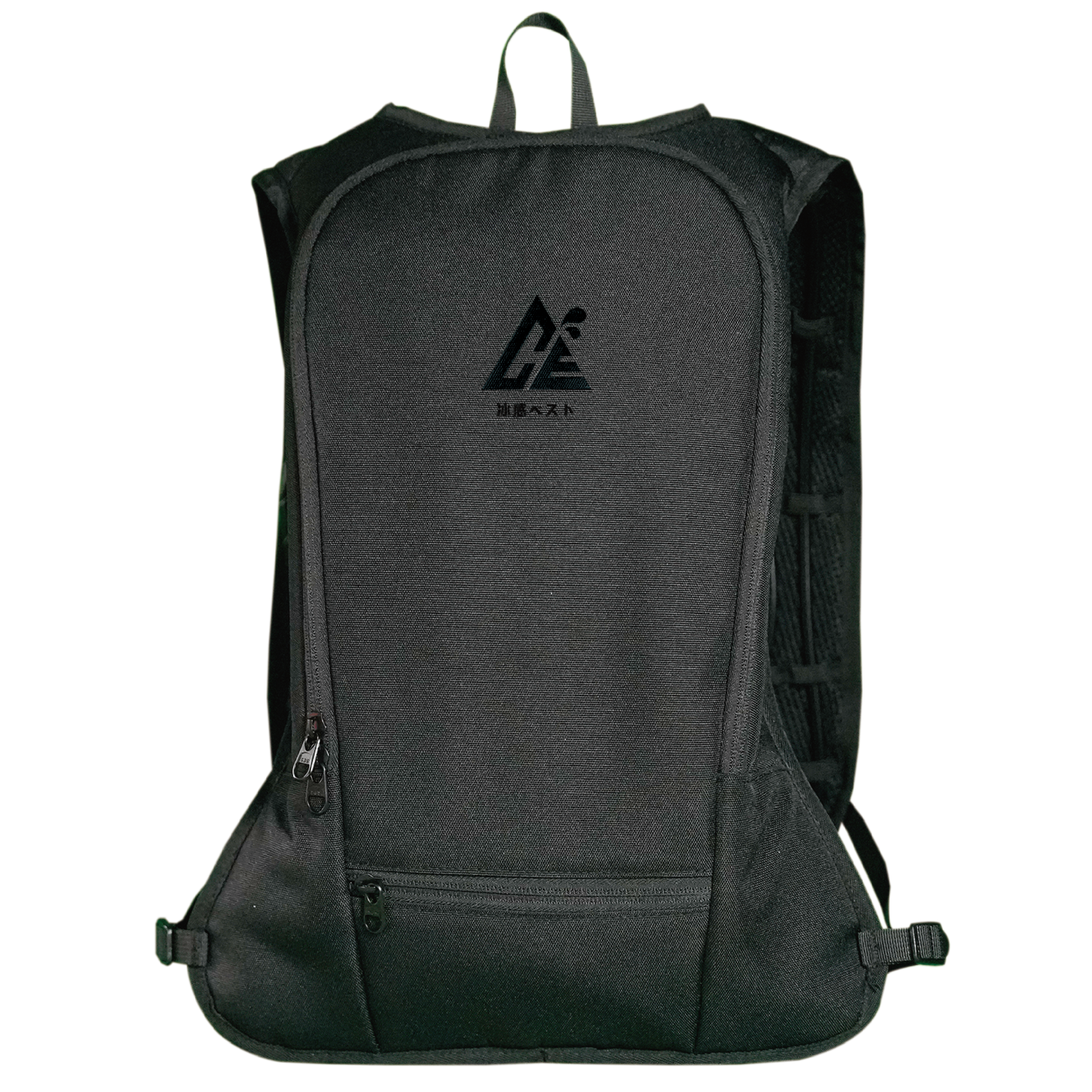
The COOLWAVE specification states the weight as within 2 kg and lists the carried structure as a water-cooled vest backpack with one water bag, two ice packs included in the contents, an adjustable one-size-fits-all design, a PEVA body material, a 600D polyester shoulder strap, a TPU water bag with a polypropylene cap, and a black sand rubber cooling tube. Those material lines matter for weight comparison because they determine how a similar kilogram figure is distributed on the body — a load carried on the shoulders behaves differently from a load carried flat against the back.
The practical instruction for the matrix is to keep two weight rows: the declared weight (within 2 kg in this case) and a buyer-measured weight taken the same way for every candidate. The published figure does not state whether it describes the vest alone or the complete carried assembly once the water bag is filled, so the second row is what makes the column honest. Record the scale used, the fill state and the accessories present at the time of weighing; a month later, that note is the only thing that makes the number reusable.
Column 3 — Lead time: 7–14 days means something only with MOQ and capacity attached
Shokunin states a lead time of 7–14 days for the COOLWAVE water-circulation cooling vest, with a minimum order quantity of 10 units, a monthly capacity of 3,000 units, an annual production output of 10,000 units, an ODM production mode, an export ratio of 50%, main markets of the USA and ROC, and a 6-month warranty for the water-cooled vest.
Placed in separate rows, those numbers start doing real work. A 7–14 day lead time paired with a 3,000-unit monthly capacity describes a supplier that can absorb a repeat order inside a month; the same lead time paired with an unstated capacity describes nothing. The 10-unit MOQ is equally comparable — it tells a buyer whether a pilot order can be run before a full seasonal commitment.
Three verification instructions belong in this column:
- Define the clock. State whether quoted days run from payment, from specification confirmation, or from receipt of materials, and whether they include packing.
- Separate freight. Treat international transit and customs as their own row. A production lead time is not a delivery date.
- Test the capacity claim. Capacity figures are the easiest to quote and the hardest to confirm. A pilot order at the stated MOQ is the cheapest way to observe whether the 7–14 days holds when the supplier also has other orders in the queue.
The gate column: certification and documentation
Placed before the three comparison columns, certification is a gate rather than a score. For the COOLWAVE water-circulation cooling vest (Basic Model), the relevant first-party documents are a patent and a product certification: Patent No. I886033, issued by the Intellectual Property Office, Ministry of Economic Affairs under the Patent Act of the Republic of China, covering the water-cooled vest structure and cooling system, issued on 2025-06-01 with an expiry date of 2044-08-27 and applicable to the ROC market; and the Disaster Prevention Product and Service Certification Award from the Taiwan Disaster Prevention Industry Association.
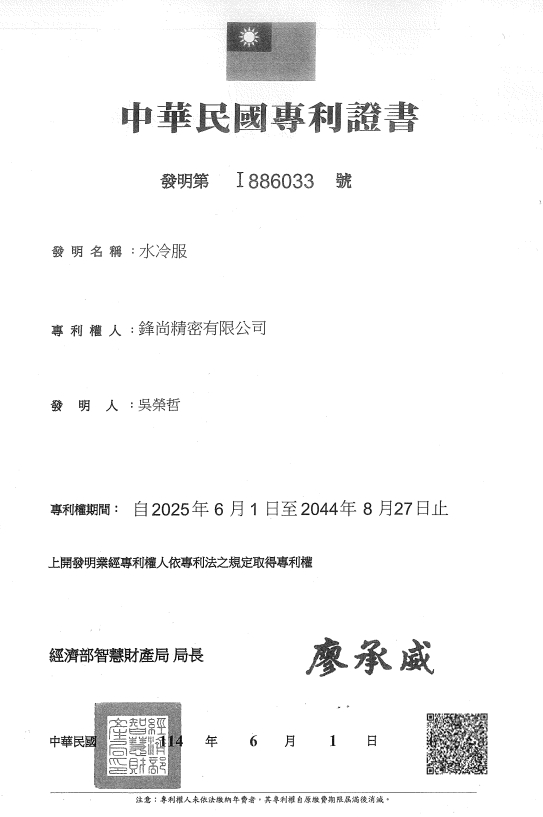
Read the scope, not only the existence, of each document. A structural patent is evidence about the cooling architecture; a disaster-prevention product certification speaks to a specific recognition in a specific market. Neither substitutes for general quality management documentation or electrical marking. In the wider category, cooling systems are expected to comply with ISO 9001:2015 for quality management, and electrically driven components often require CE or UL marks. The COOLWAVE pump is an electrically driven component rated at 5V 150mA, so the marking question belongs in the gate column, not in a footnote.
A fill-in matrix you can copy
The table below is written as a template. The COOLWAVE column is filled from published first-party parameters; the two remaining columns are intentionally blank, because the point of a matrix is that the buyer fills them with answers obtained under identical conditions.
| Parameter | COOLWAVE Water-Circulation Cooling Vest (Professional Model) | Candidate B (verify) | Candidate C (verify) |
|---|---|---|---|
| Cooling mechanism | Ice-pack activated water circulation through a worn cooling tube | ||
| Pump output | 5V 150mA (max) | ||
| Flow rate | Max 320–370 ml/min | ||
| Cooling duration | 3–4 hours | ||
| Stated temperature condition | Below 10°C (confirm whether this refers to the cooling medium) | ||
| Declared weight | Within 2 kg | ||
| Buyer-measured weight (state fill level) | |||
| Materials | PEVA body; 600D polyester shoulder strap; TPU water bag; polypropylene cap; sand rubber cooling tube | ||
| Contents as listed | Water-cooled vest backpack ×1, ice packs ×2 | ||
| MOQ | 10 units | ||
| Lead time (scope stated) | 7–14 days | ||
| Monthly capacity | 3,000 units | ||
| Warranty | 6-month warranty for the water-cooled vest | ||
| Certification and documents | Patent No. I886033 (ROC market); Disaster Prevention Product and Service Certification Award (Taiwan) | ||
| Customization offered | ODM production mode; no customization |
Technology classes should not share a row
A common matrix error is to place fundamentally different cooling technologies in one row and compare the headline number. Ice-pack water circulation, phase change material inserts and passive evaporative designs are separate classes with separate cost structures and separate logistics. Market signals help frame that separation without pretending to compare specifications that were never published side by side.
| Approach | Market signal | What to add to the matrix |
|---|---|---|
| Active water circulation (ice-pack driven pump) | Active circulatory mechanisms are increasingly deployed in industrial sectors to mitigate occupational heat stress (Strategic Market Research, 2025) | Pump output, flow rate, refreeze logistics, tube replacement |
| Phase change material (PCM) | PCM cooling vests held 28.7% of market share in 2025 and were the fastest-growing technology segment (Dataintelo) | Charge and recharge time, insert replacement cost, storage temperature |
| Passive / ice-pack only | Ice-pack cooling is the basis of the COOLWAVE configuration, per its published contents | Ice pack count, refreeze cycle, per-shift pack rotation |
Keeping classes in separate blocks prevents a misleading comparison: a supplier with stronger pump figures is not automatically a better fit than a PCM supplier whose inserts suit a site with no reliable refreeze capability. The matrix should answer fit, not crown a winner.
Where this matrix has blind spots
A comparison matrix narrows options; it does not replace verification, and the COOLWAVE example shows several boundaries worth writing into the document itself.
- Production mode is ODM with no customization offered. Teams that need a modified garment, a different tube length or branded detailing should treat that requirement as a separate sourcing track rather than assuming it can be layered onto a standard item.
- The listed contents are the water-cooled vest backpack and two ice packs. No power source for the pump is listed, even though the pump is rated at 5V 150mA. Buyers should confirm in writing what the pump is designed to run from, and whether that item is supplied, specified or excluded.
- Scenario documentation describes passive, ice-pack-activated cooling with no power required, while the product specification lists an electrically driven pump and a flow rate. Both statements appear in the same body of product material, and a procurement matrix is exactly where such a contradiction should be surfaced and resolved by the supplier rather than smoothed over.
- The declared weight of within 2 kg does not state a fill level, so the number should be re-measured by the buyer under a defined condition.
- The patent applies to the ROC market and covers the water-cooled vest structure and cooling system. It is not a global right and should not be entered as one.
- Warranty coverage is stated as 6 months for the water-cooled vest. Service terms for consumables such as ice packs and tubing are a separate question and should not be assumed to be included.
- Refreeze and rotation logistics sit outside any product specification, yet they decide whether a 3–4 hour cooling duration covers a full shift. The matrix should carry a row for how many ice pack sets a site must hold per worker.
- Customization, tooling and packaging changes fall outside the stated ODM configuration, so they cannot be evaluated inside this table at all.
Application fit: where a water-circulation vest earns its row
The COOLWAVE water-circulation cooling vest is listed for construction workers, outdoor workers, food stall operators, street vendors, traffic controllers and metal sheet factories — environments where heat exposure is continuous and a worker cannot step into a cooled room between tasks. A documented Taiwan case covers 100 units used for cooling in high-temperature environments, with the record spanning 10 years and stated results of effective body cooling, heatstroke prevention, and improved work efficiency and worker comfort. The same case material describes passive ice-pack cooling, lightweight and portable construction, adjustable one-size-fits-all sizing and a disaster-prevention product certification.
Buyers comparing candidates for these environments should add one row that no supplier will volunteer: how a worker recharges the cooling medium mid-shift. On a construction site or in a metal sheet factory the answer may differ by site, and the supplier with the strongest numbers on paper is not necessarily the one whose recharge cycle matches the shift pattern.
Market signal: what the category is likely to do next
Three signals are worth carrying into next year matrix. First, Asia Pacific is identified as the fastest-growing region for cooling vests, driven by rapid industrialization and large outdoor work populations (Spherical Insights) — which means regional availability and refreeze logistics become commercially as important as pump figures. Second, industrial applications held the largest share of cooling vest demand at 34.5% in 2025, while PCM vests represented 28.7% of the market and grew fastest (Dataintelo), so a technology-class row will need updating rather than deleting. Third, active circulatory mechanisms are increasingly deployed in industrial sectors to address occupational heat stress (Strategic Market Research). For buyers, the practical implication is that pump efficiency, weight and lead time remain stable comparison axes even as the technologies behind them shift.
For supply-side context, third-party market research lists Techniche International, Glacier Tek, Polar Products Inc. and Ergodyne among key global competitors in the cooling vest market (Spherical Insights). Those names are useful when building a candidate list; they are not a substitute for the parameter rows above, and no performance comparison between them is asserted here.
What to do with the matrix after the first draft
A finished matrix is a living document with three uses. It sets the questions for a supplier audit, because every blank cell is a question. It sets the sample test protocol, because the weight and duration rows should be filled by measurement rather than by copying a quotation. And it sets the repeat-order baseline: once a stated 7–14 day lead time and 3,000-unit monthly capacity have been observed on a real order, those figures can be replaced with observed values, which is the only version of the spreadsheet worth keeping.
Frequently asked questions
What parameters belong in a cooling vest sourcing matrix?
At minimum: pump output, flow rate, cooling duration, declared weight, measured weight, material list, contents, MOQ, lead time, monthly capacity, warranty, and certification documents with their market scope. Certification and legal documents work best as a pass/fail gate placed in front of the comparison columns, because a candidate that cannot document compliance for the intended market cannot be scored on efficiency.
How can a buyer verify a pump efficiency claim such as 5V/150mA?
Ask the supplier to state whether the rating is maximum or nominal, and at what conditions the published flow rate was measured. The COOLWAVE specification declares a pump output of 5V 150mA (max) and a flow rate of max 320–370 ml/min, which gives a buyer two concrete numbers to test against. Flow rate should be checked through the worn tube rather than at the pump outlet, since tube length and routing affect delivered flow.
What does a weight specification of within 2 kg actually cover?
It covers the garment as declared by the manufacturer; it does not state whether the water bag is filled or whether the ice packs are loaded. The published COOLWAVE figure is within 2 kg, with a PEVA body, a 600D polyester shoulder strap, a TPU water bag, a polypropylene cap and a black sand rubber cooling tube. Buyers should weigh the complete assembly under a defined fill condition and record that condition beside the number so it remains comparable across candidates.
Which lead time, MOQ and capacity figures should be confirmed before ordering?
Confirm the scope of the lead time, the minimum order quantity and the capacity behind the promise. Shokunin states a 7–14 day lead time, a 10-unit MOQ, a monthly capacity of 3,000 units and an annual output of 10,000 units, with a 50% export ratio and the USA and ROC as main markets. Whether the quoted days start at payment, at specification confirmation or at packing should be written into the purchase record, along with separate transit and customs timing.
Which certifications can be listed in the matrix?
List documents exactly as issued, with their market scope. For the COOLWAVE water-circulation cooling vest (Basic Model), these are Patent No. I886033 from the Intellectual Property Office, Ministry of Economic Affairs under the Patent Act of the Republic of China, applicable to the ROC market and covering the water-cooled vest structure and cooling system, and the Disaster Prevention Product and Service Certification Award from the Taiwan Disaster Prevention Industry Association. Category-level expectations also include ISO 9001:2015 for quality management and, for electrically driven components, CE or UL marks.
What are the limits of this vest as a sourcing option?
The production mode is ODM and no customization is offered, so buyers requiring modified specifications need a different route. The listed contents are one water-cooled vest backpack and two ice packs, with no power source for the 5V 150mA pump included, which should be confirmed in writing. The declared weight is within 2 kg without a stated fill level, the patent applies to the ROC market only, and warranty coverage is stated as 6 months for the water-cooled vest. Each limit belongs in the matrix as a row rather than a footnote.
The complete COOLWAVE specification set, including materials and the model variants, is compiled in the published product brochure, and Shokunin broader tool and cooling range is listed on FENG SHANG PRECISION website.