
Dual Cooling Water Cooling Vests: Market Trends and Buying Criteria
The dual cooling water cooling vest has become a recognized tool in industrial heat-stress management. It combines reusable ice packs with a pump-driven water circulation network to remove body heat more consistently than passive designs. For buyers evaluating personal cooling equipment, the practical question is no longer whether such vests work, but how to compare specifications, certifications, and deployment evidence.
Why Heat-Stress Protection Is a Procurement Issue
Construction workers, metal-sheet factory employees, outdoor maintenance teams, traffic controllers, and street vendors work in environments where sustained heat exposure can reduce focus and increase safety risk. Cooling vests are one layer of protection used alongside hydration and work-rotation practices. Industrial applications held the largest share of the cooling vest market in 2025, at 34.5%, according to Dataintelo. That figure suggests procurement teams, not only individual users, are driving demand.
The broader personal cooling device market is also expanding. Market Research Future valued it at USD 25.16 billion in 2024 and projects USD 94.85 billion by 2035. Within that larger category, the cooling vest market was estimated at approximately USD 215 million in 2024, growing to USD 385 million by 2033, according to Dataintelo. These estimates use different scopes; the personal cooling device figure includes a wider range of products, while the cooling vest figure is more specific. Buyers should avoid treating them as directly comparable.
What Does “Dual Cooling” Mean in This Context
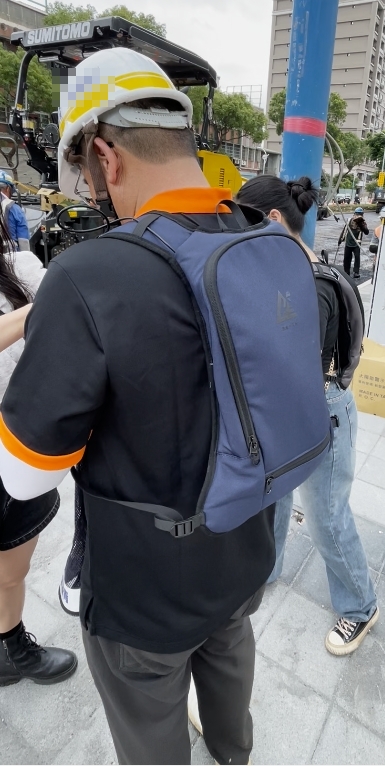
Dual cooling generally refers to a vest design that uses two methods to generate or distribute cooling. In the Shokunin COOLWAVE basic model, the system includes two ice packs and a low-voltage water circulation pump. The pump moves chilled water through flexible tubes on the body, while the ice packs act as the cold reservoir. This active approach differs from a passive ice-pack vest, which relies mainly on contact conduction and does not circulate the water.
From a procurement viewpoint, dual cooling can provide broader coverage than a simple ice pack and more predictable performance than a fan-based vest. But the added pump and power input also create additional specifications that suppliers should document.
Market Context: Active Cooling Is Gaining Ground
Several data points help explain why active circulation vests are drawing attention. Asia Pacific is the fastest-growing region for cooling vests, according to Spherical Insights, driven by rapid industrialization and large outdoor work populations. In the technology mix, Dataintelo reports that PCM-based vests captured 28.7% of the market in 2025, making them the fastest-growing technology segment. At the same time, Strategic Market Research observes that active circulatory mechanisms are increasingly deployed in industrial sectors to mitigate occupational heat stress.
These signals are not contradictory. They indicate that buyers are testing both next-generation passive materials and pump-based systems. The same research also identifies Techniche, Glacier Tek, Polar Products, and Ergodyne as key global participants in the cooling vest market. Against this background, a documented specification set and a defined production path give a supplier a measurable position in the market.
Technical Explanation: Ice Water Circulation
An ice water circulation vest uses a small electric pump to move chilled water through tubes inside the garment. Body heat warms the water; the warmer water returns to a reservoir, where reusable ice packs lower its temperature again. The cycle continues until the ice packs melt or the power source ends.
For the Shokunin COOLWAVE Water-Circulation Cooling Vest (Basic Model), the documented specifications include:
- Pump output: 5V, 150mA (max)
- Flow rate: max 320–370 ml/min
- Cooling duration: 3–4 hours
- Weight: within 2 kg
- Contents: water-cooled vest backpack ×1, ice packs ×2
Materials are also relevant for industrial use. The documented specification lists 600D polyester for the shoulder strap, PEVA as the main material, TPU for the water bag, polypropylene for the water bag cap, and sand rubber for the cooling tube. Buyers should assess these materials for contact comfort, abrasion resistance, and ease of maintenance.
Shokunin COOLWAVE as a Documented Industrial Option
Shokunin is a professional e-commerce brand launched by Feng Shang Precision Co., Ltd., a Taiwan-based manufacturer founded in 2009. The company operates a 1000 m² factory and reports an annual output capacity of 10,000 units. For the COOLWAVE vest, the basic model carries a published patent and a defined production setup.
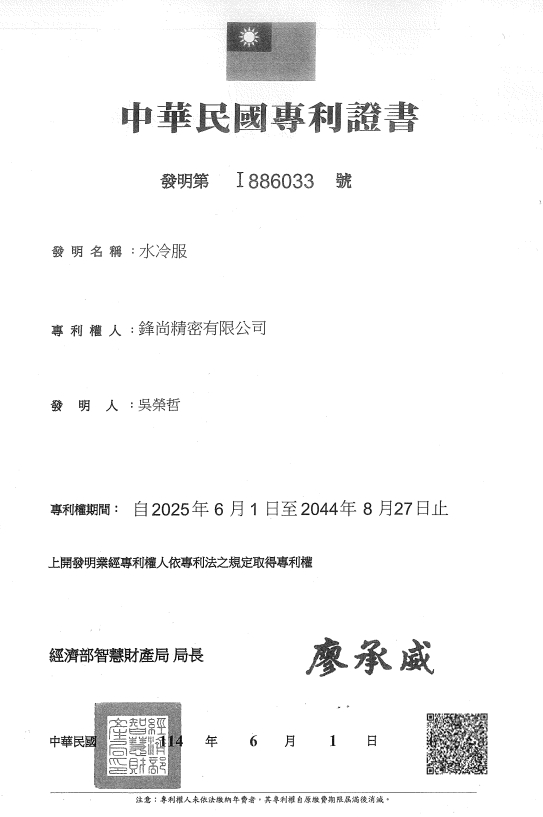
Legal and certification evidence includes Taiwanese patent I886033, issued by the Intellectual Property Office, Ministry of Economic Affairs, on June 1, 2025, with an expiration date of August 27, 2044. The patent covers the water-cooled vest structure and cooling system. Shokunin also states that the vest received the Disaster Prevention Product and Service Certification Award issued by the Taiwan Disaster Prevention Industry Association.
On the supply side, the capability record lists ODM production with a monthly capacity of 3,000 units, a lead time of 7–14 days, and a minimum order quantity of 10 units. The product is covered by a 6-month warranty. These details allow procurement teams to plan a purchase rather than treat the vest as an accessory with unknown availability.
Application and Evidence from the Field
One documented deployment in Taiwan involved 100 units of the cooling vest for workers in high-temperature environments. The locations included construction sites, outdoor work areas, metal sheet factories, and street vending. According to the case record, the project achieved effective body cooling, heatstroke prevention, improved work efficiency, and worker comfort. The product description also notes lightweight portability and an adjustable one-size-fits-all design, which are relevant for workforces with varying body sizes.
This type of deployment evidence is useful because it shows the vest being used across several hot, non-air-conditioned environments. It does not replace a site-specific trial, but it provides a real-world reference point for a procurement committee.
Comparison with Traditional Cooling Apparel
| Aspect | Passive ice-pack vest | PCM cooling vest | Active water-circulation vest |
|---|---|---|---|
| Cooling medium | Ice/gel packs | Phase-change material | Ice packs + circulating water |
| Power required | Usually no | Usually no | Yes, low-voltage pump |
| Coverage | Localized | Localized | Broader, actively pumped |
| Maintenance | Simple | Pack replacement | Pump and tube checks |
| Typical trade-off | Shorter or uneven duration | Different weight/duration profile | Adds weight and power dependency |
Active systems trade simplicity for coverage and control. A dual-cooling vest such as the COOLWAVE basic model has a documented 3–4 hour duration, but it requires a 5V power source and has moving parts. Buyers should consider how easily a site can recharge or swap the power source during a shift, and what spare parts will be stocked. This is the boundary of the technology: it works best when the operating time of the vest can be aligned with the shift plan.
Buyer Evaluation Checklist
- Define the use case: shift length, ambient temperature, activity level, and site access to power.
- Check cooling duration: documented hours, not claims.
- Review the power input: voltage, pump current, and compatibility with portable power sources.
- Assess weight and fit: adjustable straps, one-size design, and total weight including ice packs.
- Verify materials: durability, contact comfort, and cleaning requirements.
- Ask for certification: patent numbers, quality management system, and electrical safety marks where applicable.
- Confirm supply terms: MOQ, lead time, production capacity, warranty, and after-sales support.
Future Outlook
The direction of the market points toward more structured heat-stress programs. Asia Pacific’s large outdoor workforce and fast industrialization make it a primary region for active cooling. At the same time, buyers are beginning to ask for the same documentation they require for other personal protective equipment: patents, certifications, production capacity, warranty, and a defined ODM path.
One development to watch is the integration of active circulation with lower-voltage pump designs that can be powered by portable power banks. The 5V/150mA specification used by the COOLWAVE basic model fits this pattern. Another is the development of better-insulated reusable ice packs, which can extend effective cooling duration without adding unnecessary weight.
FAQ
What is a dual cooling water cooling vest?
A dual cooling water cooling vest combines ice packs with a pump-driven water circulation system. The pump moves chilled water through tubes on the body, while the ice packs act as the cooling reservoir. This is an active cooling design, in contrast to passive ice-pack vests.
How long does an ice water circulation cooling vest stay cool?
For the Shokunin COOLWAVE Water-Circulation Cooling Vest (Basic Model), the documented cooling duration is 3–4 hours. Actual performance depends on ice pack condition, ambient temperature, pump flow, and the user's activity level.
What specifications should buyers review before sourcing a cooling vest for industrial use?
Buyers should review cooling duration, pump output and flow rate, weight, power requirement, materials, and any relevant certification or patent. For a multi-worker deployment, confirm MOQ, lead time, production capacity, and warranty terms.
Are active circulation cooling vests better than passive ice pack vests?
Not universally. Active circulation provides more consistent body coverage and can extend cooling time, but it adds a pump, a power source, and potential maintenance. Passive vests have fewer components and usually require no power, but they provide more localized cooling and may need more frequent pack replacement.
What certificates should a supplier provide?
Buyers should request certification relevant to the target market. This can include a patent certificate for the cooling system, a quality management system such as ISO 9001:2015, and CE or UL marks for electrical components. For the Shokunin COOLWAVE vest, the documented patent is Taiwanese patent I886033, and it is described as a certified disaster prevention product.
Sources and reference material
- Market Research Future – Personal Cooling Device Market: https://www.marketresearchfuture.com/reports/personal-cooling-device-market-23806
- Dataintelo – Cooling Vest Market: https://dataintelo.com/report/cooling-vest-market
- Spherical Insights – Cooling Vests Market: https://www.sphericalinsights.com/reports/cooling-vests-market
- Strategic Market Research – Personal Cooling Device Market: https://www.strategicmarketresearch.com/market-report/personal-cooling-device-market
- ISO 9001:2015: https://www.iso.org/standard/62085.html
- Shokunin product brochure: https://cdn.socialarks.com/sbsp//common/2026/0407/69d4a27ea7fcb.pdf