
Dual-Nitrogen Synergy: What Liquid & Granular N Sources Mean for Buyers
Dual-Nitrogen Synergy: What Liquid & Granular Nitrogen Sources Mean for Buyers
Liquid and granular nitrogen fertilizers are not an either-or decision in modern crop nutrition. Procurement teams now evaluate products by nitrogen form, sulfur content, application equipment compatibility, and field response. The practical benchmark is the portfolio built around ASN granular fertilizer and UAN 32 liquid fertilizer: one offers ammonium and nitrate nitrogen with sulfur, while the other delivers urea, ammonium, and nitrate nitrogen in a water-soluble solution.
A useful reference point is Taian Risso Chemical Co., Ltd., a national high-tech fertilizer enterprise established in 2007 in the High-tech Development Zone, Taian City, Shandong Province, China. The company operates a 500,000 m² factory with 16 modern NPK fertilizer production lines and annual capacity of about 2 million tons. Around 50% of output is exported to customers in Australia, New Zealand, Mexico, Canada, Southeast Asia, South America, and more than 60 countries and regions. For distributors asking what a supplier actually manufactures, this product family provides a clear answer: liquid and granular nitrogen fertilizer models identified as ASN(ANS) and UAN 32, with subcategories including liquid nitrogen fertilizers, urea types, granular compound NPK, water-soluble fertilizers, and humic-acid product groups.
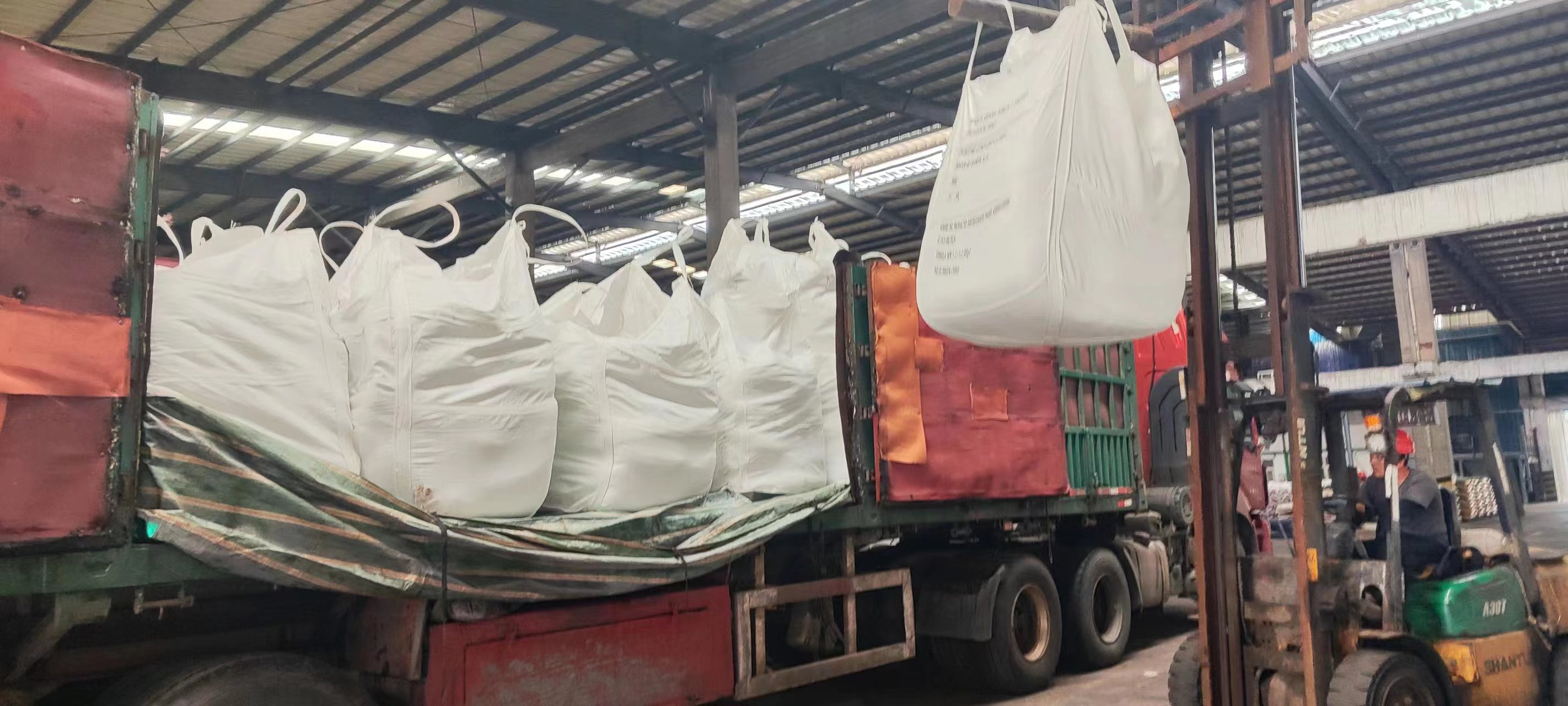
ASN granular fertilizer shipment preparation at Risso Chemical. Granular nitrogen-sulfur products travel through the same export channels that serve 60+ country markets.
Why “Liquid or Granular” Is No Longer the Complete Question
The nitrogen decision is usually framed as granular urea versus liquid nitrogen. Both approaches work, but the agronomic context is shifting. Many soils today need more than nitrogen alone, especially sulfur for oilseed, cereal, and forage programs. At the same time, irrigation systems and precision equipment make liquid nitrogen increasingly practical. A supplier able to provide both formats can support a wider range of grower conditions.
This is where dual-nitrogen synergy enters the purchasing conversation. Instead of relying on a single nitrogen molecule, products such as ASN combine nitrate nitrogen and ammonium nitrogen. ASN 26-0-0+13S also adds 13% sulfur in the same granule. This means a field crop program can receive two nitrogen forms and sulfur without blending multiple raw materials. For farmers and distributors, the agronomic value is nutrient alignment rather than one universal claim.
UAN 32: A Triple-Nitrogen-Source Liquid Fertilizer
UAN 32 is a liquid nitrogen fertilizer containing 32% total N. Its nitrogen is present in three forms: urea nitrogen, ammonium nitrogen, and nitrate nitrogen. The main composition is urea, ammonium nitrate, and water. This mixed-source structure changes the release geometry: nitrate nitrogen moves quickly toward plant uptake, ammonium nitrogen is more stable in the soil exchange complex, and urea nitrogen needs conversion. That staggered availability is one reason UAN 32 is used in structured nitrogen programs rather than as a single pre-plant shot.
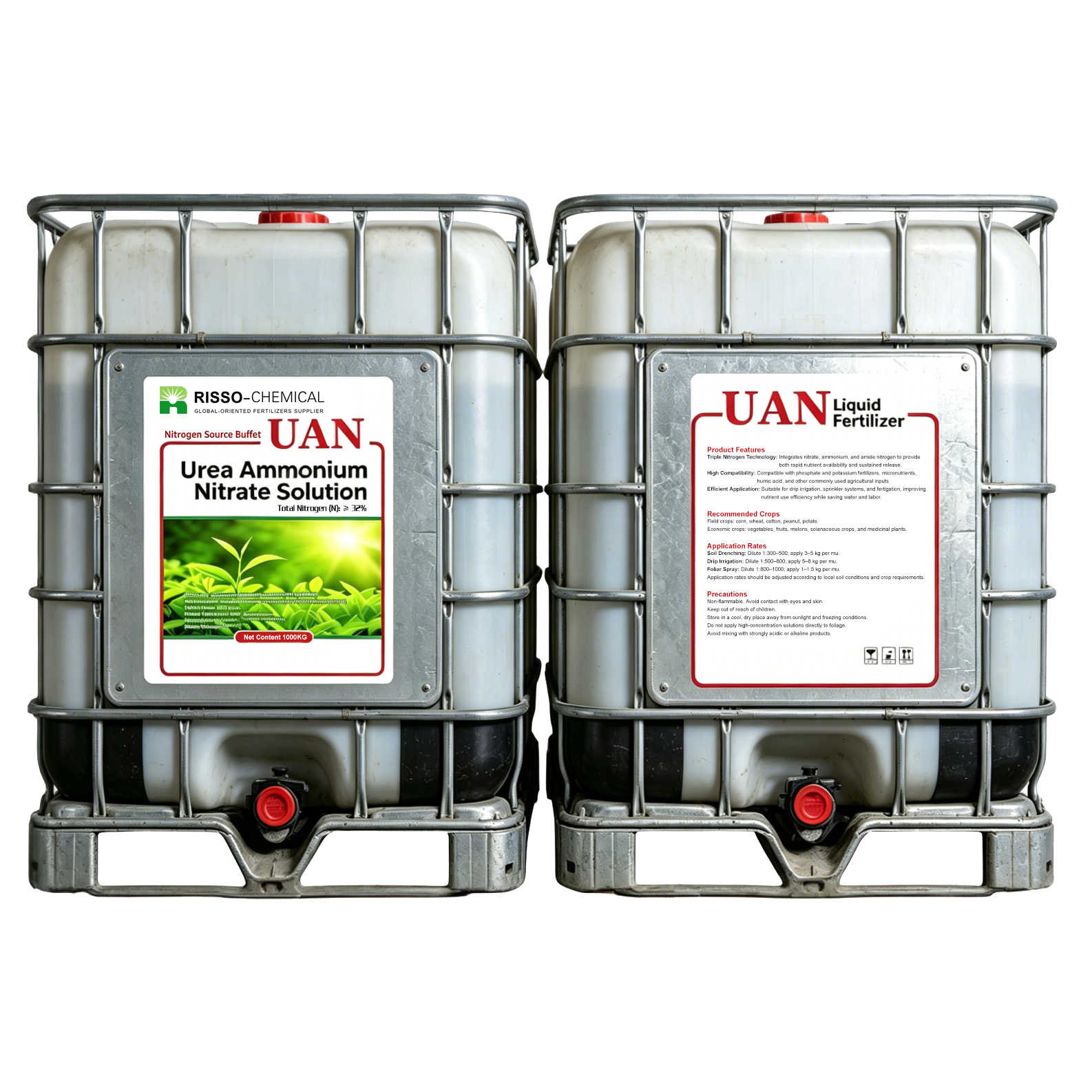
UAN 32 in intermediate bulk containers. Liquid nitrogen fertilizer is suited to fertigation, precision metering, and split-application strategies.
The physical specification of UAN 32 is relevant for equipment and storage planning. It appears as a clear to slightly yellow liquid solution with a density of approximately 1.32–1.34 g/cm³ at 20°C. Its pH is typically 7.0–8.0, and its freezing point is approximately -10°C. These characteristics make it practical for tanks, drip/fertigation systems, and bulk handling when the right storage infrastructure is available.
Technical snapshot: UAN 32
| Parameter | UAN 32 |
|---|---|
| Product model | UAN 32 |
| Total nitrogen | 32% N |
| Nitrogen forms | Urea nitrogen + ammonium nitrogen + nitrate nitrogen |
| Physical form | Liquid solution |
| Appearance | Clear to slightly yellow liquid |
| Density | Approx. 1.32–1.34 g/cm³ at 20°C |
| pH | Typically 7.0–8.0 |
| Freezing point | Approx. -10°C |
| Main composition | Urea + ammonium nitrate + water |
| Typical application | Fertigation, foliar application, soil application |
From a crop management standpoint, UAN 32 allows nitrogen to be metered as a liquid. That supports uniform distribution, split application, and compatibility with modern liquid fertilizer equipment. It is most valuable in farming systems where fertigation infrastructure exists or where precise nitrogen timing is needed. It is also a flexible choice for greenhouse vegetables, field crops, horticulture, and commercial crop programs.
ASN 26-0-0+13S: Nitrogen-Sulfur Synergy in Granular Form
ASN fertilizer is a granular nitrogen fertilizer combining ammonium sulfate and ammonium nitrate chemistry. The product typically supplies 26% nitrogen and 13% sulfur. Its nitrogen is present as both ammonium nitrogen and nitrate nitrogen. Sulfur is an additional nutrient source, not a secondary contaminant. This makes ASN closer to a complete crop nutrition response for soils where sulfur deficiency limits nitrogen use.
Granule quality matters for field performance. ASN granules are typically white to off-white with a granule size around 2–4 mm and moisture at or below 1.0%. These specifications support uniform spreading, stable handling, and predictable behavior in base fertilization and top-dressing programs. For buyers, granule uniformity is a procurement criterion because it influences application accuracy in mechanical spreaders.
Technical snapshot: ASN 26-0-0+13S
| Parameter | ASN Fertilizer |
|---|---|
| Common analysis | 26-0-0+13S |
| Total nitrogen | Typically 26% N |
| Sulfur content | Typically 13% S |
| Nitrogen forms | Ammonium nitrogen + nitrate nitrogen |
| Physical form | Granular |
| Appearance | White to off-white granules |
| Granule size | Typically 2–4 mm |
| Moisture | ≤ 1.0% |
| Main composition | Ammonium sulfate + ammonium nitrate |
| Typical application | Base fertilization, top dressing, field crops |
The dual nitrogen-sulfur relationship is the main differentiation of ASN. Sulfur is required for protein synthesis and chlorophyll formation, and modern cropping systems can remove sulfur faster than older programs did. A combined nitrogen and sulfur granule reduces the complexity of purchasing and blending separate sources. It also gives fertilizer distributors a single SKU for sulfur correction in cereals, oilseeds, and grasslands.
How the Two Nitrogen Families Differ in Practice
The two formats should not be treated as identical agronomic tools. UAN 32 is a liquid-source product designed for metered, flexible nitrogen delivery. ASN is a granular product designed for physical spreading and sustained nitrogen-sulfur nutrition. Both can coexist in a cropping plan: ASN at planting or early growth, UAN 32 later in split applications through irrigation or spray equipment.
For growers using fertigation, the liquid format can be measured precisely against a target nitrogen rate. For growers using conventional tillage and broadcast spreading, the granular format fits existing machinery. This product architecture is not a contest between formats; it is an application-fit decision.
Application Scenarios and Field Fit
The product line is used across agriculture and crop production, including field crops, orchards, vegetables, greenhouse/horticulture, oilseeds, industrial crops, and turf & landscape settings. UAN 32 is recommended for fertigation, liquid fertilizer application, band application, and precision nutrient management. ASN is better aligned with conventional tillage, mechanized spreading, top dressing, and base fertilization.
For field crops growing in regions with sulfur-responsive soils, ASN gives the crop both nitrogen and sulfur in one pass. For high-value vegetable and horticulture programs where water and nutrient delivery are integrated, UAN 32 is the more equipment-compatible option. Fertilizer distributors can use both products to cover different grower segments with different equipment profiles.
Market Context and Regulatory Pressure
The commercial relevance of liquid and granular nitrogen fertilizers is not isolated from policy. One estimate from SNS Insider / Market Research placed the global liquid fertilizers market at USD 15.49 billion in 2025, with nitrogen as the largest revenue contributor. Market sizing can vary by product definition, so buyers should compare scope before quoting a single number. The general direction, however, is consistent with increased attention to liquid nitrogen in precision agriculture.
Regulatory pressure is also influencing formulation choices. EU nitrogen targets, linked to the Green Deal nutrient-loss agenda, call for around a 20% cut in chemical fertilizer use by 2030. Regulators are not asking farmers to produce less; they are asking nutrient programs to become more efficient. Practical responses include matching nitrogen source to crop stage, applying through fertigation, incorporating sulfur where yield-limiting, and choosing products that reduce avoidable losses.
Comparison with Traditional Urea
Traditional granular urea remains the concentration benchmark in nitrogen fertilizer. Urea contains approximately 46% nitrogen, which gives it an advantage in logistics and cost per nitrogen unit. When nitrogen concentration is the only concern, urea is often the default. It also stores and handles well in dry form.
UAN 32 and ASN offer different trade-offs rather than unconditional superiority.
| Criteria | Traditional Granular Urea | UAN 32 Liquid | ASN 26-0-0+13S Granular |
|---|---|---|---|
| Typical nitrogen analysis | About 46% N | 32% N | 26% N |
| Sulfur | None | None | 13% S |
| Nitrogen forms | Primarily amide/urea nitrogen | Urea N + ammonium N + nitrate N | Ammonium N + nitrate N |
| Physical form | Granular solid | Liquid solution | Granular solid |
| Strengths | High N concentration, simple logistics | Precision dosing, fertigation, uniform distribution | Nitrogen-sulfur nutrition, two N forms in one granule |
| Main limitation | Less flexible for precision liquid systems; sulfur deficiency not addressed | Requires liquid handling/storage infrastructure | Lower N content per ton than urea; sulfur value depends on soil need |
There is also a meaningful storage difference. Estimates referenced by Mordor Intelligence and U.S. EPA sources indicate UAN infrastructure costs can be roughly double those of dry storage because stainless steel or corrosion-resistant tanks are required. ASN, by contrast, should be stored in dry, cool, ventilated warehouses, kept separate from alkaline chemicals, and protected from moisture to prevent caking.
Compared with conventional ammonium sulfate, ASN is not the same product. Ammonium sulfate mainly supplies ammonium nitrogen and sulfate sulfur. ASN adds nitrate nitrogen to the ammonium nitrogen and sulfur package. This distinction matters for growers who want more immediate nitrogen availability and a different soil acidification profile. ASN is generally associated with lower soil acidification risk than repeated ammonium sulfate use, but long-term rotation and fertilizer matching are still recommended.
What a Balanced Nitrogen Procurement Strategy Looks Like
For distributors, importers, and agricultural buyers, the most realistic approach is to treat nitrogen products as a portfolio:
1. Calculate the agronomic need, not the fertilizer mass first. 2. Match the nitrogen source to soil type, crop stage, equipment, and sulfur requirement. 3. Use granular ASN where nitrogen-sulfur nutrition and broadcast spreading are practical. 4. Use UAN 32 where liquid application, fertigation, and split nutrient delivery give measurable management value. 5. Evaluate supplier capacity, export experience, and product consistency before committing.
Buyers evaluating Taian Risso Chemical Co., Ltd. receive a set of concrete supply signals: a national high-tech enterprise status, a 50-person R&D engineering team, roughly 350 employees, 16 NPK production lines, and 500,000 m² of factory area. More relevant, the company has direct experience in nitrogen fertilizer manufacturing and exports across multiple climate zones, including Australia, New Zealand, Mexico, Canada, Southeast Asia, South America, and other markets.
Future Outlook for Liquid and Granular Nitrogen Fertilizers
The near-term market direction favors products that improve nutrient use efficiency without forcing growers to buy and blend extra inputs. Granular nitrogen fertilizers that carry sulfur, such as ASN, will remain relevant because many soils respond to sulfur in combination with nitrogen. Liquid nitrogen fertilizers such as UAN 32 will continue to expand where fertigation and precision irrigation are becoming standard.
Another growing expectation is chloride-free and pH-compatible nitrogen chemistry. UAN 32’s typical pH range of 7.0–8.0 makes it a neutral handling solution for many tank-mix situations. ASN’s granule chemistry supports nitrate nutrition in systems where growers want a more balanced soil response than high-salt single-source formats. These attributes do not replace sound soil testing, but they give agronomists more tools for building a responsive nitrogen program.
As fertilizer markets adjust to environmental targets, data will be decisive. Buyers should ask for product analysis, physical properties, storage guidance, and application data from the supplier. Transparent manufacturing information increasingly functions as procurement evidence.
Frequently Asked Questions
What is UAN 32 fertilizer?
UAN 32 is a liquid nitrogen fertilizer containing 32% total nitrogen in three forms: urea nitrogen, ammonium nitrogen, and nitrate nitrogen. Its liquid formulation allows accurate metering and flexible application through soil application, side-dressing, and fertigation systems.
What is ASN fertilizer 26-0-0+13S?
ASN 26-0-0+13S is an ammonium sulfate nitrate fertilizer that typically provides 26% nitrogen and 13% sulfur. Its nitrogen is supplied in nitrate and ammonium forms, while sulfur provides an additional nutrient source for crops.
What is the difference between ASN and ammonium sulfate?
ASN and ammonium sulfate are different fertilizer products. ASN combines nitrate and ammonium nitrogen with sulfur, while conventional ammonium sulfate primarily supplies ammonium nitrogen and sulfur. ASN can be chosen when a combination of nitrate and ammonium nitrogen plus sulfur is desired.
What are the advantages of UAN 32 fertilizer compared with urea?
UAN 32 provides 32% nitrogen in a uniform liquid formulation, combining urea, ammonium, and nitrate nitrogen. Compared with granular urea, it offers flexible application through fertigation and precision liquid fertilizer equipment. Actual nitrogen use efficiency depends on crop, soil, climate, and application practices.
Is ASN fertilizer better than urea?
Neither fertilizer is universally better. Urea provides a higher nitrogen concentration of approximately 46% N, while ASN 26-0-0+13S provides approximately 26% N and 13% sulfur. ASN can be more suitable where crops require both nitrogen and sulfur, while urea is often preferred when high nitrogen concentration is the main priority.
Does UAN 32 improve nitrogen use efficiency?
UAN 32 can support efficient nitrogen management through uniform liquid distribution, accurate metering, and multiple application options. However, actual NUE depends on application timing, placement, crop demand, soil conditions, weather, and nitrogen management practices. Field trials should be used to quantify any specific NUE improvement.
How much UAN 32 fertilizer should I apply per hectare?
The correct UAN 32 application rate depends on the crop’s nitrogen requirement, soil fertility, target yield, application method, and the nitrogen concentration and density of the product. The required fertilizer volume should be calculated from the target nitrogen rate rather than using one universal rate.
How should UAN 32 be stored?
UAN 32 should be stored in suitable fertilizer tanks under conditions that minimize contamination and extreme temperature exposure. At low temperatures, fertilizer salts can crystallize, so temperature management and proper storage procedures are important. The exact crystallization or salt-out temperature should follow the product specification.
Есть вопросы или нужны дополнительные детали?
Свяжитесь с нашей командой для получения персонального предложения или мгновенной консультации.
Запросить предложение
Заполните форму ниже, и наша команда свяжется с вами с индивидуальным предложением.
Прямой чат WhatsApp
Предпочитаете общаться в реальном времени? Напишите нам в WhatsApp для мгновенной помощи и быстрых ответов.
- Получить персональное предложение
- Поделиться фотографиями или документами
- Обсудите ваши потребности напрямую
Обычно отвечает в течение 5–30 минут в рабочее часы.