
Ducted vs. Ductless Fume Hoods: Buyer Decision Framework
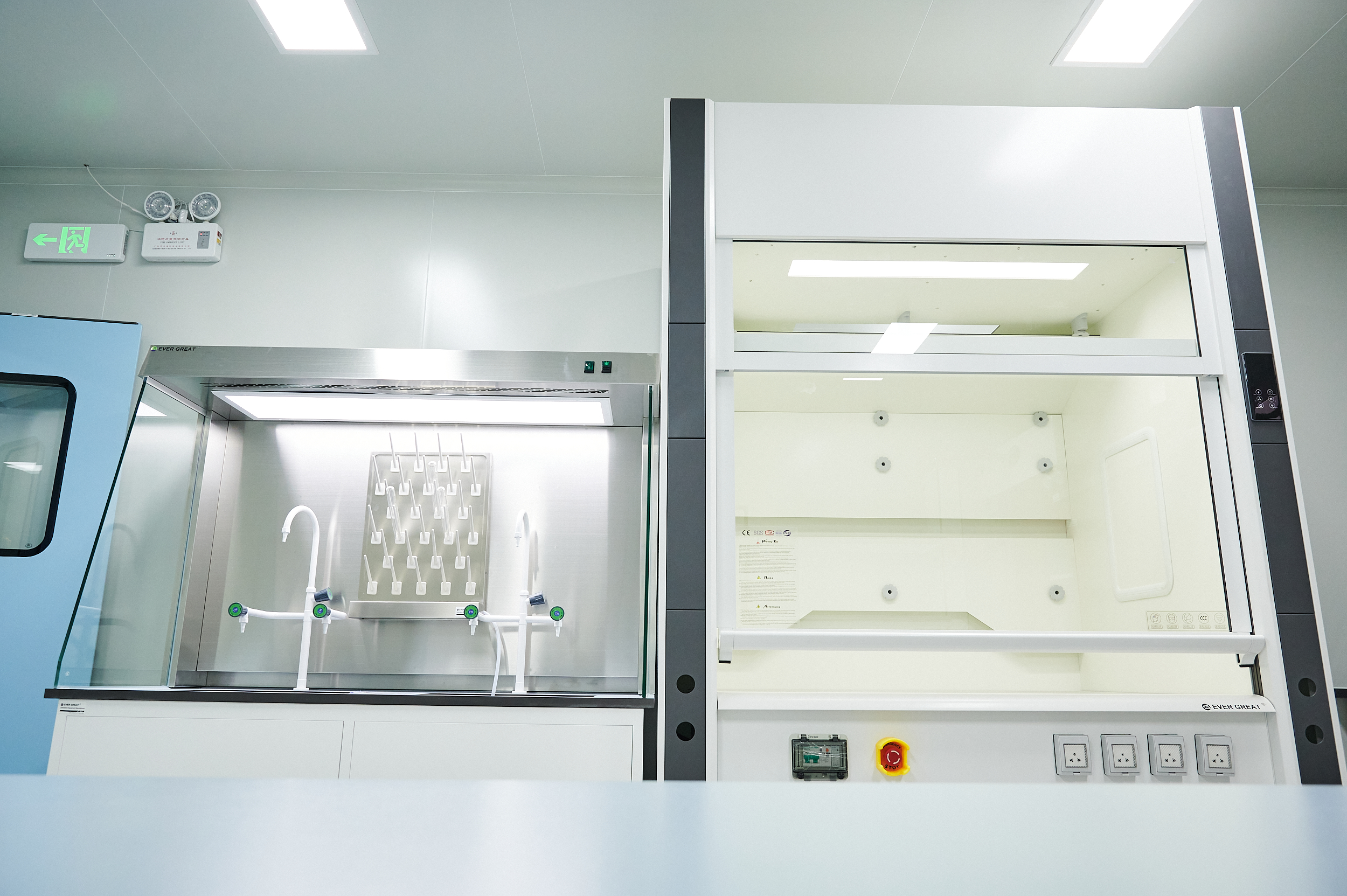
The working zone inside a laboratory fume hood. Baffle geometry, sash height and face velocity — not the exterior finish — determine whether a ducted or ductless design can serve a given chemical inventory.
A chemical laboratory does not simply choose a fume hood. It chooses an exhaust architecture. That distinction matters because the two dominant containment options — ducted and ductless — differ far less in how they look at the bench than in what they demand from the building, the chemical inventory, and the maintenance budget across the working life of the lab.
Laboratory planning guidance is consistent on the core trade-off. A ducted fume hood exhausts 100% of fumes outdoors and places no limitation on chemical types, with lower long-term filter replacement costs. A ductless (filtered) fume hood passes air through HEPA and activated carbon filtration and recirculates cleaned air back into the room, which reduces HVAC energy costs and installation complexity. Both share one physical requirement: a continuous face velocity of roughly 0.3–0.5 m/s (60–100 FPM) across the sash opening at the standard working sash height, typically 400–500 mm.
Guangdong Ever Great Laboratory Equipment Co., Ltd. (Ever Great), located in Shishan Town, Nanhai District, Foshan City, Guangdong Province, China, is a laboratory infrastructure manufacturer and EPC solutions provider founded in 2011. The company builds fume hoods, laboratory workbenches, safety storage cabinets, and PP and stainless steel laboratory furniture from a 6,000 m² manufacturing base, and its ventilation and containment products are tested against EN 14175 and ASHRAE 110 benchmarks, supported by third-party test reports from inspection bodies such as SGS. Its catalogue is relevant to this comparison for one practical reason: it contains both a narrow-frame fume hood platform offered in benchtop and walk-in configurations and a seamless-welded polypropylene fume hood — the two hardware directions a ducted-versus-ductless decision ultimately produces.
The Real Question Behind “Ducted or Ductless”
Answer first: ducted containment is the default where the chemical scope is broad, where the process includes acid digestion or another high-hazard operation, or where the bench runs continuously. Ductless containment is defensible where the chemical inventory is light to moderate, fully characterised, and demonstrably capturable by the filter media fitted — and where no viable duct route exists.
Most procurement errors are created before the hood is ever specified, by three assumptions:
- “We can add ducting later.” Ceiling clearance, duct routing to the roof, and makeup air capacity are building decisions. Retrofitting a route after fit-out is usually a construction project, not an equipment purchase.
- “Filters capture everything.” Filter selection depends on the specific chemicals in use, including their boiling points and evaporation rates. Whether carbon filters can safely capture a given vapour is a chemistry question, not a catalogue question.
- “Face velocity is a number on a datasheet.” Face velocity only becomes meaningful once sash height, baffle arrangement, and room air currents are all set together. A containment check performed at commissioning is the only reliable evidence.
A Five-Gate Comparison Framework for Chemical Laboratories
The framework below converts the ducted-versus-ductless question into five sequential gates. Each gate produces a decision or a piece of evidence; if a gate cannot be closed, the specification is not ready for tender.
| Gate | Question the buyer must answer | Evidence to request |
|---|---|---|
| 1. Chemical inventory & hazard assessment | Can carbon filtration safely capture every chemical in use, or is outdoor ducting mandatory? | Full chemical list including boiling points and evaporation rates; safety data sheets |
| 2. HVAC ducting & makeup air capacity | Is there ceiling clearance, a feasible duct route to the roof, and makeup air able to sustain continuous airflow? | Duct route assessment; makeup air calculation; roof penetration plan |
| 3. Sash calibration & airflow monitoring | Is the working sash height fixed and is the face velocity monitor calibrated with a low-flow alarm? | Sash height setting; monitor calibration record; alarm function test |
| 4. Containment testing | Does the installed hood contain smoke and hold velocity across the whole sash opening? | Smoke containment check; face velocity grid test; test report referencing EN 14175 / ASHRAE 110 |
| 5. Lifecycle & service continuity | Who replaces filter media on breakthrough, and who inspects fan belts and exhaust dampers? | Service level agreement; spare parts plan; maintenance schedule |
Gate 1 is the gate that most often decides the architecture on its own. If the inventory includes volatile toxic gases, heated acid digestions, or a broad mix of solvents and reagents, filtration becomes an unverifiable promise, and outdoor exhaust is the route with no chemical-type limitation.
Gate 2 is where ductless systems earn their place. Where the building offers no duct route — leased floors, listed structures, modular teaching laboratories — the reduced installation complexity of a recirculating hood is a genuine engineering advantage rather than a compromise.
Gates 3 and 4 apply equally to both architectures. A ducted hood that is commissioned without a smoke containment check and a face velocity grid test is no more proven than a filtered hood commissioned without filter-breakthrough monitoring.
Gate 5 is usually the largest cost line over ten years, and the one most often left out of the tender. On a ducted installation it covers rooftop blower belts and exhaust dampers; on a ductless installation it covers carbon filter replacement the moment chemical breakthrough is detected.
Ducted vs. Ductless: Structured Comparison
| Comparison dimension | Ducted fume hood | Ductless fume hood |
|---|---|---|
| Exhaust path | 100% of fumes discharged outdoors via ductwork | HEPA / activated carbon filtration with recirculation into the room |
| Chemical scope | No limitation on chemical types; suited to heavy chemical work, acid digestions, volatile toxic gases, high-throughput research | Light-to-moderate chemical handling; suitability depends on filter media matching the inventory |
| Infrastructure required | Duct route to roof, roof penetration, makeup air capacity, exhaust fan and (in acid service) scrubbing | No external ductwork; suitable for leased spaces |
| HVAC energy effect | Continuous conditioned-air discharge; higher load | Reduced HVAC energy cost |
| Installation complexity | Higher; coordinated with building works | Lower; faster deployment |
| Recurring maintenance | Lower long-term filter replacement cost; fan belts and exhaust dampers inspected routinely | Carbon filter replacement, immediate on breakthrough detection |
| Typical fit | Chemical, petrochemical, metallurgical and R&D laboratories with broad inventories | Educational laboratories, leased or retrofit spaces, low-hazard benches |
Matching the Framework to Real Containment Hardware
A framework only becomes useful when it maps onto equipment that can actually be ordered. Two Ever Great platforms illustrate how the gates translate into specifications.
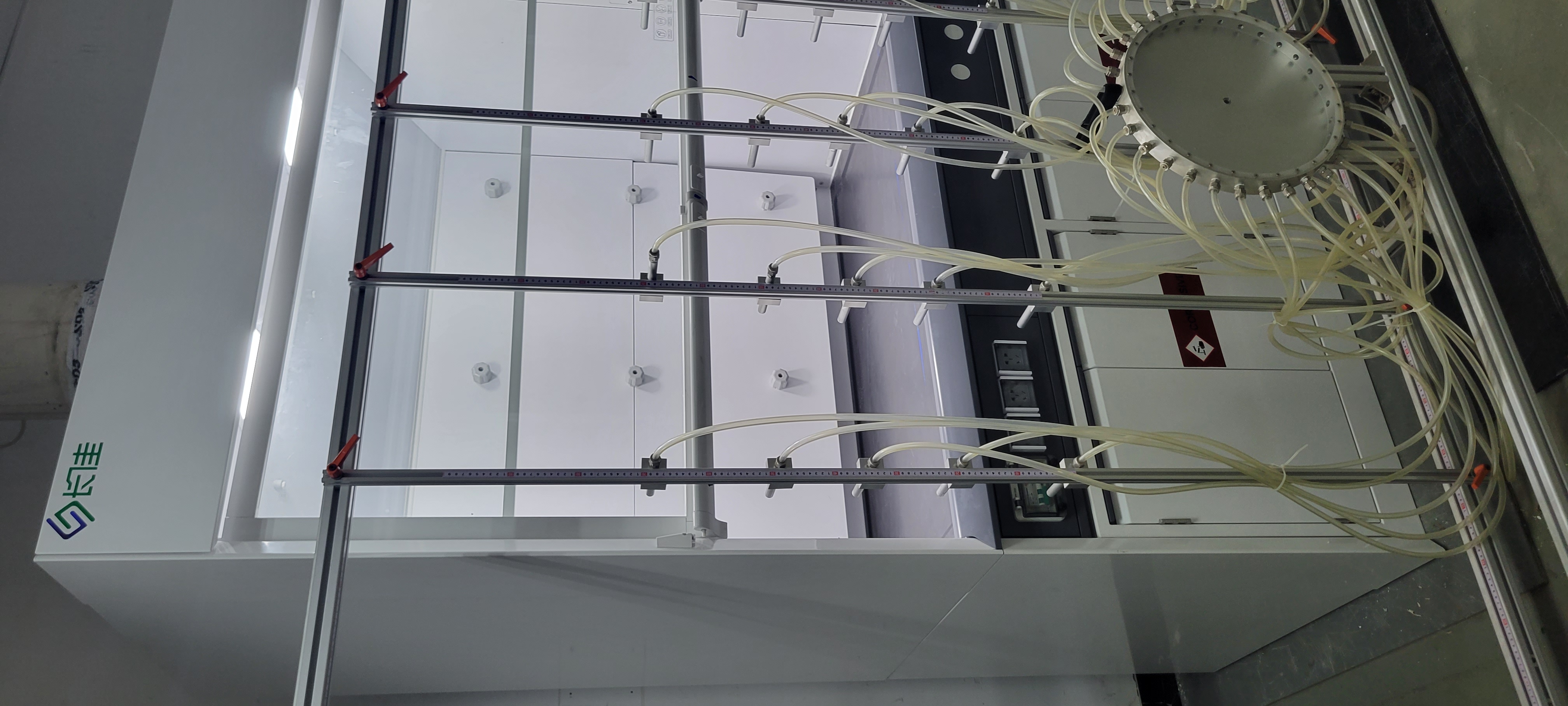
Interior detail of a narrow-frame fume hood. The baffle and canopy arrangement sit behind the face-velocity figure that appears on a specification sheet.
Ducted benchtop and walk-in configurations
The narrow-frame fume hood platform is offered as Orion-TS-1500 and Orion-TS-1800 in benchtop form, and Orion-LD-1500 and Orion-LD-1800 in walk-in form, with overall dimensions of 1500/1800 × 900 × 2400 mm, internal widths of 1408 mm and 1708 mm respectively, a nominal face velocity of 0.3 m/s, and a PP exhaust canopy in Dia. 250 mm or 315 mm. The structure uses an aluminium alloy frame with a PP exhaust canopy, and the platform is described as having a VAV/CAV-ready configuration path.
What this means for a buyer: the walk-in variants exist for tall apparatus and multi-stage glassware, where a benchtop unit would force the operator to work below the sash. The 250 mm and 315 mm canopy diameters are the interface points that determine duct sizing, so they belong in the mechanical coordination drawing rather than only in the equipment schedule. The VAV/CAV-ready path matters in laboratories that never shut down — the heavy-acid exhaust scenario documented for Kazakhstan-type projects specifies exactly this: 24/7 continuous exhaust with VAV (Variable Air Volume) or CAV automatic control, matched with a centrifugal PP exhaust fan, an acid scrubber tower, a ductwork system, and an airflow monitor controller.
Polymer construction for acid and alkali service
Where the inventory is dominated by acids and alkalis, the containment questions shift from airflow alone to material compatibility. The polypropylene fume hood model EG-PP-FH is a seamless-welded PP anti-corrosion fume hood with overall dimensions of 1200/1500/1800 × 850 × 2350 mm, PP sheet thickness of at least 8.0 mm, a face velocity range of 0.3–0.6 m/s, and a three-stage baffle. It is built from homogeneous PP, PP welding rod, and tempered glass, with an optional ceramic worktop, and is intended for chemical, electroplating, and acid-alkali laboratories.
One detail buyers commonly overlook is the working surface inside the hood, which absorbs direct spill and heat load. Guidance on worktop selection is straightforward: epoxy resin is recommended for heavy chemical synthesis, university research, and high-heat environments, offering resistance to harsh corrosives and thermal shock up to 600°C; phenolic resin suits biology, pharmaceutical QC, physical testing, and general chemistry, with better scratch and impact resistance and better cost efficiency. For the highest acid service, the corresponding project specification adds a seamless PP inner liner, a ceramic worktop, and explosion-proof lighting — a reminder that the hood itself is one component in a system that also includes the exhaust fan, scrubber, and ductwork.
Scenario Fit: Where Each Architecture Belongs
Continuous heavy-acid exhaust
In high-risk acid digestion laboratories handling HCl, HNO3, and HF at elevated temperature, with continuous airflow inside an indoor hazardous zone, the containment role is defined as hazardous vapour containment, operator safety protection, and face velocity airflow control. The supporting equipment list is fully ducted in nature: a centrifugal PP exhaust fan, an acid scrubber tower, a ductwork system, and an airflow monitor controller. Special requirements include EN 14175 / ASHRAE 110 compliance, a seamless PP inner liner, a ceramic worktop, and explosion-proof lighting. This is a ducted scenario in every meaningful sense; a recirculating unit would require the buyer to prove, chemical by chemical, that filtration is equivalent.
Corrosive chemical storage on the same exhaust circuit
Vented storage is often specified in the same tender as the hood, and it carries the same infrastructure dependency. In a corrosive chemical storage scenario, a vented cabinet operates in passive secure storage with a 24/7 top exhaust ventilation connection, relies on external exhaust ventilation ductwork as supporting equipment, and is used with chemical spill trays and safety padlocks. Special requirements include 100% pure polypropylene seamless welding, a leak-proof liquid basin, and anti-static design. The procurement implication is direct: specifying vented storage has already committed the project to ductwork, so the ducted-versus-ductless decision for the hood should be made in the same design pass rather than afterwards.
Metallurgical and high-temperature sample preparation
Not every laboratory containment problem is a fume hood problem. In metallurgical and foundry QC environments, the documented working conditions are extreme high temperature, heavy mechanical impact, oil and grease exposure, and high vibration. Benches in this setting are specified with SUS 304/316 stainless steel, heat resistance up to 800°C, and heavy load capacity up to 800 kg, and are used with a local extraction arm. The correct containment strategy here is local extraction combined with heat-resistant bench systems, rather than a standard chemical hood sized for a different hazard.
Cleanroom and GMP environments
Cleanroom projects involve a separate set of parameters: ISO Class 5 to Class 8 conditions, automatic sensor-triggered air showers, HEPA/ULPA filter units, differential pressure gauges, ISO 14644-1 compliance, HEPA filtration efficiency of 99.99% at 0.3 μm, and noise below 65 dB. Filter architecture in this context addresses particulate and sterility control. It is a design mistake to assume that such filtration also resolves a chemical vapour problem; where a chemical bench sits within or alongside a cleanroom, exhaust for chemical hazard and filtration for particulate control must be treated as two separate engineering decisions.
Large laboratory rollouts and campus-scale programmes
At scale, the framework has to survive procurement over multiple phases. Documented project conditions for large industrial and research facilities include indoor operation, high load-bearing up to 500 kg/m², moderate chemical exposure, and 24/7 continuous operation, with worktops specified in phenolic, epoxy resin, or ceramic. Delivery history of this type is a reasonable proxy for continuity capability: 105 units of laboratory furniture installed for a biotech company in the Philippines, completed within five years; 200 units installed across various departments of a pharmaceutical building in China, completed within five years; and 45 units installed in a pharmaceutical building in Australia for R&D use across departments, also completed within five years. For a buyer, the relevance is that the same supplier has to deliver a consistent containment specification across buildings, not a single hood.
What Market Data Says About Containment and Furniture Spend
Published research points to a laboratory furniture market valued at approximately USD 4.8 billion in 2025, projected to reach USD 8.1 billion by 2034, according to Dataintelo. Buyers should read that number carefully: estimates for the same year vary substantially across research houses because the definitions differ, particularly on whether integrated laboratory services and high-end components such as gas piping are counted. A market figure is a definition, not a benchmark, and should never be used as a substitute for measured project data.
The material structure of that spend is more informative. Metal laboratory furniture holds a 52.7% revenue share by material in 2025, confirming that steel-framed benches and metal-bodied equipment remain the volume mainstream. Polymer-bodied and PP-lined containment sits in a smaller but chemically decisive segment, which is consistent with the fact that polymer construction is specified where metal cannot survive the chemical environment.
Supply depth is also shifting toward component-level trade. China exported over USD 4.15 billion of furniture parts (HS 940390), a category that includes laboratory furniture components, in 2024 according to OEC data. That is a signal that buyers can source bench frames, cabinetry, and hardware through established component supply chains, which in turn raises the relative importance of the containment engineering — hood, ductwork, scrubber, and control — as the differentiating part of a laboratory project.
A further trend is the convergence of verification standards. ANSI/ASHRAE Standard 110-2016 (R2025) is the primary American national standard for quantitative performance testing of laboratory fume hoods, and it is complemented in Europe by EN 14175. Tenders increasingly ask for test evidence at commissioning rather than datasheet claims, which favours suppliers able to provide documented third-party reports, VAV/CAV-ready control paths, and long-term spare parts support.
Traditional Practice vs. a Framework-Based Selection
Traditional practice selects a hood by bench footprint, visible finish, and unit price, treats ducting as the contractor's problem, and assumes filtration is a universal substitute for exhaust. A framework-based selection runs the five gates in sequence and assigns each of them to a named responsible party before the order is placed.
The difference shows up in what gets verified. A traditional tender may specify “fume hood, 1500 mm, chemical resistant.” A framework-based tender specifies the sash height, the target face velocity, the canopy diameter that the mechanical contractor must match, the exhaust medium (ductwork to scrubber, or ductwork to rooftop fan), the commissioning test method, and the maintenance responsibilities for belts, dampers, and filter media.
It is equally important to state where the framework does not resolve anything. Ductless filtration remains chemistry-specific: its safety depends on the filter media matching a fully characterised inventory, and on immediate replacement when breakthrough is detected. Ducted containment remains building-specific: without a viable duct route and sufficient makeup air, the equipment cannot be commissioned at all. Neither architecture removes the fundamental operating constraints. Perchloric acid and radioisotopes must not be handled in standard ducted or ductless fume hoods without specialised washdown systems. Fan belts and exhaust dampers on rooftop blowers require routine inspection. Excess chemical bottles stored inside the hood workspace obstruct airflow regardless of the design. These are boundaries, not preferences, and they should be written into the operating procedure from day one.
Future Outlook
Three shifts are visible in the way laboratory containment is being specified.
First, verification-first procurement. Standards such as ANSI/ASHRAE 110-2016 (R2025) and EN 14175 are becoming the shared language between buyers, contractors, and suppliers, and containment testing is moving from an optional commissioning step to a contractual milestone.
Second, hybrid exhaust design. Rather than a single architecture across a building, laboratories increasingly separate high-hazard benches on ducted exhaust with scrubbing from low-hazard benches on filtered enclosures, keeping the ducted footprint small without weakening containment where it matters most.
Third, materials and service continuity. As acid-intensive and high-temperature applications grow, demand for PP-bodied hoods, seamless-welded liners, and ceramic worktops rises alongside demand for documented spare parts availability. Manufacturing capacity, lead time, and after-sales structure become part of the containment specification, because a hood that cannot be maintained is a hood that eventually fails. Ever Great, for example, publishes OEM/ODM production with a monthly capacity of 2,000 units, lead times of 10–30 days, a minimum order quantity of one unit, 100% testing, and after-sales support covering service level agreements, technical assistance, and spare parts and maintenance — the kind of operational data that buyers now weigh alongside the equipment specification itself.
FAQ
1. How should a laboratory decide between a ducted and a ductless fume hood?
The decision depends on three inputs: the chemical hazard profile, the building exhaust infrastructure, and the flexibility required. Ducted fume hoods are recommended for heavy chemical applications, heating reactions with acid digestions, volatile toxic gases, and high-throughput research, because they exhaust 100% of fumes outdoors with no limitation on chemical types and lower long-term filter replacement costs. Ductless (filtered) fume hoods are recommended for light-to-moderate chemical handling, educational laboratories, or leased spaces without external ductwork, using HEPA and activated carbon filtration to recirculate cleaned air with reduced HVAC energy costs and installation complexity.
2. What building conditions must be confirmed before a ducted fume hood is ordered?
Buyers should measure ceiling clearance, confirm the feasibility of the duct route to the roof, and verify that the laboratory makeup air system can support a continuous face velocity of 0.3–0.5 m/s (60–100 FPM). On the equipment side, the exhaust interface must be fixed in advance — for example, a PP exhaust canopy in Dia. 250 mm or 315 mm on the narrow-frame fume hood platform. Where the exhaust stream carries heavy acid, the supporting equipment set typically also includes a centrifugal PP exhaust fan, an acid scrubber tower, a ductwork system, and an airflow monitor controller.
3. Can a ductless hood be used for acid digestion involving HCl, HNO3, or HF?
This should be answered chemically rather than commercially. Ductless hoods are intended for light-to-moderate chemical handling, while ducted hoods are recommended for heating reactions with acid digestions and volatile toxic gases. Where heavy acid exhaust conditions involving HCl, HNO3, and HF are involved, the corresponding project specification calls for EN 14175 / ASHRAE 110 compliance, a seamless PP inner liner, a ceramic worktop, and explosion-proof lighting, together with ducted exhaust under 24/7 VAV or CAV control. A ductless unit is not interchangeable with that configuration.
4. Which airflow parameters should be set and verified at commissioning?
During commissioning, the standard working sash height is set — typically 400–500 mm — and the digital face velocity monitor and low-flow audio/visual alarm are calibrated. A standard smoke containment check and a face velocity grid test across the sash opening are then performed to confirm zero turbulence and leakage before routine use. Nominal face velocity values on the equipment to be verified may differ by platform: 0.3 m/s nominal on the narrow-frame fume hood, and a 0.3–0.6 m/s range on the polypropylene fume hood.
5. When is a walk-in configuration needed instead of a benchtop hood?
A walk-in configuration becomes appropriate when the work involves tall apparatus or multi-stage setups that cannot be handled comfortably below a benchtop sash. The narrow-frame fume hood platform is available in both benchtop and walk-in versions — Orion-TS-1500 and Orion-TS-1800 for benchtop use, and Orion-LD-1500 and Orion-LD-1800 for walk-in use — with internal widths of 1408 mm and 1708 mm, an overall height of 2400 mm, and a nominal face velocity of 0.3 m/s. The working sash height and face velocity still have to be verified at commissioning in either configuration.
6. Which worktop material belongs inside a fume hood in acid service?
Selection follows chemical exposure intensity and heat resistance requirements. Epoxy resin is recommended for heavy chemical synthesis, university research, and high-heat environments, offering resistance to harsh corrosives and thermal shock up to 600°C, with water absorption below 0.05%. Phenolic resin is recommended for biology, pharmaceutical QC, physical testing, and general chemistry, offering better scratch and impact resistance and better cost efficiency. For the most aggressive acid service, a ceramic worktop is the alternate option on polypropylene hoods.
From Decision Framework to Specification
The ducted-versus-ductless choice is best made at the design stage, as an exhaust architecture decision supported by chemical data, building data, and a commissioning plan. Buyers who run the five gates in order — inventory, infrastructure, sash calibration, containment testing, lifecycle service — will usually find that the correct answer becomes obvious before the equipment schedule is written, and that the answer is often a hybrid rather than a single choice for an entire facility.
Ever Great publishes its full 2026 laboratory furniture and containment product documentation, including fume hood configurations and materials, for download: Ever Great 2026 product brochure (PDF).