
Durability Sourcing: Evaluating Portable Axial Flow Pump Suppliers
Multi-year drainage programmes rarely fail on the day of commissioning. They fail in year three, when the replacement unit no longer matches the original, when a spare impeller cannot be sourced inside the flood season, or when the control cabinet supplied with the 2022 fleet is not the cabinet quoted in 2026. Durability sourcing treats those outcomes as procurement constraints to be verified before a purchase order, not as service issues to be resolved afterwards.
This reference is written for buyers in the research and evaluation stages who are comparing suppliers of High Efficiency Portable Axial Flow Pumps for projects that will run across several budget cycles. It focuses on three questions that ordinary specification sheets do not answer: whether a supplier keeps a stable model family, whether parts and control equipment remain available, and whether build quality stays consistent from the first batch to the fifth.
Zhejiang Chuangmei Electromechanical Co., Ltd., the manufacturer behind the chuangmei Pumps range, is based in the TA'AO Industrial Zone, Wenling City, Zhejiang Province, China. Founded in 1996, it operates a 12,000 m² facility with 46 employees and an annual output of 30,000 units, and exports approximately 25% of production to Southeast Asia, Africa, Morocco and Central Asian markets.
Why durability is a constraint, not a specification
First Mover market research projects the global axial flow pump market at approximately USD 4.49 billion by 2026. That figure is a demand signal rather than a purchasing standard, and buyers should note that published valuations for the same category vary considerably between research houses, largely because the boundary between axial-flow and mixed-flow equipment is drawn differently. Market size does not help a procurement team decide whether the pump ordered in 2026 will match the pump ordered in 2029.
Four verifiable constraints do. They form the practical core of a long-term supplier evaluation:
- Model continuity — whether the supplier publishes recurring model families whose codes can be read and re-ordered without re-engineering.
- Material and motor consistency — whether the same code always delivers the same construction, and whether that construction is stated on the order.
- Parts and control-equipment support — whether cabinets, impellers, pump bodies, connectors and float bodies remain orderable after the original batch closes.
- Compliance validity — whether certificates cover the exact models in the fleet and stay valid beyond the project handover date.
A supplier that answers all four in writing is a lower-risk partner than one that answers only the performance question.
Reading the 200SZQ and 300SZQ model families
The SZQ naming convention is itself a procurement tool. In this range the numeric prefix identifies the discharge size — 100SZQ for 4-inch, 150SZQ for 6-inch, 200SZQ for 8-inch, 250SZQ for 10-inch and 300SZQ for 12-inch pumps — and the following blocks identify rated flow in cubic metres per hour, rated head in metres, and motor power in kilowatts. A code such as 300SZQ1000-10-45 therefore describes a 12-inch unit rated at 1,000 m³/h, 10 m head and 45 kW.
Because the same convention repeats across the 200SZQ and 300SZQ families, a buyer can plan a multi-year fleet around contiguous codes rather than around individual quotations. The table below shows a selection of listed configurations, with net weights taken from published model data.
| Model | Rated flow | Rated head | Motor power | Net weight |
|---|---|---|---|---|
| 200SZQ150-20-15 | 150 m³/h | 20 m | 15 kW | 26 kg (aluminium alloy) |
| 200SZQ200-25-22 | 200 m³/h | 25 m | 22 kW | 29 kg |
| 200SZQ150-45-30 | 150 m³/h | 45 m | 30 kW | 32 kg (aluminium alloy) / 52 kg (stainless steel) |
| 200SZQ600-10-30 | 600 m³/h | 10 m | 30 kW | 27.5 kg |
| 200SZQ100-100-50 | 100 m³/h | 100 m | 50 kW | 59 kg |
| 300SZQ800-15-55 | 800 m³/h | 15 m | 55 kW | 80 kg (stainless steel) |
| 300SZQ1000-10-45 | 1,000 m³/h | 10 m | 45 kW | 55 kg (aluminium alloy) / 78 kg (stainless steel) |
| 300SZQ1200-10-55 | 1,200 m³/h | 10 m | 55 kW | 58 kg (aluminium alloy) / 98 kg (stainless steel) |
| 300SZQ1500-10-75 | 1,500 m³/h | 10 m | 75 kW | 65 kg (aluminium alloy) / 105 kg (stainless steel) |
This is the single most common continuity failure in multi-year pump sourcing, and it is entirely avoidable: pin the material, the cabinet configuration and the cable arrangement into the purchase specification, then repeat that specification verbatim on each release.
Material choice as a durability variable
In this range the impeller is produced by precision stainless steel casting and the pump shaft is also stainless steel. The motor housing and pump body are offered in either aluminium alloy or stainless steel, and the cable outlet is protected by a rubber sheath with a stainless steel spring guard. Some models in the wider catalogue are listed with a cast iron pump body combined with a stainless steel impeller, which is a further reason to confirm construction per model rather than per brand.
The measurable difference is weight. At the same rated duty — 150 m³/h at 45 m with a 30 kW motor — the aluminium alloy 200SZQ150-45-30 is listed at 32 kg in a 280×280×580 mm envelope, while the stainless steel version is listed at 52 kg in a 280×280×700 mm envelope. At 12-inch scale the gap widens: 300SZQ1000-10-45 is 55 kg in aluminium alloy against 78 kg in stainless steel.
Neither option is universally superior, and a supplier that presents one as a blanket upgrade is not giving a procurement-grade answer. Aluminium alloy reduces handling weight, which matters where units are moved by two people, loaded onto vehicles, or redeployed between sites during a flood season. Stainless steel raises mass but is the conventional choice where water chemistry, abrasion or long immersion periods place higher demands on the wetted structure. The correct decision rule is site-specific: match the material to the water condition and the handling method, then keep that choice constant across the fleet so that spares and lifting arrangements stay valid.
What the permanent magnet synchronous submersible motor changes
The permanent magnet synchronous motor high-speed axial flow pump is covered by utility model patent ZL2014200091521.8. The manufacturer states that it holds national first-class energy conservation certification for high-tech energy-saving products and that it has developed 20 permanent magnet synchronous motor submersible axial flow pump models.
Three characteristics matter for long-term sourcing rather than for a single tender:
- Speed stability under voltage fluctuation. The manufacturer states that pump speed does not vary with grid voltage fluctuation, so head and flow remain stable when supply voltage drops — a condition that conventional asynchronous motor axial flow pumps do not handle in the same way. On projects with weak or variable supply, this reduces the risk of seasonal performance drift that is otherwise blamed on the pump.
- Stepless speed regulation. Infinitely adjustable speed produces adjustable head and variable flow from one unit, which lets a single model cover more than one duty point across a multi-year programme instead of forcing a new model purchase each time requirements shift.
- Reduced mass. The manufacturer describes these units as approximately one-quarter the weight of conventional axial flow pumps, with high efficiency, large flow and portability. Lower mass directly affects transport cost, manual handling risk and the size of the vehicle needed for emergency deployment.
A related option is the dual-purpose pump, in which two pump-head sets — impeller, pump body and flow deflector — are supplied so that a low-head high-flow duty and a high-head duty can be served by swapping the set. Models 200SZQ-HL-22 and 250SZQ-HL-30 are listed with this configuration. For a buyer, this is a hedge against duty-point uncertainty: one capital purchase covers two operating envelopes, at the cost of storing and tracking an additional pump-head set.
Regulatory context is shifting alongside the technology. China implemented GB 30253-2024, the mandatory energy label standard for permanent-magnet synchronous motors, for products sold from 2025. Buyers specifying PMSM pumps for Chinese projects should expect energy-label documentation to become a routine part of the submittal package rather than an optional extra.
Consistent build quality: the evidence a buyer can request
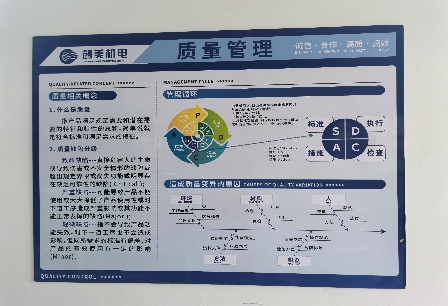
Durability claims are only as good as the production system behind them. The manufacturer operates a 12,000 m² facility with 46 employees and an annual output of 30,000 units, supported by a three-engineer engineering team and documented production management visible in facility records covering assembly stations, incoming material areas, performance testing and finished-goods dispatch.
The most decision-relevant quality statement in the supplier's capability data is that every unit undergoes a 100% pre-shipment hydraulic performance test. For a multi-year programme this should be converted into a contractual routine: the same test bench, the same recorded parameters, and a per-unit test record retained with the serial number. Where a project requires formal acceptance against a tolerance band, ISO 9906 provides the reference framework, and ISO 9906 Grade 1 tolerances of ±5% on flow and head are the appropriate reference for high-precision applications.
The three-engineer team is also a planning constraint. It is adequate for standard configurations and nameplate-level customization, but non-standard heads, special voltage arrangements or new cabinet logic should be scheduled early in the project calendar rather than assumed to be available at short notice.
Lifecycle support: cabinets, parts and flood units
A pump fleet is a system, and the parts that fail or go missing first are rarely the pump body. The control cabinet is the component most exposed to specification drift, because cabinet electronics change faster than castings.
The supplied cabinet offers panel or touch-screen display with a built-in frequency inverter, real-time display of frequency, voltage, current and rotational speed, and remote control through 3G and 4G mobile networks via computer and mobile phone application, including remote start and stop and remote speed adjustment. It supports time-segmented operation and provides overheat, overcurrent, overload, overvoltage and phase-failure protection, with automatic shutdown within half a minute when water is fully drained followed by standby mode. Cabinets are available in single-unit or one-drives-two configurations, with IP44 or IP54 protection, and the three-phase four-wire arrangement uses waterproof plugs and sockets.
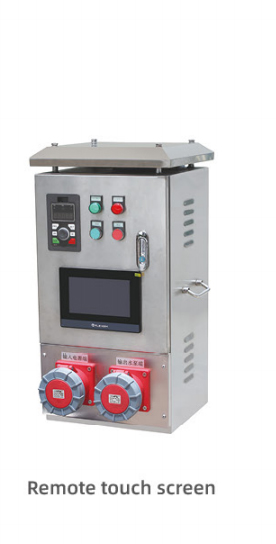
Cabinet availability spans 5.5–7.5, 11–15, 18.5–22, 30, 37, 45, 55, 75 and 110 kW ratings, each offered as a mini-style unit, a vehicle-mounted single system or a vehicle-mounted double system. Weight differences are significant enough to affect vehicle planning: the 5.5–7.5 kW mini-style cabinet measures 300×270×500 mm at 15 kg, while the 110 kW vehicle-mounted single system measures 700×500×1600 mm at 130 kg.
| Cabinet power range | Mini-style | Vehicle-mounted single | Vehicle-mounted double |
|---|---|---|---|
| 5.5–7.5 kW | 300×270×500 mm, 15 kg | 300×270×500 mm, 15 kg | 520×270×550 mm, 25 kg |
| 18.5–22 kW | 360×350×530 mm, 19 kg | 390×350×700 mm, 32 kg | 390×350×700 mm, 61 kg |
| 45 kW | 450×430×710 mm, 37 kg | 480×430×960 mm, 50 kg | 480×430×960 mm, 82 kg |
| 75 kW | 500×450×780 mm, 46 kg | 600×430×1080 mm, 70 kg | 1000×430×1000 mm, 100 kg |
| 110 kW | Not listed | 700×500×1600 mm, 130 kg | Not listed |
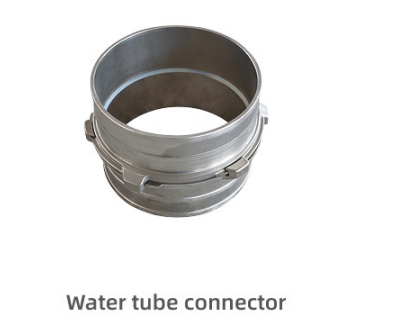
Mechanical spares follow the same logic. Pump flat bodies are listed with defined buoyancy and dead load figures — the 8–10 inch flat body at 600×600×280×300 mm with 78 kg floatage and 8 kg dead load, the 12-inch flat body at 800×350×350 mm with 120 kg floatage and 12.5 kg dead load — alongside hose connection fittings, water hose clamps, quick clamping hoops, water outlets and an 8-inch aluminium alloy floating body rated at 35 kg floatage and 4.5 kg dead load. A flood prevention unit, model CMFD01, is also offered in stainless steel at 200 kg and 1000×800×1250 mm for buyers who prefer a containerised arrangement over loose components.
Where a project's discharge route lengthens after the initial design — a common change in multi-phase drainage works — booster pumps extend the same pump family rather than introducing a new supplier. Listed options include 200SZQ500-10-22GL at 500 m³/h and 10 m with 22 kW and 48 kg, 250SZQ800-10-37GL at 800 m³/h with 37 kW and 69 kg, and 300SZQ1000-10-45GL at 1,000 m³/h with 45 kW and 98 kg, with high-head variants such as 150SZQ150-35-22GL, 200SZQ300-30-37GL, 200SZQ400-30-55GL and 200SZQ400-80-150GL covering longer or steeper runs.
Service terms complete the lifecycle picture. The manufacturer provides a one-year warranty with free maintenance during the warranty period, supported by remote technical guidance, spare parts supply and on-site maintenance consultation. Procurement teams should record the warranty start point — commissioning, delivery or acceptance — because that single definition determines when the coverage window actually closes.
Certification continuity across the project timeline
Certificates expire; projects do not always finish on schedule. The portable axial flow pump range holds a Machinery and EMC Directive Attestation of Conformity issued by UDEM under certificate M.2025.206.C120727, issued on 13 June 2025 and valid to 12 June 2030. The listed standards include EN ISO 12100:2010, EN 809:1998+A1:2009/AC:2010, EN IEC 61000-3-2:2019+A2:2024, EN 61000-3-3:2013/A2:2021/AC:2022-01, EN IEC 61000-6-1:2019 and EN IEC 61000-6-3:2021.
A second attestation, M.2025.206.C120734, addresses EN 60204-1:2018/A1:2025 — the electrical equipment of machines standard — which is the more directly relevant reference for cabinet integration. Both certificates share the same issue and expiry dates, giving a five-year compliance window that comfortably covers most multi-year drainage programmes.
Scope is the part buyers most often overlook. The certificate model list covers a defined set of configurations, including units such as 200SZQ450-8-15, 200SZQ500-10-22, 250SZQ600-12-30, 250SZQ800-10-37, 300SZQ1000-8-37, 300SZQ1000-10-45, 300SZQ1200-10-55, 300SZQ1000-15-75 and 300SZQ1500-10-75. A model added to the fleet later may fall outside that list, so written confirmation of coverage should be obtained before the unit is ordered rather than after it is delivered.
Two further references are worth recording in the project file. Axial flow and mixed flow vertical pumps primarily for water handling are classified under HS code 84138130, which simplifies customs treatment across repeat shipments. And where an impartial performance benchmark is required, ISO 9906 supplies the tolerance framework referenced earlier.
Where this sourcing approach has limits
A supplier evaluation that only lists strengths is not an evaluation. The following boundaries should be planned for explicitly:
- Material choice is not a free upgrade. Aluminium alloy units are considerably lighter, but stainless steel remains the appropriate consideration where water chemistry, abrasion or extended immersion place higher demands on wetted parts. Choosing aluminium purely to reduce handling weight can be the wrong decision for aggressive water.
- Warranty coverage is shorter than project life. The standard one-year warranty with free maintenance does not span a multi-year programme; extended terms, spares holding or a service agreement must be negotiated separately if continuity of cover is required.
- Standard lead times assume standard configurations. Published figures of 15–20 days for OEM supply and 15–30 days for ODM supply, with a minimum order of one unit for OEM, apply to defined specifications. Non-standard heads, special voltages, multi-unit cabinet builds and larger project volumes require separate scheduling, and the three-engineer engineering team means customization queues should be booked early.
- Not every part interchanges. Impellers, pump bodies and flow deflectors are model-specific; the dual-purpose pumps require swapping both pump-head sets rather than a single component. Spares planning must be per model, not per family.
- Certificate scope is fixed at issue. CE coverage applies to the listed models only, and new configurations require confirmation.
Future outlook
Two forces are reshaping how portable axial flow pumps will be bought over the next several years. The first is efficiency regulation: China's GB 30253-2024 energy label requirement for permanent-magnet synchronous motors, applied to products sold from 2025, signals that motor efficiency documentation is becoming a standard procurement attachment rather than a differentiator. Suppliers who can produce model-level efficiency evidence as routine paperwork will be easier to keep in a multi-year programme than those who assemble it case by case.
The second is application mix. High-head configurations in the 20–60 m band, with special specifications reaching beyond 100 m, are increasingly specified for subway and underground space drainage alongside conventional flood control, bridge, culvert, basement and garage fixed drainage. As duty points diversify within a single programme, the value of a stable model family — and of light, speed-regulated units that can be redeployed — rises relative to the value of a single lowest-price tender.
The practical consequence for buyers is that durability sourcing will be judged on documentation as much as on hardware: model continuity across years, material stated per order, parts identified per model, and certificates whose validity extends past handover. Those are checkable facts, and they are the ones that survive a project.
FAQ
Which model family should a multi-year project standardise on — 200SZQ or 300SZQ?
The choice follows discharge size and duty, not preference. The 200SZQ family is the 8-inch series and covers moderate flows such as 150 m³/h at 20 m with 15 kW, or 600 m³/h at 10 m with 30 kW; the 300SZQ family is the 12-inch series and covers higher flows including 800 m³/h at 15 m with 55 kW and up to 1,500 m³/h at 10 m with 75 kW. Projects needing both moderate and high flows typically run both families in parallel, since the model codes remain readable in the same way.
Is aluminium alloy or stainless steel the better long-term material choice?
Neither is categorically better. Aluminium alloy reduces unit weight substantially — the 200SZQ150-45-30 is listed at 32 kg in aluminium alloy against 52 kg in stainless steel, and the 300SZQ1000-10-45 at 55 kg against 78 kg. Lower weight supports manual handling, vehicle loading and rapid redeployment. Stainless steel adds mass but is the conventional consideration where water chemistry, abrasion or prolonged immersion are demanding. The impeller is precision stainless steel cast and the pump shaft is stainless steel in either case.
How long does the CE certification remain valid, and which models does it cover?
Certificate M.2025.206.C120727, issued by UDEM on 13 June 2025, is valid to 12 June 2030, and the companion attestation M.2025.206.C120734 addressing EN 60204-1 shares the same dates. The certificate lists specific models, including 200SZQ450-8-15, 200SZQ500-10-22, 250SZQ600-12-30, 250SZQ800-10-37, 300SZQ1000-10-45, 300SZQ1200-10-55 and 300SZQ1500-10-75. Models outside that list require separate confirmation.
What spare parts and control options should be included in lifecycle sourcing?
Electrical cabinets are offered from 5.5–7.5 kW to 110 kW in mini-style, vehicle-mounted single-system and vehicle-mounted double-system formats, with panel or touch-screen display, built-in frequency inverter, 3G and 4G remote control, time-segmented operation and protective functions covering overheat, overcurrent, overload, overvoltage and phase failure, at IP44 or IP54. Mechanical spares include pump flat bodies in 8–10 inch and 12-inch sizes, hose connection fittings, hose clamps, quick clamping hoops, water outlets and aluminium alloy floating bodies. A stainless steel flood prevention unit, model CMFD01 at 200 kg, is also available.
What are the practical limits of a long-term supply arrangement in this range?
The standard warranty is one year with free maintenance during that period, which is shorter than most multi-year programmes, so extended coverage must be contracted. Published lead times of 15–20 days for OEM and 15–30 days for ODM, with a minimum order of one unit for OEM, apply to standard configurations; non-standard heads, special voltages and larger volumes need separate scheduling. Spares do not interchange across every model, and CE coverage is fixed to the listed models at issue.
Есть вопросы или нужны дополнительные детали?
Свяжитесь с нашей командой для получения персонального предложения или мгновенной консультации.
Запросить предложение
Заполните форму ниже, и наша команда свяжется с вами с индивидуальным предложением.
Прямой чат WhatsApp
Предпочитаете общаться в реальном времени? Напишите нам в WhatsApp для мгновенной помощи и быстрых ответов.
- Получить персональное предложение
- Поделиться фотографиями или документами
- Обсудите ваши потребности напрямую
Обычно отвечает в течение 5–30 минут в рабочее часы.