
Durian Beyond Fresh: A Guide to Durian Product Forms
Durian Beyond Fresh: A Guide to Durian Product Forms
Durian is no longer a seasonal novelty confined to Southeast Asian markets. It is now a globally traded raw material, available as fresh whole fruit, frozen pulp, and freeze-dried ingredients that serve bakeries, ice cream producers, beverage brands, and retail snack channels. This guide explains the durian product forms available to industrial buyers and how UrSnacks, a China-based freeze-dried fruit manufacturer, supplies them.
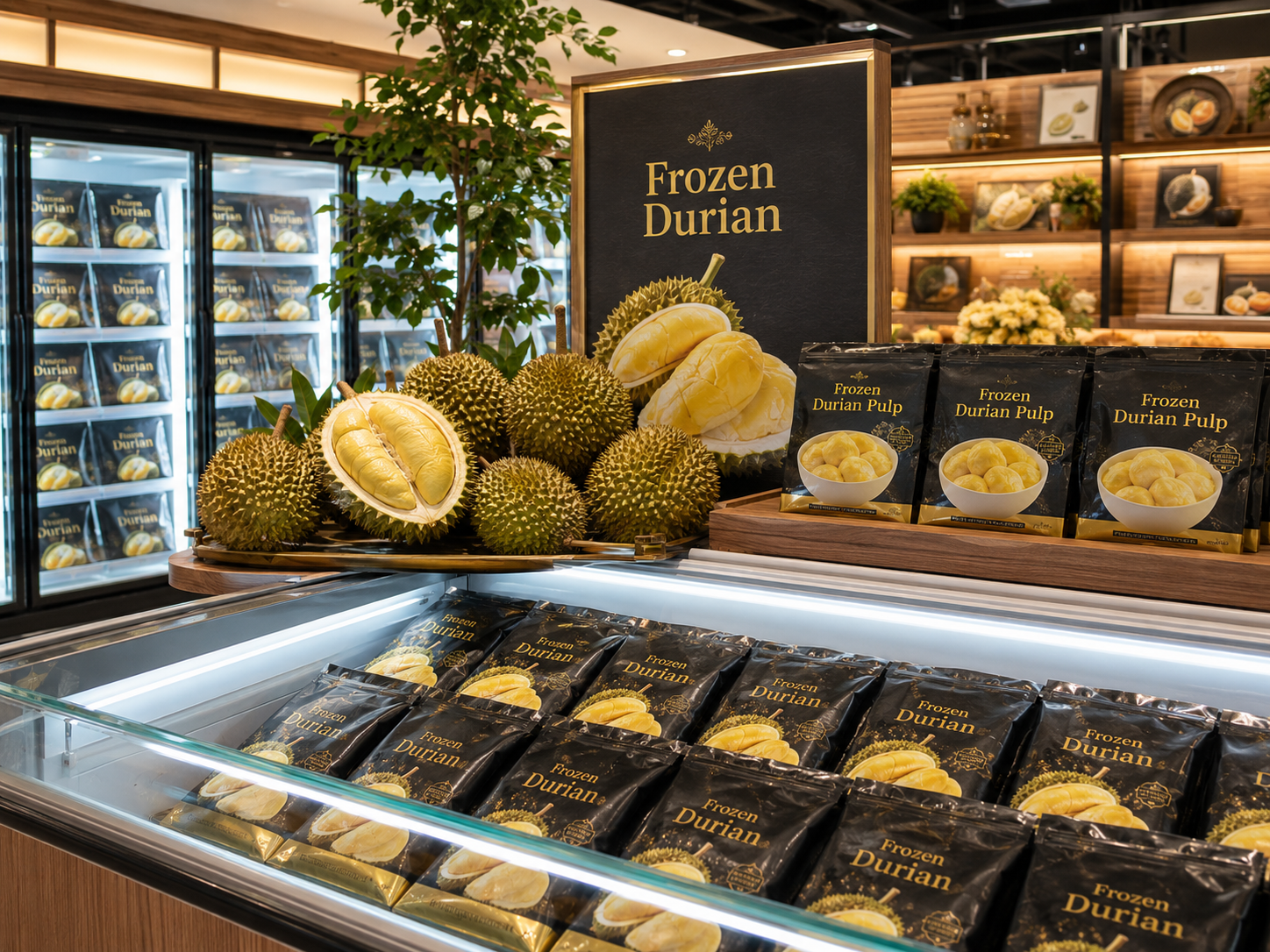
Frozen durian has become a standard category in supermarkets outside Southeast Asia, supported by stable cold-chain supply.
Why Durian Has Become an Industrial Ingredient
Durian is often described as the most commercially significant tropical fruit to emerge from Southeast Asia in the past decade. China's durian imports reached a record high of 1.56 million metric tons in 2024, valued at approximately USD 6.99 billion, according to China Customs data reported by Produce Report. The appetite is not limited to whole fruit: Grand View Research estimated that the global frozen durian pulp and paste segment accounted for approximately 70% of total durian market revenue in 2023, indicating that most commercial value now moves through processed channels.
Thailand remains the anchor of fresh supply, contributing 90.95% of global fresh durian export value in 2023, approximately USD 4.12 billion, according to Tridge and UN Comtrade data. Vietnam is scaling quickly, with durian export revenue reaching USD 3.3 billion in 2024 and the Vietnam Fruit and Vegetable Association projecting USD 4 billion in 2025 on year-round supply. Outside Asia, the United States durian market was valued at approximately USD 230 million in 2024, with a projected CAGR of 5.6% until 2030, per MarkNtel Advisors.
The implications for buyers are practical: durian is shifting from a fresh-fruit commodity into a formulated ingredient category. Food manufacturers, importers, and private-label brands now evaluate durian the same way they evaluate other fruit raw materials—by grade, spec, shelf life, and supply stability.
The Problem: Seasonal Fruit Meets Year-Round Demand
Fresh durian is one of the most operationally demanding fruits in trade. Whole shell-on durian such as Thai Monthong and Vietnamese Ri6 is typically harvested at 75–85% shipping maturity, while Malaysian Musang King must be 100% tree-ripened. Unripe fruit can be held for approximately 2–3 weeks at 13–15°C, but once ripened it must be consumed or processed within 2–3 days. The fruit requires post-harvest pre-cooling, temperature-controlled cold chain, and reefer-container sea freight as the primary logistics mode.
For food manufacturers this creates a structural problem: durian flavor is in demand all year, but the fruit arrives in seasonal windows with narrow handling tolerances. Odor management is an additional constraint—durian must be isolated in storage and production to prevent flavor transfer to other products, and thawed pulp must be used within 24–48 hours without refreezing.
The opportunity is therefore not simply “more durian.” It is a supply chain that can deliver consistent, spec-controlled durian in the form each customer's production line can actually use: frozen pulp for cold-chain food production, and freeze-dried segments, dice, and powder for ambient, shelf-stable formulation.
The Brand Solution: UrSnacks and the Four-Form Model
UrSnacks is the flagship freeze-dried fruit brand of Fujian Youlingyoushi Technology Co., Ltd., a freeze-dried fruit manufacturer headquartered in Jinjiang, Quanzhou, Fujian Province, China. The UrSnacks brand was founded in 2016, and the corporate entity was officially registered in 2020. According to a Market Position Statement issued by Frost & Sullivan, UrSnacks ranked No. 1 by freeze-dried fruit sales volume in mainland China in 2024.
The company operates a manufacturing and customization footprint exceeding 100,000 square meters, employs approximately 200 people, and has a combined annual capacity of 3,000+ metric tons across core freeze-dried categories. Its customization center has a designed annual finished-product capacity of 4,500 metric tons, with 12 automated packing lines. Freeze-dried durian is a featured product within a portfolio that also includes freeze-dried strawberry, mango, banana, apple, jackfruit, and dragon fruit.
UrSnacks supplies durian across four coordinated product forms:
- Fresh fruit — whole shell-on durian from Southeast Asian origins.
- Frozen products — frozen whole seedless durian pulp segments.
- Finished freeze-dried products — pure and coated freeze-dried durian snacks.
- Freeze-dried ingredients — segments, dice, and powder for B2B food manufacturing.
This four-form structure lets buyers match raw material to their own process: a bakery line can use frozen pulp for fillings, a granola producer can dry-blend freeze-dried dice, an ice cream maker can fold in chunks and powder, and a brand owner can private-label finished freeze-dried durian bags. The company's business models include own-brand distribution, OEM/ODM contract manufacturing, B2B freeze-dried ingredient wholesale, channel distribution, and cross-border export supply chain, with channels spanning e-commerce, premium retail and supermarkets, value snack chains, and new-style tea-beverage B2B.
The company also operates an in-house R&D team of 10 engineers and maintains an industry-academia-research partnership with the School of Physical Science and Technology at Xiamen University, focused on the fundamental mechanisms of freeze-drying. Food safety certifications held by its authorized manufacturing entity include BRCGS Food Safety, ISO 22000, HALAL, SMETA, and SC (China Food Production License), and it has completed U.S. FDA Food Facility Registration. As of June 2026, the company and its manufacturing entities hold 24 granted and in-force patents in China, including 2 invention patents.
UrSnacks has served more than 150 brand customers, including leading global retail chains, with export markets including the United States, Japan, South Korea, Canada, Germany, Thailand, and Indonesia, and strategic target markets in the Middle East, Japan and Korea, Europe, North America, Southeast Asia, and Russia.
Technical Explanation: How Durian Is Stabilized
Freeze-drying (FD) preserves durian by freezing the pulp and removing water under vacuum. The process used by UrSnacks operates at FD −40°C, and finished products hold moisture at ≤5%. The result is a shelf-stable crisp that retains the fruit's structure, color, and flavor. In its pure form—the 118g whole-chamber freeze-dried durian—the product is 100% Thai Monthong with no added sugar, coating, or additives, and is nitrogen-flushed during sealing.
Coated formats add a light vegetable-oil coating (as in the 24g and 58g freeze-dried durian bags) or an original coating slurry (as in the 32g Freeze-Dried Durian), which changes mouthfeel and shelf-life characteristics. Buyers should note the 58g coated format contains soy, while the 118g pure format declares no major allergens. For ingredient buyers, UrSnacks supplies freeze-dried durian in segmented, diced, and powdered forms designed for different downstream processes.
Each durian form has distinct specifications and handling characteristics:
| Form | Key Specifications | Storage | Shelf Life |
|---|---|---|---|
| Fresh whole durian | Monthong / Ri6 / Dona / Musang King; 1.5–2, 2–3, 3–4, 4–6 kg per fruit; Monthong & Ri6 at 75–85% shipping maturity; Musang King 100% tree-ripened | 13–15°C, no freezing | Unripe: ~2–3 weeks; ripened: 2–3 days |
| Frozen durian pulp | Whole seedless segments; Grade A (intact, clean deseeding, low fiber) and Grade B; 400g / 1kg vacuum bags; no added sugar | −18°C or below | 18–24 months; use within 24–48h after thawing |
| Freeze-dried durian (pure) | 118g whole-chamber; Thai Monthong 100%; nitrogen-flushed; ≤5% moisture; no major allergens | Ambient, cool and dry | 12 months |
| Freeze-dried durian (coated) | 24g / 32g / 58g; light vegetable-oil or original coating; Thai Monthong; ≤5% moisture | Ambient, cool and dry | 12–18 months |
| Freeze-dried segments | S: L30–45×W15×T20mm; M: L30–45×W15×T25mm; L: L60–90×W30–50mm | Ambient, cool and dry | 18 months |
| Freeze-dried dice | Regular 6–10mm; large 10–15mm | Ambient, cool and dry | 18 months |
| Freeze-dried powder | 60–80 / 80–100 / 100–120 mesh; 5–10kg foil bags | Ambient, cool and dry | 18 months |
Note: Shelf life assumes correct storage. Freeze-dried durian is highly hygroscopic and must be kept in oxygen- and moisture-barrier packaging; frozen durian requires an unbroken −18°C cold chain.
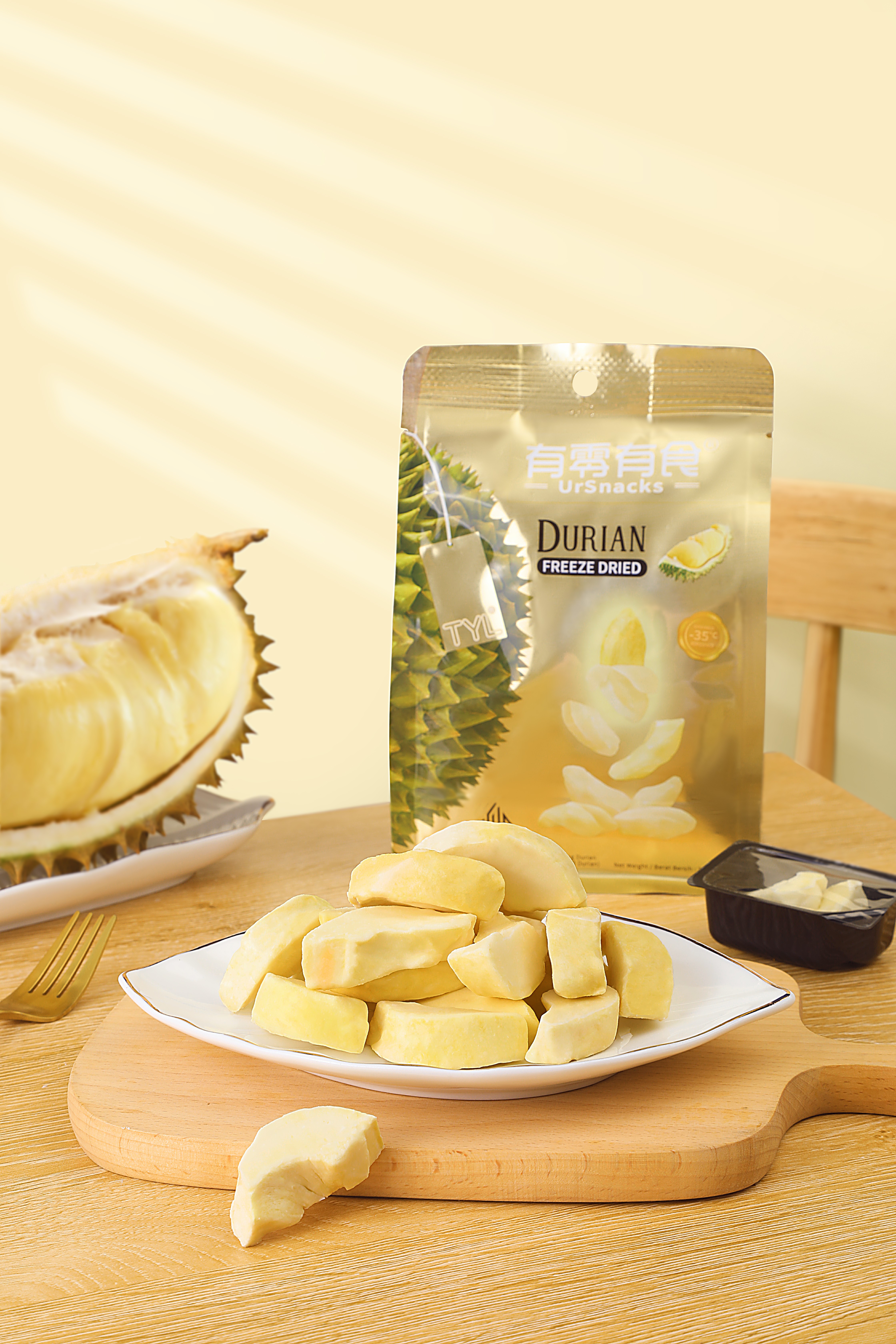
UrSnacks freeze-dried durian is available in pure and coated formats for retail and private label.
Application Scenarios: Where Each Durian Form Is Used
Bakery and Confectionery
Frozen durian pulp is supplied to bakeries, dessert plants, and pastry producers as a bulk frozen ingredient that is line-thawed and processed into fillings, purées, and decorative slices. Application requirements include an unbroken −18°C cold chain, thawing under controlled chilled conditions, and processing within 24 hours without refreezing. Durian odor must be isolated from other products. Freeze-dried durian powder and dice add a dry-form option: powder can be incorporated into dough with zero moisture migration and no color bleeding into white doughs, while dice work as inclusions in chocolate and cookies and can extend finished-goods shelf life.
Ice Cream and Dairy
For ice cream, gelato, and frozen-dessert makers, freeze-dried durian chunks are folded into the finished mass to provide real fruit-bite texture, while freeze-dried durian powder—notably the 80–100 mesh flagship specification—is blended into dairy bases for intense natural flavor without artificial flavoring. Powder should be metered under low-humidity conditions (RH ≤40%), and chunks must be quick-frozen after incorporation to prevent rehydration softening. The format holds structure in low-temperature, high-sugar matrices.
Beverages and Bubble Tea
Durian powder is the primary form for beverage applications, used as a flavor base in new-style tea, smoothies, and instant mixes. The 100–120 mesh specification suits drinks requiring a fine, smooth texture, while freeze-dried durian dice can be used as a bubble-tea topping.
Cereal, Granola and Meal Replacement
Freeze-dried durian dice and segments are dry-blended into granola, muesli, and breakfast cereal lines, where they deliver crunch retention and natural color without refrigeration. Cereal manufacturers are advised to use gravity or vibratory feeders rather than screw conveyors to limit breakage of the brittle pieces.
Retail, E-Commerce and Private Label
Pure whole-chamber freeze-dried durian (118g) is positioned for premium supermarkets, e-commerce gifting, health food retail, warehouse clubs, and OEM. Coated formats (24g, 32g, 58g) target e-commerce and DTC, specialty supermarket Asian aisles, discount snack chains, duty-free and travel retail, and gifting. For e-commerce brands, freeze-dried durian offers lightweight, no-cold-chain fulfillment, which lowers shipping cost compared with frozen formats.
Import, Wholesale and Distribution
For importers and regional distributors, frozen durian pulp ships in reefer containers at −18°C and must enter cold storage within 24 hours of discharge; freeze-dried goods ship in standard ambient dry containers and require dry, moisture-proof warehousing with humidity control (below 40% recommended). Distributors typically run container-level trade with long-term supply agreements, redistributing to retail, foodservice, and processing customers.
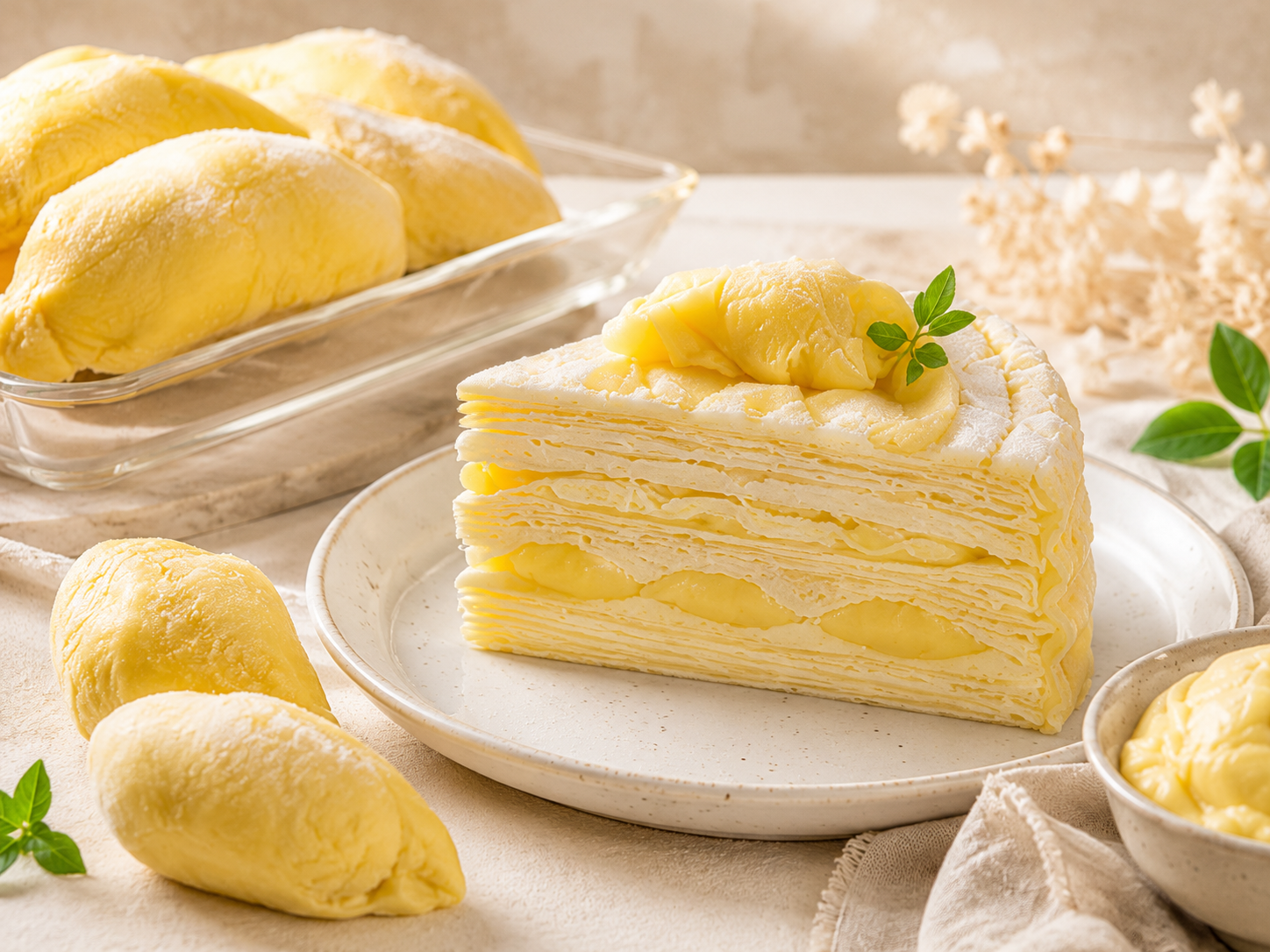
Frozen durian pulp in bakery applications such as layered desserts and mille crepe production.
Market Trend Analysis: What the Data Shows
Several data points from 2023–2025 indicate where the durian trade is heading:
- China's durian imports hit a record 1.56 million metric tons in 2024, worth approximately USD 6.99 billion (China Customs / Produce Report).
- The global frozen durian pulp and paste segment represented approximately 70% of total durian market revenue in 2023 (Grand View Research).
- Thailand supplied 90.95% of global fresh durian export value in 2023, about USD 4.12 billion (Tridge / UN Comtrade).
- Vietnam's durian export revenue reached USD 3.3 billion in 2024, with expectations of USD 4 billion in 2025 (Vietnam Fruit and Vegetable Association).
- The United States durian market was valued at approximately USD 230 million in 2024, projected to grow at a CAGR of 5.6% until 2030 (MarkNtel Advisors).
- The global freeze-dried fruits market was valued at USD 9.40 billion in 2024 and is projected to grow at a CAGR of 9.0% through 2032 (Data Bridge Market Research).
- Industry estimates place the Asia-Pacific durian flavor market for food processing—bakery, ice cream, and beverages—at over USD 800 million (Fact.MR / Global Market Insights).
Compliance is tightening alongside volume. Thailand's Ministry of Agriculture enforces a “4 No's” export policy for durian: no unripe fruit, no pests, no rights fraud, and no chemical residues. Buyers sourcing from Thailand or neighboring origins will increasingly be expected to document traceability, maturity, and residue status across all product forms, from fresh to freeze-dried.
Comparison with Traditional Durian Handling
Traditional options for moving durian are whole fruit and manually extracted fresh pulp, both highly perishable and logistically intensive. Frozen pulp improves on this by standardizing grade—Grade A means intact segments with clean deseeding and low fiber—and extending availability to 18–24 months at −18°C. Freeze-dried durian removes cold chain entirely for retailers and formulators, with a 12–18 month ambient shelf life at ≤5% moisture, which also lowers e-commerce fulfillment cost for lightweight, no-cold-chain shipments.
One honest limitation should be considered by buyers: freeze-dried durian is brittle and highly hygroscopic. It requires oxygen- and moisture-barrier packaging, crush protection in transit, and prompt resealing when used in bulk. Frozen durian, by contrast, demands a disciplined cold chain—no freeze-thaw cycling, no refreezing after thaw, and dedicated storage to prevent odor transfer. Neither form is a drop-in replacement for fresh fruit; each is a different operational constraint that buyers must engineer around.
Future Outlook
The direction of the durian trade is toward processed, ambient-stable ingredients. Year-round supply from multiple origins—Thailand, Malaysia, and Vietnam—reduces the seasonal dependence of any single harvest, while clean-label demand supports pure freeze-dried formats without added sugar, coating, or additives. Halal certification, already held by UrSnacks' manufacturing entity, matters increasingly for Middle East and Southeast Asian channels.
For manufacturers, the practical takeaway is to qualify durian suppliers on four criteria: origin traceability, product-form fit, certification coverage, and logistics discipline for the specific form being purchased. As durian continues to migrate from the produce aisle into bakery, dairy, beverage, and snack formulations, the buyers who integrate these forms early will have the widest product development runway.
FAQ
What is freeze-dried durian?
Freeze-dried durian is durian pulp that has been frozen and dried under vacuum at FD −40°C, reducing moisture to ≤5%. UrSnacks supplies it as pure whole-chamber freeze-dried durian (Thai Monthong, no added sugar or coating) and as coated crisps with a light vegetable-oil or original coating.
What is the difference between frozen durian pulp and freeze-dried durian?
Frozen durian pulp consists of whole seedless durian segments that must be stored at −18°C or below and have a shelf life of 18–24 months. Freeze-dried durian is ambient-stable, stored cool and dry, with a shelf life of 12–18 months. Frozen pulp is thawed and processed in production lines; freeze-dried durian is used directly as a crisp, inclusion, or milled powder.
Which durian varieties does UrSnacks source?
UrSnacks sources Thai Monthong (Golden Pillow), Malaysian Musang King and Black Thorn, and Vietnamese Ri6/Dona, with the specific origin confirmed per purchase order.
What durian ingredient forms are available for food manufacturing?
Available forms include frozen whole seedless segments (Grade A and Grade B), freeze-dried durian segments in small, medium, and large sizes, freeze-dried durian dice in regular 6–10mm and large 10–15mm, and freeze-dried durian powder in 60–80, 80–100, and 100–120 mesh.
What certifications does UrSnacks hold?
The authorized manufacturing entity holds BRCGS Food Safety, ISO 22000, HALAL, SMETA, and SC (China Food Production License) certifications, and has completed U.S. FDA Food Facility Registration.
How should freeze-dried durian be stored after opening?
Freeze-dried durian is highly hygroscopic. After opening a bulk pack, repack and reseal within 24 hours, keep it in a cool, dry environment away from direct sunlight, and protect it from compression and strong odors.
What are the typical order quantities?
Frozen durian pulp is typically ordered by one 40ft reefer container, approximately 24–26 metric tons. Fresh durian ships by 40ft reefer container (FCL) or pallet consolidation via air freight. Freeze-dried ingredient and finished-product quantities are quoted by the business team.
UrSnacks — freeze-dried fruit manufacturing and OEM/ODM customization by Fujian Youlingyoushi Technology Co., Ltd.
For durian product specifications, samples, and MOQ: Jerry Lu · sales2@ursnacks.cn · +86 18005073978 (Tel / WhatsApp) · WeChat: ursnacks
Download the company brochure: UrSnacks Brochure (PDF)