
Durian Ingredient Sourcing: From Fresh Fruit to Freeze-Dried
Durian Ingredient Sourcing: From Fresh Fruit to Freeze-Dried
An industry briefing for food manufacturers, importers and retail brands evaluating durian as a raw material.
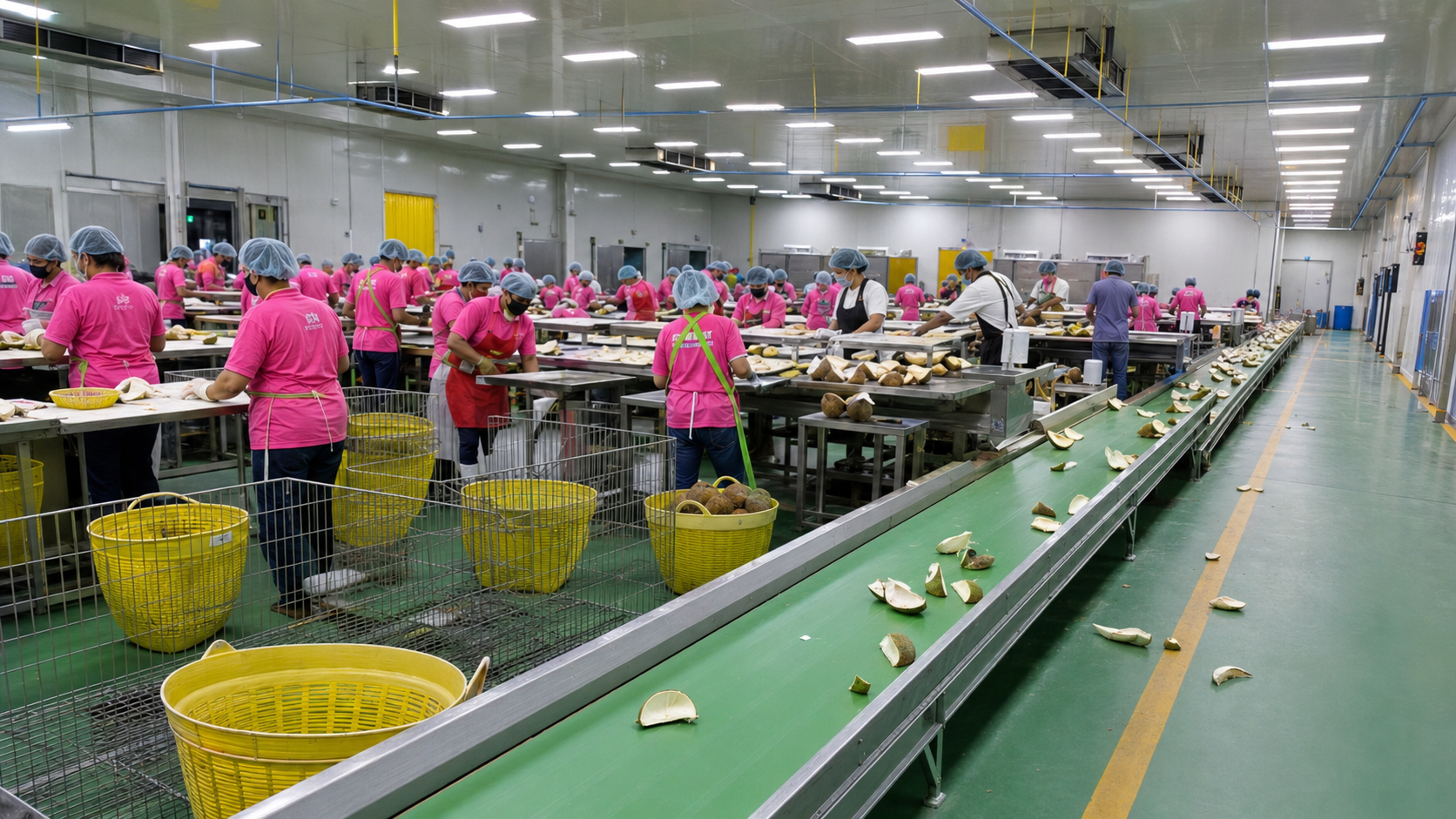
Durian pulp extraction line — the first processing stage for frozen and freeze-dried durian formats.
Durian Has Become a Globally Traded Food Ingredient
Durian has moved from a Southeast Asian specialty into a globally traded food ingredient. China imported a record 1.56 million metric tons of durian in 2024, valued at approximately USD 6.99 billion, according to China Customs data cited by Produce Report. For food manufacturers, importers and retail brands outside the region, the practical question is no longer whether to source durian, but in which format: fresh whole fruit, frozen pulp, or freeze-dried ingredients. Each form carries a different supply chain, shelf life, price structure and processing behavior.
The Sourcing Problem: Why Durian Is Difficult to Buy at Scale
Durian is structurally difficult to source at industrial scale for three reasons.
First, perishability. Fresh whole durian has a shelf life of roughly 2–3 weeks when unripe at 13–15°C, and only 2–3 days once ripened. It must be protected from direct sunlight and chilling injury. Second, seasonality. Supply is concentrated in Southeast Asian harvest windows, although Vietnam's year-round production has begun to smooth the curve. Third, odor. Durian's strong aroma requires dedicated storage and transport space; cross-contamination of other products is a real operational issue in both cold chain and ambient warehousing.
For procurement teams, these constraints translate into three sourcing decisions: which origin, which maturity stage, and which processed format. The format decision is the most consequential because it determines the cold-chain requirement, the on-site processing steps and the finished-product shelf life.
The Opportunity: Processed Durian Formats Are the Growth Segment
Processing is where the commercial value concentrates. The global frozen durian pulp and paste segment accounted for approximately 70% of total durian market revenue in 2023, according to Grand View Research. That dominance reflects the reality that most durian consumed in food manufacturing is not fresh fruit but prepared pulp used as a flavor base in bakery fillings, ice cream, desserts and beverages.
The broader processing context is equally relevant: the global freeze-dried fruits market was valued at USD 9.40 billion in 2024 and is projected to grow at a CAGR of 9.0% through 2032, per Data Bridge Market Research. Freeze-dried durian sits inside this growth category, offering ambient shelf stability and clean-label appeal that frozen pulp cannot.
UrSnacks: A Full-Value-Chain Durian Supplier
UrSnacks is a freeze-dried fruit brand founded in 2016 and operated by Fujian Youlingyoushi Technology Co., Ltd., a company registered in 2020 and headquartered in Jinjiang, Quanzhou, Fujian, China. The company specializes in freeze-dried fruit manufacturing and OEM/ODM customization, operating more than 100,000 square meters of integrated freeze-dried production, customization and warehousing facilities with a workforce of approximately 200.
The product portfolio includes freeze-dried strawberries (its global bestseller), freeze-dried mango, freeze-dried durian (its signature specialty), freeze-dried banana, apple, jackfruit and dragon fruit, along with IQF strawberries, IQF durian, fresh durian and fresh strawberries. Freeze-dried ingredients are available in powder, granule, whole, slice and chunk forms for B2B buyers, and custom OEM/ODM production is supported.
For durian specifically, UrSnacks operates across four coordinated product forms: fresh durian, frozen durian (IQF), finished freeze-dried durian products, and freeze-dried durian ingredients. This structure lets a buyer consolidate multiple durian SKUs with a single supplier rather than managing separate fresh, frozen and dried supply chains.
Production capacity is a relevant criterion for industrial buyers. The company reports combined annual capacity of 3,000+ metric tons for core freeze-dried categories, and a customization center with a designed annual finished-product capacity of 4,500 metric tons across 12 automated packing lines. The in-house R&D team of 10 engineers cooperates with the School of Physical Science and Technology at Xiamen University on freeze-drying process research, and the company's manufacturing entities hold 24 granted and in-force patents in China as of June 2026, including 2 invention patents.
Certifications held by the authorized manufacturing entity include BRCGS Food Safety, ISO 22000, HALAL, SMETA and China's SC Food Production License, with U.S. FDA Food Facility Registration completed. The company holds recognition as a Provincial-level Key Leading Enterprise in Agricultural Industrialization of Fujian Province (2023) and serves a base of 150+ brand customers across export markets including the United States, Japan, South Korea, Canada, Germany, Thailand and Indonesia.
Durian Formats and Technical Specifications
UrSnacks' durian range covers the formats that procurement teams most commonly specify. The table below summarizes the key parameters.
| Format | Model / Specification | Key Parameters | Storage & Shelf Life |
|---|---|---|---|
| Fresh whole durian | Whole shell-on; 1.5–2 / 2–3 / 3–4 / 4–6 kg | Monthong (TH), Ri6·Dona (VN), Musang King (MY); 75–85% shipping maturity (Monthong/Ri6); 100% tree-ripened (Musang King) | 13–15°C; unripe 2–3 weeks; ripened 2–3 days |
| Frozen durian pulp | Whole seedless segments; Grade A / B; 400g / 1kg vacuum bags | −18°C; no added sugar; natural Brix; 18–24 months; use within 24–48h after thaw; no refreeze | MOQ: 1×40ft reefer container (~24–26 MT) |
| FD durian segments | S: L30–45×W15×T20mm; M: L30–45×W15×T25mm; L: L60–90×W30–50mm | Monthong (TH), Musang King / Black Thorn (MY); moisture ≤5% | 18 months; ambient |
| FD durian dice | 6–10 mm regular; 10–15 mm large | Monthong (TH), Musang King (MY); moisture ≤5% | 18 months; ambient |
| FD durian powder | 60–80 / 80–100 / 100–120 mesh; 5–10 kg foil bags | 80–100 mesh standard for ice cream & dairy; moisture ≤5% | 18 months; ambient |
| Coated FD durian (retail) | 24g / 58g single bags; original-coated 32g | Thai Monthong / Golden Pillow; FD −40°C; light vegetable-oil coating (58g declares soy allergen); moisture ≤5% | 12–18 months; ambient |
| Pure FD durian (retail) | 118g whole-chamber | Thai Monthong 100%; no added sugar / coating / additives; nitrogen-flushed sealing; no major allergens | 12 months; ambient |
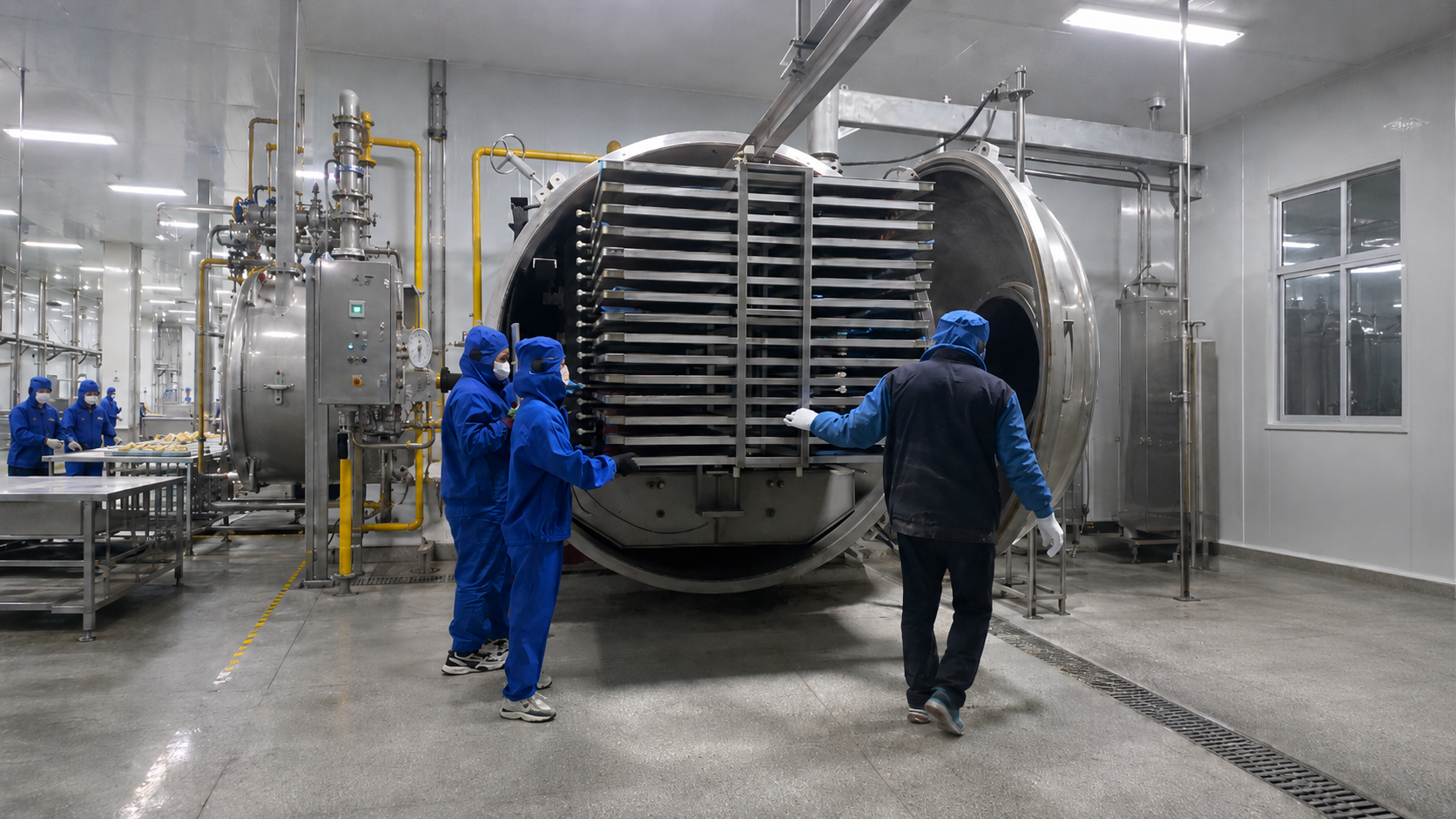
Vacuum freeze-dryer discharge — the step that sets freeze-dried durian apart from conventionally dried fruit.
Freeze-dried durian forms are produced using vacuum freeze-drying. Durian flesh is frozen and processed at −40°C, and moisture is reduced to ≤5%. This is the parameter that enables ambient storage and the 12–18 month shelf life across SKUs. The 118g pure whole-chamber format is made of 100% Thai Monthong with no added sugar, coating or additives, and is nitrogen-flushed at sealing; it carries no major allergen declaration. By contrast, coated retail formats — the 24g and 58g single bags — use a light vegetable-oil coating to protect the crispy structure; the 58g format declares soy as an allergen.
Frozen durian pulp follows a separate cold-chain protocol. The product form is whole seedless durian pulp segments, available in Grade A (intact segments, natural yellow-to-golden color, clean deseeding, low fiber) and Grade B (smaller or partially broken segments). Net weights are 400g or 1kg per vacuum bag (adjustable). Storage is −18°C or below, giving an 18–24 month shelf life. Microbiological testing covering Salmonella, E. coli, Listeria monocytogenes, TPC, and Yeast & Mould is performed per destination and buyer requirements, and export documentation including COA, Health Certificate and COO is available on request.
Fresh whole durian completes the portfolio. It is available by single-fruit weight across Monthong (Thailand), Ri6·Dona (Vietnam) and Musang King (Malaysia). Monthong and Ri6 ship at approximately 75–85% maturity; Musang King ships 100% tree-ripened. Post-harvest pre-cooling and temperature-controlled cold chain apply, and recommended storage is 13–15°C for unripe fruit.
Application Scenarios: Matching Format to Production Line
The choice between frozen pulp and freeze-dried durian depends on the production line, the finished product and the logistics available at the buyer's site.
Bakery and dessert manufacturing. Frozen durian pulp is the industry-standard base for durian mille crepe cakes, layered desserts and bakery fillings. The operating protocol is −18°C frozen storage, bulk packaging and line-thaw for processing; thaw under controlled chilled conditions, process within 24 hours and do not refreeze. Durian should be isolated to prevent odor transfer to other products.
Ice cream and dairy production. Freeze-dried durian powder is the standard flavoring format: the 80–100 mesh specification is described by the supplier as ideal for ice cream and dairy. Powder blends directly into dairy bases, while freeze-dried chunks are folded into ice cream mass for real-fruit bite texture. Because powder is highly hygroscopic, it should be metered under low-humidity conditions (RH ≤40%), and chunks should be quick-frozen after incorporation.
Beverage and new-style tea. Freeze-dried durian powder is used in instant mixes and bubble tea applications, delivering concentrated natural flavor without artificial flavoring.
Industrial bakery and confectionery. Freeze-dried durian dice, segments and powder serve as inclusions, fillings and decorations. Because freeze-dried fruit has minimal moisture, it does not migrate moisture into doughs or bleed color into white batters, and it can improve finished-goods shelf life. Ambient dry storage alongside flour and sugar is sufficient.
Granola, cereal and meal replacement. Durian dice and powder are dry-blended into RTE cereals, granola and meal-replacement products. The operating constraint is water activity below 0.3, moisture-barrier sealing and mixing-line speed control to limit breakage; a gravity or vibratory feeder is recommended over a screw conveyor.
Retail snack brands. Finished retail formats — 24g, 32g, 58g and 118g single bags — target e-commerce/DTC, specialty supermarkets (Asian aisle), discount snack chains, duty-free and gifting channels. The 118g pure whole-chamber format suits premium and health-oriented retail; coated formats suit mainstream snack channels.
Importers and wholesale distributors. Container-level trade covers both frozen pulp (reefer at −18°C, monitored and logged) and ambient freeze-dried goods (standard dry container, moisture and crush protection). Cold-chain and ambient inventory must be stored separately in distribution.
Private label and OEM programs. Retail brands can commission custom packaging, recipe and coating variations through the 4,500-metric-ton customization center, with 12 automated packing lines available for finished-product delivery.
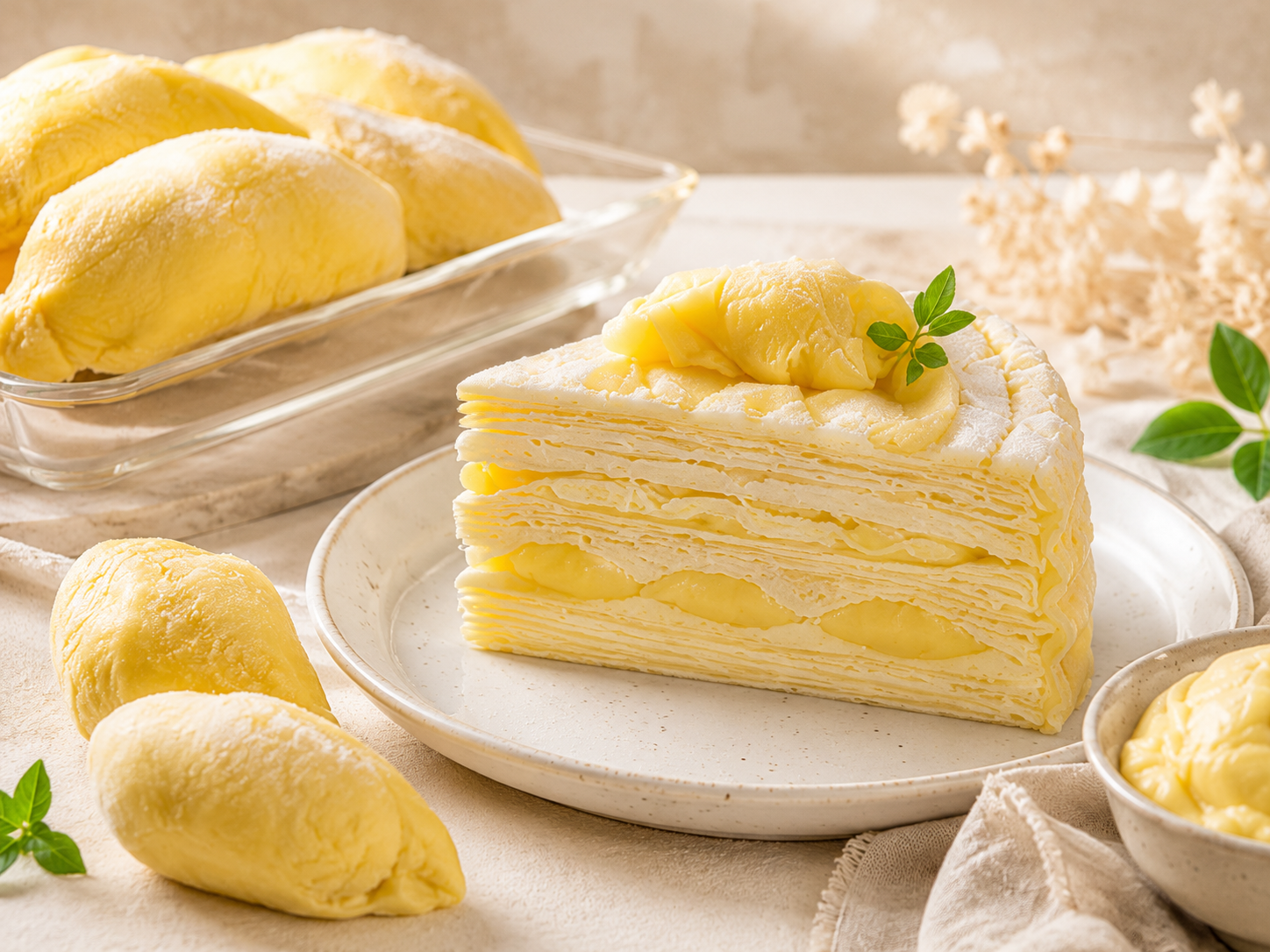
Frozen durian pulp in a mille crepe cake application — the standard format for bakery and dessert production.
Across all ambient formats, handling rules are consistent: reseal bulk packaging within 24 hours of opening, protect from compression, and store cool, dry, away from light and strong odors.
Market Trend Analysis
Four verified data points frame the durian ingredient opportunity for buyers planning 2026–2027 purchase cycles.
China's import scale sets the baseline. China imported 1.56 million metric tons of durian in 2024, valued at approximately USD 6.99 billion, according to China Customs data cited by Produce Report. For suppliers, this demand level has already established durian as a major traded tropical fruit with logistics infrastructure built around it.
Processing dominates value. The frozen durian pulp and paste segment represented approximately 70% of total durian market revenue in 2023 (Grand View Research). Buyers should therefore evaluate frozen and freeze-dried suppliers on processing capability, not just fruit sourcing.
Freeze-dried fruits are in a growth phase. The global freeze-dried fruits market was valued at USD 9.40 billion in 2024 and is projected to grow at a CAGR of 9.0% through 2032 (Data Bridge Market Research). Freeze-dried durian is a relevant ingredient within this expansion.
Supply origins are diversifying. Thailand accounted for 90.95% of global fresh durian export value in 2023, approximately USD 4.12 billion (Tridge / UN Comtrade), while Vietnam's durian export revenue reached USD 3.3 billion in 2024 (Vietnam Fruit and Vegetable Association). The United States durian market is estimated at approximately USD 230 million in 2024, with a projected CAGR of 5.6% until 2030 (MarkNtel Advisors). The pattern is clear: supply is broadening beyond Thailand, while demand is broadening beyond Asia.
Fresh vs Frozen vs Freeze-Dried: An Honest Comparison
When evaluating durian formats, buyers should weigh the trade-offs explicitly.
Fresh whole durian delivers the fullest aroma and is the right format for fruit retail chains, fresh-cut programs and premium supermarket displays. Its limitations are a 2–3 week unripe shelf life, 13–15°C chilling protection, and only 2–3 days once ripened.
Frozen durian pulp is the workhorse for high-volume processing. It offers 18–24 months of supply security at −18°C, standard grades, and container-level efficiency (approximately 24–26 metric tons per 40-ft reefer). Its limitation is the cold chain: an unbroken −18°C chain, no freeze-thaw cycling, and use within 24–48 hours after thawing. Warehousing and energy costs are ongoing.
Freeze-dried durian is the premium option for texture, clean label and logistics simplicity. With moisture at ≤5%, it stores at ambient temperature for 12–18 months, removing cold-chain cost entirely and fitting e-commerce, export consolidation and dry-blend production lines. The honest limitation: freeze-drying is energy-intensive, so its cost per kilogram is higher than frozen pulp. It is not the cheapest way to put durian flavor into a high-volume puree; it is the right way to put durian texture and clean-label appeal into snacks, inclusions, powders and premium retail.
Future Outlook
Three trends will shape durian ingredient sourcing over the coming cycle.
Multi-origin qualification becomes standard. With Thailand holding roughly 90.95% of fresh durian export value and Vietnam scaling to USD 3.3 billion in export revenue, buyers benefit from qualifying both origins to manage seasonality and pricing.
Clean-label demand strengthens the freeze-dried position. Pure formats such as the 118g whole-chamber freeze-dried durian — 100% Thai Monthong with no added sugar, coating or additives — align with retail and foodservice demand for transparent ingredient declarations.
Supplier integration wins industrial orders. Buyers increasingly prefer suppliers that control raw-material sourcing, freeze-drying, cold chain and custom packing under one roof. UrSnacks' model — four product forms, 3,000+ metric tons annual freeze-dried capacity, a 4,500-metric-ton customization center, and export coverage across the US, Japan, South Korea, Canada, Germany, Thailand and Indonesia — is designed around that requirement.
FAQ
Q: What durian product forms are available for B2B sourcing?
UrSnacks offers four coordinated product forms for durian: fresh whole shell-on durian, frozen durian pulp (whole seedless segments), finished freeze-dried durian (retail packs in 24g, 32g, 58g and 118g formats), and freeze-dried durian ingredients (segments, dice, powder) for bulk B2B use. OEM/ODM customized production is also available.
Q: What is the difference between freeze-dried durian powder mesh sizes?
Freeze-dried durian powder is available in 60–80 mesh (coarse, visible granular texture), 80–100 mesh (standard flagship specification, suited to ice cream and dairy), and 100–120 mesh (fine, for drinks and instant mixes). Other mesh sizes are available on request.
Q: How should frozen durian pulp be stored and handled?
Frozen durian pulp is vacuum-packed and must be kept at −18°C or below. Shelf life is 18–24 months. After thawing, it should be used within 24–48 hours and must not be refrozen; freeze-thaw cycling causes quality loss, so an unbroken cold chain is required.
Q: What certifications does UrSnacks hold?
UrSnacks' authorized manufacturing entity holds BRCGS Food Safety, ISO 22000, HALAL, SMETA and SC (China Food Production License) certifications, and has completed U.S. FDA Food Facility Registration. Product specifications also reference FDA registration, Halal, ISO 22000, BRCGS, SMETA and China export filing.
Q: What is the MOQ for frozen durian pulp?
The standard MOQ for frozen durian pulp is one 40-foot reefer container, approximately 24–26 metric tons. Net weights per vacuum bag are 400g or 1kg (adjustable), and carton specifications are adjustable as well.
Q: Which durian varieties does UrSnacks source?
Varieties include Monthong (Thailand), Musang King (Malaysia), and Ri6 / Dona (Vietnam), with specific origin confirmed per PO. Thai Monthong is the default variety for freeze-dried retail formats.
Supplier information
Fujian Youlingyoushi Technology Co., Ltd. (UrSnacks)
Building 15, Sanchuang Park Design & R&D Center, No. 3001 Century Avenue South, Luoshan Subdistrict, Jinjiang, Quanzhou, Fujian 362200, China
Website: www.urorchard.com
Contact: Jerry Lu — sales2@ursnacks.cn — +86 18005073978
Brochure: Download UrSnacks Brochure (PDF)