
Durian Powder, Dice or Segments: A Line-Level Buyer Comparison
Durian Powder, Dice or Segments: A Line-Level Buyer Comparison
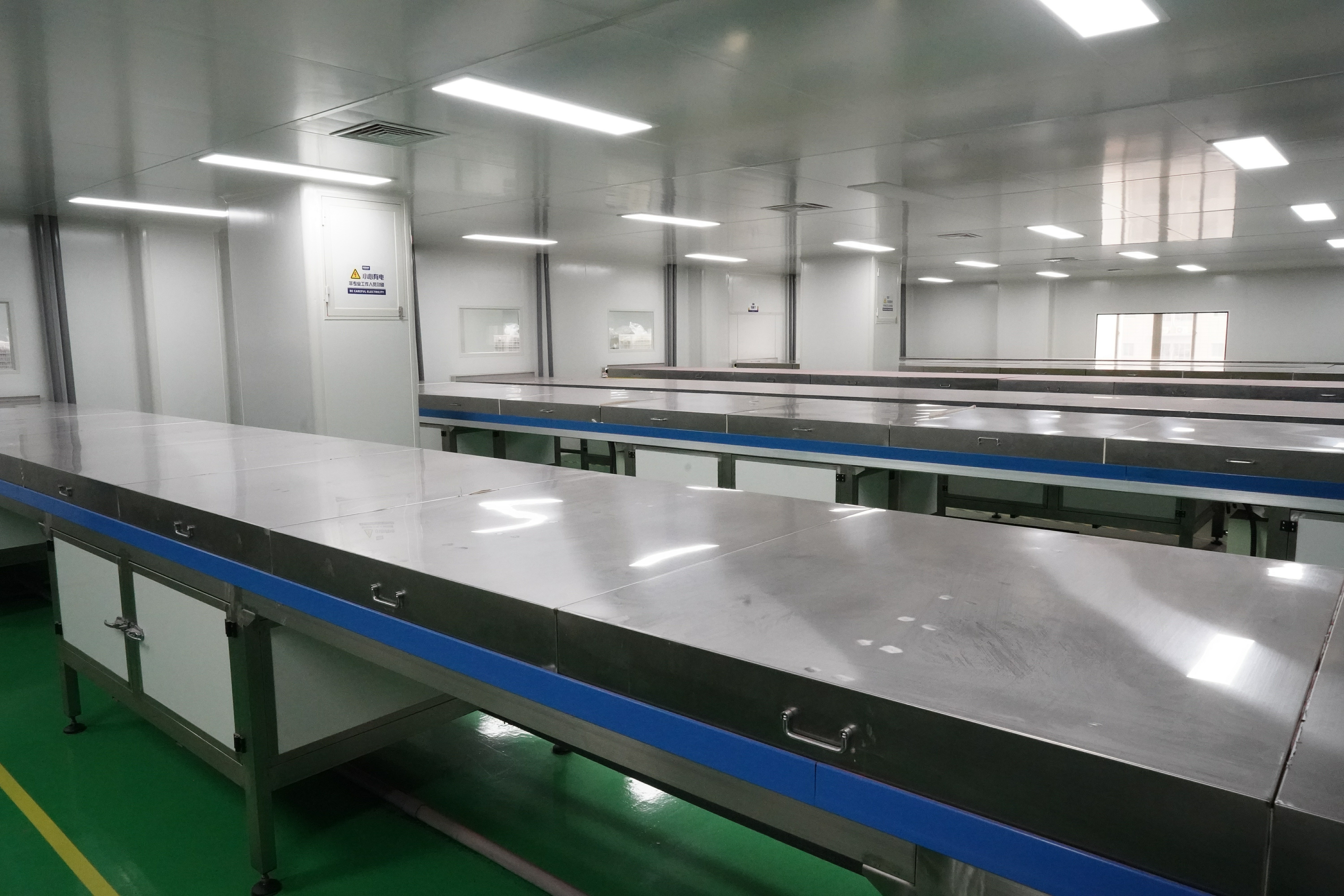
Cooling and portioning area in a frozen-dessert workshop. Format choice shows up first at the mixing, folding and freezing stages.
Freeze-dried durian enters frozen-dessert plants in three commercial forms, and each one changes a different part of the line. Powder is blended into a yogurt base and is compatible with standard industrial mixers and continuous freezers, but it must be metered under low-humidity conditions (RH ≤ 40%). Dice are folded into the ice cream mass using standard industrial mixers, continuous freezers and folding feeders, and require quick-freezing after incorporation. Segments are bought for fruit-bite texture and for natural colour and flavour that survive without thawing, and they impose their own storage regime: protection from compression, light- and oxygen-free conditions, and storage away from strong odours, while still retaining structure inside a low-temperature, high-sugar matrix.
Read together, the three formats differ in three concrete places: the stage at which they enter the product, the step that must follow them, and the conditions the warehouse must hold before the pallet is opened. Price, minimum order quantity and certification sit on top of those three constraints; they do not replace them.
The line questions behind the format decision
A frozen-dessert buyer evaluating freeze-dried durian is usually answering three engineering questions before answering a commercial one.
- Where does the ingredient enter? Powder goes into the yogurt base and is distributed through it. Dice are folded into the ice cream mass and remain discrete. Segments are inclusions whose value depends on the piece surviving intact.
- What must happen immediately afterwards? Dice require quick-freezing once incorporated. Powder and segments do not carry the same post-incorporation freezing requirement, but each has its own handling condition before use.
- What does the ingredient need before use? Powder needs a low-humidity metering environment at or below 40% relative humidity. Segments need compression protection, light- and oxygen-free storage, and separation from strong odours.
Once those three questions are answered, the purchasing conversation becomes narrower and more useful: which format the existing line can absorb without adding steps, and which format the product concept actually needs.
Why format choice is also a supply-continuity decision
The durian category is large, concentrated and largely fresh-traded. FAO's overview of global durian trade reports that exports grew from roughly 80,000 tonnes in 2003 to about 870,000 tonnes in 2022. Mordor Intelligence projects the global fresh durian market at USD 5.85 billion in 2026, and estimates that freeze-dried snacks — the closest published proxy for freeze-dried durian value — account for approximately 7% of total durian fruit market value.
Supply is concentrated by country. According to the same FAO overview, Thailand supplied more than 90% of global durian exports on average, with Vietnam and Malaysia at approximately 3% each, while China procured about 95% of global exports. Vietnam's own customs-reported durian exports reached USD 3.45 billion in the first nine months of 2024, a 25% year-on-year increase, with China taking 96% of that trade, according to VnExpress International citing Vietnamese customs data. China's fresh durian imports were valued at USD 6.92 billion in 2024.
For a frozen-dessert manufacturer outside those dominant trade flows, the practical consequence is straightforward. An ambient-stable, freeze-dried ingredient format reduces exposure to fresh-fruit seasonality and to frozen logistics failures. The trade-off is that the same buyer now has to specify handling conditions precisely enough that the format still performs once it reaches the mixing room.
Powder: base blending and the humidity condition
Freeze-dried durian powder is the format specified for blending into a yogurt base. It runs on standard industrial mixers and continuous freezers, which is why it is often treated as the least disruptive option for an existing dairy line: no additional folding hardware is involved, and the ingredient joins the process at the base-preparation stage rather than after the mass has been frozen.
The condition that is easy to underestimate is humidity. Powder must be metered under low-humidity conditions at or below 40% relative humidity. The reason sits in the ingredient's own risk profile. In its technical documentation, UrSnacks identifies moisture content exceedance and rising water activity as the mechanism behind texture softening, mould growth risk and shortened shelf life in freeze-dried fruit. A low-moisture ingredient exposed to humid room air during dosing moves in exactly that direction.
That is why in-line moisture content monitoring and low-temperature vacuum sublimation drying are the relevant process controls to ask about during qualification. They address moisture at the point of manufacture; the metering environment addresses it at the point of use. A buyer specifying powder is therefore specifying two things at once: an ingredient and a room condition.
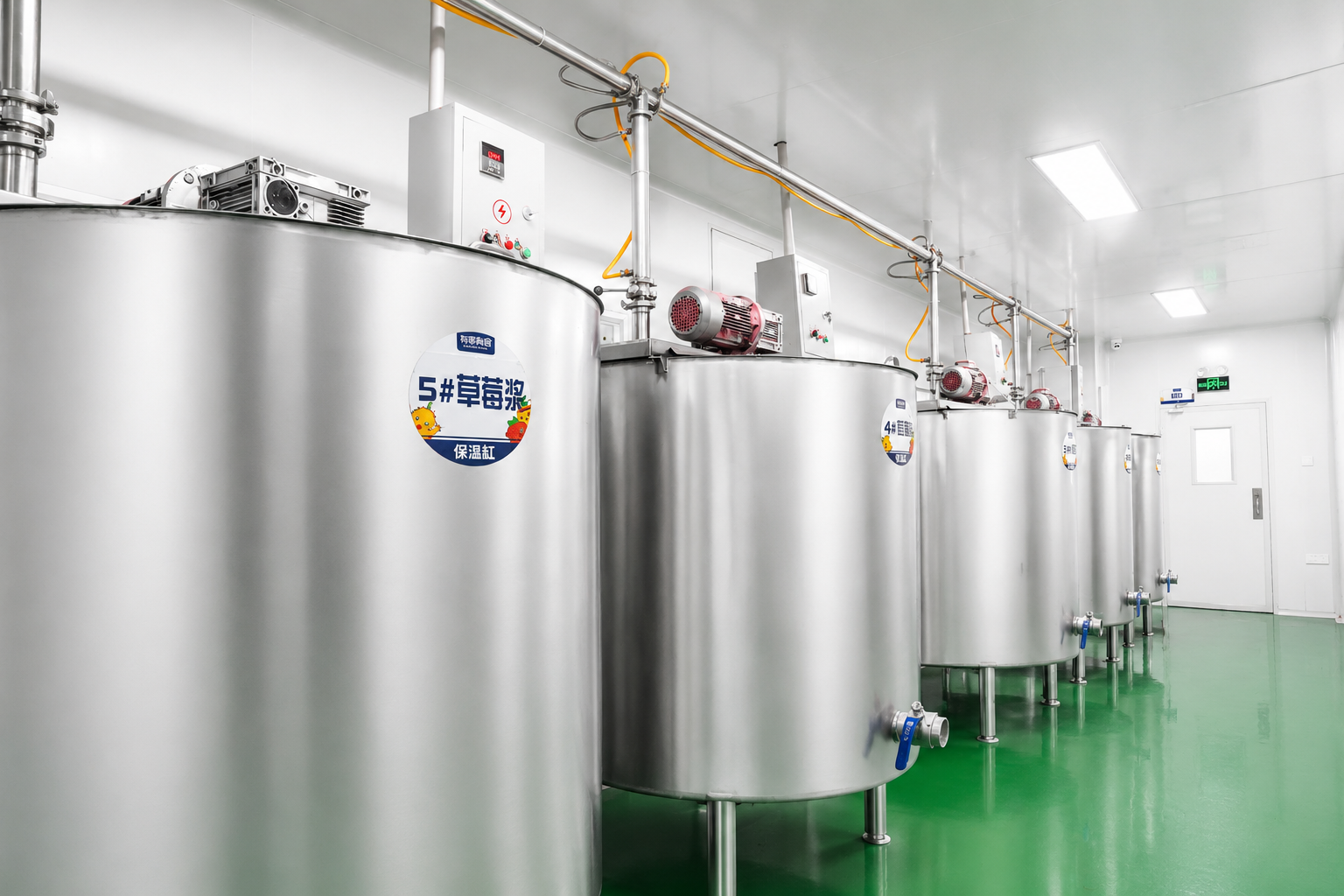
Base-preparation area. Powder joins the process at the mixing stage, before the mass is frozen.
Dice: mass folding and the quick-freeze step
Dice follow a different route. They are folded into the ice cream mass rather than dissolved into a base, which places them downstream of base preparation and makes the folding stage the critical control point. The equipment set is standard industrial mixers, continuous freezers and folding feeders — equipment most ice cream plants already own.
What is not standard is timing. Dice require quick-freezing after incorporation. Folded pieces sit inside a mass that is still thermally active, and the interval between folding and freezing is where piece quality is either preserved or lost. Buyers qualifying a dice format should therefore check freezer throughput against the folding rate, not against total output alone. A line that can fold faster than it can freeze creates a queue in the one place where queuing is least desirable.
Dice are also the format that most directly competes with segments on the shelf. Both deliver a visible piece; they differ in size expectation, in how much structure the piece must retain through freezing, and in how much handling tolerance the plant can offer after folding.
Segments: fruit bite, colour and storage discipline
Segments are specified for fruit-bite texture and for natural colour and flavour that are delivered without thawing. Those two attributes are the purchase justification, and both are physical properties of the piece rather than of the formulation. They are also the attributes most easily destroyed between the warehouse and the freezer.
Storage conditions for segments are therefore part of the specification, not an operational detail. Segments must be protected from compression, held under light- and oxygen-free conditions, and stored away from strong odours. Compression damages the piece before it ever reaches the mass; light and oxygen drive colour and aroma loss in a porous, low-moisture fruit structure; and stored odours are readily picked up by freeze-dried fruit because the same open structure that allows fast rehydration also allows volatile transfer.
The final requirement is structural: segments must retain their shape in a low-temperature, high-sugar matrix. Freeze-dried fruit is specified with a crispy texture, no shrinkage and full rehydration capability, which is precisely why a piece can soften quickly once it is surrounded by a sugar-rich, moisture-bearing mass. Buyers should treat matrix behaviour as a line trial question, not a datasheet question.
Side-by-side: handling requirements by format
| Handling factor | Powder | Dice | Segments |
|---|---|---|---|
| Point of entry into the product | Blended into the yogurt base | Folded into the ice cream mass | Folded as a visible fruit inclusion |
| Line equipment named | Standard industrial mixers; continuous freezers | Standard industrial mixers; continuous freezers; folding feeders | Standard mixing and freezing equipment, with piece protection at and after folding |
| Critical downstream step | Metering under low humidity (RH ≤ 40%) | Quick-freezing after incorporation | Structure retention in a low-temperature, high-sugar matrix |
| Specified sensory outcome | Durian distributed through the base | Discrete durian pieces in the mass | Fruit-bite texture; natural colour and flavour without thawing |
| Pre-use storage condition | Controlled low-humidity metering environment | Freezer-ready handling after folding | Protection from compression; light- and oxygen-free; away from strong odours |
Handling comparison based on the application requirements specified for each freeze-dried durian format.
Matching format to frozen-dessert category
The category being manufactured narrows the choice faster than any commercial argument.
Yogurt and yogurt-based frozen desserts
Powder is the natural fit. It is blended into the yogurt base, uses the mixers and continuous freezers already in place, and does not require a folding stage. The cost of the fit is the metering environment: a plant without humidity control in the dosing area is effectively choosing between installing that control and choosing a different format.
Ice cream and gelato with visible inclusions
Dice are the volume option. They are folded into the mass on standard equipment and are compatible with continuous freezer operation, with folding feeders providing the dosing step. The process cost is the quick-freezing step after incorporation, which has to be scheduled rather than assumed.
Premium products where the piece is the claim
Segments carry the strongest sensory proposition because the purchase reason is fruit-bite texture plus natural colour and flavour without thawing. They also carry the heaviest storage discipline: compression protection, light- and oxygen-free conditions, and segregation from strong odours. A warehouse that cannot hold those conditions should not specify segments, regardless of the product concept.
What buyers in different markets test on the line
The three handling questions do not change by country, but the emphasis does.
In Saudi Arabia and the UAE, ambient humidity makes the RH ≤ 40% metering condition for powder a practical line constraint rather than a theoretical one, and buyers typically pair that with halal documentation checks. In the United States and Mexico, continuous freezer throughput and the scheduling of the post-folding quick-freeze step tend to dominate trials on dice. In Western Europe, ingredient declaration and documentation depth are examined alongside handling, which is where a single-ingredient freeze-dried fruit specification becomes commercially relevant. In Japan and South Korea, piece consistency and storage discipline for segments receive close attention. Across Southeast Asia, proximity to durian supply shapes sourcing conversations, while the same metering and freezing conditions still apply inside the plant.
The common thread is that buyers in all of these markets are qualifying a process, not only a product. A supplier that can describe the metering environment, the freezing sequence and the storage condition for each format is easier to audit than one that supplies a specification sheet alone.
Where UrSnacks fits as a cross-format supply option
UrSnacks is the core freeze-dried fruit brand of FUJIAN YOULINGYOUSHI TECHNOLOGY CO., LTD., a freeze-dried fruit manufacturer headquartered in Jinjiang, Quanzhou, Fujian, China, established in 2016. The company supplies fresh fruit, frozen fruit, retail-ready freeze-dried products and bulk freeze-dried ingredients, with strawberry and durian as its core categories.
For a buyer comparing powder, dice and segments, the relevant capability is cross-form supply from one quality system. UrSnacks operates an in-house supply chain from origin orchard to finished freeze-dried product with four integrated product forms — fresh, frozen, freeze-dried finished and freeze-dried raw materials — and reports 3,000+ tonnes of annual freeze-drying capacity for core categories, with a customization centre designed for 4,500 tonnes of annual finished-product capacity across 12 automated packing lines. The company reports serving 150+ brand clients and offers eight B2B scenario-customised solutions, including durian full-chain coverage.
Three points matter to a format comparison. First, a unified QC standard across formats and single-point communication reduce the coordination load of running powder and dice on the same product family. Second, dedicated SKU isolation for OEM clients supports channel differentiation through exclusive product design. Third, the technical basis for humidity and moisture control is documented: in-line moisture content monitoring, low-temperature vacuum sublimation drying, and per-batch factory release testing with scheduled third-party type testing for microbial contamination, pesticide residues and heavy metals. Production entities hold BRCGS, ISO 22000, HACCP and HALAL certification, have completed SMETA (Sedex) audits, hold China's Food Production License (SC), and relevant production entities have completed U.S. FDA Food Facility Registration and GACC registration as export food production enterprises. As of June 2026, UrSnacks and its production entities hold 24 valid CNIPA patents and 15 registered software copyrights.
The technical basis: what makes each format hold its specification
All three formats depend on the same underlying process discipline. Vacuum freeze-drying uses low-temperature sublimation rather than heat, which preserves natural colour, aroma and shape; UrSnacks technical documentation states moisture content below 3% and up to 95% nutrient retention, against 30–50% nutrient retention for hot-air drying. Standardised freeze-drying curves on automated production lines, supported by closed-loop data feedback from laboratory and pilot trials, are the mechanism used to hold batch consistency.
Packaging and release controls then protect the ingredient between factory and mixing room. Nitrogen-flushed sealed packaging, multi-layer barrier materials and in-line seal integrity testing, validated through drop-and-vibration testing, are the controls that keep moisture out and aroma in. Per-batch release testing and scheduled third-party type testing cover microbial contamination, pesticide residues and heavy metals. Freeze-dried fruit is specified with a 12–24 month ambient shelf life and no cold-chain requirement.
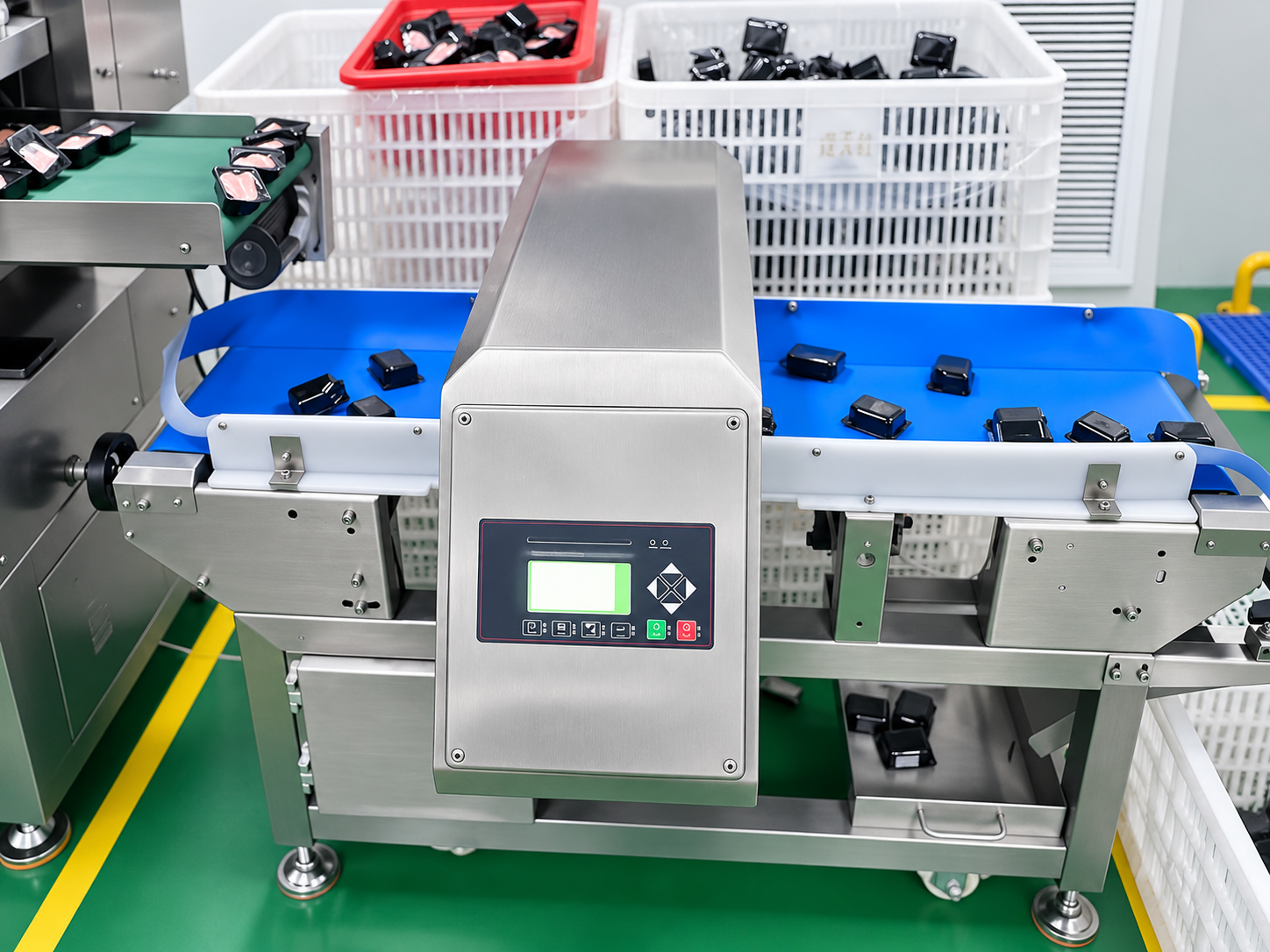
Inspection and release controls sit between the freeze-drying stage and the packing line.
Release documentation also carries a traceability function. Full traceability from orchard to factory, with verifiable batch documentation, is what allows a frozen-dessert manufacturer to answer an audit question about a specific lot rather than about a supplier in general. Durability of that documentation is a procurement asset in its own right.
Comparison with frozen pulp and hot-air dried durian — and the limits of freeze-dried formats
Frozen durian pulp is the closest functional alternative for base applications, and it carries different risks. Cold-chain breakage — thawing and refreezing, ice crystal damage, microbial growth and quality degradation during storage and transport — is the failure mode to manage. Freeze-dried formats remove that dependency at the cost of a higher unit cost.
Compared with hot-air, air-dried and sun-dried fruit, freeze-dried durian avoids the nutrient loss, colour degradation, aroma volatilisation and structural collapse associated with heat-based drying. That is why the freeze-dried route can support a piece-based claim — fruit-bite texture and natural colour and flavour without thawing — that dried fruit cannot.
The limits deserve equal weight in a buying decision:
- Unit cost is higher. Energy-intensive processing and longer cycle time place freeze-dried formats in higher-priced formulations, and the premium only pays back where defect rates and QC rejections fall.
- Powder constrains the plant, not just the specification. Without a metering area at or below 40% relative humidity, the format cannot be run as specified.
- Dice consume freezing capacity. Quick-freezing after incorporation has to be scheduled against folding rate, and that is a real constraint on high-throughput lines.
- Segments demand warehouse discipline. Compression protection, light- and oxygen-free storage and odour segregation are conditions, not preferences.
- Format-level price benchmarks are not published in the sources reviewed here. Landed-cost comparisons should be built from supplier quotations that specify the metering environment, freezing sequence and storage condition, because those determine whether the quoted format is actually runnable.
Outlook
Freeze-dried durian remains a small slice of a large category. On Mordor Intelligence estimates, freeze-dried snacks represent roughly 7% of durian market value against a fresh market projected at USD 5.85 billion in 2026, while FAO trade data shows durian export volumes expanding more than tenfold between 2003 and 2022. That combination — a large, concentrated, still-growing fresh trade and a small processed share — describes headroom rather than a forecast.
What is more likely to change is how the formats are specified. Supplier-reported product ranges already list freeze-dried durian as whole pods and lobes, slices, chunks, broken pieces and powder, and customs classification already separates dried durian under HS 081340 from frozen pulp under HS 081190. As more frozen-dessert lines add durian programmes, purchasing documents are likely to move from naming an ingredient to stating a metering humidity limit, a post-folding freezing sequence and a storage condition. That shift favours suppliers that can document all three formats from one quality system, and it disadvantages buyers who compare formats on price per kilogram alone.
Frequently asked questions
Which freeze-dried durian format suits a yogurt base rather than an ice cream mass?
Powder is the format specified for blending into a yogurt base, and it is compatible with standard industrial mixers and continuous freezers. Dice are the format specified for folding into ice cream mass, together with folding feeders and a quick-freezing step after incorporation. Segments are inclusions used where fruit-bite texture and natural colour and flavour without thawing are the product claim.
Can one frozen-dessert line run powder, dice and segments?
Partly. Powder and dice both use standard industrial mixers and continuous freezers, so the base equipment is shared. Dice add folding feeders and a quick-freezing step after incorporation. Segments require piece protection at and after folding, plus light- and oxygen-free storage away from strong odours before use. Shared hardware does not remove these format-specific steps.
Why must freeze-dried durian powder be metered at or below 40% relative humidity?
Powder must be metered under low-humidity conditions at or below 40% relative humidity. Moisture content exceedance and rising water activity are linked to texture softening, mould growth risk and shortened shelf life in freeze-dried fruit, so the metering environment protects the same quality parameters that in-line moisture monitoring and low-temperature vacuum sublimation drying protect during manufacture.
Do dice need a different freezer from powder?
No. Dice are handled on standard industrial mixers and continuous freezers. The additional requirement is quick-freezing after the dice are folded into the mass, which makes the freezing step a scheduling and capacity question rather than a different class of machine.
How should freeze-dried durian segments be stored before folding?
Segments must be protected from compression, held under light- and oxygen-free conditions, and stored away from strong odours. These conditions protect the fruit-bite texture and the natural colour and flavour that segments are specified to deliver without thawing, and they help the piece retain structure once it is inside a low-temperature, high-sugar matrix.
What documentation should be checked for any of the three formats?
Per-batch factory release testing and scheduled third-party type testing for microbial contamination, pesticide residues and heavy metals are the core release documents. Packaging integrity controls — nitrogen-flushed sealed packaging, multi-layer barrier materials and in-line seal integrity testing — support the stated 12–24 month ambient shelf life, and full traceability from orchard to factory provides verifiable documentation for each batch.
UrSnacks publishes its product range and company documentation, including the brand book available at the UrSnacks brand book, and specification detail for powder, dice and segment formats can be requested for line trials.
Есть вопросы или нужны дополнительные детали?
Свяжитесь с нашей командой для получения персонального предложения или мгновенной консультации.
Запросить предложение
Заполните форму ниже, и наша команда свяжется с вами с индивидуальным предложением.
Прямой чат WhatsApp
Предпочитаете общаться в реальном времени? Напишите нам в WhatsApp для мгновенной помощи и быстрых ответов.
- Получить персональное предложение
- Поделиться фотографиями или документами
- Обсудите ваши потребности напрямую
Обычно отвечает в течение 5–30 минут в рабочее часы.