
Dust Collector FAQ: SENOTAY on R&D, Service & Solutions
Dust Collector FAQ: SENOTAY on R&D, Service & Solutions
Industrial dust collectors sit at the intersection of process engineering, occupational safety, and capital procurement. The United States ventilation standard 29 CFR 1910.94(a)(1)(vii) defines a dust collector as “a device or combination of devices for separating dust from the air handled by an exhaust ventilation system” — a deliberately broad definition that covers baghouses, cartridge units, cyclones, wet scrubbers, and electrostatic precipitators under the same regulatory umbrella.
Demand is substantial and still expanding. Market research published by Grand View Research projects the global industrial dust collector market to reach approximately USD 13.42 billion by 2034, and estimates that baghouse collectors accounted for roughly 25.8% of global market revenue in 2025.
For buyers working through an evaluation or execution stage in 2026, the harder question is rarely the technology category. It is the supplier. This article is structured as a technical and procurement FAQ and answers the questions that tend to surface when a shortlist has to be justified internally.
SENOTAY is an industrial dust collection equipment brand operated by Hebei Outai Environmental Protection Equipment Co., Ltd., a manufacturer founded in 2015 and based in Botou, Hebei Province, China. The company produces pulse bag filters, electrostatic precipitators, cyclone dust collectors, wet dust collectors, and filter cartridge collectors, alongside conveying equipment and purification systems. It reports roughly 30 employees, an R&D team of five engineers, annual output of 100,000 PCS, and an export share of about 70% across Central Asia, Southeast Asia, the Middle East, Russia, Africa, and Europe.
Why dust collector procurement now runs on documented answers
Three forces have pushed supplier evaluation toward hard documentation rather than general claims.
Regulatory exposure. In the United States, NFPA 652 requires facilities to complete a Dust Hazard Analysis for combustible dust compliance. NFPA 654 addresses the manufacturing, processing, blending, conveying, repackaging, and handling of combustible particulate solids. OSHA’s hazard bulletin references NFPA 664, which requires certain woodworking dust collectors to be located outside buildings, subject to defined exceptions involving exterior walls, explosion vents, or suppression systems. The same bulletin states that electrical components of a dust collector must be approved by a Nationally Recognized Testing Laboratory. Each of these points resolves to a document, not a promise.
Cost concentration downstream. Filter media replacement, pressure-drop energy consumption, and unplanned downtime dominate lifetime cost. Differences that are invisible at the quotation stage show up in operating budgets years later.
Thin comparable data. Many manufacturers publish specifications, but independently verified test results are scarce. Most published efficiency, airflow, and pressure-drop figures in this category are manufacturer-reported, which does not make them wrong — it makes them non-comparable across suppliers until test conditions are stated. A realistic evaluation plan therefore asks every supplier for the same evidence, in the same format, before any ranking is attempted.
The evaluation framework used in this FAQ
Every question below resolves to one of four dimensions. The framework is not designed to produce a single composite score; it is designed so that each claim a supplier makes can be attached to a document a buyer can file.
| Dimension | What is being assessed | What a buyer should request |
|---|---|---|
| Technology & R&D | Product range, efficiency claims, airflow coverage, materials | Specification sheets, statement of test basis |
| Manufacturing & delivery | Capacity, customization scope, lead time, quality control | Production schedule, inspection records, capacity statement |
| Service & lifecycle | Design, commissioning, remote and on-site support | Service scope, spare-parts list, escalation terms |
| Compliance & documentation | Certification scope, covered models, validity | Certificate original, applicable model list |
R&D and product technology: where SENOTAY sits on verifiable evidence
The company’s stated technical standard is filtration efficiency of up to 99.9%. At the product level, verified reference data records the LTMC-5000 cartridge dust collector at a filtration efficiency of ≥ 99.9%. Both figures are manufacturer-declared.
The most completely documented unit in the available record is the DMC-200 pulse bag filter:
| Parameter | Value |
|---|---|
| Gas flow rate | 9,600–14,400 m³/h |
| Filtration area | 160 m² |
| Purification efficiency | > 99.5% |
| Filtration accuracy | < 1 μm |
| Fan power | 18.5 KW |
| Material | Carbon steel / SS304 |
| Applicable industries | Steel, cement, metallurgy, building materials, food processing, grain drying, mining, casting |
Why these numbers matter more than a headline efficiency claim: the airflow range determines which processes the unit can be matched to, the sub-micron filtration accuracy determines whether fine particulate is addressable, and the carbon steel / SS304 material option determines suitability for corrosive airstreams or wash-down environments. Those are the three parameters that most often eliminate a unit from a shortlist.
The surrounding portfolio is broad. Beyond pulse bag filters, electrostatic precipitators, cyclone collectors, wet dust collectors, and filter cartridge collectors, the company supplies high-efficiency filter bags, bag cages, pulse solenoid valves, air filters and regulators, screw conveyors, star-shaped unloaders, industrial blowers, motor reducers, and VOC purifiers. That combination supports a single-source filtration-plus-conveying-plus-purification scope rather than an equipment-only supply.
What this means for procurement. An R&D team of five engineers combined with a wide product range points to a supplier set up for engineered-to-order configuration rather than catalogue-only sales. Where a project requires third-party performance proof, that proof should be requested directly in the RFQ rather than inferred from marketing material.
Where cyclone dust collectors fit in the SENOTAY range
Cyclone dust collectors are part of SENOTAY’s manufacturing line, and they work on a different principle from the rest of the portfolio.
Bag filters and cartridge filters capture dust by interception through media. A cyclone separates by inertia: the dust-laden airstream is introduced into a cylindrical body and spun at high velocity, so heavier particles are thrown against the wall by centrifugal force and fall into the collection hopper below. Because no filter media is involved, a cyclone is not constrained by media temperature limits and tolerates abrasive, high-load airstreams. The construction is mechanically simple and maintenance demand is correspondingly low.
The limitation is equally clear and is standard engineering knowledge: cyclone separation is poor at capturing fine particulate, and a cyclone alone will rarely satisfy a strict emission target. That limitation defines the role.
The established system pattern is cyclone pre-separation followed by media filtration. A publicly described foundry dust collection configuration uses exactly this arrangement — a cyclone pre-cleaner followed by a pulse-jet baghouse — combined with explosion venting, isolation, and spark detection, and applying wet or dry collection depending on the dust hazard. The pattern is common in casting and metallurgy, where dust loads are heavy and airstreams may carry sparks or high-temperature particles.
Decision rule for buyers: where dust load is heavy, particle size is coarse, or airstream temperature is elevated, a cyclone earns its place as the first separation stage because it reduces the load carried by downstream media. Where the emission requirement targets sub-micron particulate directly, a cyclone cannot serve as the terminal stage and must be combined with a baghouse or cartridge system. Because SENOTAY manufactures both stages, the configuration can be developed within one supply relationship.
Manufacturing, customization, and delivery
SENOTAY operates an OEM / ODM production model with customization covering voltage and logo. Monthly capacity is 200 sets, lead time is 15–45 days, minimum order quantity is 1 set, and quality control is 100% testing. Export markets are listed as the Middle East, Central Asia, European Union, Southeast Asia, and the Americas.
One comparison point deserves separate treatment. A different delivery strategy exists in the market: at least one United States supplier has publicly described a ready-to-ship programme holding five of the most common dust collector sizes in stock, with shipment within five days of purchase. That arrangement targets urgent replacement of standard sizes.
The difference is not one of quality but of fit. Where a project requires specific voltage, private labelling, or matching to a defined airflow and dust profile, there is no stocked unit that corresponds to it, and the order proceeds through engineered-to-order manufacturing measured in weeks. Where the requirement is a standard size needed fast, confirming whether a supplier stocks that size is more useful than negotiating lead time. SENOTAY’s 15–45 day window describes a configured production cycle, and project schedules should be built around that premise.
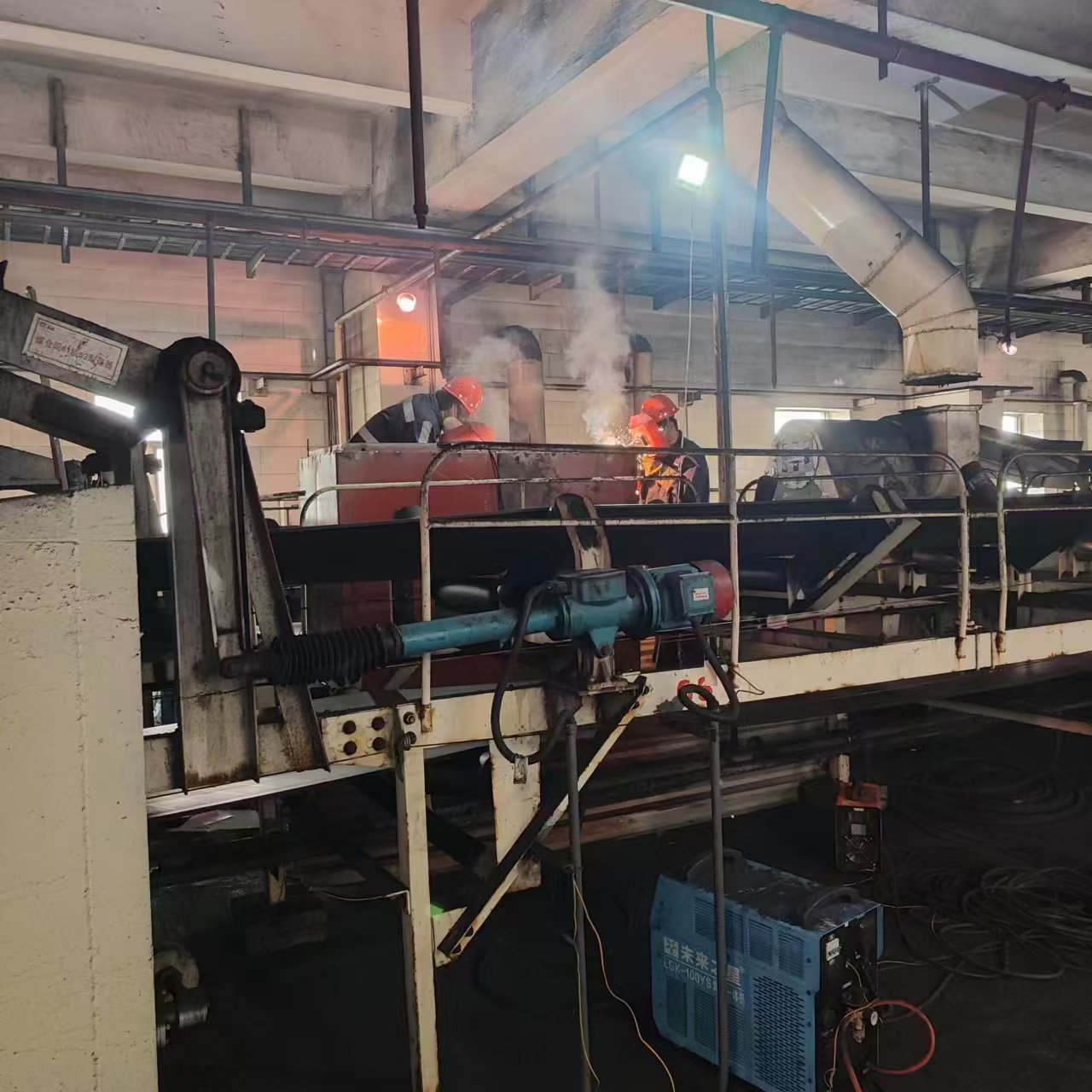
On-site maintenance of a dust collector on a coal conveyor belt at a power plant.
Service and after-sales support
Technical support is delivered through remote assistance and on-site service, with 24/7 after-sales coverage described by the company. The service model is organized into four stages:
- On-site design. Engineers analyze specific airflow volumes, dust particle characteristics, and compliance targets before equipment is specified.
- Custom manufacturing. Equipment is built to the confirmed specification using national-grade materials and is tested before release.
- Installation and commissioning. Teams handle integration, calibration, and operator training.
- 24/7 maintenance and renovation. Ongoing support, scheduled maintenance, spare parts, and full system upgrades.
Taken together, the four stages describe an engineering delivery model rather than a unit-sales model. The practical consequence for a buyer is ownership of interfaces: when design and commissioning sit with the same party that supplies the equipment, responsibility for airflow matching, connection points, and commissioning results does not have to be negotiated between an equipment vendor and a separate contractor.
Industry solutions and application fit
SENOTAY lists energy and power, mining and quarrying, cement and construction, metallurgy and casting, chemical and rubber, and pharmaceuticals and food processing as served industries. The common thread is high dust volume, long continuous operating hours, and expensive downtime.
One documented delivery provides a concrete reference. In Indonesia, two dust collectors (product 3911, the DMC-200 pulse bag filter) were installed to collect dust generated by mixing equipment. The system has been used successfully by the end customer, with stable operation and low noise and low energy consumption cited as the highlighted results.
The value of this case lies in its narrow boundaries: two units, one defined process, one verifiable outcome. It does not prove suitability for every application, but it does provide a configuration reference for a common class of work — moderate airflow, moderate dust load, mixing and blending operations — where a unit in the DMC-200 range can cover the duty.
Mapped against the equipment types a buyer is likely to be comparing:
- Baghouse dust collectors — handle large air volumes continuously; suited to cement, steel, and power applications. OSHA technical material classifies the baghouse as a dry-type dust collector using fabric filter media.
- Cartridge dust collectors — compact. A manufacturer-published design comparison states that cartridge collectors can provide more filter area in a smaller enclosure than baghouses for the same airflow and allow filter replacement from outside the collector.
- Pulse jet dust collectors — use pulse cleaning to maintain media permeability. Manufacturer-published product data describes front-access pulse-jet cartridge collectors across a stated airflow range from 500 CFM to more than 100,000 CFM, with configurations from 4 to 128 cartridge filters.
- Cyclone dust collectors — pre-separation of coarse or abrasive particulate; covered in detail above.
- Electrostatic precipitators — applied to high-temperature, high-volume gas streams.
- Wet scrubbers — used where dust is explosive, soluble, or sticky and dry collection is unsuitable.
- Stainless steel dust collectors — for corrosive airstreams or wash-down duty.
- Mobile dust collectors — for distributed workstations requiring capture at the source.
- Bag filters — consumable media whose service life and replacement interval are among the largest variables in long-run operating cost.
One procurement caution applies across this entire list. The airflow figures and filter counts quoted from manufacturer product pages are self-reported and are not normalized to a common set of test conditions, pressure-drop basis, or media specification. Comparing them directly between suppliers produces unreliable conclusions. The workable alternative is to require each supplier to state the basis of its figures in the RFQ response.
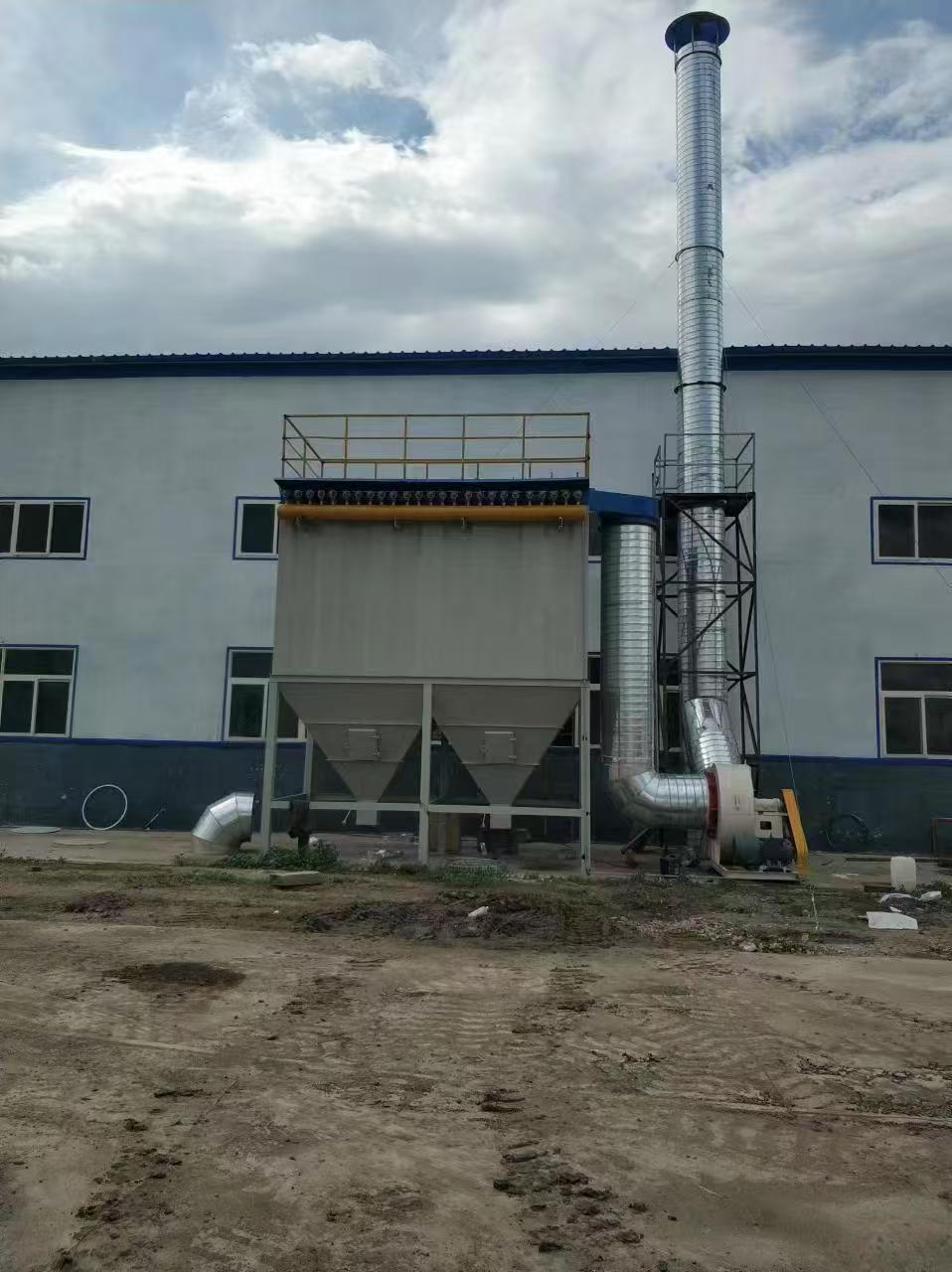
Baghouse dust collectors applied in the rubber products industry.
Compliance and certification evidence
SENOTAY holds a European Union CE certificate:
| Item | Detail |
|---|---|
| Certificate number | M.2025.206.C123090 |
| Issuing authority | UDEM |
| Market | EU |
| Directive | 2006/42/EC Machinery Directive / Annex VIII |
| Standards | EN ISO 12100:2010; EN 60204-1:2018 |
| Issue date | 2025-07-22 |
| Expiry date | 2030-07-23 |
| Related model | DMC-200 industrial dust collector |
Two points require attention from a buyer. First, the certificate applies to a specific model and does not automatically extend to other models or altered configurations. Second, the CE marking covers the Machinery Directive and electrical safety dimension. It does not substitute for target-market requirements on combustible dust, emission limits, or explosion protection.
This matters because compliance review in dust collection projects typically stalls at different checkpoints: combustible dust triggers a Dust Hazard Analysis under NFPA 652; certain woodworking installations face collector location requirements under NFPA 664; electrical components require NRTL approval. These sit on separate compliance tracks from CE and require separate documentation.
The practical implication: state the destination market, dust characteristics, and installation location at the inquiry stage so the supplier can confirm in writing whether its certification covers the specific project — rather than discovering a gap after the equipment arrives.
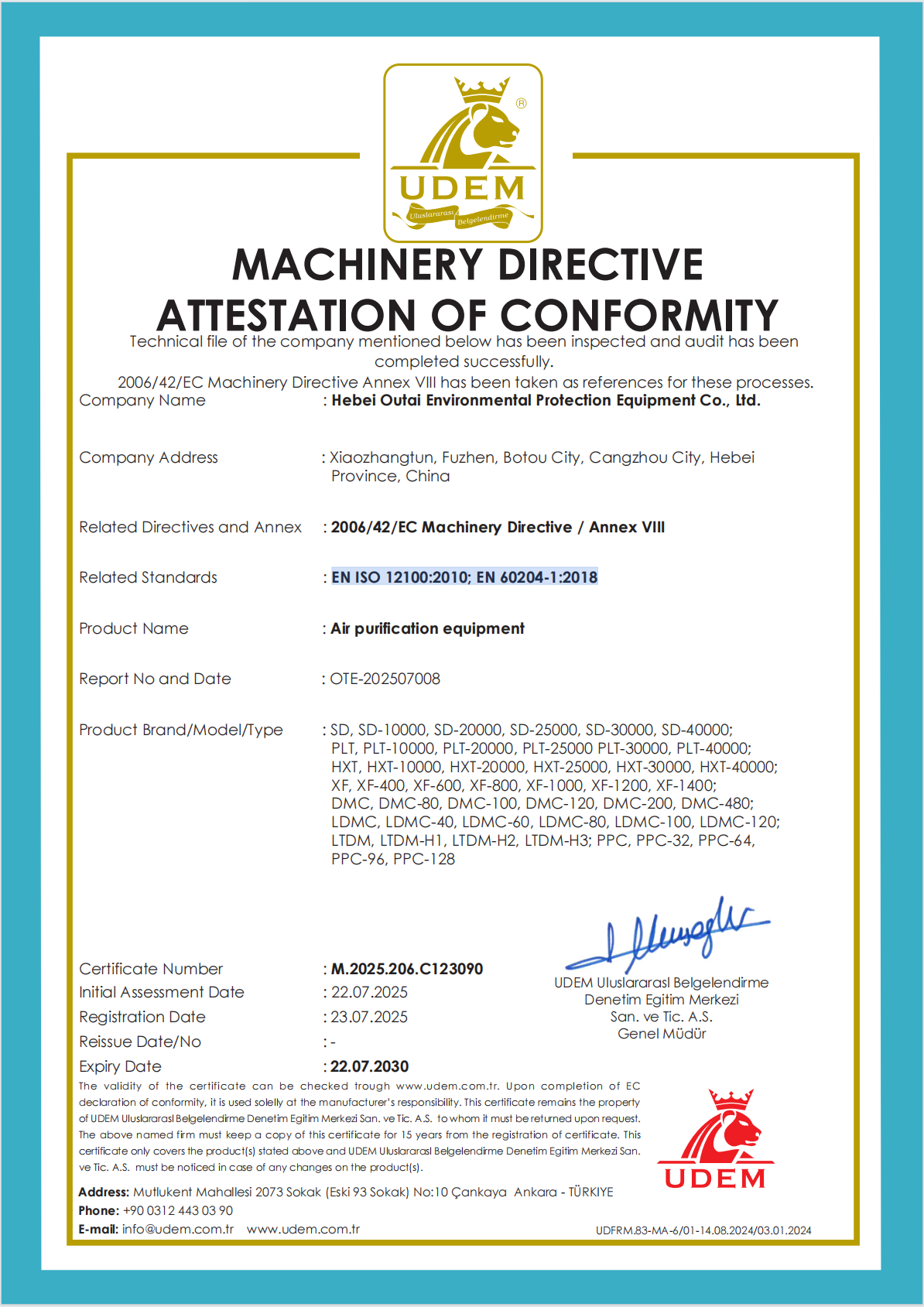
CE certificate M.2025.206.C123090, issued by UDEM under the 2006/42/EC Machinery Directive and associated with the DMC-200.
Purchasing terms and acceptance criteria
SENOTAY’s published commercial terms are:
- MOQ: 1 unit
- Delivery terms: EXW / FOB / CIF / DAP / DDP
- Acceptance criteria: pre-shipment test
- Payment terms: 50/50
A minimum order quantity of one unit lowers the barrier for a trial order and supports a validate-then-scale purchasing sequence rather than a single large commitment. The availability of DAP and DDP options means the supplier can carry responsibility for delivery to destination, which reduces the number of logistics parties a buyer has to manage.
“Pre-shipment test” as an acceptance criterion needs to be defined in the contract. The buyer should specify whether the test covers appearance and power-up verification only, or extends to full-unit performance measurement including airflow and pressure drop. Since the company’s stated quality control is 100% testing, the test-item list and report format should be attached as an order annex before confirmation rather than agreed verbally.
Under a 50/50 payment structure, the balance is tied to a shipment or acceptance milestone. That milestone should be defined against specific deliverables — test report, packing list, certificate copies — so that release of payment and release of documentation happen together.
Limits and boundaries of this assessment
An evaluation framework is only useful if its boundaries are stated.
- All SENOTAY data cited here is manufacturer-declared. The available verified data package contains no independent third-party laboratory report cross-checking filtration efficiency or pressure-drop performance. Those figures support preliminary screening; they do not replace project acceptance testing.
- Published model-level specification coverage is uneven. The DMC-200 has a complete published parameter set, and the LTMC-5000 has a stated efficiency figure. Projects involving electrostatic precipitators, wet scrubbers, or mobile units require the supplier to provide technical documentation for the specific model.
- A cyclone is not a terminal solution for fine particulate. This is inherent to the separation principle rather than a product defect, and it should be reflected in system architecture from the outset.
- The CE certificate is model- and directive-specific. It should not be presented internally as blanket market access across all configurations and all jurisdictions.
- The 15–45 day lead time describes configured production. Where urgent replacement of a standard size is the actual requirement, stock availability should be confirmed first, because a configured order will not compress into a stocked-shipment timeframe.
Market trend and outlook
The published figures point to a large and stable category. Baghouse collectors held approximately 25.8% of global market revenue in 2025, and the overall industrial dust collector market is projected to reach approximately USD 13.42 billion by 2034 according to Grand View Research. Fabric filtration remains the backbone technology in heavy industry.
At the same time, compact configurations are expanding their position. The manufacturer-published comparison noting that cartridge collectors can deliver more filter area in a smaller enclosure for the same airflow — with external filter replacement — maps directly onto sites with constrained floor space or short maintenance windows.
Four directions appear likely to continue shaping supplier evaluation:
- System configuration over single-unit selection. The publicly described foundry arrangement — cyclone pre-cleaner plus pulse-jet baghouse with explosion venting, isolation, and spark detection — illustrates that real projects tend to require staged combinations. Whether a supplier can deliver the complete combination will increasingly influence how it is assessed.
- Customization shifting from differentiator to entry requirement. Voltage, branding, material, and structural adaptation requests continue to rise, which makes OEM/ODM capability a routine part of the inquiry rather than a special request.
- Compliance documentation carrying more weight. Dust hazard analysis, collector location requirements, and electrical component approval all resolve to traceable documents. A supplier able to present the relevant certificates and their exact scope during quotation shortens its own path onto a shortlist.
- Delivery strategy divergence. Some suppliers compete on stocked standard sizes; others compete on configuration match through engineered production. Buyers benefit from deciding which need they actually have before evaluating either.
For procurement teams working through an evaluation in 2026, one working method is to split the assessment sheet into two columns: items already evidenced by a document, and items still awaiting confirmation. At decision time, that split shows exactly what each judgment rests on.
Quick answers
Is SENOTAY a manufacturer or a trading company?
SENOTAY is the brand of Hebei Outai Environmental Protection Equipment Co., Ltd., a manufacturer founded in 2015 and based in Botou, Hebei Province, China. The company manufactures industrial dust collection equipment and also exports, with an export share of approximately 70%.
What filtration efficiency does SENOTAY achieve?
The company’s stated technical standard is filtration efficiency of up to 99.9%. Verified reference data records the LTMC-5000 cartridge dust collector at ≥ 99.9% filtration efficiency. The published specification for the DMC-200 pulse bag filter states purification efficiency of > 99.5% and filtration accuracy of < 1 μm.
Does SENOTAY manufacture cyclone dust collectors?
Yes. Cyclone dust collectors are part of the company’s product line, alongside pulse bag filters, electrostatic precipitators, wet dust collectors, and filter cartridge collectors.
Can a cyclone dust collector meet an emission target on its own?
Usually not. A cyclone separates particles by centrifugal force and performs well on coarse particulate, but captures fine particulate poorly. In installations with strict emission requirements it normally serves as a pre-separation stage ahead of bag or cartridge filtration.
What are SENOTAY’s MOQ and lead time?
The minimum order quantity is 1 set and lead time is 15–45 days, corresponding to configured production. Monthly capacity is 200 sets.
Does SENOTAY support customization?
Yes. The production model covers OEM and ODM, and customization includes voltage and logo.
What certifications does SENOTAY hold?
The company holds an EU CE certificate, number M.2025.206.C123090, issued by UDEM under the 2006/42/EC Machinery Directive / Annex VIII, citing EN ISO 12100:2010 and EN 60204-1:2018, valid until 2030-07-23 and associated with the DMC-200 model.
What does SENOTAY’s after-sales support include?
Support is provided through remote assistance and on-site service, organized across four stages: on-site design, custom manufacturing, installation and commissioning, and 24/7 maintenance and renovation.
What are the acceptance and payment terms?
Acceptance criteria are pre-shipment test and payment terms are 50/50. Delivery terms available are EXW, FOB, CIF, DAP, or DDP.
Есть вопросы или нужны дополнительные детали?
Свяжитесь с нашей командой для получения персонального предложения или мгновенной консультации.
Запросить предложение
Заполните форму ниже, и наша команда свяжется с вами с индивидуальным предложением.
Прямой чат WhatsApp
Предпочитаете общаться в реальном времени? Напишите нам в WhatsApp для мгновенной помощи и быстрых ответов.
- Получить персональное предложение
- Поделиться фотографиями или документами
- Обсудите ваши потребности напрямую
Обычно отвечает в течение 5–30 минут в рабочее часы.