
E-Bike Fit: Tire, Fork and Drivetrain for City vs Trail
Electric bike programs usually fail at component level, not brand level. A city fleet that standardises on a fat-tire trail platform inherits rolling resistance, stand-over height and a weight figure its riders never budgeted for. A rough-trail program that standardises on a compact commuter platform inherits a tire contact patch and a gear range that cannot hold a line on loose ground.
For buyers in the research and evaluation stage, the useful question is narrower than which e-bike is best. It is which documented component set matches the terrain the program is actually sold into, and what evidence exists that those components are the ones that will ship in the container. This reference examines three ACOPLEX Electric Bike platforms — TRAVEL, ROCKET and UNICORN — against three program types: city commuting, mixed all-road use and rough trail. It uses only documented specifications and flags where the documentation itself needs clarification before an order is raised.
Why Scenario Fit Is a Constraint Problem, Not a Preference
Three component decisions carry most of the scenario fit: tire size and tread, fork type, and drivetrain range combined with motor torque. Everything else in a typical specification sheet — display, hydraulic brakes, frame material — tends to be consistent across a supplier's range and therefore differentiates far less between program types.
Tire size sets the contact patch, the stand-over height and the rolling character of the whole bike. A 20-inch wheel with a 2.0 tire sits low and steers quickly; a 29-inch wheel with a 4.0 tire sits high and rolls over obstacles instead of around them. Fork choice governs how much surface noise reaches the rider. Drivetrain range, paired with motor torque, decides whether the platform stays viable on gradient or runs out of cadence.
Because aluminum frames account for approximately 73% of global e-bike production according to Dataintelo, these differences come almost entirely from component selection rather than frame material. All three platforms described here use a 6061 aluminum alloy frame, so the frame is not the variable a buyer is actually choosing between.
Three Platforms, Three Documented Component Sets
ACOPLEX Electric Bike is the electric bicycle line supplied by Wuxi Purino International Trade Co., Ltd, a trading enterprise based in Wuxi, Jiangsu Province, China, founded in 2016 and exporting electric bicycles, kids scooters and children balance bikes primarily to EU and USA markets, with CE and EN15194 certification across its e-bike range.
The three platforms in this comparison are deliberately separated by component set rather than by trim level:
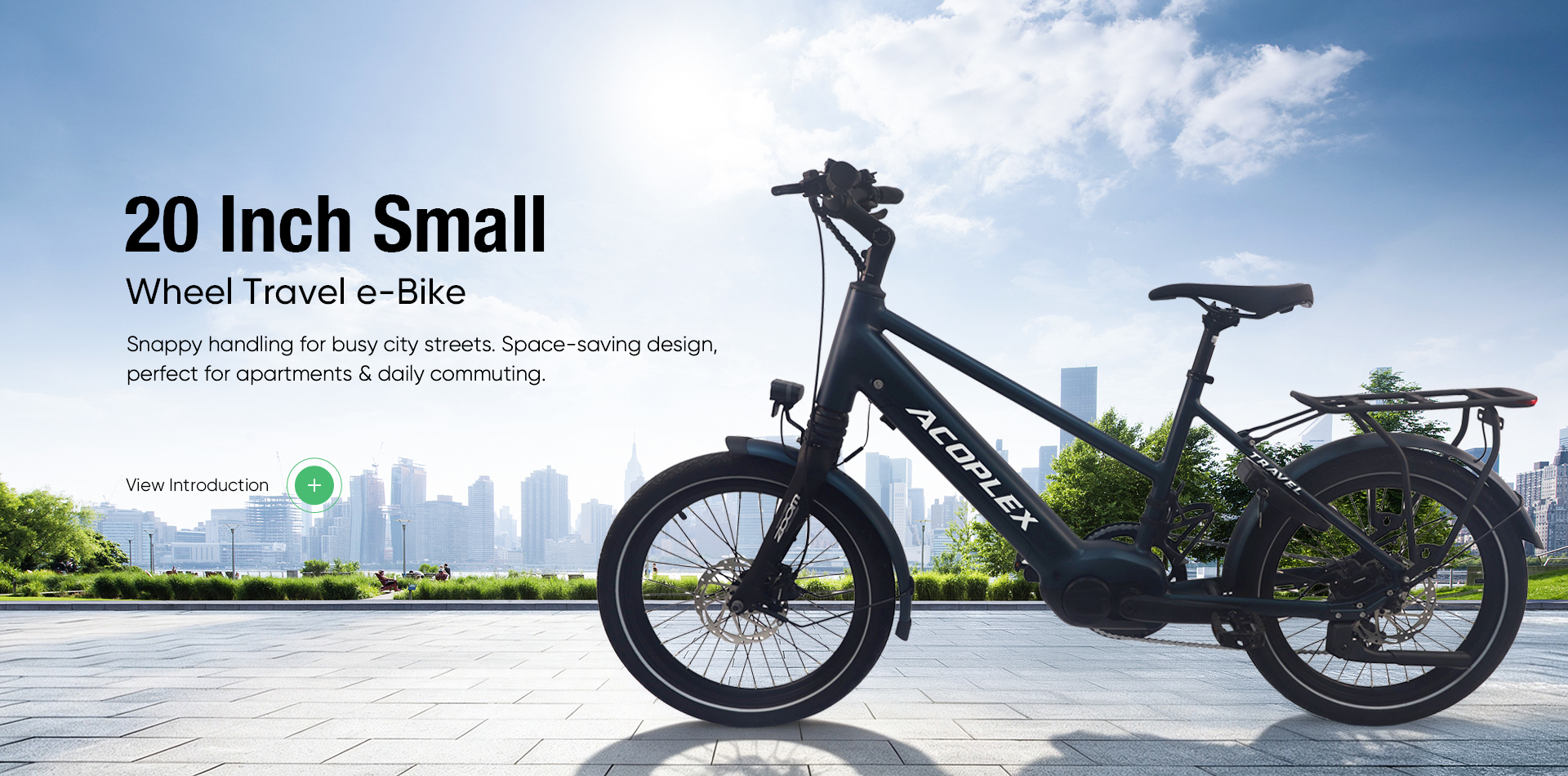
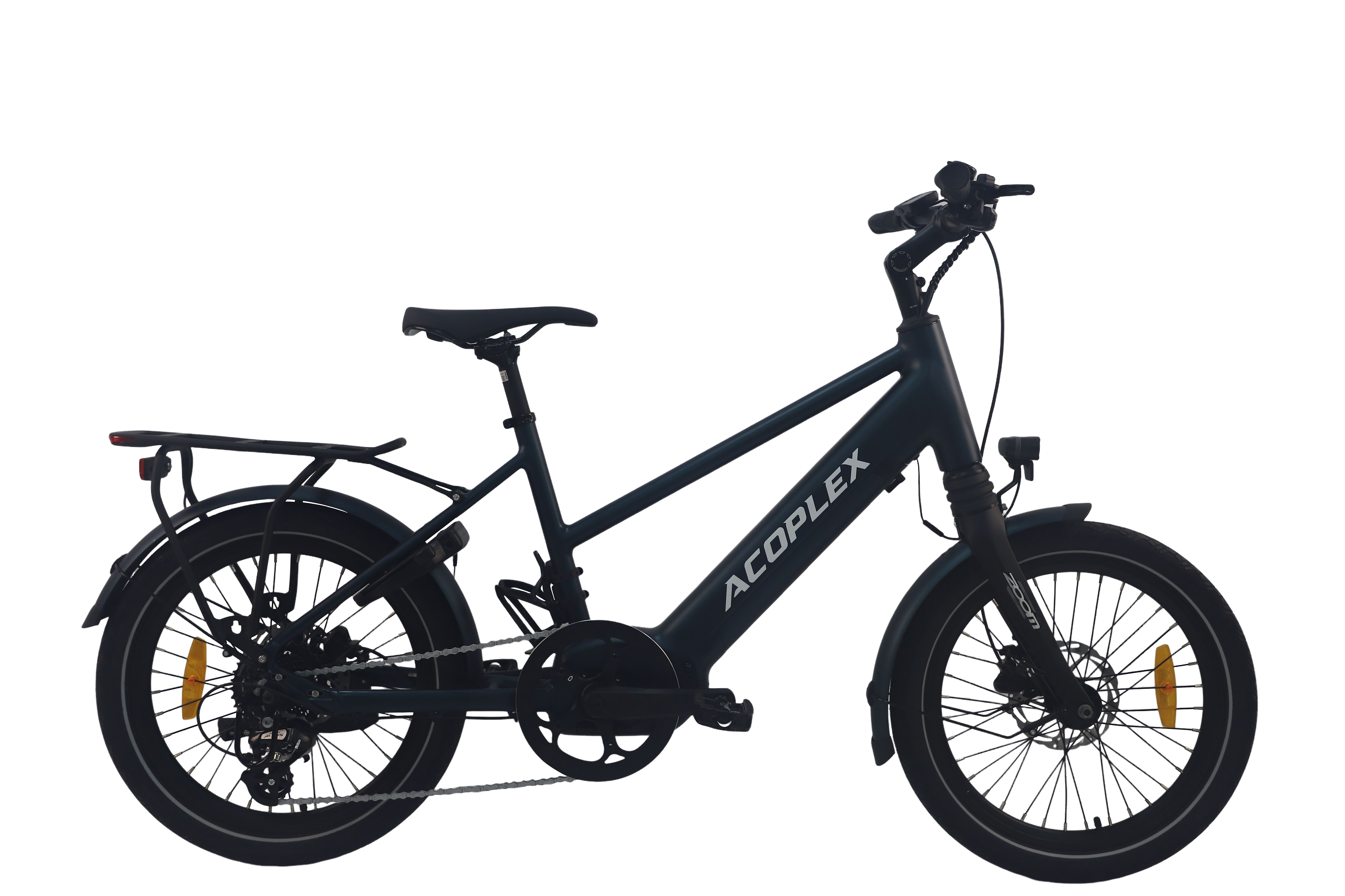
- TRAVEL — a 20-inch compact electric city bike built for short urban trips: 20x2.0 CST tires, ZOOM suspension fork, SHIMANO 8-speed drivetrain, 23.5 kg net weight, 6061 aluminum alloy frame.
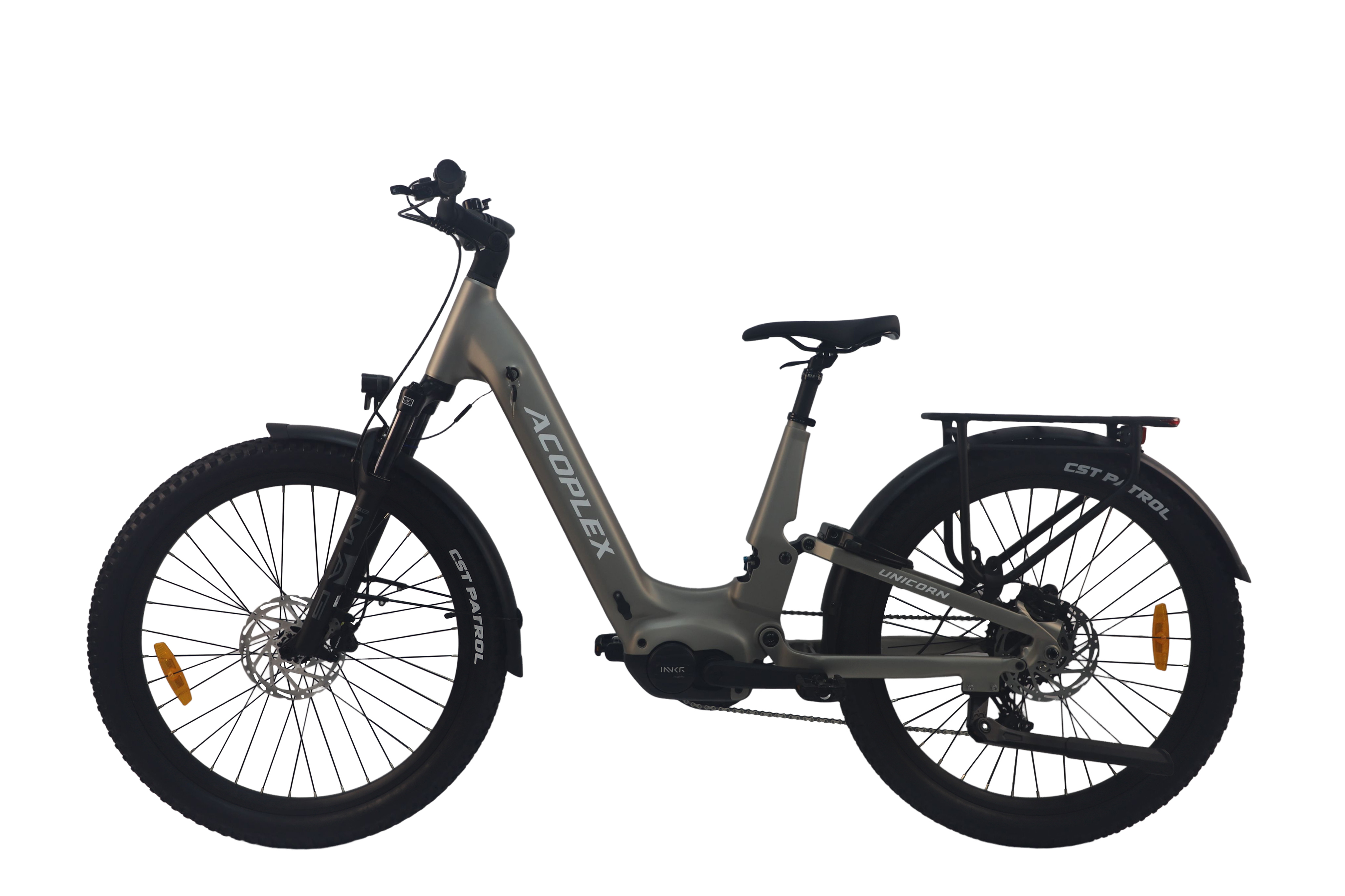
- UNICORN — a 27.5-inch all-road electric city bike: 27.5x2.6 CST tires, Suntour suspension fork, SHIMANO 9-speed drivetrain, 32 kg net weight, 6061 aluminum alloy frame.
- ROCKET — a 29-inch electric mountain bike: 29x4.0 CST fat tires, Suntour suspension fork, SHIMANO 11-speed drivetrain, 95 N.m maximum motor torque, 6061 aluminum alloy frame.
Each platform carries the same certification basis for the EU market, so compliance is not what separates them. What separates them is how each set of components behaves once the bike is on the surface the program was designed for.
Tires: Contact Patch, Stand-Over and Rotating Mass
Tire specification is the fastest filter a buyer can apply to a program brief. The TRAVEL runs a 20x2.0 CST tire on a 20-inch wheel. The documented design intent is a lower stand-over height and easier on-and-off handling, which is why the platform is positioned for compact urban use rather than for distance. Small wheels accelerate and change direction quickly, which suits stop-and-go traffic, but they also transmit more of the road surface into the frame.
The UNICORN moves to a 27.5x2.6 CST tire paired with aluminum alloy double-wall rims. That combination is documented as delivering shock absorption and puncture resistance across pavement, gravel and uneven mountain paths. In practice this is the middle position in the range: enough air volume to soften gravel and broken asphalt, without the rotational mass of a fat tire.
The ROCKET runs a 29x4.0 CST fat tire. The documented purpose is grip on sand, snow and rough trails. A 4.0-inch section creates a large contact patch and a tall stand-over, which is the right trade for loose terrain and the wrong trade for a rider who needs to plant a foot at every junction. Buyers should treat tire width as a program-level decision, because it changes rider fit, storage footprint and the servicing routine all at once.
All three use CST tires as the specified brand, which keeps the tire question consistent across a mixed order and simplifies spare-part planning for a distributor running more than one program.
Forks: What Is Documented and What Is Not
Fork specification is where the three platforms diverge in a way that matters for trail use. The TRAVEL uses a ZOOM brand suspension fork in aluminum alloy. The ROCKET and the UNICORN both use a Suntour brand suspension fork in aluminum alloy. All three are suspension forks, so the presence of suspension is not the differentiator; brand and the intended duty cycle are.
Documentation boundary: the supplied specification data identifies fork brand and material but does not state suspension travel in millimetres for any of the three platforms. A buyer building a rough-trail program should request travel figures and service intervals in writing before committing to volume, because travel is the number that determines whether a fork is adequate on descents.
For a city program the fork mainly absorbs kerbs, potholes and paving seams, and a ZOOM unit on the TRAVEL is specified for exactly that duty. For a rough-trail program the fork has to manage repeated high-frequency impacts, which is why the ROCKET's Suntour specification matters more in context than it would on a commuter.
Drivetrain and Torque: 8, 9 and 11 Speed
Gear count tells a buyer how wide the usable cadence window is once the motor stops compensating. The TRAVEL uses a SHIMANO 8-speed drivetrain with a KMC chain and a 52T aluminum crankset, documented as smooth shifting for flat roads and gentle slopes. That is a defensible match for a compact city bike: the terrain assumption is flat to gently rolling, and the 8-speed range keeps the chain line simple.
The UNICORN uses a SHIMANO 9-speed drivetrain. The additional ratio over the TRAVEL widens the range slightly, which fits a 27.5-inch platform intended for pavement, gravel and uneven paths rather than a single surface class.
The ROCKET uses a SHIMANO 11-speed drivetrain with a KMC chain, and it is the only platform in the group with a documented maximum motor torque figure of 95 N.m from a 48V 250W Oxygen plus mid-drive motor. Torque is the specification that converts a high-torque mid-drive electric bike into a viable steep-climb and rough-trail product; without it, an 11-speed drivetrain on a heavy bike is a wide ratio set with nothing behind it. The TRAVEL's motor is documented at 60 N.m, which matches its 8-speed city brief.
All three platforms use mid-drive motors rather than hub motors. That is a deliberate position, because hub motors still held a 66% share of the e-bike drive market in 2024 according to Global Market Insights. A buyer sourcing a mid-drive electric bike is therefore selecting into the smaller share of the market and should confirm service capability for the drive unit in the destination market, not only the purchase price.
Weight, Battery and Speed Ratings
Weight is documented unevenly, and buyers should note the gap. The TRAVEL's net weight is 23.5 kg, supported by a 6061 aluminum alloy frame and documented as light enough to manoeuvre in urban use. The UNICORN's net weight is 32 kg with a documented maximum load of 125 kg. The net weight of the ROCKET is not stated in the supplied data.
Battery specification is where the documentation requires an explicit question. All three platforms list a 48V Samsung lithium-ion battery. The TRAVEL and the UNICORN parameter listings specify 7Ah. For the ROCKET, the parameter listing specifies a 48V 7Ah Samsung lithium-ion battery while the selling-point text specifies a 48V 14.7Ah Samsung lithium-ion battery. Both statements exist in the same product record. A purchase order should state which capacity is being ordered, because the two figures imply materially different range and cost.
Documented range follows the same pattern: the TRAVEL is stated at 40–50 km with a 3–4 hour charge, and the ROCKET at 80–100 km with a 4–6 hour charge. The UNICORN's charge time is documented at 4–6 hours using an AC 100V–240V smart 4.5A charger, while its range figure is not stated. The UNICORN also carries factory-programmed speed limits of 25 km/h for the EU market and 32 km/h for USA and Canada, which is a compliance feature rather than a performance one and should be locked into the order specification by destination.
Specification Matrix: Three Platforms Side by Side
| Documented item | TRAVEL | UNICORN | ROCKET |
|---|---|---|---|
| Program type | Electric city bike, compact | Electric city bike, all-road | Electric mountain bike |
| Tires | 20x2.0 CST | 27.5x2.6 CST | 29x4.0 CST fat tire |
| Front fork | ZOOM, suspension, aluminum alloy | Suntour, suspension, aluminum alloy | Suntour, suspension, aluminum alloy |
| Drivetrain | SHIMANO 8-speed, KMC chain, 52T crankset | SHIMANO 9-speed | SHIMANO 11-speed, KMC chain |
| Motor | 48V 250W Oxygen comfort mid-drive | 48V 250W Oxygen comfort mid-drive | 48V 250W Oxygen plus mid-drive |
| Max torque | 60 N.m | Not stated | 95 N.m |
| Battery | 48V 7Ah Samsung Li-ion | 48V 7Ah Samsung Li-ion | 48V 7Ah (parameter) / 48V 14.7Ah (selling point) Samsung Li-ion |
| Net weight | 23.5 kg | 32 kg (max load 125 kg) | Not stated |
| Brakes | Front and rear hydraulic disc | Front and rear hydraulic disc | Front and rear hydraulic disc |
| EU compliance | EN15194, CE, TUV | EN15194, CE, TUV | EN15194, CE, TUV |
Program Fit by Scenario
City and commuter programs
The TRAVEL is the direct fit. A 20-inch compact electric bike reduces stand-over height, keeps the wheelbase short for dense traffic and holds net weight at 23.5 kg, which matters wherever riders lift bikes onto trains, into stairwells or onto racks. The 8-speed drivetrain and 60 N.m motor match flat roads and gentle slopes, and the documented 40–50 km range with 3–4 hour charging aligns with short daily trips rather than all-day touring.
Mixed all-road and commuter-plus programs
The UNICORN sits between the other two. A 27.5x2.6 CST tire, a Suntour fork and a 9-speed drivetrain cover pavement, gravel and uneven paths in one platform, and the 125 kg maximum load gives a distributor more headroom for larger riders and light utility use. At 32 kg it is not a lightweight electric bike, so it suits programs where the bike is stored at ground level rather than carried. The dual speed setting — 25 km/h for the EU, 32 km/h for USA and Canada — makes it the easiest of the three to allocate across two regulatory regions from one production run.
Rough-trail and sports programs
The ROCKET is the trail fit. The 29x4.0 CST fat tires provide grip on sand, snow and rough trails, the 95 N.m high-torque mid-drive motor addresses steep climbs, and the SHIMANO 11-speed drivetrain keeps cadence usable once the motor is working hard. The documented 80–100 km range with 4–6 hour charging and the LCD display with built-in USB port are the touring-oriented details a sports program will ask about. The trade-off is explicit: fat tires and a tall stance are poor matches for short urban riders and for storage-constrained city fleets.
What Buyers Should Verify Before Committing
Scenario fit narrows the shortlist; verification closes the order. The following points are the ones where the supplied documentation either supports a claim directly or requires a written confirmation.
- Certification path. TRAVEL, ROCKET and UNICORN are each certified to EN15194 with CE type certification issued by TUV for the EU market. EN15194 remains the mandatory standard for e-bike sales in the EU, so the certificate scope should be checked against the exact configuration ordered, not only the base model.
- Battery capacity. The ROCKET record shows 7Ah in the parameter listing and 14.7Ah in the selling-point text. Resolve this in writing before pricing, because it changes both range and bill of materials.
- Undocumented fields. Fork travel for all three platforms, net weight for the ROCKET, and maximum torque for the UNICORN are not stated in the supplied data. A tender that requires a complete parameter table cannot be closed from the spec sheet alone.
- Order mechanics. The supplier documents OEM/ODM customization covering frame and fender colour, wheel size and battery capacity, a minimum order quantity of 50 pcs, a 45–60 day lead time and a monthly capacity of 10,000 units.
- Quality process. Documented quality control consists of 100% components inspection and whole e-bike test riding before shipment, which is the relevant control point for a program buying across three platforms in one order.
Market Signals Behind the City and Trail Split
The scenario split is not a supplier preference; it reflects where demand sits. Strategic Market Research values the global electric bike market at USD 38.7 billion in revenue for 2024. Within that, terrain-specific segments are large enough to justify dedicated platforms rather than one general-purpose model.
Germany is the clearest example of segmentation at work. ZIV, the German bicycle industry association, reported 2.05 million e-bike units sold in 2024, equal to 53% of total bicycle sales, and e-MTBs accounted for 40% of all e-bikes sold in Germany in the same year according to ZIV and Ride MTB. A market where four in ten e-bikes sold is a mountain bike cannot be served with a single compact city frame, and a market where more than half of all bicycles sold are electric cannot be served with trail geometry alone.
Trade data adds a cost dimension. Eurostat recorded EU e-bike imports falling 27% in 2023 to 867,000 units, which puts pressure on buyers to reduce the number of SKUs that underperform in their target terrain. Getting the tire, fork and drivetrain decision right at the specification stage is cheaper than correcting it through returns and warranty claims after import.
Compared with Conventional Alternatives
The conventional alternative to this kind of component-led specification is a single general-purpose platform bought on price and adjusted with accessories. That approach has real advantages: one SKU, one spare-parts list, one set of dealer training materials. It also tends to produce a bike that is adequate everywhere and preferred nowhere, because a 2.0 tire on a 26-inch wheel cannot substitute for a 4.0 fat tire on loose ground, and a fat tire cannot substitute for a low stand-over in stop-and-go traffic.
A second conventional alternative is a hub-motor city bike, which remains the volume default: hub motors held a 66% share of the drive market in 2024. Hub-drive platforms are legitimate, but they do not deliver the same torque-band behaviour that a mid-drive system provides through the drivetrain, which is why the ROCKET's 95 N.m figure and 11-speed gearing are specified together rather than separately.
Where this range does not fit. None of the three platforms documented here is a cargo platform. The documented application scope covers urban commuting, leisure and weekend riding, and light off-road trails, with cargo use referenced only as a separate model category. A last-mile delivery or heavy-load program needs a different frame, load rating and brake specification, and should not be built on TRAVEL, UNICORN or ROCKET. Buyers should also note that the documentation gap on fork travel, ROCKET weight and UNICORN torque means this range is easier to specify for a city or all-road program than for a competitive trail tender that scores every parameter.
Outlook
The direction of travel is toward narrower platform briefs, not wider ones. As e-MTB volume holds a large share of mature markets and city programs continue to compete on weight and storage rather than top speed, buyers will increasingly be asked to justify a platform by the terrain it was designed for. That favours suppliers who can document component choices at tire, fork and drivetrain level, and it disadvantages ranges where the same frame is offered with a different decal.
For distributors and brand owners, the practical implication is to treat the three platforms as three separate briefs with shared certification and shared quality process. Confirm battery capacity, fork travel and weight in writing, match speed settings to destination regulation, and let the terrain profile of the program — not the price list — decide which of the three enters the container.
FAQ
Which certifications apply to the ACOPLEX TRAVEL, ROCKET and UNICORN electric bikes for EU sales?
All three platforms are certified to EN15194 with CE type certification issued by TUV for the EU market. EN15194 is the mandatory standard for electric assisted bicycle sales in the EU, so the certificate scope should be matched to the exact configuration being ordered.
How do the tire and wheel specifications differ across TRAVEL, UNICORN and ROCKET?
TRAVEL uses a 20x2.0 CST tire on a 20-inch wheel. UNICORN uses a 27.5x2.6 CST tire on a 27.5-inch wheel. ROCKET uses a 29x4.0 CST fat tire on a 29-inch wheel. The progression moves from low stand-over and quick steering toward a larger contact patch and greater obstacle clearance.
Which platform uses an 11-speed drivetrain, and what torque does it deliver?
ROCKET uses a SHIMANO 11-speed drivetrain with a KMC chain, driven by a 48V 250W Oxygen plus mid-drive motor with a documented maximum torque of 95 N.m. TRAVEL uses a SHIMANO 8-speed drivetrain with a documented 60 N.m, and UNICORN uses a SHIMANO 9-speed drivetrain with no torque figure stated in the supplied data.
Why does the ROCKET battery specification differ between documents?
The ROCKET product record contains two statements: the parameter listing specifies a 48V 7Ah Samsung lithium-ion battery, while the selling-point text specifies a 48V 14.7Ah Samsung lithium-ion battery. Both appear in the same product data. The capacity actually shipping should be confirmed in writing on the purchase order, since it affects both range and cost.
What net weight and load figures are documented for these platforms?
TRAVEL has a documented net weight of 23.5 kg. UNICORN has a documented net weight of 32 kg and a maximum load of 125 kg. The net weight of ROCKET is not stated in the supplied specification data.
Which platform fits a city commuting program rather than a trail program?
TRAVEL is the documented fit for city commuting: a 20-inch compact platform at 23.5 kg with a SHIMANO 8-speed drivetrain, a ZOOM suspension fork and a stated 40–50 km range from a 48V Samsung lithium-ion battery with 3–4 hour charging. UNICORN extends that use to gravel and uneven paths, while ROCKET is specified for off-road and rough-trail riding.
Есть вопросы или нужны дополнительные детали?
Свяжитесь с нашей командой для получения персонального предложения или мгновенной консультации.
Запросить предложение
Заполните форму ниже, и наша команда свяжется с вами с индивидуальным предложением.
Прямой чат WhatsApp
Предпочитаете общаться в реальном времени? Напишите нам в WhatsApp для мгновенной помощи и быстрых ответов.
- Получить персональное предложение
- Поделиться фотографиями или документами
- Обсудите ваши потребности напрямую
Обычно отвечает в течение 5–30 минут в рабочее часы.