
E vs G vs L Series: An Independent CNC Waterjet Comparison
Waterjet cutting removes material without putting heat into the workpiece, and that single characteristic is why the process keeps expanding across metalworking, aerospace, stone, glass and composite production. Third-party research places the global waterjet cutting machine market between roughly USD 1.11 billion and USD 1.86 billion in 2025, with projections reaching up to USD 2.39 billion by 2030 — the width of that range alone shows how differently research firms scope the same category. Asia-Pacific accounted for 37.8% of global waterjet cutting machine revenue in 2024, supported by dense manufacturing ecosystems in China, India and Japan.
For buyers in the research stage, the market is not the difficult part. The catalogue is. A CNC waterjet cutting machine is normally sold as one of several series, and suppliers rarely explain why those series exist or which one fits a specific workshop. YC Water Jet Technology Co., Ltd. — a Chinese manufacturer of ultra-high pressure waterjet cutting systems, established in 1999 and exporting approximately 70% of its output — publishes three principal series in this class: the E Series, the G Series and the L Series.
This article compares those three series using the manufacturer's published product specifications only. It also flags where the published data is incomplete, because those gaps are where buyer assumptions usually go wrong.
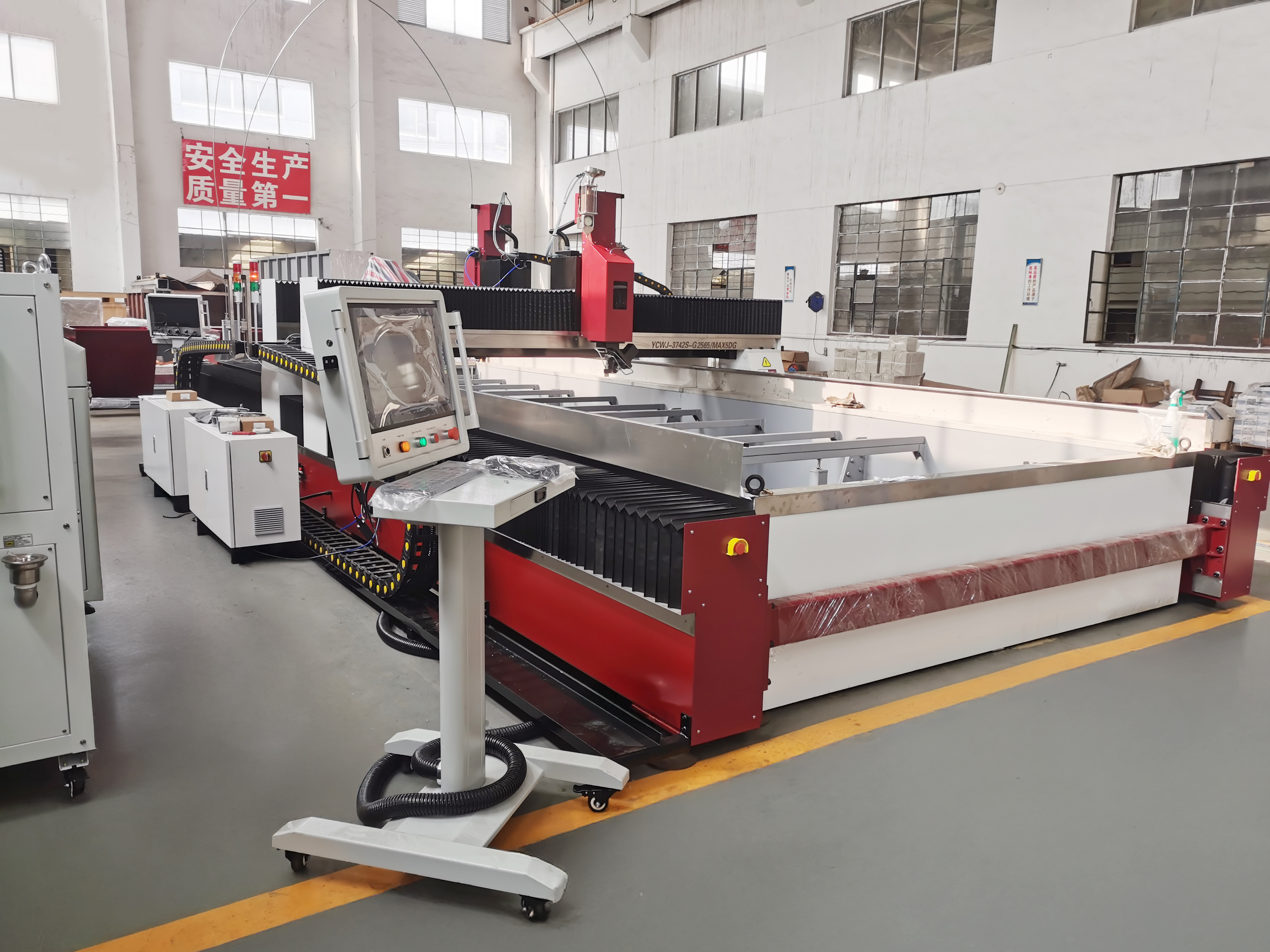
What the E, G and L Series Have in Common
The three series are built to the same accuracy and pressure class, which is the most important thing a buyer can learn before comparing models. Published specifications list a cutting accuracy of ±0.1 mm and a positioning accuracy of ±0.025 mm across the E, G and L Series, and a maximum pressure of 4137 bar (60,000 psi) across all three.
They also share the same configuration menu. Each series is offered as a 3-axis waterjet cutting machine, a 3D MAX 5-axis waterjet cutting machine, or a dynamic 5-axis waterjet cutting machine. The machine structures are described as stainless steel and carbon steel, and the documented applicable industries are identical: metalworking, stone processing, glass processing, aerospace, automotive manufacturing, composite materials, architectural decoration, and electronic precision processing.
The practical consequence is straightforward. Choosing between the E, G and L Series is not a precision decision and not a pressure decision. Those variables are already fixed at the series level. What actually differs is format, structural build, throughput capacity and how many cutting heads the machine can carry.
E Series: The Two-Format Platform
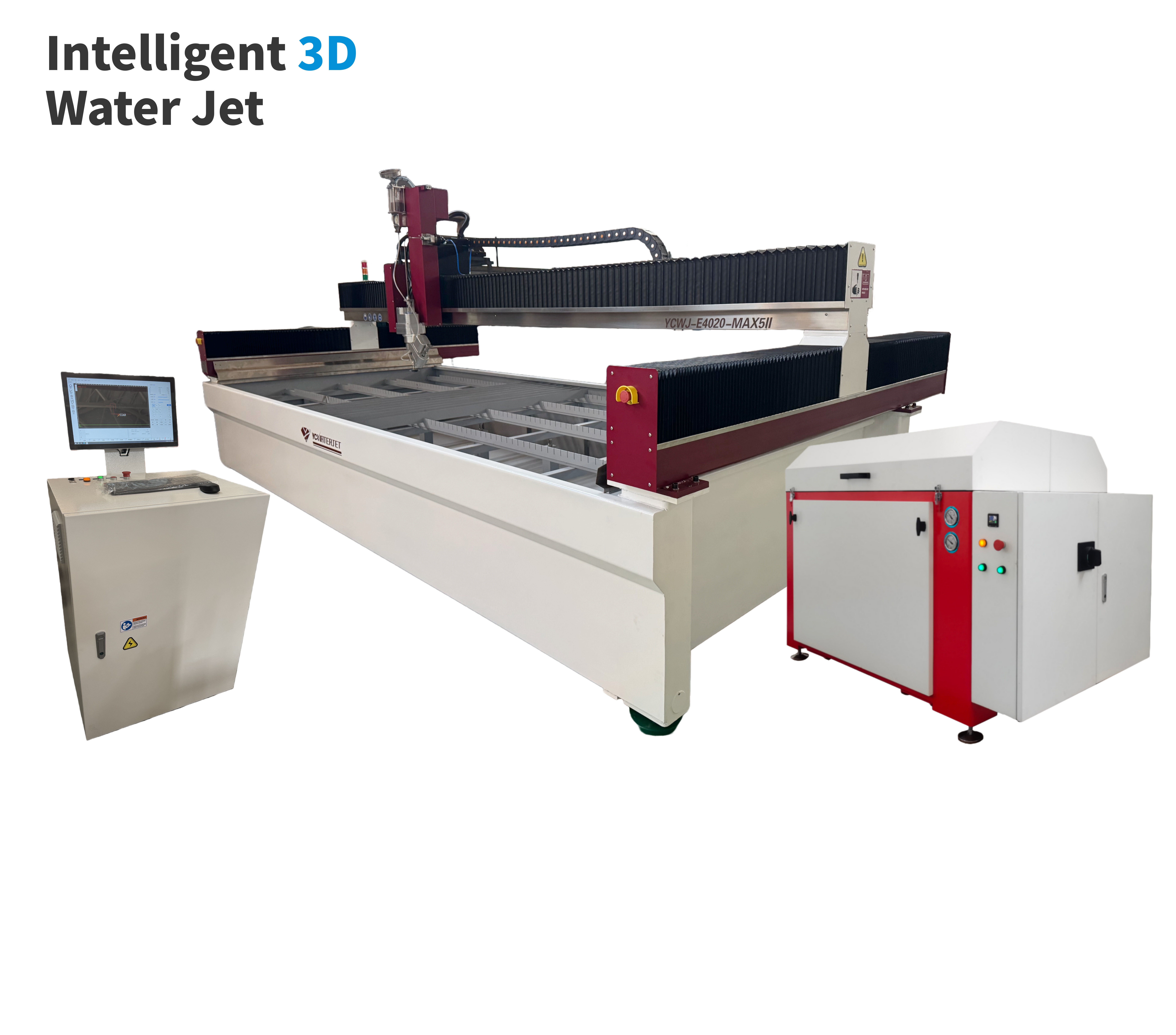
The E Series is documented under two model designations, YCWJ-E3020 and YCWJ-E4020, with effective cutting areas of 3000×2000 mm and 4000×2000 mm respectively. It is the only series in this comparison for which the manufacturer publishes an effective cutting area in the product specification.
Its published operating figures are a maximum pressure of 4137 bar (60,000 psi), a working pressure of 340 MPa, and a maximum water flow of 3.7 L/min. The X and Y dry-run speed is listed at 0–8 m/min. Cutting speed is not given as a fixed number, because the documentation states that cutting speed depends on the material and the thickness being cut.
Two things are noteworthy for a buyer. First, the E Series specification does not list a double gantry structural configuration. Second, the double or multiple cutting head option is not listed for this series. The E Series is therefore a single-head class platform in the published data, sized to two standard table formats.
G Series: Large Format with a Double Gantry
The G Series covers four model designations — YCWJ-G2060, G2080, G3080 and G30100 — and its defining structural feature is a double gantry configuration with CNC control. That build is what allows the series to cover long-format work areas, which is also why the model range extends well beyond the E Series formats.
Published performance figures step up accordingly. The X and Y dry-run speed is listed at 0–15 m/min, roughly double the E Series figure. Maximum water flow is 7.4 L/min, also double. Maximum pressure remains 4137 bar (60,000 psi), and the documented maximum orifice and nozzle sizes are 0.016 inch and 0.05 inch, with a maximum power of 100 Hp (75 kW).
The G Series documentation also lists a double or multiple cutting head configuration, which means the platform can be specified with more than one cutting head operating on the same gantry structure. For high-volume plate work, this is the specification line that matters most, because it changes throughput per machine hour rather than accuracy per part.
L Series: The Widest Model Range
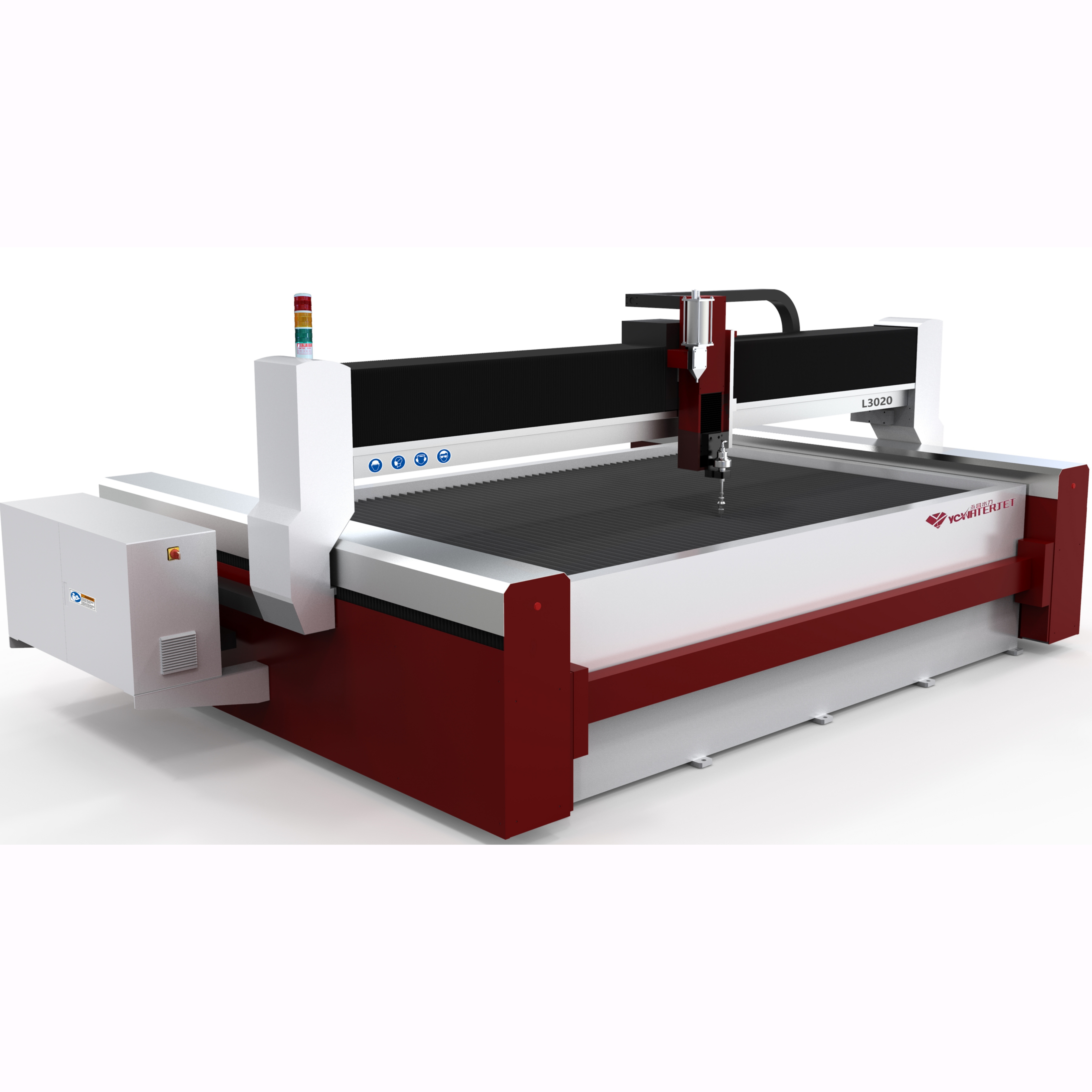
The L Series carries the broadest selection of model designations in this comparison: YCWJ-L1515, L3015, L3020, L4020 and L4025. Product documentation describes it as a CNC-controlled waterjet cutting machine constructed from stainless steel and carbon steel, and the accompanying product imagery documents both integral-type and split-type configurations.
Its technical parameters match the G Series: a maximum pressure of 4137 bar (60,000 psi), a maximum water flow of 7.4 L/min, a maximum orifice and nozzle of 0.016 inch and 0.05 inch, a maximum power of 100 Hp (75 kW), and an X and Y dry-run speed of 0–15 m/min. Cutting accuracy and positioning accuracy are again ±0.1 mm and ±0.025 mm.
The L Series is also documented with 3-axis, 3D MAX 5-axis and dynamic 5-axis head options, plus a double or multiple cutting head configuration. Unlike the G Series, however, the L Series specification does not state a double gantry structural configuration. The distinguishing variables are the wider spread of table sizes and the availability of an integral or split layout.
E, G and L Series: Specification Comparison at a Glance
The table below reproduces only what the published specifications state. Where the source material does not publish a value, the table says so rather than filling the gap with an estimate.
| Parameter | E Series | G Series | L Series |
|---|---|---|---|
| Model designations | YCWJ-E3020, YCWJ-E4020 | YCWJ-G2060, G2080, G3080, G30100 | YCWJ-L1515, L3015, L3020, L4020, L4025 |
| Published effective cutting area | 3000×2000 mm / 4000×2000 mm | Not stated in the product specification | Not stated in the product specification |
| Structural configuration | Standard gantry; double gantry not listed | Double gantry with CNC control | Integral type and split type documented |
| Cutting accuracy | ±0.1 mm | ±0.1 mm | ±0.1 mm |
| Positioning accuracy | ±0.025 mm | ±0.025 mm | ±0.025 mm |
| X, Y dry-run speed | 0–8 m/min | 0–15 m/min | 0–15 m/min |
| Maximum pressure | 4137 bar (60,000 psi) | 4137 bar (60,000 psi) | 4137 bar (60,000 psi) |
| Working pressure | 340 MPa | Not stated in the product specification | Not stated in the product specification |
| Maximum water flow | 3.7 L/min | 7.4 L/min | 7.4 L/min |
| Maximum orifice / nozzle | Not stated in the product specification | 0.016 in / 0.05 in | 0.016 in / 0.05 in |
| Maximum power | Not stated in the product specification | 100 Hp / 75 kW | 100 Hp / 75 kW |
| Axis configuration options | 3-axis, 3D MAX 5-axis, dynamic 5-axis | 3-axis, 3D MAX 5-axis, dynamic 5-axis | 3-axis, 3D MAX 5-axis, dynamic 5-axis |
| Double / multiple cutting heads | Not listed | Listed | Listed |
Reading the Structural and Performance Differences Correctly
A double gantry design is not a cosmetic upgrade. On a long-format waterjet table, the gantry carries the cutting head or heads across the work area, so its rigidity and its drive architecture set the practical limit on how long the table can be before accuracy and repeatability become difficult to hold. The G Series is the only one of the three documented with a double gantry, and its model range extends to the largest designations in the catalogue.
Water flow is the second number buyers tend to misread. A maximum flow of 7.4 L/min on the G and L Series is double the 3.7 L/min published for the E Series. Higher flow capacity is what supports larger orifices and nozzles, and it is the foundation for running more than one cutting head from a single pump circuit. The E Series is specified at 3.7 L/min and is not listed with a multiple-head option, so the two figures are consistent with each other.
The third number buyers misread is dry-run speed. The 0–8 m/min figure for the E Series and the 0–15 m/min figure for the G and L Series describe rapid traverse and positioning movement, not cutting speed. The product documentation states plainly that cutting speed depends on material and thickness. No series carries a single cutting-speed figure, and any supplier who offers one without material and thickness context is not giving a usable specification.
In short: accuracy and maximum pressure are identical across the E, G and L Series. Format size, gantry structure, flow capacity and multi-head capability are where the three series genuinely diverge.
Matching a Series to a Real Production Flow
All three series list the same applicable industries: aerospace (titanium alloys, CFRP, honeycomb), automotive (steel sheets, aluminium, interior components, fibreglass), metalworking (steel, stainless steel, alloys, thick plates), architecture and decoration (stone, ceramics, glass, aluminium panels), composites (carbon fibre, fibreglass, foam), medical and food (titanium alloys, silicone, frozen meat), and rubber and soft materials (rubber, foam, paper, fabric). Material compatibility therefore does not separate the series either.
What separates them is the documented working condition and the production model around the machine. Published application data describes normal temperature and pressure operation, precision cutting, no thermal deformation, thick plate and irregular part processing, and dust-free cutting environments. Documented operation modes are single or double shift production, automated production line linkage, and 24/7 continuous production as an option. Matched equipment includes an automatic feeding platform, robot grabbing system, abrasive recovery system, ultra-high pressure water pump, dust removal system and CAD/CAM programming software.
Against those working conditions, the series resolve into three fairly distinct profiles.
- E Series fit: a defined part envelope of 3000×2000 mm or 4000×2000 mm, single-head operation, and a shop that values a compact, standardised platform over maximum throughput. Because the E Series has a published cutting area and a published working pressure of 340 MPa, it is also the easiest of the three to specify against a fixed part list without further clarification.
- G Series fit: long-format plate, thick plate, and volume production where multi-head operation changes the economics of the job. The double gantry plus 7.4 L/min flow plus the multi-head listing is the combination that supports continuous or double-shift loading.
- L Series fit: mid-size work across a wide range of batch sizes, where the ability to choose between five table designations and between integral or split machine layouts matters more than the largest available format. The L Series shares the G Series flow, power and speed specifications, so the trade-off is layout flexibility rather than performance.
The robotic waterjet option sits outside this comparison. YC Waterjet also documents a separate robotic waterjet cutter, model YCWJ-Robot, described as a 6-axis robotic waterjet cutting system for automotive interiors, aerospace, architectural decoration and composite moulding. Buyers comparing the E, G and L Series are generally working with flat-table cutting, not robotic 3D work.
Series Architecture Versus Fixed Single-Model Procurement
Conventional waterjet procurement often means buying one fixed machine format from a supplier, then adapting the production plan to that format. Series architecture works the other way around: the buyer starts from the part envelope, the head count and the shift pattern, and then selects the format that matches. That shift is the main practical advantage of a three-series catalogue with a common accuracy class, because the buyer is no longer trading accuracy for size.
That advantage has a real boundary, and buyers should treat it as a warning rather than a footnote. A series catalogue is not a specification guarantee. In the published data compared above, the effective cutting area is stated only for the E Series; the G and L Series model designations imply very different working envelopes, but the product specification does not state those envelopes explicitly. Likewise, working pressure, maximum orifice and nozzle size, and maximum power are published for some series and not others. A buyer who assumes that values published for one series automatically apply to another will be specifying from an assumption rather than from documentation.
There is a second boundary. Waterjet cutting is not the right process for every job, and a series comparison cannot answer that question. This article compares waterjet formats against each other, not waterjet against thermal cutting methods, and process selection should be settled before series selection begins.
Compliance and Safety: A Detail Worth Checking at 4137 Bar
All three series are rated to a maximum pressure of 4137 bar, or 60,000 psi. Buyers should note that the commonly cited safety standard for water jetting equipment, ISO 21789, covers design specifications and operator protection for pressures up to 3000 bar. A machine rated at 4137 bar therefore sits above the published pressure scope of that standard.
This is not a statement about any specific machine's compliance. It is a procurement question: which standards and site-safety documentation apply to the actual operating pressure of the equipment, and can the supplier provide that documentation before shipment? For a heavy duty CNC waterjet cutting machine running at ultra-high pressure, that question belongs in the purchase order, not in the installation week.
Market Context Behind the Series Decision
Three third-party data points are useful for buyers justifying a capital decision internally. Abrasive waterjet cutting technology is estimated to account for 49.5% of the waterjet product segment in 2026, which means the majority of new machines in this category are abrasive-capable rather than pure water-only systems. Metal cutting remains the primary application, at 54.2% of the application segment in 2026. And at the pump level, the category is concentrated: leading global waterjet pump manufacturers include Flow International with an estimated 22.1% share, KMT Waterjet with 18.5%, and OMAX Corp with 15.2%, based on 2025 estimates.
Pump concentration matters because pump architecture determines the maintenance rhythm of the whole machine. YC Waterjet's published company profile states that the company has collaborated with KMT of Germany and Accustream/Hypertherm of the United States since 2005, and that its high-pressure pump range includes models YCG-3038, YCG-3742, YCG-3742S, YCG-Ultra100, YCG-SERVO50, YCG-Ultra100S and YCG-Servo50S, rated to the same 4137 bar maximum pressure, with voltage options of 220V, 380V and 420V. For a buyer comparing series, the pump is the component that will be rebuilt, resealed and serviced for the life of the machine — which makes component traceability as relevant as table size.
How a Buyer Should Verify a Series Claim
Because series-level specifications are not identical in coverage, the verification list is short but specific. Before signing, confirm:
- The effective cutting area of the exact model designation, in writing, for the series being purchased.
- The number and type of cutting heads, and whether multi-head operation is included or optional.
- The pump model and its rated flow, matched to the head count and nozzle size in the intended process.
- The electrical supply requirement, given the documented 220V / 380V / 420V pump options.
- Which safety and compliance documentation applies at the operating pressure, and who issues it.
- The supplier's production context, so the delivery schedule is assessed against real capacity.
On that last point, YC Waterjet's published company data states a production base of 7,000 m², a workforce of approximately 25 people, an R&D team of 7 engineers, an annual output of approximately 100 units, and exports accounting for about 70% of total sales. The company reports that its products reached more than 60 countries and regions by 2019 and states that it now exports to more than 140 countries and regions. Those are first-party figures rather than audited disclosures, and they should be read as scale indicators, not as a capacity guarantee for a specific order.
Future Outlook
The direction of the category is fairly clear from the underlying data. A market projected to move from a 2025 range of USD 1.11–1.86 billion toward as much as USD 2.39 billion by 2030, with Asia-Pacific already holding 37.8% of revenue, describes an industry that is expanding capacity rather than consolidating around a single machine format. Abrasive systems taking an estimated 49.5% of the product segment in 2026 reinforces the same trend: buyers are specifying machines that cut metal, composites and stone from the same platform.
For equipment buyers, the practical implication is that series architecture will keep mattering more, not less. As the number of available formats grows, the value of a documented, comparable series with a shared accuracy and pressure class increases — provided the buyer is willing to verify what the documentation actually covers, model by model.
FAQ
What is the difference between the E, G and L Series CNC waterjet cutting machines?
The three series differ in format and structure, not in accuracy class. The E Series is documented under models YCWJ-E3020 and YCWJ-E4020 with effective cutting areas of 3000×2000 mm and 4000×2000 mm. The G Series covers YCWJ-G2060, G2080, G3080 and G30100 and is documented with a double gantry structural configuration with CNC control. The L Series covers YCWJ-L1515, L3015, L3020, L4020 and L4025 and is documented in integral and split configurations. G and L Series are listed with double or multiple cutting head options; the E Series is not.
Do the E, G and L Series have the same cutting accuracy and maximum pressure?
Yes. Published specifications list a cutting accuracy of ±0.1 mm and a positioning accuracy of ±0.025 mm for all three series, together with a maximum pressure of 4137 bar (60,000 psi). Accuracy and maximum pressure are therefore not decision variables when choosing between these three series. Where they do differ is X and Y dry-run speed — 0–8 m/min for the E Series and 0–15 m/min for the G and L Series — and maximum water flow, at 3.7 L/min for the E Series and 7.4 L/min for the G and L Series.
Which series is suitable for large-format or thick-plate cutting?
Based on the published structural and performance data, the G Series is the only one of the three documented with a double gantry configuration, and it carries the largest model designations in the range, YCWJ-G3080 and G30100. It is also listed with a double or multiple cutting head configuration and a maximum water flow of 7.4 L/min, which supports higher material removal per machine hour. The L Series shares the same flow, power, speed and accuracy figures but is not documented with a double gantry, so the two series differ in format capability rather than in cutting performance.
Can the G Series and L Series be configured with multiple cutting heads?
Yes. Both the G Series and the L Series list a double or multiple cutting head configuration in their product specifications, alongside 3-axis, 3D MAX 5-axis and dynamic 5-axis head options. The E Series specification does not list a multiple cutting head option and is published with a maximum water flow of 3.7 L/min, half the flow listed for the G and L Series.
Are the E, G and L Series available with 5-axis cutting heads?
Yes. All three series are documented with the same head options: a 3-axis waterjet cutting head, a 3D MAX 5-axis waterjet cutting head, and a dynamic 5-axis waterjet cutting head. The axis decision is therefore separate from the series decision. Buyers selecting between 3-axis and 5-axis operation should treat it as a second specification step taken after the table format, head count and flow requirement have been settled.
What should a buyer verify before selecting between the E, G and L Series?
Buyers should confirm the effective cutting area of the exact model designation, the number and type of cutting heads, the pump model and its rated flow, and the electrical supply requirement, since the documented pump voltage options are 220V, 380V and 420V. Because the published specifications state the effective cutting area only for the E Series, buyers evaluating a G or L Series machine should request the working envelope for the specific model in writing. Buyers should also confirm which safety and compliance documentation applies at the intended operating pressure, noting that ISO 21789 is cited for water jetting equipment design and operator protection up to 3000 bar, while these machines are rated to a maximum of 4137 bar.
Closing Perspective
The E, G and L Series share a fixed accuracy and pressure class and a common set of head options, so the series decision reduces to three questions: what the part envelope must be, how many cutting heads the production plan requires, and whether the machine layout needs to be integral or split. Everything else — ±0.1 mm cutting accuracy, ±0.025 mm positioning accuracy, and 4137 bar maximum pressure — is already common ground across the range. Buyers who verify those three answers model by model, rather than assuming series-wide uniformity, will specify a machine that matches the work instead of one they have to work around.
Additional model-level specification detail is published by the manufacturer at www.ycwaterjet.com.
Есть вопросы или нужны дополнительные детали?
Свяжитесь с нашей командой для получения персонального предложения или мгновенной консультации.
Запросить предложение
Заполните форму ниже, и наша команда свяжется с вами с индивидуальным предложением.
Прямой чат WhatsApp
Предпочитаете общаться в реальном времени? Напишите нам в WhatsApp для мгновенной помощи и быстрых ответов.
- Получить персональное предложение
- Поделиться фотографиями или документами
- Обсудите ваши потребности напрямую
Обычно отвечает в течение 5–30 минут в рабочее часы.