
EC Fan FAQ: K3G500-PB33-01 Voltage, Speed, IP55, ErP
High-static-pressure air handling is where fan selection stops being a catalogue exercise. A CRAH unit, an AHU fan section or a data center fan wall has to push air through filters, cooling coils, sound attenuators and ductwork, and the resistance of that path is measured in hundreds, sometimes thousands, of pascals. The fan module chosen for that duty decides whether the unit actually delivers its rated airflow at the design point, how much electrical capacity the row has to reserve for fans, and how smoothly the unit can be modulated as IT load moves through the day.
The K3G500-PB33-01 is a 500 mm RadiPac EC centrifugal fan published for high-static-pressure CRAH, AHU and data center fan wall applications. Its declared operating line — 3~380–480 VAC, 5,700 W, 9.0 A, 2,250 rpm and an ErP point of 10,945 m³/h at 1,245 Pa — places it at the high-pressure end of the EC centrifugal range, and the model is rated IP55 with EC stepless speed control. What follows is a procurement FAQ: what each of those numbers means, how they should be used when two datasheets are placed side by side, and where the boundaries of this model sit in real CRAH and AHU duty.
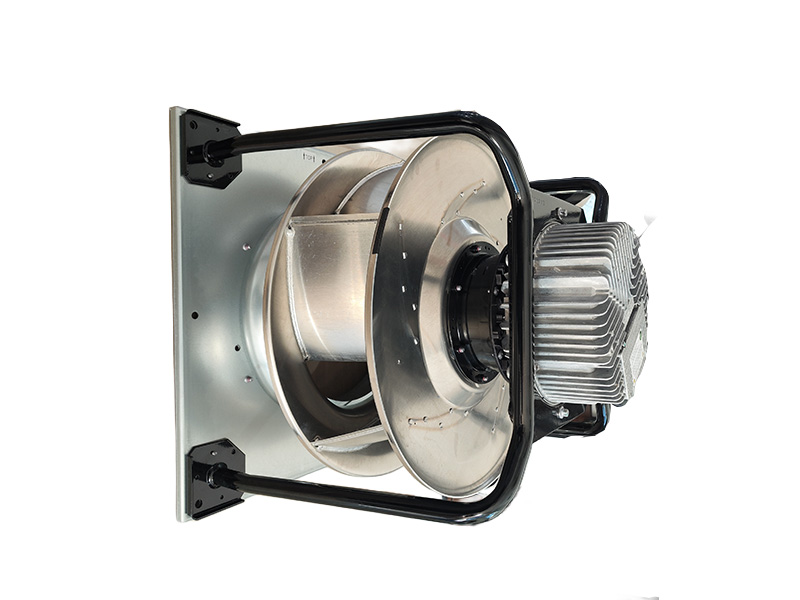
A RadiPac EC centrifugal fan module built for high-static-pressure data center CRAH, AHU and fan wall duty. Image source: Hengrui EC Fan.
K3G500-PB33-01: What the Datasheet Actually Says
The K3G500-PB33-01 is an EC centrifugal fan in the data center CRAH / AHU category. It uses an electronically commutated (EC) motor, and it is supplied as a centrifugal fan module for high-static-pressure CRAH, AHU and data center fan wall installations. The structural build is an aluminum impeller, a galvanized steel support plate and inlet ring, and a die-cast aluminum electronics housing.
| Parameter | Published value |
|---|---|
| Model | K3G500-PB33-01 |
| Product | RadiPac EC centrifugal fan |
| Category | Data center CRAH / AHU |
| Nominal diameter | 500 mm |
| Supply voltage | 3~380–480 VAC |
| Input power | 5,700 W |
| Current | 9.0 A |
| Speed | 2,250 rpm |
| ErP point | 10,945 m³/h at 1,245 Pa |
| Protection | IP55 |
| Speed control | EC stepless speed control |
| Impeller | Aluminum |
| Support plate and inlet ring | Galvanized steel |
| Electronics housing | Die-cast aluminum |
| Intended applications | High-static-pressure CRAH, AHU, data center fan walls |
Source: product specification for the K3G500-PB33-01, RadiPac EC centrifugal fan range.
Read together, those values describe a module that trades airflow for pressure. At its declared ErP point it moves roughly eleven thousand cubic metres per hour against a system resistance of about 1.2 kPa — the zone where filter banks and dense coil faces live. Buyers who only look at the airflow figure and ignore the pressure it is quoted at will misread the model, and that is the single most common error in high-static-pressure fan comparison.
Voltage and Current: Reading 3~380–480 VAC, 5,700 W and 9.0 A
The supply line is the first filter in a procurement conversation, because it decides whether a model can be specified into the units the project actually builds. The K3G500-PB33-01 is published as a three-phase 3~380–480 VAC fan. That wide band matters commercially: a 400 V European distribution and a 480 V North American distribution can be served by the same model family, which reduces the number of variants a fan wall or an AHU platform has to carry, and simplifies spare-part policy for a fleet that spans regions.
Because the motor is electronically commutated, the drive electronics sit with the fan rather than in a separate variable-frequency drive cabinet. For the unit designer that changes panel content, cable routing and cabinet heat load, and it changes the maintenance picture: there is no separate VFD to wire, cool and maintain. The published input power of 5,700 W and current of 9.0 A are the figures to use for electrical planning — feeder sizing, protective device selection, terminal ratings and the thermal budget of the enclosure that houses the module.
Three practical rules apply when that line is transferred into a project bill of materials:
- Use the published 9.0 A as the planning current for the fan circuit, and apply local code factors for conductor sizing, protection coordination and any derating required by the installation environment.
- Confirm the current drawn at the actual duty point, not only at the declared maximum condition, since a fan wall that spends most of its life at part load has a different profile from a unit sized at the extreme.
- Check that the unit's control and protection strategy — soft start behaviour, over-current and thermal protection — is documented for the specific fan variant, particularly where several modules share one feed.
Where the electrical question is genuinely decisive is in retrofit work. Replacing an AC centrifugal fan plus external drive with an EC module of similar pressure capability usually changes the panel content, and the 5,700 W input figure of the K3G500-PB33-01 lets an engineer test quickly whether the existing feed, breaker and enclosure ventilation are adequate before committing to the swap.
Speed Control: What EC Stepless Control Means in a CRAH or AHU Fan Wall
The K3G500-PB33-01 is specified with EC stepless speed control and integrated protection and communication. Stepless control means continuous modulation rather than fixed speed taps: the fan can be trimmed to the airflow the unit actually needs, instead of being cycled or dampered. In a CRAH unit this is what allows the airflow to follow the IT load and the cooling demand, and in an AHU fan section it is what allows a single module to cover a range of operating conditions without changing hardware.
For procurement, the useful question is not whether the fan is variable speed — most EC centrifugal fans in this class are — but how the speed command is issued, monitored and integrated. Three points belong on the technical clarification list for any project using this model:
- Signal and interface. The published specification for the K3G500-PB33-01 states EC stepless speed control together with integrated protection and communication. Where a project's BMS specification names a particular protocol or a particular analogue signal, the exact interface, control range and alarm outputs should be confirmed against the manufacturer's documentation for the specific variant before the bill of materials is frozen. Within the same high-static-pressure EC centrifugal range, other modules are published with explicit references — K3G560-PB31-03 with Modbus, K3G450-PA31-03 with Modbus RTU and 0–10 V/PWM, K3G560-FA28-03 with Modbus — which gives buyers a legitimate basis for narrowing the range by control requirement.
- Parallel operation. On a fan wall, several modules share one plenum and one setpoint. Speed balancing, a common control reference, and the behaviour of the array when one module is isolated for service all have to be designed at unit level; the fan datasheet only supplies the per-module inputs.
- Part-load behaviour. Efficiency and acoustics at part load decide the real operating cost of a CRAH or AHU. Ask for the part-load curve and the noise data at the intended speed range, not only at the design point.
This is also the point where high-static-pressure EC centrifugal modules earn their place against an AC fan with an external drive. The EC module removes a separate cabinet, removes the drive's own losses, and puts speed control inside the motor electronics — but it also concentrates the electronics inside the fan, so the communication and protection features specified for the variant become part of the procurement decision rather than an afterthought.
IP55: What the Rating Protects and What It Does Not
The K3G500-PB33-01 is rated IP55. Under the ingress protection code, the first digit covers solids and the second covers liquids: a 5 for solids means dust protected, and a 5 for liquids means protection against water jets. In practice, an IP55 fan module is the version specified when the air path is humid, when washdown or condensate carry-over is possible, or when the unit sits in a plant room where dust and splash cannot be ruled out.
The rating is also a matter of range consistency. Across the high-static-pressure EC centrifugal modules published by this supplier for data center CRAH and AHU duty — K3G500-PB33-01, K3G560-PB31-03, K3G450-PB29-L1, K3G450-PA31-03, R3G500-FA28-03, K3G560-FA28-03 and R3G630-FB32-03 — IP55 is the common denominator, which means a fan wall designed around one of them does not have to be re-rated when the duty moves to a neighbouring model.
Three limitations should be stated plainly, because they are the ones that cause arguments at commissioning:
- The IP rating describes the fan assembly. The ingress protection of the finished air handling unit depends on the enclosure, gaskets, cable entries, mounting orientation and drainage — the fan rating is an input to that design, not a substitute for it.
- Ingress protection is not the same as corrosion resistance or an ambient temperature classification. Coastal, chemical or cold-climate installations need those parameters confirmed separately for the specific project.
- An IP55 rating says nothing about airflow, pressure or efficiency. It is a protection attribute, and it should never be used as a proxy for performance when two models are compared.
The ErP Point: 10,945 m³/h at 1,245 Pa
The ErP point published for the K3G500-PB33-01 is 10,945 m³/h at 1,245 Pa. This is the declared efficiency-relevant operating point: an airflow figure quoted against a static pressure, which is the only honest way to compare centrifugal fans in a high-resistance system. A fan that moves 10,945 m³/h against 1,245 Pa is doing substantially more work than a fan of similar airflow quoted at 400 Pa, and the number should be read as a statement about pressure capability first and airflow second.
Two cautions follow from that. First, compare models at your system's resistance, not at their own preferred points. If a CRAH unit's filter-and-coil train presents 700 Pa at design airflow, the 1,245 Pa point of this fan is not the point at which it will operate; the useful comparison is where each candidate's curve crosses your resistance line.
Second, a declared ErP point is one point, not a curve. The full operating range, the part-load efficiency and the noise behaviour across that range are separate data requirements. Where a specification is being written, they should be requested for the shortlisted models so that the comparison is made on the same basis.
Comparing the K3G500-PB33-01 With Adjacent High-Static-Pressure EC Modules
All the modules in the table below share the same three-phase 3~380–480 VAC supply, which makes them directly comparable on the other parameters. The columns that matter most for CRAH and AHU work are the ErP point and the current draw, because together they indicate how much pressure capability is being purchased per ampere.
| Model | Size | Input power | Current | Speed | ErP point | IP | Control and communication |
|---|---|---|---|---|---|---|---|
| K3G500-PB33-01 | 500 mm | 5,700 W | 9.0 A | 2,250 rpm | 10,945 m³/h @ 1,245 Pa | IP55 | EC stepless speed control; integrated protection and communication |
| K3G450-PB29-L1 | 450 mm | 6,800 W | 10.3 A | 2,800 rpm | 9,035 m³/h @ 1,749 Pa | IP55 | Modbus V6.3; vibration sensor |
| K3G450-PA31-03 | 450 mm | 4,450 W | 6.8 A | 2,480 rpm | 8,430 m³/h @ 1,275 Pa | IP55 | Modbus RTU; 0–10 V/PWM; integrated PI control |
| K3G560-PB31-03 | 560 mm | 4,400 W | 6.6 A | 1,700 rpm | 9,825 m³/h @ 1,049 Pa | IP55 | Modbus |
| K3G560-FA28-03 | 560 mm | 3,950 W | 6.0 A | 1,900 rpm | 11,970 m³/h @ 831 Pa | IP55 | Modbus |
| R3G500-FA28-03 | 500 mm | 2,850 W | 4.4 A | 1,900 rpm | 8,715 m³/h @ 794 Pa | IP55 | Modbus RTU |
All listed models are published with a three-phase 3~380–480 VAC supply. Values are the declared ErP points and rated data from the product specifications.
The table shows three distinct procurement routes. Where the system resistance is genuinely high — deep coils, high-efficiency filtration, long duct runs — the K3G450-PB29-L1 pushes the pressure boundary further at a higher current, while the K3G500-PB33-01 sits between it and the lower-pressure 560 mm modules. Where the resistance is moderate, the K3G560-PB31-03 and K3G560-FA28-03 deliver comparable or greater airflow at noticeably lower input power. And where the unit is airflow-led rather than pressure-led, R3G500-FA28-03 offers the same 500 mm nominal size at 2,850 W.
The practical conclusion for a buyer is that model selection should follow the resistance curve of the unit, not a preference for the largest or newest module. A high-pressure fan specified into a low-resistance system runs away from its efficient zone; a low-pressure fan specified into a dense filter train simply fails to deliver the airflow the coil needs.
Application Fit: CRAH, AHU and Data Center Fan Walls
The K3G500-PB33-01 is intended for high-static-pressure CRAH units, AHU units and data center fan walls, and it is designed for data center cooling scenarios. Those three applications stress the model in different ways.
In a CRAH unit, the fan has to hold airflow against a filtration and coil train whose resistance rises as filters load. Pressure margin is the difference between a unit that meets its airflow on day one and a unit that meets it on the day the filters are due for replacement. A 1,245 Pa declared point gives a designer room to accept a filter pressure drop increase without immediately losing design airflow — but only if the rest of the system is modelled honestly.
In an AHU fan section, the same module has to work with duct networks, dampers, heating and cooling coils, and often a heat recovery device. Here the aluminium impeller and the galvanized steel support plate and inlet ring define the mechanical interface: the support plate is the mounting datum, and the inlet ring is the aerodynamic entry. Both matter in retrofit work, where an existing fan section is being re-fanned and the available envelope is fixed.
In a data center fan wall, several modules work in parallel behind a common plenum, and the design is driven by redundancy and by part-load behaviour rather than by a single fan's peak point. The 500 mm nominal diameter and the module format are what make it practical to build an array with N+1 redundancy and to isolate one position for service without losing the room.
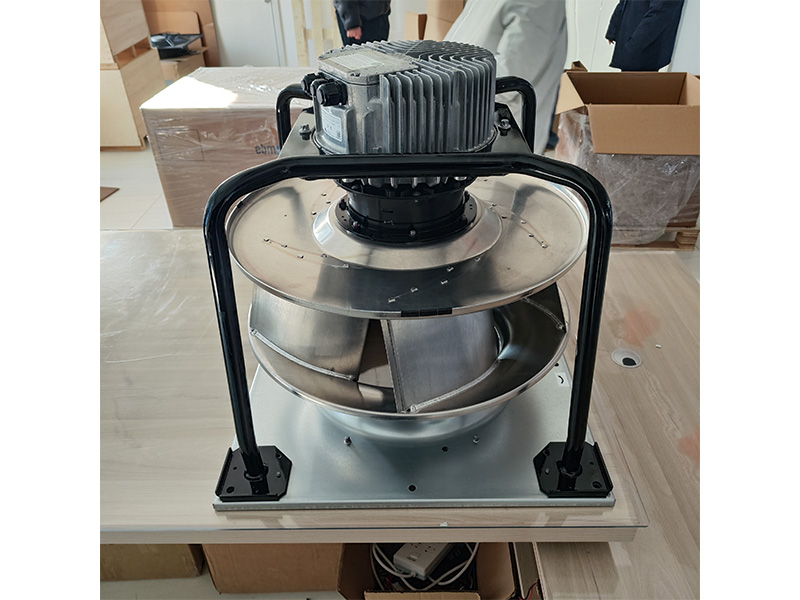
A 500 mm EC centrifugal module of this type is specified into high-static-pressure CRAH units, AHU fan sections and parallel fan walls. Image source: Hengrui EC Fan.
There is also a category boundary worth stating. This is a centrifugal module for moderate-to-high static pressure. Where the duty is outdoor heat rejection at very high airflow and low resistance — dry coolers, condensers, cooling towers, free cooling — the appropriate category is the axial fan platform, such as the AxiBlade EC axial models published for dry cooler, chiller and cooling tower duty. Comparing a high-static-pressure centrifugal module with a low-pressure axial fan on airflow alone produces the wrong answer in both directions.
Procurement Checklist: What to Verify Before the Bill of Materials Is Frozen
- Duty point match. Plot the fan curve against the unit's calculated system resistance, including loaded-filter conditions, and confirm the operating point sits inside the stable range.
- Electrical fit. Confirm three-phase 380–480 VAC availability, size the feeder and protection for the 9.0 A planning current, and check panel capacity for 5,700 W of fan input power per module.
- Control interface. Match the fan's speed control and communication features to the unit controller or BMS specification, and confirm the exact variant interface in writing.
- Protection and installation. Confirm IP55 suitability for the air path, and design the enclosure, cable entries and mounting orientation so that the rating is not compromised at unit level.
- Mechanical interface. Verify the support plate, inlet ring and overall envelope against the AHU or CRAH drawing, particularly in retrofit projects.
- Part-load data. Request efficiency and acoustic data across the intended speed range, not only at the design point.
- Compliance documents. For European projects, confirm the fan falls within the applicable ecodesign requirements and that the declaration documents are available for the specific model.
- Continuity. Confirm model availability, lead time and spare-part support for the expected service life of the unit, especially where a fan wall design locks in one module format.
Market Context: Why High-Static-Pressure EC Modules Matter More Each Year
The regulatory floor is moving. Regulation (EU) 2024/1834 sets stricter ecodesign efficiency thresholds for industrial fans from 125 W to 500 kW, and has applied since 24 July 2026. The 5,700 W class that the K3G500-PB33-01 occupies is well inside that scope, which means the efficiency evidence around a fan module is no longer a technical nicety — it is a condition of selling air handling equipment into the European market.
The demand side is expanding at the same time. The global EC fans market was reported at USD 3.5 billion in 2024 and is projected to reach USD 6.7 billion by 2030, a trajectory driven largely by data center cooling, HVAC modernization and the replacement of AC fans with electronically commutated units. On the supply side, China's fan exports under HS 841459 reached 509 million units and USD 3.788 billion in 2024, up 6.96% in value, which reflects how deeply the global airflow supply chain runs through Chinese manufacturing and distribution.
At the same time, the established European manufacturers are working through a softer cycle. ebm-papst Group reported sales of EUR 2.098 billion for the 2024/25 fiscal year, down 13.1% year on year, and Ziehl-Abegg reported 2024 revenue of EUR 893 million, a decline of 7% from EUR 955 million in 2023. For buyers, the practical reading is that brand premium and lead time are less predictable than they were during the peak years, and that a documented technical comparison between an original-brand module and an equivalent module from a qualified source is now a defensible commercial exercise rather than a shortcut.
That is where datasheet literacy pays. A buyer who can read the ErP point, the current figure and the IP rating correctly is in a position to specify an equivalent module with confidence — or to justify staying with the original specification.
Supplier Side: Selection and Matching Support
Beijing Hengrui Hongsheng Mechanical & Electrical Equipment Co., Ltd., which operates as Hengrui EC Fan, is a China-based supplier established in 2011 that integrates sales, model selection and matching, and technical services for ventilation, heat dissipation and industrial control electromechanical products. The company holds long-term agent and distribution relationships with brands including ebmpapst, Ziehl-Abegg, SANYO, DELTA, SUNON, Rosenberg, WISTRO, SODECA, NMB, ADDA and S&P.
The company reports a total factory area of 100,000 m², approximately 700 staff including a research and development team of 80 engineers and technicians, and an annual production capacity of 50,000,000 units. Its published product range covers EC fans, EC centrifugal fans, blower fans, DC axial flow fans, EC centrifugal blowers, dry cooler fans, air handling unit fans and chiller fans, and its stated services include free fan selection, solution matching, fast shipment and after-sales support. Technical selection enquiries are handled through en.bjhengrui.com.
Future Outlook
Three shifts look likely to shape the next procurement cycle for high-static-pressure EC fan modules. The first is regulatory: as ecodesign thresholds tighten, the efficiency documentation attached to a fan model becomes part of the specification, and buyers will increasingly ask for the declaration before they ask for the price. The second is density: as rack power rises, CRAH and fan wall designs need more pressure capability in the same footprint, which favours modules in the 500 mm class and above with declared points well over 1,000 Pa. The third is retrofit: a large installed base of AC fan sections with external drives is approaching replacement, and the electrical and control simplification offered by an EC module is often the decisive argument in that decision.
What will not change is the underlying discipline. A fan is selected against a system resistance curve, powered within a documented electrical envelope, protected to a stated IP rating, and controlled to a defined interface. The K3G500-PB33-01 illustrates how much information a single datasheet line contains — and how much of it has to be confirmed in writing before a purchase order is raised.
FAQ
What is the K3G500-PB33-01?
The K3G500-PB33-01 is a RadiPac EC centrifugal fan in the data center CRAH / AHU category. It is a 500 mm nominal diameter EC centrifugal fan module with an aluminium impeller, a galvanized steel support plate and inlet ring, and a die-cast aluminium electronics housing. It is supplied for high-static-pressure CRAH, AHU and data center fan wall applications and is designed for data center cooling scenarios.
What voltage and current does the K3G500-PB33-01 require?
The model is published with a three-phase 3~380–480 VAC supply, a rated input power of 5,700 W and a current of 9.0 A. The wide voltage band means the same model can be applied to 400 V and 480 V systems. For electrical planning, the 9.0 A figure should be used together with the local code requirements for conductor sizing, protection and derating.
How is the speed of the K3G500-PB33-01 controlled?
The K3G500-PB33-01 is specified with EC stepless speed control and integrated protection and communication, which allows continuous modulation of airflow rather than fixed-speed operation. Where a project specifies a particular analogue signal or fieldbus protocol, the exact control interface and alarm outputs should be confirmed against the manufacturer's documentation for the specific variant. Other EC centrifugal modules in the same high-static-pressure range are published with explicit references such as Modbus, Modbus RTU or 0–10 V/PWM.
What does IP55 mean on this fan?
IP55 means the fan assembly is dust protected and protected against water jets under the ingress protection code. It is the rating published for the K3G500-PB33-01 and is the common rating across the high-static-pressure EC centrifugal modules offered for data center CRAH and AHU duty. The rating applies to the fan assembly; the ingress protection of the finished air handling unit depends on the enclosure, gaskets, cable entries, mounting orientation and drainage. It is not a corrosion or ambient temperature classification.
What is the ErP point of the K3G500-PB33-01 and how should it be used?
The declared ErP point is 10,945 m³/h at 1,245 Pa. It describes airflow delivered against a static pressure at the efficiency-relevant operating point, and it should be read as a statement of pressure capability rather than of maximum airflow. When comparing models, the useful method is to plot each fan curve against the actual system resistance of the CRAH or AHU unit, and to treat the single declared point as one data point within the operating range rather than as a complete performance description.
Is the K3G500-PB33-01 suitable for CRAH and AHU fan walls?
Yes. The model belongs to the data center CRAH / AHU category and is intended for high-static-pressure CRAH, AHU and data center fan wall applications. Fan wall designs typically use several modules in parallel behind a common plenum, with speed balancing and redundancy designed at unit level. Where the duty is instead very high airflow at low resistance, such as dry cooler or condenser heat rejection, the axial fan category is the appropriate choice.
Есть вопросы или нужны дополнительные детали?
Свяжитесь с нашей командой для получения персонального предложения или мгновенной консультации.
Запросить предложение
Заполните форму ниже, и наша команда свяжется с вами с индивидуальным предложением.
Прямой чат WhatsApp
Предпочитаете общаться в реальном времени? Напишите нам в WhatsApp для мгновенной помощи и быстрых ответов.
- Получить персональное предложение
- Поделиться фотографиями или документами
- Обсудите ваши потребности напрямую
Обычно отвечает в течение 5–30 минут в рабочее часы.