
EC Fan OEM Capability: Matching, Capacity and Inspection
EC Fan OEM Capability: Matching, Capacity and Inspection
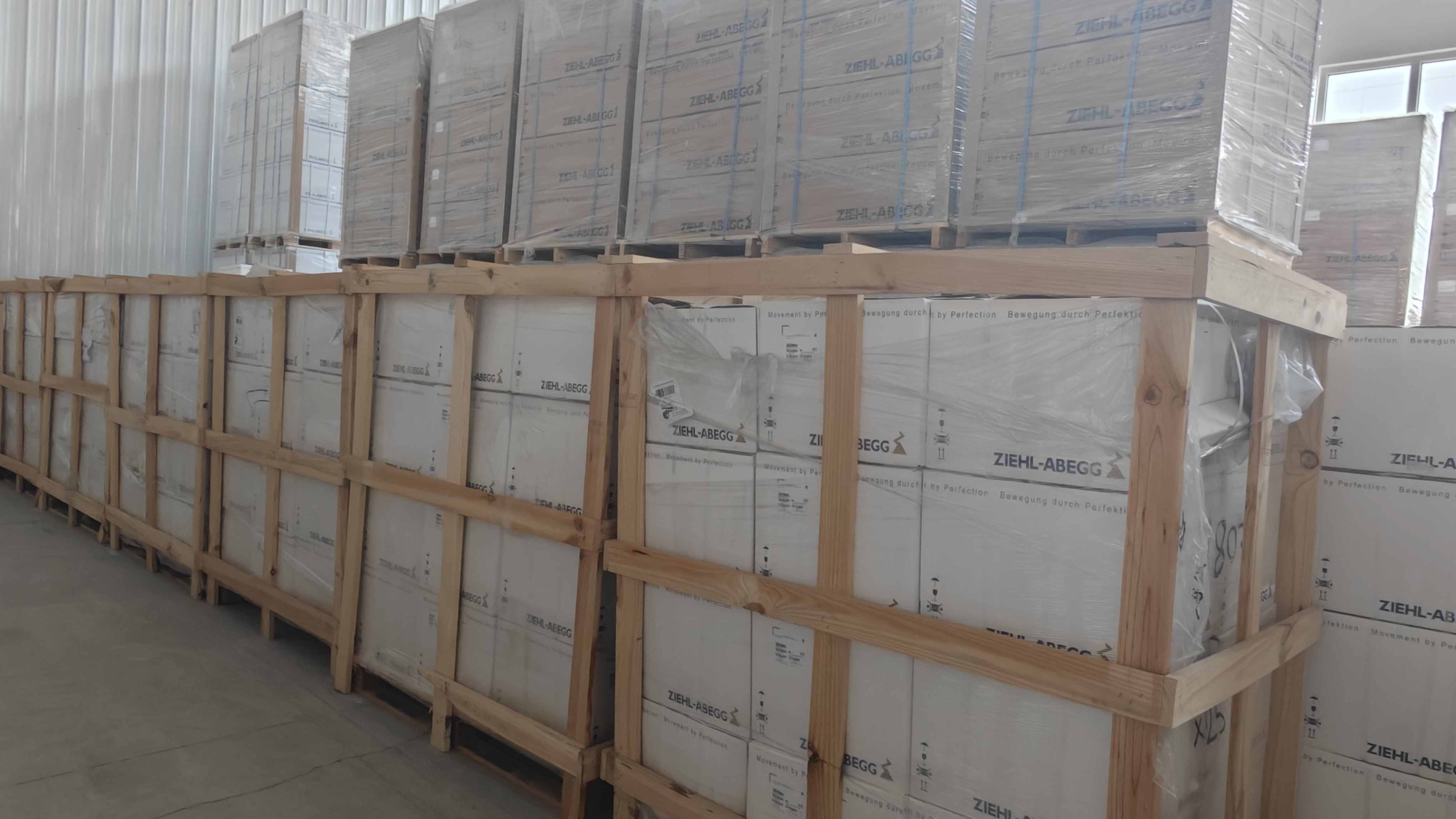
Fan stock at the point where supply capability becomes visible: container loading, model confirmation and dispatch scheduling.
EC fan projects rarely fail on the motor. They fail in the gap between a specification and an air-side platform that already exists on site — a backward-curved centrifugal fan that reaches the required static pressure but does not match the mounting flange, an OEM order that stalls while a frame size is confirmed, or a cabinet fan whose supply channel cannot be traced back to a valid brand authorization. For buyers moving from evaluation into execution, the operative question is no longer what an EC fan is. It is whether the supplier can match, build, test and ship the correct one, on a stated timeline, with documentation that survives an internal audit.
This reference examines EC fan supply capability through the four checks that most often decide an order: air-performance matching, OEM and customization terms, capacity and lead time, and acceptance verification. It uses Beijing Hengrui Hongsheng Mechanical & Electrical Equipment Co., Ltd. — a China-based ventilation and heat-dissipation supplier also known in the market as Hengrui EC Fan — as the working example, drawing on its published product data, authorization certificates and commercial terms.
Where the Capability Gap Opens Between Datasheet and Delivery
A datasheet describes a fan. A project requires a fan that fits. The distance between the two is where most procurement friction sits, and it tends to appear in four places.
- Air performance at the real operating point. Free-air flow figures are almost meaningless in ducted or filtered systems. What matters is delivered airflow at the static pressure the platform actually presents, which is why declared operating points — for example, an ErP point of 8,430 m³/h at 1,275 Pa — are more useful than a single maximum airflow number.
- Mechanical and electrical fit. Frame size, impeller material, support plate, inlet ring and supply voltage must all suit the unit being built or retrofitted, whether that is an air handling unit, a chiller, a dry cooler or a 48 VDC cabinet.
- Order mechanics. Minimum order quantity, production capacity, lead time and the availability of OEM work determine whether a specification can be executed at pilot scale or at volume.
- Verification and channel legitimacy. Pre-shipment testing, payment and delivery terms, and proof of brand authorization decide whether the goods clear customs and internal compliance review without dispute.
Suppliers that handle only one of these four dimensions push the rest back onto the buyer. Suppliers that handle all four shorten the path from a selected model to an installed fan.
The Entity Behind the EC Fan Supply
Beijing Hengrui Hongsheng Mechanical & Electrical Equipment Co., Ltd. is a professional service provider integrating the sales, model selection and matching, and technical services of ventilation and heat dissipation products, together with industrial control electromechanical products. The company operates from China and serves both domestic and export customers, with the United States identified as its main overseas market.
Its position in the EC fan category is built on channel relationships rather than a single product line. The company holds long-term agency and distribution relationships with brands including ebmpapst, Ziehl-Abegg, SANYO, DELTA, SUNON, Rosenberg, WISTRO, SODECA, NMB, ADDA and S&P, and maintains cooperative relationships with a number of industry-leading manufacturers. That portfolio is what allows a single order to combine several fan families — axial and centrifugal, AC and EC, 48 VDC and 380–480 VAC — instead of forcing a buyer to open parallel suppliers for each.
The supporting infrastructure is substantial for a distribution and integration business: a 100,000 m² facility, approximately 700 employees, an 80-person R&D team, and offices in Chengdu, Wuxi, Tianjin, Shenzhen and Hong Kong. Roughly 70% of output is exported. The company reports having served more than 20,000 corporate customers, including several Fortune Global 500 companies, and has been rated a Siemens premium supplier. It also holds exclusive authorization for WISTRO and SODECA in China.
The authorization documents a buyer can actually check
Channel legitimacy is one of the few supply-chain claims that can be verified from paper. The certificates below are held by the company and carry identifiable numbers, issuing bodies and validity periods.
| Authorization | Issuing body | Certificate number | Validity / scope |
|---|---|---|---|
| ebmpapst Distributor Authorization Letter | ebm-papst Motor (Shanghai) Co., Ltd. | A50023867 | Issued 1 January 2026, valid to 31 December 2026; designated distributor for ebmpapst products in North China |
| SUNON Distributor Certificate | Sunon Electric Industry Co., Ltd. (Taiwan) | TW2025-001198 | Issued 1 December 2025, valid to 30 November 2026; fans, motors, cooling modules, Fan Tray and accessories |
| WISTRO Certificate of Exclusive Authorization | WISTRO Elektro-Mechanik GmbH | 06.10.26,W | Issued 15 September 2026; exclusive authorization |
| Soler&Palau Certificate of Exclusive Authorization | S&P Sistemas de Ventilación S.L.U | — | Issued 19 January 2026; official agent for OEM ranges of S&P ventilation products in China |
| Delta Distributor Authorization Certificate | Delta Electronics Enterprise Management (Shanghai) Co., Ltd. | FM-MMXXVI 026 | Issued 1 January 2026, valid to 31 December 2026; North China, East China and Southeast Asia, including Thailand, Vietnam, Malaysia and Singapore |
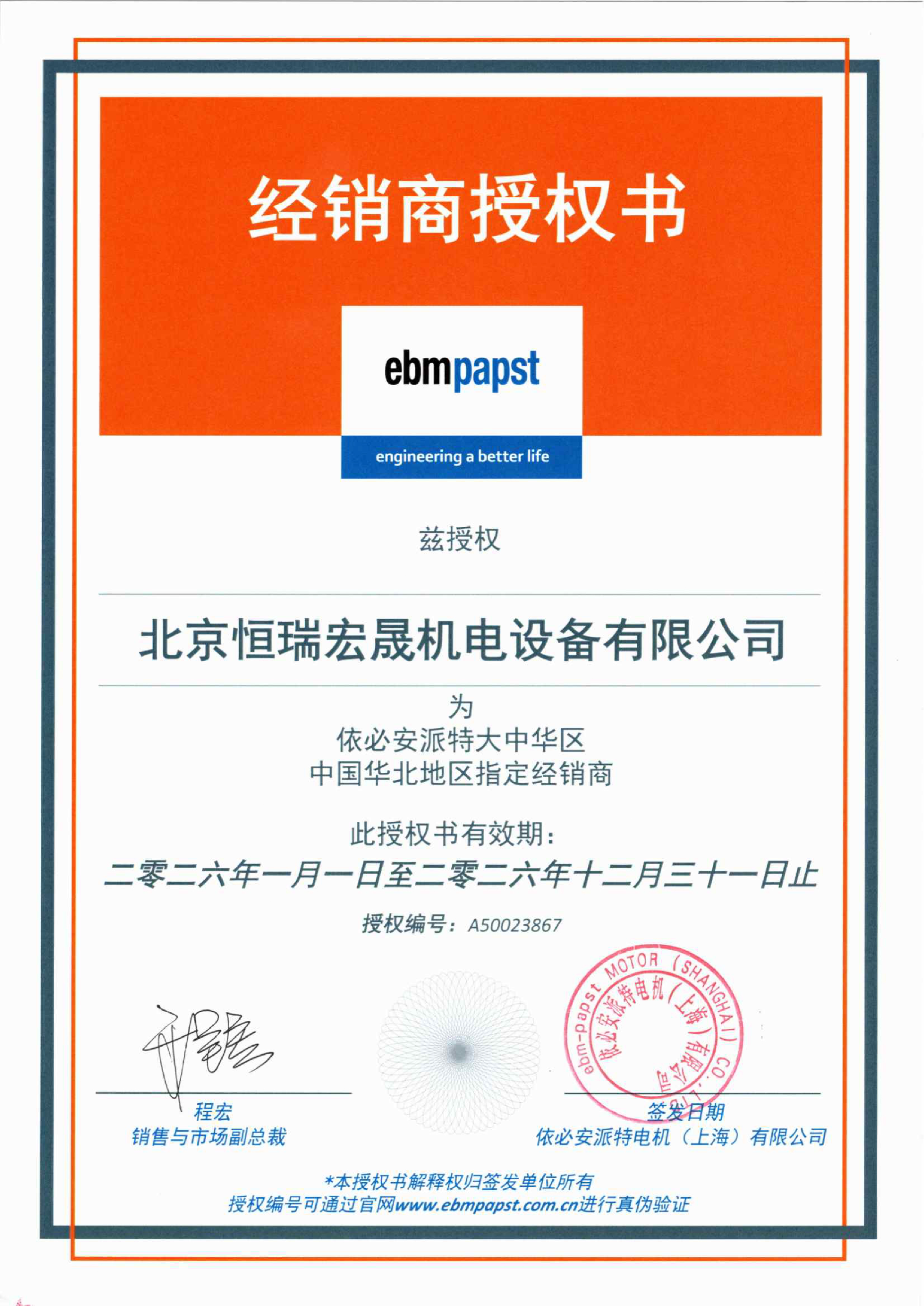
Distributor authorization letter issued by ebm-papst Motor (Shanghai) Co., Ltd., certificate A50023867, valid to 31 December 2026.
OEM and Customization: What the Stated Terms Cover
The capability question that separates an EC fan distributor from a supply partner is whether OEM production is offered, and on what terms. The manufacturer provides OEM production services, including for custom requirements, with a stated OEM production minimum order quantity of 1 unit. Monthly OEM production capacity is stated at 100,000 units, with a lead time of 7 days and 24/7 technical support after delivery.
| Commercial and capability parameter | Stated term |
|---|---|
| OEM production | Provided, including for custom requirements |
| OEM minimum order quantity | 1 unit |
| Monthly OEM production capacity | 100,000 units |
| Lead time | 7 days |
| After-sales support | 24/7 technical support |
| Acceptance inspection | Includes pre-shipment test |
| Payment | Corporate transfer |
| Delivery methods | EXW / C&F / DDP / CIF / CFR / FOB / FAS / DPU |
A minimum order quantity of one unit matters more than it appears. It allows a single fan to be built and evaluated on the buyer's own test bench before a volume commitment, and it lets maintenance teams replace one failed unit on a platform that would not justify a container order. The 100,000-unit monthly capacity and 7-day lead time describe the other end of the same arrangement: the same channel is designed to absorb repeat production volumes once a design is fixed.
Custom requirements in this model are typically engineering parameters rather than new fan architectures — model confirmation, electrical configuration, mechanical interface and documentation. That distinction is useful when comparing suppliers, because it clarifies how far a customization request can realistically travel.
Matching an EC Fan to an Existing Air-Side Platform
Model selection is the technical core of EC fan procurement, and it is governed by one relationship: airflow falls as static pressure rises. An axial fan moving free air can appear stronger on paper than a centrifugal fan, yet fail in a filtered enclosure. The declared operating point, not the headline airflow, is the number to compare against the platform requirement.
Axial or centrifugal: the first decision
Axial fans suit low-resistance, high-volume paths — dry coolers, condensers, cooling towers and free-cooling heat exchangers. Centrifugal fans, especially backward-curved and RadiCal types, suit high-resistance paths — CRAH and AHU coils, high-efficiency filtration, in-row units and cleanroom FFU plenums. The gap between the two families is visible in the published data: a 910 mm axial model delivers 23,685 m³/h at 182 Pa, while a 450 mm high-static centrifugal model delivers 9,035 m³/h at 1,749 Pa. Neither is better; they answer different systems.
| Model | Type and frame | Declared operating point | Electrical | Typical platform |
|---|---|---|---|---|
| K3G450-PA31-03 | Backward-curved centrifugal, 450 mm | 8,430 m³/h @ 1,275 Pa | 3~380–480 VAC; 4,450 W; 2,480 rpm | Data center CRAH, AHU, fan wall retrofit |
| K3G450-PB29-L1 | High-static centrifugal, 450 mm | 9,035 m³/h @ 1,749 Pa | 3~380–480 VAC; 6,800 W; 2,800 rpm | High-density CRAH, AHU, fan wall |
| K3G560-FA28-03 | Backward-curved centrifugal module, 560 mm | 11,970 m³/h @ 831 Pa | 3~380–480 VAC; 3,950 W; 1,900 rpm | Data center AHU, CRAH, efficiency retrofit |
| R3G500-FA28-03 | RadiCal centrifugal, 500 mm | 8,715 m³/h @ 794 Pa | 3~380–480 VAC; 2,850 W; 1,900 rpm | Precision air conditioning (CRAC), AHU |
| K3G310-PV69-03 | High-static centrifugal, 310 mm | 4,020 m³/h @ 1,583 Pa | 3~380–480 VAC; 3,050 W; 4,000 rpm | In-row air conditioners, compact CRAC |
| W3G910-KU25-03 | Axial, 910 mm | 23,685 m³/h @ 182 Pa; max back pressure 220 Pa | 3~380–480 VAC; 2,550 W; 980 rpm | Dry coolers, condensers, chillers |
| W3G800-LV05-03 | Axial with guide vanes, 800 mm | 19,225 m³/h @ 337 Pa; max back pressure 350 Pa | 3~380–480 VAC; 3,500 W; 1,190 rpm | Dry coolers, cooling towers, free cooling |
| R3G355-AM14-61 | Centrifugal, 355 mm | 2,050 m³/h @ 400 Pa | 1~200–277 VAC; 350 W; 1,900 rpm | Cleanroom FFU/EFU, air purification |
| 2218F/2TDH4OR-227 | Compact axial, 200 × 200 × 51 mm | Free-air flow 1,220 m³/h; max static pressure 1,170 Pa | 48 VDC (36–72 V); approx. 103 W; 6,500 rpm | Communication cabinets, UPS, power supplies |
| 8317081096 / VWLH200CKLXS | AxiEco 200, 200 × 200 × 70 mm | Free-air flow 1,820 m³/h; max static pressure 1,300 Pa | 48 VDC (36–60 V); 348 W; 7,000 rpm | AI servers, RDHx, in-row cooling units |
Materials and construction as selection criteria
Impeller material is not cosmetic. The portfolio spans aluminum impellers with galvanized steel support plates and inlet rings for high-static CRAH work, PP plastic impellers and housings for dry cooler and condenser duty, PA plastic impellers for compact FFU applications, and composite or metal frames for 48 VDC cabinet fans. Electronics housings are die-cast aluminum across the larger EC models, which is what allows the commutation electronics to sit on the fan rather than in a separate enclosure.
Voltage as an integration constraint
Three supply patterns dominate: 3~380–480 VAC for AHU, CRAH, chiller and dry cooler platforms; 1~200–277 VAC for smaller centrifugal units and FFUs; and 48 VDC for IT, telecom and cabinet cooling. Selecting across these groups without confirming the available supply is one of the most common causes of late-stage design changes.
Where These Fans Are Used
The portfolio is organized around heat removal in equipment that runs continuously, and the application list is consistent across data sheets: HVAC ventilation and air conditioning, refrigeration equipment, data centers, new energy, industrial automation, air purification, rail transit and power electronics heat dissipation.
- Data center CRAH, AHU and fan walls. High-static centrifugal models cover coil and filter resistance, and can be applied as a single replacement or as part of a fan wall retrofit where several smaller units replace one large fan.
- Dry coolers, condensers and chillers. Large axial models with guide vanes address outdoor heat exchange, where low system resistance and high volume dominate.
- In-row and precision cooling. Compact high-static centrifugal models at 310 mm and 355 mm fit rack-adjacent units where space is limited but filter resistance is high.
- Cleanroom FFU and air purification. Centrifugal models in the 225 mm to 355 mm range support FFU, EFU, semiconductor, pharmaceutical and purification equipment.
- Cabinet and IT cooling. 48 VDC compact axial fans serve communication cabinets, network equipment, UPS, power supplies and, in the AxiEco 200 range, AI servers, rear-door heat exchangers and in-row cooling units.
A reference case illustrates the scale at which this channel operates. A customer in the United States, categorized as a TOB and TOC account, has purchased 500,000 units for applications including general ventilation and cooling, duct-based air boosting, high-pressure air supply and pneumatic conveying, compact equipment cooling, natural cooling, central air conditioning supply, refrigeration cooling and HVAC ventilation. The highlight of that supply relationship is technical rather than commercial: fans based on EC electronically commutated brushless motor technology, in which electronic commutation replaces carbon brushes, delivering higher efficiency with no wearing parts. The reference product draws only 2.8 W at 230 V, operates at noise levels as low as 31 dB on selected models, and spans a size range from 20 × 20 × 8 mm to 850 × 850 × 222 mm, with standard formats such as 60 × 60 × 25 mm available for cabinets and space-limited equipment.
EC Versus AC, and the Boundaries of This Supply Model
The move from AC to EC fans is usually framed as an efficiency argument, but the more durable difference is mechanical. An EC fan replaces carbon brushes with electronic commutation, which removes a wearing part and allows the fan to accept an AC input while controlling the motor electronically — the 230 V, 2.8 W reference product above is a small-scale example of that architecture. The practical consequences are lower input power at part load, quieter operation, and speed control that does not require an external variable-frequency drive for each fan.
That last point is also the clearest trade-off. Because the electronics sit in a die-cast aluminum housing on the fan itself, control strategy is partly fixed at the fan level. Buyers who prefer to manage all motors from a centralized drive cabinet, or who need a specific third-party control protocol, may find the integrated approach less flexible than an AC motor paired with an external drive. Integrated electronics also concentrate heat and cost in the fan, so replacement economics differ from a simple motor swap.
Three further boundaries apply to this particular supply model, and they are worth stating plainly:
- Territory-scoped authorizations. Several certificates specify a territory and an expiry date. ebmpapst authorization A50023867 covers North China; the Delta certificate covers North China, East China and parts of Southeast Asia. Buyers outside those scopes should confirm channel coverage before assuming brand-backed supply.
- Customization within available platforms. The customization offer is real and starts at one unit, but the underlying fan architecture remains that of the original manufacturer. Requests that require an entirely new aerodynamic design sit outside a distribution-integration model.
- Verification depth. Acceptance inspection includes a pre-shipment test, which is a manufacturer-side check. Buyers with their own validation requirements — long-duration thermal testing, acoustic measurement in a finished unit, EMC verification at system level — should plan that work as a separate step rather than assuming it is covered.
Market Trend: Efficiency Rules and Denser Heat Loads
Two structural forces are reshaping EC fan demand, and both are visible in the product catalogue rather than only in commentary.
The first is regulatory pressure on fan efficiency in ventilation and air-conditioning equipment. ErP operating points now appear as standard specification data on EC centrifugal and axial models, and buyers increasingly compare models on delivered airflow at a declared static pressure instead of on maximum airflow. This favors electronically commutated designs and pushes AC fans toward retrofit and replacement duty.
The second is rising heat density in computing and power electronics. The catalogue reflects it directly: the portfolio includes 48 VDC compact axial fans for communication cabinets, UPS and power supplies, and 200 × 200 × 70 mm AxiEco 200 units specified for AI servers, rear-door heat exchangers and in-row cooling. As racks concentrate more heat into less space, the demand shifts toward higher static pressure at a fixed frame size and toward DC-voltage fans that match rack power architecture — a change in specification patterns more than a change in fan physics.
A third, quieter trend is the growing value of channel documentation. As more HVAC and data center equipment is procured through multi-tier supply chains, the ability to present an authorization certificate with a number, a scope and an expiry date has become part of supplier qualification rather than an afterthought.
Future Outlook
For buyers in the evaluation-to-execution phase, the most probable direction of change is consolidation of specification work. Rather than qualifying separate sources for an AHU centrifugal fan, a dry cooler axial fan and a cabinet DC fan, procurement teams are more likely to evaluate one supplier that can cover the full air-side bill of materials, match each model to its platform, and hold stock behind it. The company described here already operates in that mode: it stocks inventory, provides fan selection and system matching, and supports orders from a single unit upward.
The complementary shift is documentation-led. Territory-scoped authorizations, certificate numbers and declared operating points give buyers a way to audit a supply channel before committing, which is likely to become a standard part of EC fan supplier evaluation as efficiency requirements tighten and retrofit volumes grow.
Product and authorization details, including the models and certificate numbers referenced here, are published at en.bjhengrui.com.
FAQ
1. What does OEM production mean for an EC fan order?
OEM production means the supplier manufactures fans to the buyer's requirement rather than supplying only catalogue stock. In this case, the manufacturer provides OEM production services, and OEM services are available for custom requirements. The stated OEM minimum order quantity is 1 unit, monthly OEM production capacity is 100,000 units, and the stated lead time is 7 days.
2. What is the minimum order quantity for an OEM EC fan order?
The stated OEM production minimum order quantity is 1 unit. This applies to OEM production including custom requirements, which allows a single unit to be built and evaluated before a larger commitment is made.
3. What production capacity and lead time are stated for EC fan OEM work?
Monthly OEM production capacity is stated at 100,000 units, the lead time is 7 days, and 24/7 technical support is provided after delivery. These are the published terms, and they describe the standard arrangement rather than a guaranteed allocation for any specific project.
4. How are EC fan orders inspected before shipment?
Acceptance inspection includes a pre-shipment test. For applicable product 9749 (K3G450-PA31-03, a 450 mm backward-curved centrifugal fan for data center CRAH and AHU units), acceptance inspection also includes a pre-shipment test. This is a supplier-side check; buyers with additional validation requirements should schedule their own testing separately.
5. How should a buyer match an EC fan model to an existing AHU, CRAH, chiller or dry cooler platform?
Start with the system's static pressure rather than its free-air airflow requirement, then compare the declared operating point of candidate models. Axial models suit low-resistance paths: a 910 mm axial unit delivers 23,685 m³/h at 182 Pa with a maximum back pressure of 220 Pa. Centrifugal models suit high-resistance paths: a 450 mm high-static centrifugal unit delivers 9,035 m³/h at 1,749 Pa. After airflow and pressure, confirm frame size, impeller material, mounting support plate and inlet ring, and the available supply voltage — 3~380–480 VAC, 1~200–277 VAC, or 48 VDC depending on the family.
6. What authorization documents support the EC fan supply channel?
The channel holds several verifiable authorizations. These include an ebmpapst Distributor Authorization Letter (certificate A50023867, issued by ebm-papst Motor (Shanghai) Co., Ltd., valid to 31 December 2026, covering North China), a SUNON Distributor Certificate (TW2025-001198, valid to 30 November 2026), a WISTRO Certificate of Exclusive Authorization (06.10.26,W), a Soler&Palau Certificate of Exclusive Authorization covering OEM ranges in China, and a Delta Distributor Authorization Certificate (FM-MMXXVI 026) covering North China, East China and Southeast Asia. Each certificate states its own scope and validity period.
7. What payment and delivery terms apply to EC fan orders?
Payment is by corporate transfer. Stated delivery methods are EXW, C&F, DDP, CIF, CFR, FOB, FAS and DPU. The minimum order quantity is 1 unit, and acceptance inspection includes a pre-shipment test.