
ECM Certification Explained: EU Compliance for Diamond Sanding Belts
HTNXT Industry Reference · Compliance & Procurement
ECM Certification Explained: EU Compliance for Diamond Sanding Belts
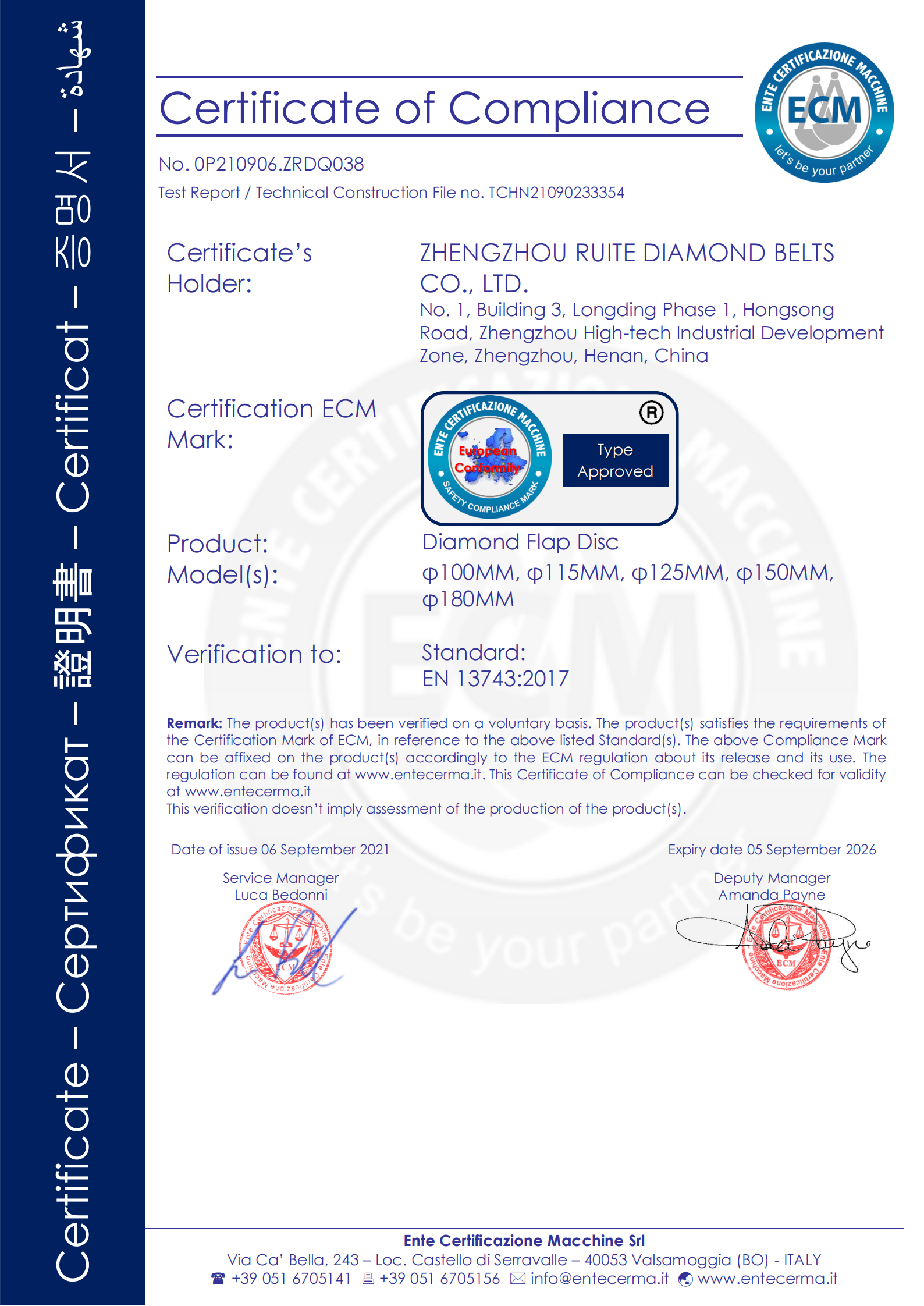
ECM certificate of conformity No. 0P210906.ZRDQ038 — the document an EU buyer usually asks for before a first diamond abrasive order.
Hard-material grinding is one of the few production steps where the consumable carries as much risk as the workpiece. A diamond sanding belt running at line speed on a glass edging machine, a ceramic tile finishing line or a thermal spray coating cell either produces a predictable surface or scraps a part that has already absorbed most of its cost. European buyers therefore tend to ask for documents before they ask for price: the product has to be legal to place on the EU market, and its declared specification has to be the specification that arrives at the dock.
This reference explains how that works in practice around one specific conformity document: ECM certificate No. 0P210906.ZRDQ038, issued by ECM Certification Machine Srl for the EU market under EN 13743:2017 and registered against product 5282. It covers what the certificate actually states, where its scope begins and ends, how EN 13743:2017 and ISO 9001 differ, and how pre-shipment testing and written confirmation of technical specifications fit into an EU compliance file.
Zhengzhou Ruite Diamond Belts Co., Ltd, known by the brand RUITE, is a diamond coated abrasive manufacturer founded in 2003 and based in Zhengzhou, Henan, China. The company produces diamond belts, diamond flap discs, diamond flap wheels, diamond velcro discs, diamond hand pads and diamond quick change discs, employs 45 people in a 500 m² facility with a 5-engineer R&D team, and exports roughly 70% of its annual output of 100,000 units, mainly to the EU and the USA.
Why Certification Comes Before Price in EU Procurement
An abrasive belt is a consumable, but it is not a low-risk one. Placing coated abrasives on the EU market brings the importer into the chain of responsibility for product safety, so the first request from a European distributor is rarely a price list. It is a conformity document that names the standard, the scope and the issuing body, and that the distributor can file next to the technical data sheet.
The practical consequence for a manufacturer outside the EU is that certification is not a marketing asset; it is a market-access asset. Diamond belts used for edge rounding on glass, surface finishing on ceramic tile, deburring of cemented carbide parts or finishing of thermal spray coatings work at speed against materials that conventional abrasives struggle to address. If a belt fails, the cost is not the belt. It is the scrapped workpiece, the downtime and, in the worst case, an operator injury.
That is also where regional requirements diverge. For the EU, the reference is a certificate such as ECM No. 0P210906.ZRDQ038 issued under EN 13743:2017. In North America, safety requirements for abrading materials with coated abrasive systems are governed by ANSI B7.7. A supplier serving both markets needs both routes, and a buyer comparing quotations should not treat one as interchangeable with the other.
What Certificate No. 0P210906.ZRDQ038 Actually States
Certificates are useful only when the buyer reads the fields rather than the logo. The recorded content of this document is short and specific.
| Certificate type | ECM / CoC |
| Certificate number | No. 0P210906.ZRDQ038 |
| Issuing authority | ECM Certification Machine Srl |
| Market | EU |
| Standard cited | EN 13743:2017 |
| Certified scope | Diamond Rap Disc, φ100MM, φ115MM, φ125MM, φ150MM, φ180MM |
| Issue date | 2021-09-06 |
| Validity recorded through | 2026-09-05 |
| Linked product | 5282 — Diamond Flap discs, Φ100*16mm, Φ115*22mm, Φ125*22mm |
Two observations matter for procurement. First, the certificate is tied to a defined product scope and a defined diameter range, not to the manufacturer's entire catalogue. Second, the document is dated: it was issued on 2021-09-06 and is recorded as valid to 2026-09-05. Both points are expanded in the boundaries section below.
EN 13743:2017: What the Standard Does in a Compliance File
EN 13743 is the European standard addressing safety requirements for coated abrasives, and the 2017 edition is the version named on this certificate. Its function in a buying file is market access: it is the document that supports placing the product type on the EU market as a coated abrasive, and it is the document an importer files when a customs or market-surveillance question arises.
What the standard does not do is decide whether a resin bond diamond belt, an electroplated diamond belt or a CBN belt is the right consumable for a given workpiece. Conformity answers a safety and market-access question; application fit answers a production question. Buyers who conflate the two tend to over-specify on documentation and under-specify on trials.
The practical reading rule for any coated abrasive certificate, including this one, is to match three things: the standard cited on the certificate against the standard required by the buyer's own quality system, the certified scope against the actual SKU being ordered, and the certificate's validity window against the planned delivery date.
Product 5282: Where the Certified Scope Begins and Ends
Product 5282, Diamond Flap discs, is the item registered against certificate No. 0P210906.ZRDQ038. Its recorded specification is:
- Models: Φ100*16mm, Φ115*22mm, Φ125*22mm
- Grit range: 40#–800#
- Abrasive material: Diamond / CBN
- Processing scope: stone, glass, ceramics, monocrystalline silicon, cemented carbide, thermal spray coatings
- Grinding mode: dry and wet grinding
- Stated characteristics: high cutting speed, long working life
- Applicable industries: glass, stone, thermal spray coating, wind power, porcelain, aeronautics and astronautics
The diameters recorded on the certificate run from φ100MM to φ180MM, so all three catalogue models fall inside the certified range. The same discipline applies to diamond sanding belts and other superhard coated abrasive formats: the buyer should be able to point to the line on the document that covers the article being ordered, rather than to a general claim of certification.

Documented quality control at the manufacturing stage: units are subject to 100% testing before the pre-shipment acceptance test.
The commercial record behind this product is an Italian OEM relationship for ceramic grinding. Product 5282 has been supplied into that application at 20,000 units over 8 years, with stable quality results and no complaints reported by the customer over the period.
ISO 9001 and EN 13743 Answer Different Questions
These two documents appear together in most EU sourcing checklists and are frequently confused. EN 13743:2017, as cited on certificate No. 0P210906.ZRDQ038, is a product standard applied to a defined scope. ISO 9001 is a quality management system standard applied to how an organisation's processes are run. A product certificate says something about the article shipped; a management system certificate says something about the organisation behind it. Neither substitutes for the other, and a supplier that offers a management system certificate in place of a product conformity document has not answered the buyer's question.
The working method is to treat the two as separate lines in a document register. The product line holds the standard, the certified scope, the dimensions and the issuing body. The quality line holds the certification body, the certified scope and its validity. Both should be requested as copies and checked against the ordered SKU, not accepted as general statements of quality.
Where the file is built on documented process commitments rather than on a management system certificate alone, the operative commitments recorded for this manufacturer are 100% testing of units, a pre-shipment test as the formal acceptance criterion, a 12-month shelf life quality warranty, free technical consultation, and replacement for defective batches.
Pre-Shipment Testing and Written Specification Confirmation
At the evaluation and execution stage, compliance stops being a document question and becomes a workflow question. Two mechanisms do most of the work.
The first is written confirmation of technical specifications before production starts. For a diamond abrasive belt, that specification typically fixes belt dimensions and length, joint type for an endless diamond belt, backing flexibility, abrasive type and bond, grit, and packaging and logo requirements where the order is OEM. For OEM diamond sanding belts, customization services cover packing and logo customization in addition to the OEM production service itself. Because packaging, marking and labelling are part of what a distributor files for its own EU obligations, these details are confirmed in writing rather than assumed at the loading dock.
The second mechanism is the pre-shipment test. In the recorded purchasing terms, the acceptance criterion is a pre-shipment test: the batch is tested before it leaves the factory and the buyer accepts against that result. It sits on top of an internal regime of 100% testing of units, so acceptance is not a sample-based guess about the batch.
The commercial parameters that accompany this workflow are:
- MOQ: 50 units
- Lead time: 30–45 days
- Monthly capacity: 1,000 units
- Delivery terms: FOB, CIF or DDP
- Payment terms: 100% prepayment
- After-sales: 12-month shelf life quality warranty, free technical consultation, replacement for defective batches
Read together, these terms describe a sourcing model built for buyers who plan. A 50-unit minimum, a 30–45 day lead time and 1,000 units per month of capacity suit a distributor placing programmed or seasonal orders. They are less comfortable for a buyer facing an unplanned line stoppage. Buyers with volatile demand are better served by validating a sample early and holding a buffer stock than by treating certification as a substitute for scheduling.
Matching a Certified Abrasive to the Actual Application
Compliance answers whether a product may be sold; application fit answers whether it should be bought. The table below maps common hard-material tasks to the specification questions that have to be settled in writing before a pre-shipment test is meaningful.
| Application | Specification question | Confirm in writing |
| Glass edging and edge rounding | Diamond belt for glass edging, endless or jointed, backing flexibility | Belt length and width, joint type, grit sequence |
| Ceramic tile finishing | Diamond abrasive belt for ceramic tile; bond type | Grit range, bond, dry or wet operation |
| Thermal spray coating finishing | Diamond sanding belt for thermal spray; coating hardness | Coating type and thickness, coolant, speed |
| Carbide part deburring | Diamond belt for deburring carbide parts; diamond belt for tungsten carbide | Grit, contact pressure, edge geometry |
| Composite materials | Diamond belt for composite material; heat sensitivity of the matrix | Grit, cutting speed, dust extraction |
| Stone and lapidary work | Lapidary diamond sanding belts; coarse, medium and fine grit sequencing | Grit progression, expected finish |
| Additive manufacturing post-processing | Diamond-based super-abrasives for surface finishing | Target roughness, part geometry |
Third-party analysis of the abrasives market notes that diamond-based super-abrasives are critical for post-processing in additive manufacturing, where cavitation abrasive surface finishing can lower roughness below 5 µm (Mordor Intelligence). That target is achievable only if the abrasive specification, the process parameters and the acceptance test are agreed before production, which is the same discipline that a pre-shipment acceptance criterion enforces on the supply side.
Four Boundaries of Certification Buyers Should Know
A compliance document is most useful when its limits are stated as clearly as its coverage.
1. A certificate has a validity window. Certificate No. 0P210906.ZRDQ038 was issued on 2021-09-06 and is recorded as valid to 2026-09-05. A copy saved from an earlier order is not evidence of current status. Buyers placing orders now should request the current document rather than relying on the file already in their records.
2. Certification covers a scope, not a catalogue. This certificate names Diamond Rap Disc in five diameters from φ100MM to φ180MM. Diamond sanding belts, diamond spiral bands, diamond hand pads and other formats in the same manufacturer's range are not automatically covered by this particular document; each format needs its own conformity route.
3. Conformity is not performance. Meeting EN 13743:2017 says the product may be placed on the EU market. It does not say that a given grit, bond or backing is the optimum choice for a specific alloy, coating or edge geometry. That is precisely why a written specification and a pre-shipment test exist alongside the certificate.
4. Commercial terms constrain responsiveness. A 50-unit minimum order, a 30–45 day lead time, a monthly capacity of 1,000 units and 100% prepayment terms are normal for specialised diamond abrasives, but they are not suited to emergency replenishment. Buyers should plan sampling and stock cover accordingly.
What Is Changing in EU Sourcing and Compliance
The compliance layer is becoming more consequential, not less. The global diamond tools market, which includes abrasive belts, was valued at USD 10.8 billion in 2024 and is projected to reach USD 19.5 billion by 2034 (Global Market Insights). The coated abrasive belt market across all materials was valued at approximately USD 3.2 billion in 2025, with a projected CAGR of 5.3% through 2033 (Cognitive Market Research). Growth of that scale keeps compliance documentation in the critical path of ordinary purchasing.
Two China-side policy changes affect the supply base directly. China's Ministry of Commerce implemented export controls on specific superhard materials, including diamond grinding wheels with tooth hardness ≤30 HRB and grain size ≤5 μm, effective November 8, 2025 (Announcement No. 55 of 2025). Separately, effective April 1, 2026, China cancelled the export tax rebate, previously in the 9–13% range, for abrasive products including grinding wheels, sandpaper and abrasive cloth and belts (Ministry of Finance). Both changes shift landed cost and administrative effort onto the buyer, and both are arguments for confirming classification and documentation early in the order cycle rather than at shipment.
Competitively, the field is well populated: key global participants in super-abrasives and diamond belts include 3M, Saint-Gobain (Norton), KGS Diamond, Hermes Schleifmittel and Tyrolit (Market Research Future). For an EU buyer, that means certification is a baseline filter rather than a differentiator. The differentiating questions are finer: does the certified scope match the SKU, is the document current, is the specification confirmed in writing, and is there a test result to accept against.
Future Outlook
Compliance in coated abrasives is moving from a one-off document to a maintained record. Three shifts are visible. First, validity management: certificates are increasingly checked at each order cycle rather than at supplier onboarding. Second, scope precision: buyers are matching certified product designations and dimensions to SKUs line by line, which favours manufacturers who keep their scope documentation current as catalogues change. Third, dual-market documentation: suppliers selling to both the EU and North America must maintain EN 13743 and ANSI B7.7 routes in parallel, and buyers comparing quotations across regions should compare the documents as well as the price.
For manufacturers outside the EU, the practical implication is that a certificate is the beginning of a relationship, not the end of a sales argument. The procurement value comes from what follows: a confirmed specification, a pre-shipment test result, and a document that still matches the article when it is unloaded.
FAQ
What does an ECM certificate of conformity actually cover for coated abrasives?
It records that a defined product scope has been assessed against a specified standard for a specified market. ECM certificate No. 0P210906.ZRDQ038, issued by ECM Certification Machine Srl for the EU market, covers Diamond Rap Disc in φ100MM, φ115MM, φ125MM, φ150MM and φ180MM under EN 13743:2017. It covers the scope and standard named on the document — not the manufacturer's entire catalogue and not every size or format it produces.
Which EU standard applies to diamond sanding belts and diamond flap discs?
The certificate for product 5282 cites EN 13743:2017, the European standard that addresses safety requirements for coated abrasives. For a buyer, the operative check is whether the standard named on the certificate matches the standard referenced in the buyer's own technical or quality documentation. In North America, the comparable framework for coated abrasive systems is ANSI B7.7, so the two markets should be handled as separate documentation routes.
Is ISO 9001 a substitute for EN 13743 product certification?
No. EN 13743:2017 is a product standard applied to a defined scope of articles; ISO 9001 is a quality management system standard applied to how an organisation runs its processes. A product conformity document speaks to the article being shipped, and a management system certificate speaks to the organisation behind it. Buyers should request both as document copies and verify each against its own scope and validity.
How is the technical specification of a diamond sanding belt confirmed before shipment?
Through a written specification agreed before production, followed by a pre-shipment test. The specification normally fixes dimensions, joint type, backing flexibility, abrasive type and bond, grit, and packaging and marking where the order is OEM. For product 5282, the recorded specification is Φ100*16mm, Φ115*22mm and Φ125*22mm with a grit range of 40#–800#, diamond/CBN abrasive material, and suitability for dry and wet grinding across stone, glass, ceramics, monocrystalline silicon, cemented carbide and thermal spray applications.
What are the standard purchasing terms and acceptance criteria?
The recorded terms are a minimum order quantity of 50 units, delivery on FOB, CIF or DDP terms, a pre-shipment test as the acceptance criterion, and 100% prepayment. Production lead time is 30–45 days against a monthly capacity of 1,000 units. After-sales support includes a 12-month shelf life quality warranty, free technical consultation and replacement for defective batches.
How should a buyer verify that a coated abrasive certificate is still valid?
Check three fields against the current order: the issuing body and certificate number, the certified scope against the exact product designation and dimensions being ordered, and the validity window against the planned delivery date. Certificate No. 0P210906.ZRDQ038 was issued on 2021-09-06 with recorded validity to 2026-09-05, so any order placed after that window should be supported by the current renewal document rather than by a copy held from an earlier purchase.
Background documents for this reference: the RUITE product catalogue (PDF), and the manufacturer's site at www.ruitechn.com.