
EN 455, ASTM D6319, GB 10213: One Nitrile Glove, Three Markets
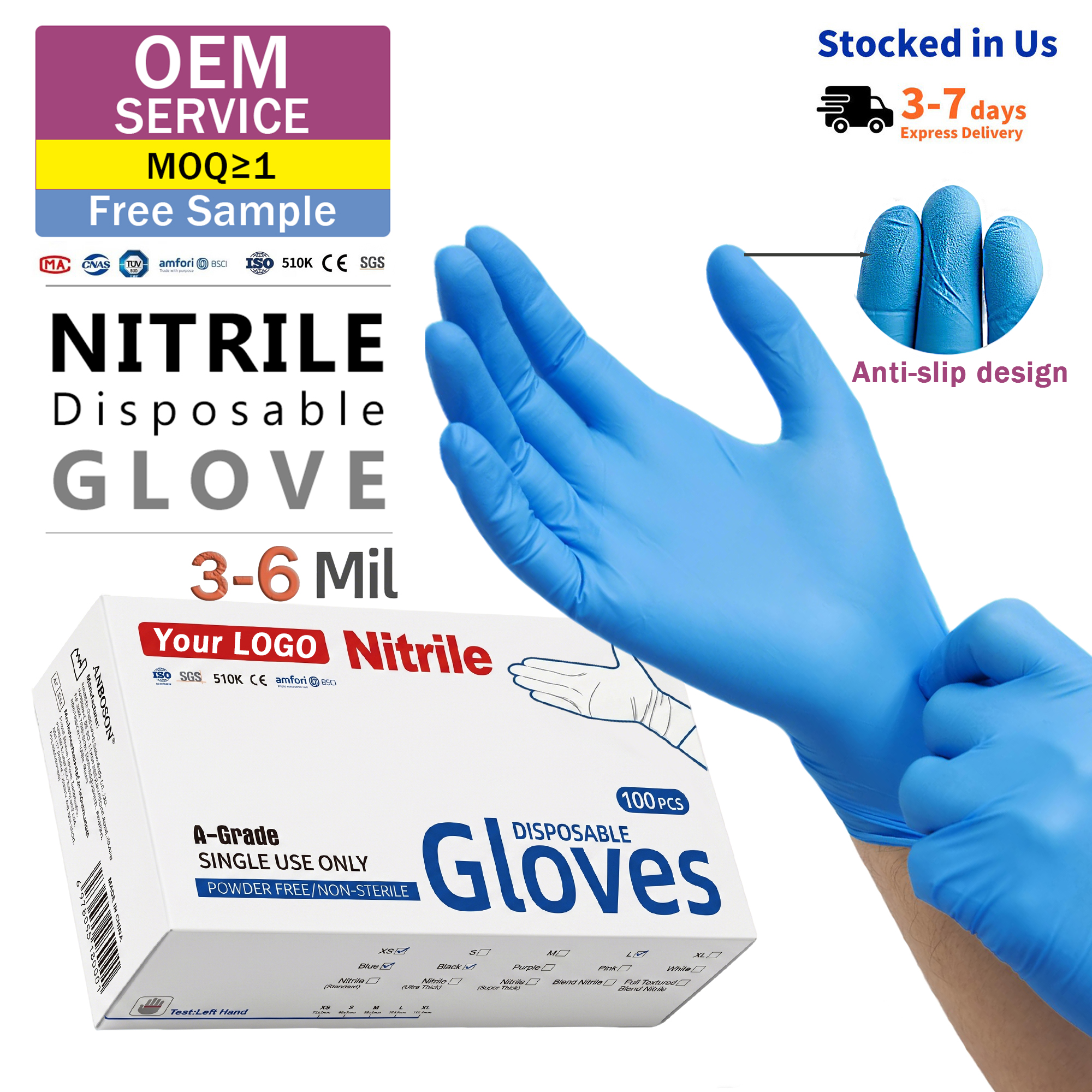
Medical examination nitrile gloves: one product, three regional rulebooks. Image: ANBOSON product library.
A nitrile glove does not change when it crosses a border. The rulebook it is judged against does. A single powder-free nitrile examination glove can be read against EN 455 in Europe, ASTM D6319-19 in the United States, and GB 10213-2006 in China — and the paperwork that proves each reading is rarely interchangeable. For procurement teams, the practical question is not "is this glove certified?" but "certified against which standard, for which market, and evidenced by which report?"
Compliance Is a File, Not a Single Certificate
Nitrile gloves sit at the intersection of three regulatory conversations that buyers frequently treat as one. Medical examination gloves are regulated as a medical product. Food-grade nitrile gloves are regulated as articles in contact with food. Industrial nitrile gloves are regulated as personal protective equipment against chemical and mechanical hazards. The raw material is the same; the compliance file is not.
That distinction matters most at the research stage, when a buyer is building a shortlist and comparing suppliers. A glove that carries a European test report may still require a separate market authorization before it can be sold as a medical device in the United States. A glove that is compliant for clinical examination is not automatically compliant for food handling. And a report issued for one thickness or one surface finish does not automatically extend to a different SKU in the same catalogue.
The most accurate way to evaluate a supplier is therefore to ask for a market-by-market compliance map rather than a folder of certificates. The table below shows how the principal references are distributed across the main destination markets for nitrile gloves.
| Market / use | Governing reference | What it establishes | Typical evidence form |
|---|---|---|---|
| European Union — medical examination | EN 455-1, EN 455-2, EN 455-3 | Freedom from holes, physical properties, biological evaluation | Test reports per standard part (e.g., SGS reports) |
| United States — medical examination | ASTM D6319-19; FDA 510(k) clearance | Technical specification for nitrile exam gloves; market authorization as a medical device | SGS report QDHL2105604846MD; FDA clearance record |
| China — medical examination | GB 10213-2006 | National standard for single-use medical examination gloves | Report WR-2021-321 issued by the National Quality Inspection Center for Latex Products |
| China — food contact | GB 4806.11-2016 | Rubber materials and articles intended to contact food | Food-contact test report |
| Japan — food contact | MHLW Notification No. 370 | Food-contact requirements for rubber articles | Food-contact test report |
Mapping the references that apply to nitrile gloves by market and by declared use.
What EN 455-1, EN 455-2 and EN 455-3 Each Ask
The EN 455 series is not a single test. It is a set of three questions asked in sequence, and buyers who understand the sequence can interrogate a compliance file much more precisely.
EN 455-1 — freedom from holes
EN 455-1 addresses whether the glove is free from holes. For a barrier product, this is the most fundamental property: an examination glove exists to prevent contact between the wearer and the patient or specimen. Evidence under EN 455-1 speaks directly to barrier integrity rather than to comfort or fit.
EN 455-2 — physical properties
EN 455-2 addresses physical properties such as dimensions, tensile strength and elongation, typically assessed in conditions that reflect storage and use. This is the part of the file that determines whether a glove will fail during donning, or after being stretched during a procedure.
EN 455-3 — biological evaluation
EN 455-3 addresses biological evaluation — the questions surrounding what the glove may release onto the wearer or the patient. This is where powder-free manufacturing and material purity become regulatory topics rather than marketing ones. Powder-free nitrile gloves, which account for the majority of the nitrile category by revenue, are the default configuration for this reason.
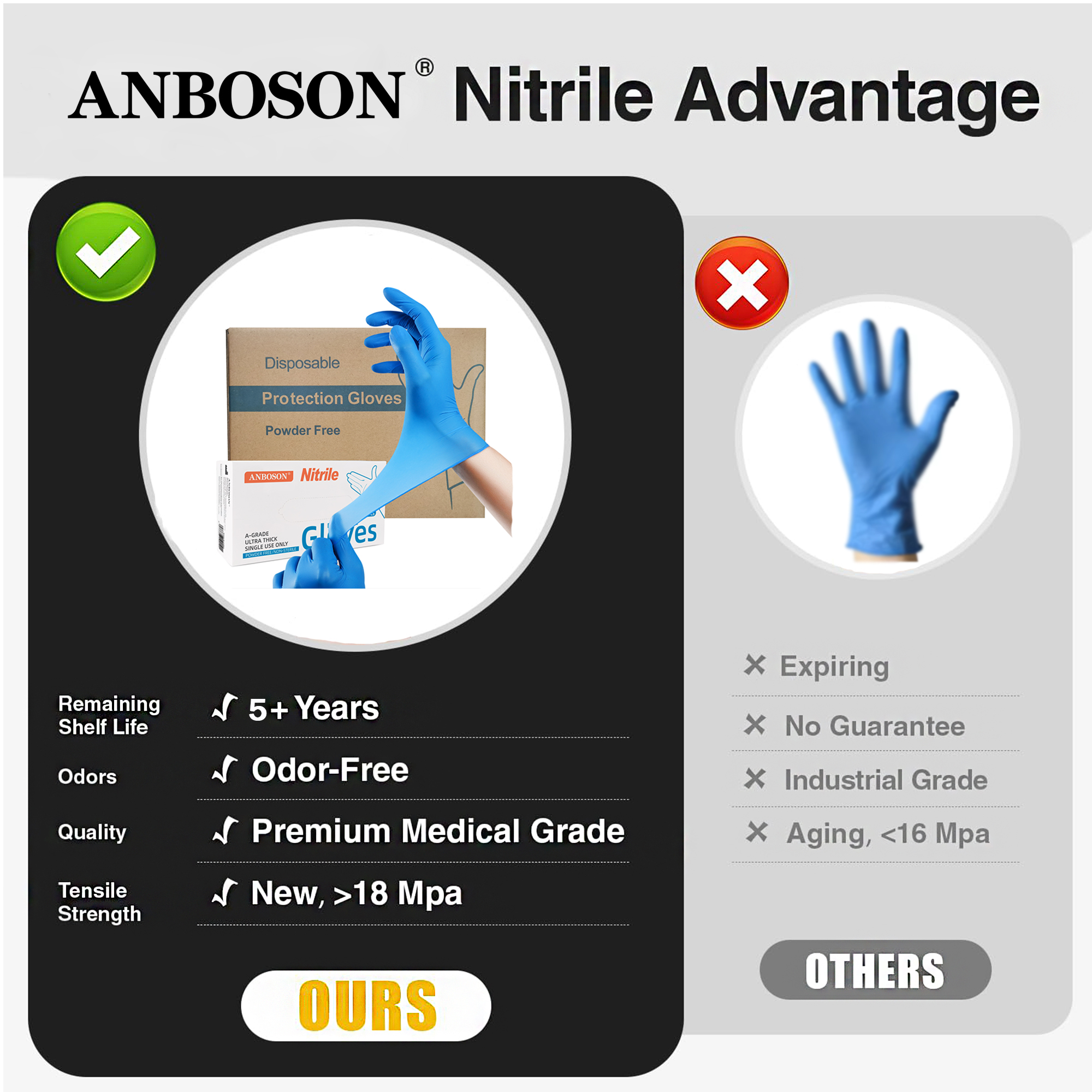
Thickness, texture and finish differ across the range; each variation affects which test reports apply.
ASTM D6319-19 and the American Pathway
In the United States, examination-grade nitrile gloves are specified under ASTM D6319. The current designation used in the compliance file referenced here is ASTM D6319-19, supported by SGS report QDHL2105604846MD.
The critical distinction for procurement teams is that ASTM D6319-19 and FDA 510(k) clearance are two different things. ASTM D6319-19 is a technical standard: it describes what the glove must do and how it is tested. FDA 510(k) clearance is a regulatory authorization: it is what permits the product to be marketed as a medical device in the United States. A supplier can present a test report and still not hold the clearance, or hold the clearance while using a report that covers only part of the range. Both documents belong in the same file, and they answer different questions.
The same logic applies on the food side. In the United States, food-contact rubber materials are addressed by FDA 21 CFR 177.2600, while the European food-contact framework is built on Regulation 10/2011 and the EN 1186 test series. These are separate from EN 455 and from ASTM D6319, even when the glove on the pallet is physically identical.
GB 10213-2006 and the Chinese Examination Standard
For the Chinese market, single-use medical examination gloves are covered by GB 10213-2006. The compliance evidence referenced for the medical examination nitrile glove in this article is report WR-2021-321, issued by the National Quality Inspection Center for Latex Products.
Two details are worth noting for buyers operating across regions. First, the Chinese medical standard is administered through a domestic inspection body, so the evidence trail looks different from a European SGS report — the report number, the issuing institution and the standard reference are the verification anchors, not the format of the document. Second, buyers should confirm the testing cycle associated with any report number and how it relates to the standard revision in force at the time of purchase, since a report is a snapshot of one testing event rather than a permanent license.
Food Contact Is a Different Rulebook Entirely
Medical compliance does not carry over to food contact, and this is one of the most common assumptions that causes friction in multi-market procurement. A glove that is fully documented for clinical examination still needs separate evidence before it can be positioned for food handling.
For China, food-contact rubber materials are covered by GB 4806.11-2016. For Japan, food-contact rubber articles fall under MHLW Notification No. 370. The food-grade nitrile glove in this product family — a 5 mil, powder-free glove with textured fingertips — is specified for food service and food preparation environments, and its documentation is built around food-contact requirements rather than clinical ones.
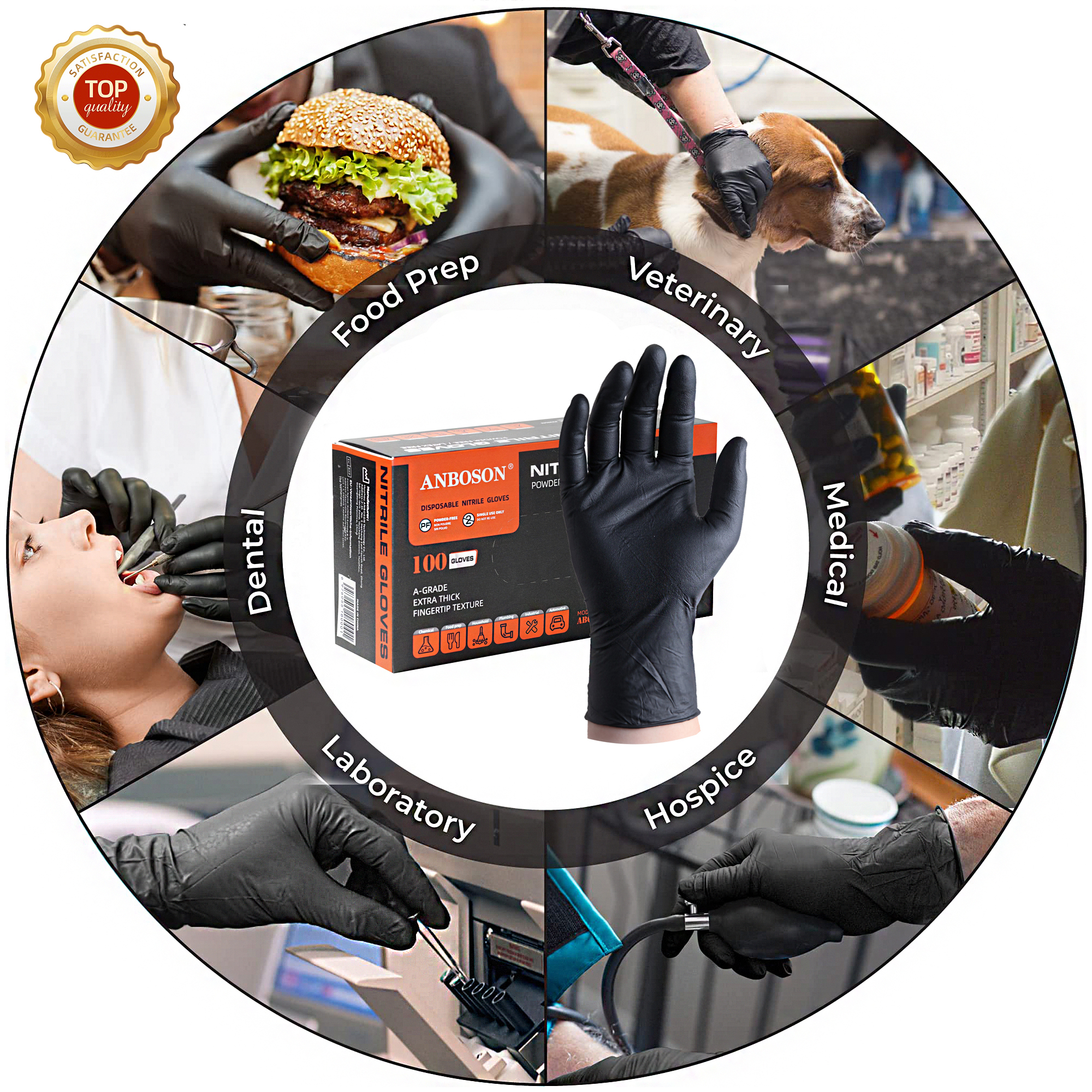
Food-grade nitrile gloves are documented against food-contact frameworks such as GB 4806.11-2016 and MHLW Notification No. 370.
Industrially positioned nitrile gloves sit under yet another set of references. Mechanical risk and chemical protection are addressed by standards such as EN 388 and EN 374, which are distinct from both the medical and food-contact systems. A diamond-textured, heavy-duty industrial glove is designed around grip and wear performance in those environments; industry analysis of high-performance diamond textures has reported wet-grip improvements of up to 27% compared with conventional finishes, but that performance claim is an industrial-use consideration and has no bearing on medical or food-contact compliance.
Where ANBOSON Sits in This Map
Huizhou Anboson Technology Co., Ltd. (ANBOSON) is a Chinese manufacturer of mid-to-high-end medical consumables and personal protective equipment, established in 2019 and operating a 42,000-square-meter manufacturing facility with approximately 300 staff, including a research and development team of 5 certified engineers. The company produces nitrile gloves across medical, examination, industrial and food-grade applications, with an annual production capacity of over 3.2 billion gloves and export business accounting for 70% of total sales, concentrated in North America, Europe and Japan.
The medical examination nitrile glove used as the central example in this article carries the model designation ABC-DG01. It is a powder-free, textured nitrile glove with a thickness of 3 mil, an AQL of 1.5, a minimum order quantity of 1,000 pieces and a price range of $0.02 to $0.03 per piece. Its compliance file is the reason it is useful as a teaching example: EN 455-1, EN 455-2 and EN 455-3 are supported by SGS test reports; ASTM D6319-19 for the United States is supported by SGS report QDHL2105604846MD; and GB 10213-2006 for China is supported by report WR-2021-321 from the National Quality Inspection Center for Latex Products.
At company level, ANBOSON holds FDA 510(k) clearance, CE marking, ISO 13485 quality management system certification, and EN 13795 and EN 14325 compliance, with verification by SGS and TÜV SÜD and RoHS and BSCI compliance. Production uses a secondary dipping process intended to deliver uniform thickness and barrier integrity, and every glove is subject to full-scale inspection before dispatch, aligned with the AQL 1.5 acceptance level referenced in the product specification.
A Procurement Roadmap for Multi-Market Compliance Files
Compliance mapping is a repeatable process. The following sequence works for nitrile gloves regardless of the sourcing region, and it keeps the technical and regulatory layers from being conflated.
- 1. Define the declared use before the standard. Decide whether the glove is being purchased for medical examination, food handling, or industrial protection. The declared use, not the material, determines which rulebook applies.
- 2. List the destination markets and their references. A three-market programme typically means EN 455-1/-2/-3, ASTM D6319-19 plus FDA clearance, and GB 10213-2006 — with GB 4806.11-2016, MHLW Notification No. 370, FDA 21 CFR 177.2600 or EN 1186 added if food contact is involved.
- 3. Request evidence report-by-report. Ask for the report number and issuing laboratory for each reference, and confirm that the report corresponds to the standard version cited in the purchase specification.
- 4. Separate technical standards from regulatory authorizations. A test report demonstrates performance. A clearance or registration permits sale. Both should be in the file, and they should not be presented as substitutes for each other.
- 5. Check scope coverage. Confirm which thicknesses, colours, surface finishes and packaging formats the report covers. A report for a 3 mil examination glove does not automatically cover a 5 mil food-grade glove or a 10 mil heavy-duty industrial glove.
- 6. Verify the quality system behind the report. An ISO 13485 certification, a named testing partner such as SGS or TÜV SÜD, and a stated in-house inspection regime are what keep the report representative of ongoing production rather than of a single sample batch.
- 7. Set a re-verification cadence. Standard revisions, report ageing and packaging changes are all triggers to re-confirm the file before the next purchase order rather than after.
Applying the Map to Real Sourcing Scenarios
In medical and healthcare supply, the file is driven by EN 455 and FDA 510(k) clearance, with the glove specified for single-use, disposable operation in hospital and clinic environments where contact with patient fluids and medical disinfectants occurs. Barrier integrity and biological evaluation are the controlling properties, and the 3 mil examination glove with AQL 1.5 is the configuration that fits that brief.
In dental, beauty, spa and travel-oriented supply, the same quality standard is applied in a different format. Individually wrapped nitrile gloves at 1 pair per pack, with AQL 1.5 and custom logo printing available, are designed for single-use hygiene in environments where cross-infection control and presentation both matter. Here the compliance file is unchanged but the packaging specification is the differentiating variable.
In food service and food preparation, the relevant question shifts to food-contact documentation. A 5 mil powder-free glove with textured fingertips, positioned for restaurant and catering supply, is assessed against food-contact frameworks rather than clinical ones — and operators benefit from the same powder-free, low-allergen configuration.
In factory and workshop supply, the controlling references become mechanical and chemical protection standards. Heavy-duty nitrile gloves in 8 mil and 10 mil with a diamond grip and waterproof construction are specified around puncture resistance and wear resistance under exposure to chemicals, oil and mechanical parts — a performance profile that is documented differently from a medical examination glove.
Market Trend: Why Compliance Files Are Becoming a Selection Criterion
Third-party market research places the global nitrile gloves market at USD 6.5 billion in 2025, projected to reach USD 13.2 billion by 2033, according to Grand View Research. Within that market, powder-free nitrile gloves accounted for 74.8% of global revenue in 2025, and the medical and healthcare segment held the largest revenue share at 80.1%.
Two implications follow for procurement teams. First, because the medical and healthcare segment dominates revenue, the standards that govern examination gloves effectively set the documentation baseline for the category — buyers in food service and industry increasingly expect a comparable level of evidence even where different references apply. Second, because powder-free construction is already the dominant configuration, powder-free is no longer a differentiator on its own; the differentiator is whether the powder-free claim is supported by the correct regional documentation.
Market concentration is also relevant to how compliance is sourced. Third-party analysis of the global nitrile market reports Top Glove Corporation Bhd leading with over 8.4% share in 2024, followed by Hartalega and Kossan Rubber. For buyers, a concentrated supply base means that multi-market documentation capability is a meaningful way to distinguish between suppliers whose catalogues look similar.
Limits and Boundaries Buyers Should Not Skip
A compliance map is only as useful as its stated limits, and there are several that apply to nitrile gloves across all markets.
A test report is a snapshot, not a permanent licence. It records the performance of a defined product against a defined standard version on a defined date. When a standard is revised, or when a product's thickness, material formulation or surface treatment changes, the report may no longer represent what is being shipped.
Standards do not transfer across declared uses. EN 455 addresses the glove as a medical examination product; it does not address chemical permeation or mechanical risk, which are covered by separate standards such as EN 374 and EN 388. A glove documented for clinical examination should not be treated as chemically protective without specific evidence under the relevant industrial standard.
Medical compliance does not imply food-contact compliance, and the reverse is also true. GB 10213-2006 and GB 4806.11-2016 answer different questions, and a buyer who needs both must request both.
Finally, report scope is often narrower than catalogue scope. A report issued for one model or one thickness may not extend to the full range, and buyers should confirm coverage explicitly rather than assuming that a family-level claim applies to every SKU.
What Comes Next
The direction of travel in glove procurement is toward the compliance file becoming a standing deliverable rather than a one-off request. As more buyers source the same glove for multiple destinations — clinical use in one market, food handling in another, industrial use in a third — the ability to present a clean, standard-by-standard, market-by-market evidence set becomes a practical qualification criterion rather than a paperwork formality.
For suppliers, that means documentation management is production infrastructure: report versions must track standard revisions, and product changes must trigger re-evaluation rather than being absorbed silently. For buyers, it means the research stage should end with a mapped file, not with a folder. The glove that wins the order is usually the one whose paperwork survives the second reading.
FAQ
What is the difference between EN 455 and ASTM D6319-19 for nitrile gloves?
Both are technical standards for single-use nitrile examination gloves, but they belong to different regional systems. EN 455 is the European series: EN 455-1 addresses freedom from holes, EN 455-2 addresses physical properties, and EN 455-3 addresses biological evaluation. ASTM D6319-19 is the United States standard specification for nitrile examination gloves. A single product can be tested against both, and the evidence is normally issued as separate test reports per standard.
Does an EN 455 test report mean a glove is cleared for sale in the United States?
No. In the United States, the technical standard and the regulatory pathway are separate requirements. ASTM D6319-19 describes what the glove must do and how it is tested, while FDA 510(k) clearance is the market authorization that permits the product to be sold as a medical device. A European test report demonstrates performance against European requirements and does not substitute for United States market authorization.
Which standards cover nitrile gloves used in food handling in China and Japan?
In China, food-contact rubber materials are covered by GB 4806.11-2016. In Japan, food-contact requirements for rubber articles are covered by MHLW Notification No. 370. These are separate from medical glove standards such as GB 10213-2006 and EN 455, and food-contact evidence must be requested independently of medical documentation.
How should a procurement team verify a compliance report?
Four checks are essential: the report number and issuing laboratory, the exact standard and revision cited, the product models, thicknesses and finishes covered, and the testing date relative to the purchasing window. A report issued for one thickness or one surface finish does not automatically cover other variants in the same product family.
Can a medical exam nitrile glove be used for industrial chemical protection?
Not automatically. Medical standards such as the EN 455 series assess the glove as a medical examination product. Chemical permeation and mechanical protection are addressed by separate standards, including EN 374 for chemical protection and EN 388 for mechanical risks. Buyers requiring chemical resistance should request evidence issued under those industrial standards.
What does AQL 1.5 mean in a nitrile glove specification?
AQL 1.5 is an acceptance quality limit commonly applied to medical examination gloves, defining the sampling-based acceptance criteria for defects. It is a quality control parameter rather than a certification, and it sits alongside — not in place of — the test reports and regulatory clearances that make up the market compliance file.