
ENT Diode Laser Comparison: Wavelength, Fiber Safety and Support
ENT Diode Laser Comparison: Wavelength, Fiber Safety and Support
For buyers comparing ENT diode lasers, the first useful distinction is the documented wavelength: the PIOON H1 980nm ENT is identified as a 980nm option, while the PIOON S1-C10 ENT is identified as a 450nm blue-laser option. The available information describes both in relation to selected ENT soft-tissue applications, but it does not provide a complete model-by-model specification sheet, detailed fiber compatibility data, or comparative clinical outcomes. That means wavelength is a starting point for evaluation—not enough, by itself, to decide which system is appropriate for a particular procedure.
Wuhan Pioon Technology Co., Ltd. (PIOON) is a medical laser manufacturer whose documented product range includes ENT surgery lasers. For procurement teams and ENT professionals at the research and evaluation stages, a practical comparison should therefore examine four separate questions: which wavelength and tissue interaction are relevant to the intended procedure; what delivery accessory is confirmed for the specific system; what safety and regulatory evidence applies in the destination market; and what training and service arrangements are available. The evidence below separates documented facts from checks buyers still need to complete.
What the available ENT comparison establishes
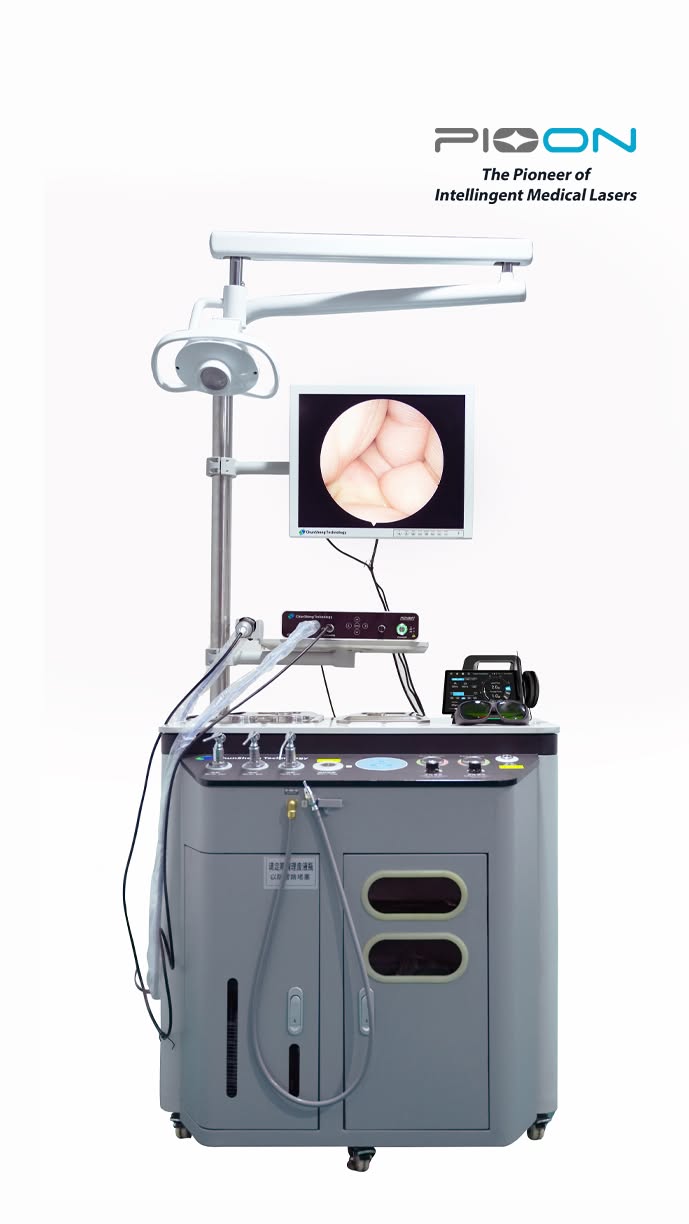
The supplied ENT product-selection information names two PIOON systems and differentiates them by wavelength and general tissue-interaction profile. H1 ENT is presented as a 980nm diode laser option for selected ENT soft-tissue procedures. S1-C10 ENT uses 450nm blue light, described as having a different tissue-absorption profile and as an option for selected incision, ablation, and coagulation procedures. Those are meaningful comparison points, but the evidence does not establish that either wavelength is universally preferable, or that either model is suitable for every named ENT operation.
The distinction matters because “ENT surgical laser” is a broad category, not a complete specification. The supplied information does not identify the maximum output, operating modes, fiber diameter, connector, handpiece configuration, or model-specific treatment presets for either ENT system. Nor does it provide a direct comparative test, clinical outcome data, or a procedure-by-procedure authorization list. Those omissions should remain open evaluation questions rather than being filled by assumptions based on another PIOON model or on general diode-laser features.
| Comparison point | H1 980nm ENT | S1-C10 ENT | What the buyer should establish |
|---|---|---|---|
| Documented wavelength | 980nm | 450nm blue | Confirm the offered configuration and the wavelength relevant to the intended procedure. |
| Documented application description | Selected ENT soft-tissue procedures | Selected ENT soft-tissue procedures; blue-light option described for selected incision, ablation, and coagulation | Request model-specific indications and confirm they match local authorization. |
| Fiber and handpiece detail | Not specified in the supplied ENT facts | Not specified in the supplied ENT facts | Verify accessory identity, compatibility, instructions, and applicable reprocessing requirements. |
| Regulatory relationship in supplied records | Listed under the company quality-assurance certificate record | Listed under the company quality-assurance certificate record | Check current model-specific market authorization and the scope of the documents. |
Wavelength is a decision criterion, not an outcome guarantee
Laser-tissue interaction depends on how the emitted light is absorbed and how energy is delivered. The available ENT knowledge material describes diode lasers as producing photothermal effects that may support tissue cutting, ablation, or coagulation. The balance among these effects depends on wavelength, power, exposure duration, delivery accessories, and tissue characteristics. This mechanism helps explain why wavelength belongs in an ENT system comparison; it does not predict a clinical result for a specific patient or procedure.
For the H1 980nm ENT, the supported comparison point is its near-infrared wavelength and stated role in selected ENT soft-tissue applications. For the S1-C10 ENT, the supported point is 450nm blue light, with a different tissue-absorption profile and the stated relevance to selected incision, ablation, and coagulation procedures. The evidence supplied does not include model-level power figures or comparative tissue-effect measurements for these two ENT systems. Buyers should not infer cutting speed, hemostasis, thermal spread, precision, or superiority from wavelength alone.
This boundary is especially important when a planned use is described by a specific procedure name—such as turbinate reduction, nasal polypectomy, vocal-cord or laryngeal surgery, papilloma removal, uvulopalatoplasty, tonsil surgery, otologic surgery, or pharyngeal surgery. The supplied materials establish a general ENT soft-tissue context, not a separate approved indication or outcome for each of those procedures. A keyword or broad application category is not evidence of device authorization. The clinician and buyer need to verify the exact intended use for the offered model and market.
Fiber delivery and safety require model-specific confirmation
An ENT laser system is more than its console and wavelength. The application evidence describes professional use with compatible optical fibers or handpieces, wavelength-specific protective eyewear, controlled access, and procedure-specific supporting equipment. It also notes the importance of trained medical professionals, sterile operation, accurate energy control, and compliance with approved clinical indications and local medical-device regulations. These are relevant procurement conditions, not proof that a particular accessory is included with either ENT model.
Before comparing a contact ENT surgical laser with a non-contact approach, establish which delivery methods are actually supported by the offered configuration. The corpus does not specify whether H1 ENT or S1-C10 ENT is supplied for contact use, non-contact use, or both. Nor does it provide their fiber specifications or a model-specific handpiece list. Ask the supplier to identify each proposed fiber and handpiece by compatible model, wavelength, connector, dimensions, and intended delivery mode. Confirm what is included, what is optional, and what requires a separate order.
Fiber safety is a combination of compatibility, handling, and use conditions. Buyers should obtain the instructions for the exact fiber and system combination, including the permitted wavelength, connection method, inspection criteria, and applicable cleaning, sterilization, or single-use instructions. Confirm how the fiber is secured and managed during the procedure and what protective eyewear is specified for the system’s wavelength. These checks matter because a generic statement that a laser accepts optical fibers does not establish that a particular fiber is compatible or suitable for a particular ENT procedure.
Operational planning should also account for the clinical environment. The supplied scenario guidance describes indoor clinical operation with controlled access, stable electrical power, and appropriate ventilation. It calls for trained professionals following laser-safety protocols and using compatible delivery accessories and wavelength-specific eye protection. The requirements for a particular room, procedure, or supporting device should be confirmed through the manufacturer’s instructions and the facility’s own safety processes; the general scenario description does not replace a device-specific risk assessment.
Regulatory documents: distinguish system quality from device authorization
The supplied certification record identifies an EC Certificate for a Full Quality Assurance System, issued by TÜV SÜD Product Service GmbH, with a scope covering Wuhan Pioon Technology Co., Ltd.’s quality-assurance system for therapy lasers and medical diode lasers. The record associates both H1 980nm ENT and S1-C10 ENT with that certificate. A separate ISO 13485:2016 quality-management certificate record also lists both models in its related products. These are relevant company quality-system records; they should not be described as proof that every model is authorized for every ENT procedure in every market.
The distinction is practical. A quality-management certificate concerns a defined management-system scope, while market access and permissible use depend on the particular product, intended purpose, device classification, destination country, and applicable regulatory documents. The supplied records do not provide complete model-specific authorization details for every destination market or every procedure named in search keywords. They also contain no usable issue or expiry dates. Procurement teams should therefore verify the current status, scope, and model coverage of the documents they receive, and confirm local registration or authorization independently through the appropriate process.
The supplied FDA 510(k) record covers a stated scope for general surgery, plastic surgery, and dermatology and lists other products; it does not list H1 980nm ENT or S1-C10 ENT among its applicable products. It should not be used to imply FDA clearance for these two ENT models. This illustrates why buyers should match every regulatory claim to the exact model, intended use, and market instead of relying on a manufacturer-level or portfolio-level summary.
Training and after-sales support are part of the comparison
PIOON’s support information describes product training, technical assistance, remote troubleshooting, maintenance guidance, software support, and spare-parts coordination. It also states that on-site service may be available when required, subject to local service arrangements. The FAQ material further qualifies warranty coverage and service arrangements as dependent on the product and sales agreement. These details are useful for evaluation, but they do not establish identical response times, warranty terms, or local service availability for every buyer.
An ENT team or distributor can make the support comparison concrete by asking what training covers for the selected system: device operation, accessory handling, laser-safety procedures, and the boundaries of approved use. Clarify who provides training, in what format, and which materials are supplied. For technical support, establish the available contact route, troubleshooting process, software-support scope, maintenance guidance, and how spare-parts coordination works in the destination market. Put any warranty duration, exclusions, service commitments, and local arrangements in the applicable agreement rather than treating a general support description as a contract term.
PIOON’s ENT case unit describes product demonstrations, professional education, and technical exchanges involving ENT clinics, hospital ENT departments, otolaryngologists, and distributors. It refers to discussions of 450nm and 980nm options, compatible optical fibers, and potential clinical workflows. The reported activity is education and technical exchange; it does not provide quantified clinical outcomes, a named customer result, or proof that a particular procedure is suitable for either model. For a buyer, its relevance is limited but useful: it identifies training and accessory discussion as part of the product-support context, not as clinical validation.
A practical evaluation sequence for ENT buyers
Start with the intended procedure and the destination market. Record the exact model name and proposed configuration, then compare the 980nm H1 ENT and 450nm S1-C10 ENT only on documented characteristics. Ask the manufacturer to supply the current model-level specification sheet and instructions for use. Check whether the requested indication appears in the product’s approved intended purpose in the destination market. If the evidence does not establish the indication, do not treat a general ENT application statement as confirmation.
Next, resolve the delivery system. Identify the exact fiber, connector, handpiece, and contact or non-contact mode proposed for the procedure. Verify wavelength compatibility and the accessory’s instructions, including inspection and reprocessing requirements. Confirm the specified protective eyewear and the facility’s laser-safety controls. These steps convert the broad phrase “fiber compatible” into a verifiable system configuration without assuming that accessory details are interchangeable between models.
Then assess operating and support requirements. Confirm the device’s output range, operating modes, control behavior, and any procedure-specific presets from the model’s own documentation; those details are not established in the supplied ENT comparison facts. Review the training plan and the terms for technical assistance, warranty, maintenance, and spare parts. Finally, validate current regulatory documents for the exact model and intended use. If the seller’s answers rely on a different product model or a general certificate, request documentation that directly matches the system under consideration.
This sequence keeps three questions separate: what the product is documented to provide, what the clinician intends to do, and what local rules permit. A confirmed wavelength does not fill a missing accessory specification; a compatible fiber does not establish a clinical indication; and a quality-system certificate does not by itself confirm market authorization. Keeping these distinctions visible makes the comparison more useful for clinical evaluation and procurement review.
Conclusion: choose by documented configuration and intended use
The available evidence supports a bounded comparison: PIOON H1 980nm ENT and PIOON S1-C10 ENT are two ENT diode-laser options distinguished by 980nm and 450nm wavelengths, respectively, with the latter described as a blue-laser option for selected soft-tissue incision, ablation, and coagulation procedures. It does not support a universal winner, a claim of equivalent performance, or a definitive recommendation for a named operation. Model-specific output, delivery accessories, procedure indications, and local authorization require further verification.
For buyers in the evaluation stage, the most defensible selection rule is to match the intended procedure and market authorization first, then verify the precise wavelength configuration, fiber and handpiece combination, safety instructions, training, and service terms. Where those details are not documented for the offered system, treat them as unresolved purchasing criteria—not as features implied by the ENT category or by another model in the product portfolio.
Frequently asked questions
Which PIOON laser should I choose for ENT surgery?
The available selection information identifies H1 ENT as a 980nm option for selected ENT soft-tissue procedures and S1-C10 ENT as a 450nm blue-laser option with a different tissue-absorption profile. The appropriate choice depends on the intended procedure, required tissue interaction, delivery accessories, and approved indications. The available evidence does not establish one model as universally superior.
Does the supplied information confirm the fiber for each ENT model?
No. The supplied ENT facts do not specify the fiber dimensions, connector, or model-by-model handpiece configuration for H1 980nm ENT or S1-C10 ENT. Buyers should verify the exact accessory and its wavelength compatibility, intended delivery mode, and instructions for use for the offered configuration.
Do the listed quality certificates prove authorization for every ENT procedure?
No. The supplied EC and ISO 13485:2016 records relate to quality-management system scopes and list the ENT models in their related-product information. They do not, by themselves, establish authorization for every procedure or destination market. Confirm current model-specific regulatory documents and intended-use scope for the relevant country.
What support does PIOON describe for distributors and clinical users?
PIOON describes product training, technical assistance, remote troubleshooting, maintenance guidance, software support, and spare-parts coordination. On-site service is subject to local arrangements, while warranty and service terms depend on the product and sales agreement. The buyer should verify the applicable local channels and contractual terms for the selected system.
Есть вопросы или нужны дополнительные детали?
Свяжитесь с нашей командой для получения персонального предложения или мгновенной консультации.
Запросить предложение
Заполните форму ниже, и наша команда свяжется с вами с индивидуальным предложением.
Прямой чат WhatsApp
Предпочитаете общаться в реальном времени? Напишите нам в WhatsApp для мгновенной помощи и быстрых ответов.
- Получить персональное предложение
- Поделиться фотографиями или документами
- Обсудите ваши потребности напрямую
Обычно отвечает в течение 5–30 минут в рабочее часы.