
EPC-1.1: Fixed vs Adjustable Starting Pressure Explained
A pump pressure control starts the pump when line pressure falls to a defined cut-in point. On the Monro EPC-1.1, that cut-in point is documented as a preset value — 1.2 bar, 1.5 bar or 2.2 bar — and the published specification for this model does not describe a continuously adjustable starting-pressure window. That single configuration detail decides whether a system can be re-tuned on site or must be re-specified. Adjustable and non-adjustable versions do exist side by side in the same product family: the EPC-5 is documented as being offered in both versions, with the EPC-5A variant adding a smart program. For a buyer already past the shortlisting stage, the useful question is therefore not which design is superior, but which configuration can still be changed once the unit is on the pipe.
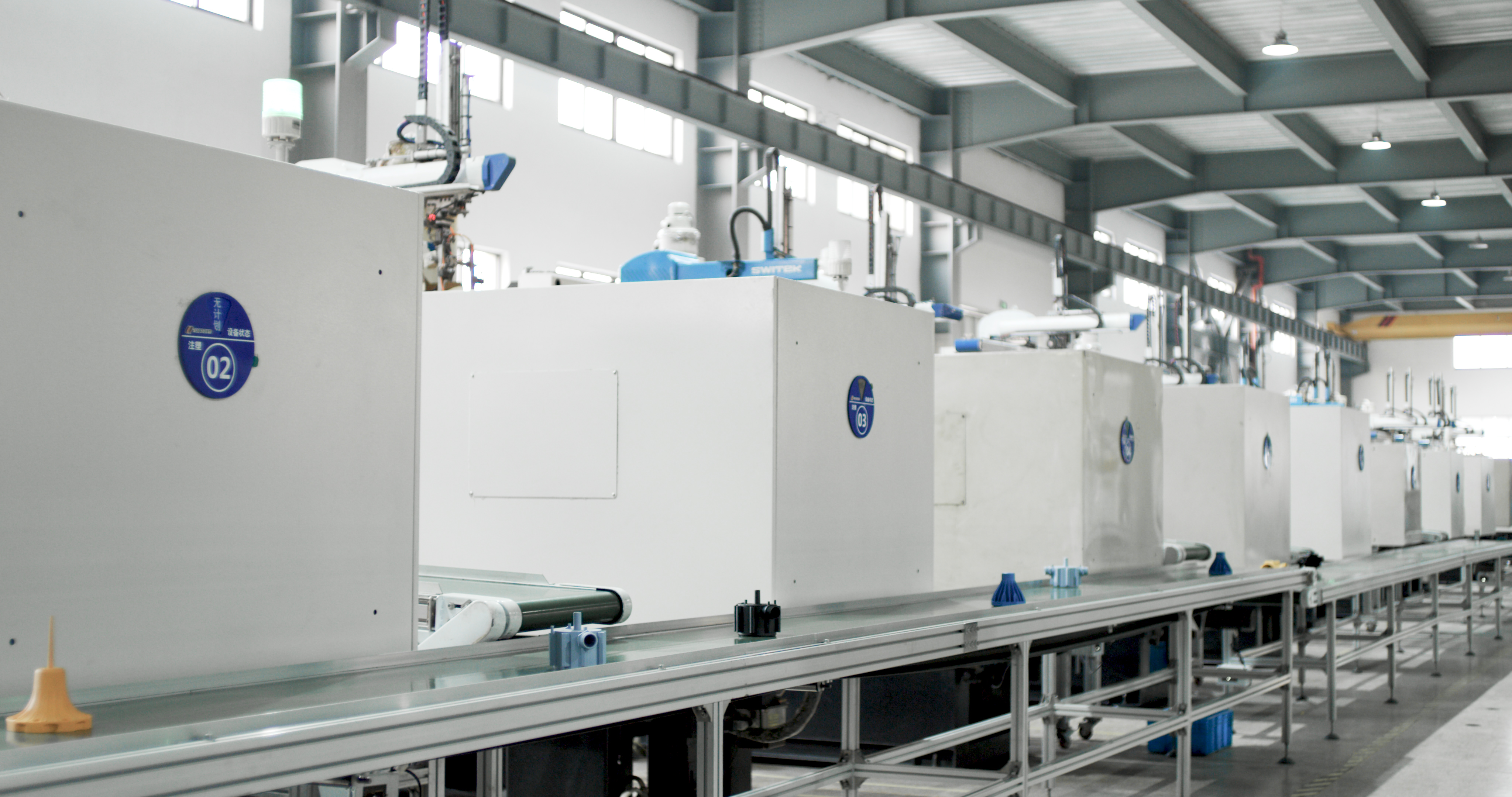
EPC-series pump pressure controls are produced and checked at Monro Switch's Wenling facility. Image: Monro Switch.
Why starting pressure is a configuration decision, not a footnote
Starting pressure is the pressure threshold at which an automatic pressure control closes the pump circuit and brings the motor online. It sits upstream of almost every other performance conversation: how high water can be lifted in a building, how often the pump cycles, and whether a system can be commissioned without ordering a second unit.
In residential and light commercial water supply, most pressure controls are purchased against a pump that has already been selected. The controller then has to fit that pump's head. When the controller's cut-in value is fixed at the factory, the fit is a matching exercise. When the cut-in value is adjustable within a documented window, the fit becomes a commissioning exercise. Both approaches are legitimate, and both appear in the Monro Switch range.
Zhejiang Monro Machinery & Electronic Co., Ltd. (Monro Switch) is a pressure controller and float switch manufacturer based in Wenling City, Zhejiang Province, China, established in 2010 and exporting roughly 90% of its output to Asia, Europe, North and South America, and the Middle East and Africa. Its catalogue covers more than 40 pressure controller models for water pump systems and air compressors, with a documented R&D team of ten engineers and an ISO 9001:2015 quality management system. Products hold TUV (Germany) and CE (Europe) certifications, with select models also approved under the CUL (U.S. and Canada) standard.
Adjustable vs non-adjustable: the actual difference
The distinction is mechanical and documentary, not cosmetic. On a non-adjustable unit, the starting pressure is built in at the point of manufacture; the value you order is the value you get, and the installation step is limited to confirming that the pump matches it. On an adjustable unit, the starting pressure can be moved within a documented window using the adjustment provided on the product — no hardware replacement is required, but the setpoint becomes a field variable that a commissioning technician has to set and record.
Monro Switch documents this split explicitly in the pump pressure control range. The EPC-5 pump pressure switch is available in both adjustable and non-adjustable versions, with the EPC-5A variant featuring a smart program for automatic restart. Other models publish a numeric adjustment window instead: the EPC-12P carries an adjustable starting pressure of 1.2–2.5 bar.
| Decision dimension | Non-adjustable (preset) configuration | Adjustable configuration |
|---|---|---|
| Where the starting pressure is set | Fixed during manufacture | Set on site within a published window |
| Example in the Monro range | EPC-5 non-adjustable version; EPC-1.1 preset values of 1.2 / 1.5 / 2.2 bar | EPC-5 adjustable version; EPC-12P at 1.2–2.5 bar |
| Hardware swap needed to change the setpoint | Yes — a different configuration must be ordered | No, within the documented window |
| Commissioning effort | Lower: verify match and install | Higher: set, verify and record the setpoint |
| Main risk | Mismatch discovered late in the project | Setpoint set outside the pump's capability |
| Best fit | Repeat installations with a known, stable pump | Projects where head, pipework or usage height may change |
Neither column is a quality ranking. A preset unit removes a field variable; an adjustable unit removes a supply-chain variable. Which one costs the buyer more depends entirely on how certain the system design is at the moment of ordering.
What the EPC-1.1 actually publishes
The EPC-1.1 is documented as a pump pressure control for domestic water supply, with the following published parameters:
| Parameter | Documented value (EPC-1.1) |
|---|---|
| Product type | Pump pressure control |
| Rated voltage | 220–240 V / 110–120 V |
| Power frequency | 50/60 Hz |
| Max. power | 1.1 kW / 1.5 kW / 0.75 kW |
| Starting pressure setting | 1.2 bar, 1.5 bar, 2.2 bar |
| Connection thread | G1", G1 1/4", G1 1/2", NPT1" |
| Protection rating | IP65 |
| Max. working temperature | 55°C |
| Material | Plastic, metal |
| Documented application | Domestic |
Read that starting-pressure line literally. It lists three discrete values — 1.2 bar, 1.5 bar and 2.2 bar — rather than a range with a lower and upper bound. Nothing in the published EPC-1.1 data describes a sliding adjustment window, and no maximum working pressure figure is published for this specific model. Buyers who need a continuously variable cut-in point should be selecting on that requirement explicitly, and should confirm the configuration with the manufacturer rather than assuming it from the model number.
This is the point where specification discipline pays off. Three preset values cover three different commissioning scenarios, and the right one is determined by arithmetic, not preference.

Range depth, not a single SKU, is what allows a preset starting pressure to be matched to a specific pump head. Image: Monro Switch.
Where adjustable windows are documented elsewhere in the family
Adjustability is a range property, not an EPC-1.1 property. Several models in the same programme publish explicit adjustment windows, which is useful when a project's head requirement sits outside the EPC-1.1's preset options.
| Model | Documented adjustment / pressure data |
|---|---|
| EPC-12P | Adjustable starting pressure 1.2–2.5 bar; built-in check valve and run-dry protection |
| EPC-10 | Starting pressure setting 0.5–9.3 bar; stopping pressure setting 0.7–9.5 bar; max. working pressure 10 bar |
| EPC-19 | Starting pressure setting 2–6 bar; max. working pressure 10 bar |
| KRS-2 (mechanical) | Adjustable pressure ranges 1.0–1.8 bar, 1.2–2.2 bar and 2.2–3.0 bar; min. cut-in 0.5 bar; max. cut-out 3.0 bar |
| KRS-1 (mechanical) | Pressure ranges 20–40 PSI, 30–50 PSI and 40–60 PSI; min. cut-in 20 PSI; max. cut-out 175 PSI |
| KRS-5 (mechanical) | Pressure range options 20–40 PSI, 30–50 PSI and 40–60 PSI; min. cut-in 15 PSI; max. cut-out 100 PSI |
Where none of the standard windows fits, the range also documents customisation. The KRS-1 mechanical pressure control can be supplied with custom hydraulic connections and custom pressure settings according to customer needs, and customised settings are documented as available within the mechanical pressure control line. That is a specification conversation rather than a catalogue selection — it needs to happen before tooling and order confirmation, not after the goods arrive.
From starting pressure to use height: the arithmetic buyers must run
The reason adjustability has value at all is that starting pressure translates directly into water height. Monro Switch documents a two-step selection rule for automatic pump controllers:
- Match the motor power of the water pump.
- Choose a suitable starting pressure according to pump lift and maximum water use height.
The documented worked example is unambiguous: with a starting pressure of 1.2 bar, maximum water use height is 1.2 × 10 m = 12 metres, and the pump lift must be at least (1.2 + 0.8) × 10 m = 20 metres.
Applying that same documented rule to the three published EPC-1.1 preset values gives a clear selection map: 1.2 bar corresponds to a maximum water use height of about 12 m; 1.5 bar to about 15 m; and 2.2 bar to about 22 m. Each case implies a minimum pump lift of roughly 0.8 bar above the start-up pressure, which is the margin the documentation requires between the pump head and the controller's cut-in point.
That 0.8 bar margin is the single most common cause of a correct-looking installation that does not work. If the pump head falls below (starting pressure + 0.8 bar), the controller can call for the pump without the pump being able to reach the cut-out point, and the system cycles or stalls. This is why the installation guidance lists verification before wiring: confirm the pump runs normally on its own, and confirm that the parameters on the pump nameplate match those of the pressure controller.
What can be changed on site — and what cannot
Buyers frequently conflate "adjustable" with "fully configurable." On this product family the two are different, and the boundary is documented.
Changeable after installation, on models that support it:
- Starting pressure, within the documented adjustable window (for example 1.2–2.5 bar on the EPC-12P).
- Timing settings, where the model provides them: 0.1–1 hour and 1–24 hours are documented on models including the EPC-12, EPC-12P, EPC-9 and EPC-17.
- Stopping pressure, on models that publish a stopping-pressure setting — the EPC-10 documents 0.7–9.5 bar and the EPC-12 documents 0.8–7.0 bar in Mode 2.
- Operating mode, on multi-mode models. The EPC-15, for example, documents three operating modes: pressure mode, timing mode and flow mode.
Not changeable after installation — these are specification decisions:
- Motor power rating. The EPC-1.1 is rated for maximum power of 1.1 kW, 1.5 kW or 0.75 kW; a higher-power pump requires a different model.
- Connection thread. The EPC-1.1 offers G1", G1 1/4", G1 1/2" and NPT1"; the thread is fixed at order.
- Protection rating. IP65 on the EPC-1.1; other models in the range are documented at IP44, such as the EPC-2.1 and EPC-5.1. Indoor installation cannot be upgraded to IP65 by adding a cover in the field.
- Maximum working temperature. 55°C on the EPC-1.1; 60°C is documented on models such as the EPC-12, EPC-12P and EPC-15.
- Preset starting-pressure values on a non-adjustable configuration.
Application fit: where a preset EPC-1.1 belongs
The EPC-1.1 is documented for domestic application. That is a narrower scope than several other models in the range, which are documented for agriculture irrigation, water treatment and construction — the EPC-1, EPC-2, EPC-3, EPC-4 and EPC-13 among them. Buyers should treat this as a real boundary rather than a marketing label.
Typical fit for a preset or narrowly specified configuration:
- Repeat residential installations where the pump model, storey height and draw-off pattern are known and stable. The 12 m / 15 m / 22 m mapping can be applied once and reused.
- Non-tower water supply arrangements, where the controller is managing a pressurised line rather than a gravity tank. Non-tower supply is documented as a design scenario within this controller family.
- Retrofit replacements, where a burned-out controller is being exchanged against an unchanged pump and pipework.
Models further up the same range extend the application envelope rather than changing the principle: the EPC-15 is documented for use with surface or submersible pumps, and the EPC-15 and EPC-12P document built-in check valves and run-dry protection — features that are model-specific and should not be assumed across the whole family.
Market context: preset switching still carries the volume
The configuration question is not a niche one. The global pressure switch market was valued at USD 3.2 billion in 2025, and Fortune Business Insights projects growth from USD 3.38 billion in 2026 to USD 5.13 billion by 2034. Within that market, Market Research Future reports that electromechanical pressure switches accounted for approximately 62% of global market share in 2024, against 38% for solid-state electronic pressure switches.
That ratio explains why preset and mechanically fixed configurations remain the volume baseline: they are the simplest thing that reliably works in a domestic water system, and simplicity has a measurable value where installers are handling hundreds of units. The regulatory frame is shared by both architectures — IEC 60730-2-6:2025 applies to automatic electrical pressure sensing controls for household and similar use, which is the standard environment the EPC-1.1 is designed around.
For trade buyers, water pump pressure switches are commonly traded under HS Code 853650. Monro Switch's purchasing terms document a minimum order quantity of 204 pcs, delivery terms of EXW / FOB / CIF, and acceptance criteria covering pre-shipment testing and third-party inspection (SGS). Those commercial terms shape the adjustability decision more than most buyers expect: a mixed order of preset and adjustable configurations is a sourcing choice, and it needs to be made at the quotation stage.
Adjustable configuration versus traditional fixed-set switching
Comparing an adjustable configuration with a traditional fixed-set pressure switch is not a comparison between modern and obsolete. It is a comparison between two risk profiles, and the honest statement is that each carries costs the other does not.
Where the adjustable configuration is stronger: it survives design change. If the maximum water use height is revised after the pipework is installed, or if a pump is swapped for a slightly different head, an adjustable unit can often be re-set within its documented window instead of being replaced. It also reduces the risk of ordering the wrong preset value, which in export orders carries lead-time and freight consequences.
Where the traditional fixed-set approach is stronger: it removes the setpoint as a failure mode. A preset unit cannot be mis-adjusted on site, cannot drift because someone turned a screw during maintenance, and does not require the commissioning technician to understand the 0.8 bar head margin. For high-volume residential projects with a stable design, that is a genuine advantage rather than a compromise.
The limitations that should be stated plainly:
- The EPC-1.1's published starting-pressure settings top out at 2.2 bar. Systems requiring a higher cut-in need a different model — the EPC-19 documents a 2–6 bar range, and the EPC-10 documents 0.5–9.3 bar.
- No maximum working pressure is published for the EPC-1.1 in the available specification data. Buyers sizing against a system relief setting should request that figure directly rather than inferring it.
- Adjustability is not universal across the family. The EPC-5 exists in both adjustable and non-adjustable versions, and many models publish only three preset starting-pressure values — 1.2 bar, 1.5 bar and 2.2 bar — without a stated window.
- Protection ratings vary by model within the same range: IP65 on the EPC-1.1 and IP44 on the EPC-2.1 and EPC-5.1. A technically equivalent pressure setting does not mean an equivalent enclosure.
- Safety-critical features are model-specific, not family-wide. Built-in check valves and run-dry protection are documented on the EPC-12P, EPC-15 and EPC-3, not on every controller in the catalogue.
Read together, those limitations describe a product family designed for selection rather than for universal specification. That is a normal and defensible engineering position, but it does mean the model number alone is not enough information to buy against.
Future outlook
Two forces are likely to reshape how this configuration question is asked over the next several years.
The first is the documented shift in market structure. With electromechanical pressure switches holding roughly 62% of the market against 38% for solid-state electronic switches, the electronic segment is the growth side of the ratio, and electronic controllers are the architectures that carry programmable setpoints, timing modes and automatic restart logic. As that share moves, buyers should expect starting pressure to be specified as a programmable parameter more often than as a factory-fixed value — which raises, rather than removes, the importance of documenting the adjustment window.
The second is standards pressure. IEC 60730-2-6:2025 already frames automatic electrical pressure sensing controls for household and similar use. As that frame evolves, the ability to demonstrate what a controller does at a defined setpoint — and to show that the setpoint is controlled and repeatable — becomes a documentation requirement rather than a differentiator.
For a manufacturer with the capability base Monro Switch documents — a 30,000 m² facility, approximately 200 employees, ten R&D engineers, and annual output across the EPC, KRS and FPS series — the practical consequence is that configuration data has to be as well organised as production data. Export coverage across Asia, Europe, North and South America, and the Middle East and Africa means the same model number has to be read the same way by an installer in Manila and a distributor in Rotterdam.
For buyers, the forward-looking advice is simple: treat "adjustable or fixed" as a mandatory field in the specification sheet, alongside the starting-pressure value itself. Ambiguity there is what causes field failures, not the choice of design.
Frequently asked technical questions
What is the difference between an adjustable and a non-adjustable starting pressure on a pump pressure control?
On a non-adjustable unit, the starting pressure is fixed during manufacture and the value ordered is the value supplied. On an adjustable unit, the starting pressure can be set within a documented window on site, without replacing hardware. Monro Switch documents both configurations in the pump pressure control range: the EPC-5 pump pressure switch is offered in adjustable and non-adjustable versions, with the EPC-5A variant featuring a smart program.
What starting-pressure values are published for the EPC-1.1?
The EPC-1.1 is documented with starting-pressure settings of 1.2 bar, 1.5 bar and 2.2 bar. Its other published parameters are rated voltage 220–240 V / 110–120 V, power frequency 50/60 Hz, maximum power 1.1 kW / 1.5 kW / 0.75 kW, connection threads G1", G1 1/4", G1 1/2" and NPT1", protection rating IP65, and a maximum working temperature of 55°C. The documented application is domestic.
Does the EPC-1.1 have a continuously adjustable starting-pressure window?
The published specification lists three preset starting-pressure values rather than a lower-and-upper adjustment window, so it should not be read as a continuously variable model. Where a project requires a sliding window, other models in the same programme publish one: the EPC-12P documents an adjustable starting pressure of 1.2–2.5 bar, the EPC-10 documents 0.5–9.3 bar, the EPC-19 documents 2–6 bar, and the KRS-2 mechanical control documents adjustable ranges of 1.0–1.8 bar, 1.2–2.2 bar and 2.2–3.0 bar.
How do I work out which starting pressure my system needs?
Match the motor power of the water pump first, then select the starting pressure from the pump lift and the maximum water use height. The documented rule uses a 10 m per bar conversion: at a starting pressure of 1.2 bar, maximum water use height is 1.2 × 10 m = 12 metres, and the pump lift must be at least (1.2 + 0.8) × 10 m = 20 metres. The pump head must be at least 0.8 bar higher than the controller's start-up pressure.
Can the starting pressure be changed after installation without replacing hardware?
On an adjustable model, yes — within the documented window, for example the 1.2–2.5 bar range on the EPC-12P. On a preset configuration, the starting pressure is a specification decision: changing it means supplying a different configuration. Motor power rating, connection thread, protection rating and maximum working temperature are fixed at order in both cases and cannot be altered on site.
Which other settings are field-adjustable on this controller family?
Timing settings are adjustable from 0.1 to 1 hour and from 1 to 24 hours on models including the EPC-12, EPC-12P, EPC-9 and EPC-17. Stopping pressure is adjustable within published ranges on models that support it, such as 0.7–9.5 bar on the EPC-10 and 0.8–7.0 bar in Mode 2 on the EPC-12. Multi-mode models document pressure, timing and flow operating modes. Features such as built-in check valves, run-dry protection and automatic restart are model-specific and should be confirmed per model rather than assumed across the range.
What should be verified before an EPC-1.1 is connected to power?
Check that the water pump operates normally on its own and that the pump nameplate parameters match those of the pressure controller, with the pump head at least 0.8 bar above the controller's start-up pressure. Install the controller in the direction indicated by the arrow on its housing, connect the power cord to a separate plug wire and seal the joints with waterproof insulating tape. Open the main outlet valve and all faucets before energising the controller.
Which compliance and certification references apply?
Monro Switch operates an ISO 9001:2015 quality management system, and products hold TUV (Germany) and CE (Europe) certifications, with select models also approved under the CUL (U.S. and Canada) standard. At system level, IEC 60730-2-6:2025 applies to automatic electrical pressure sensing controls for household and similar use. Water pump pressure switches are commonly traded under HS Code 853650.
Summary for buyers
The EPC-1.1 is a preset-configuration pressure control with three documented starting-pressure values — 1.2 bar, 1.5 bar and 2.2 bar — and an IP65 enclosure rated to 55°C for domestic application. Adjustable and non-adjustable versions exist elsewhere in the same Monro Switch programme, and adjustable windows range from 1.2–2.5 bar on the EPC-12P up to the wider windows published on the EPC-10 and EPC-19. The correct question at the decision stage is not which design is more advanced, but whether the system's head, pipework and usage height are already fixed. If they are, a preset configuration removes risk. If they are not, an adjustable one removes cost.
Technical reference: Monro Switch 2025 product catalogue — download the full specification set. Product and company information: www.monroswitch.com.