
ESS Battery Pack Insertion Robots: Solving the Container Automation Bottleneck
Industry Analysis / Green Energy & New Materials
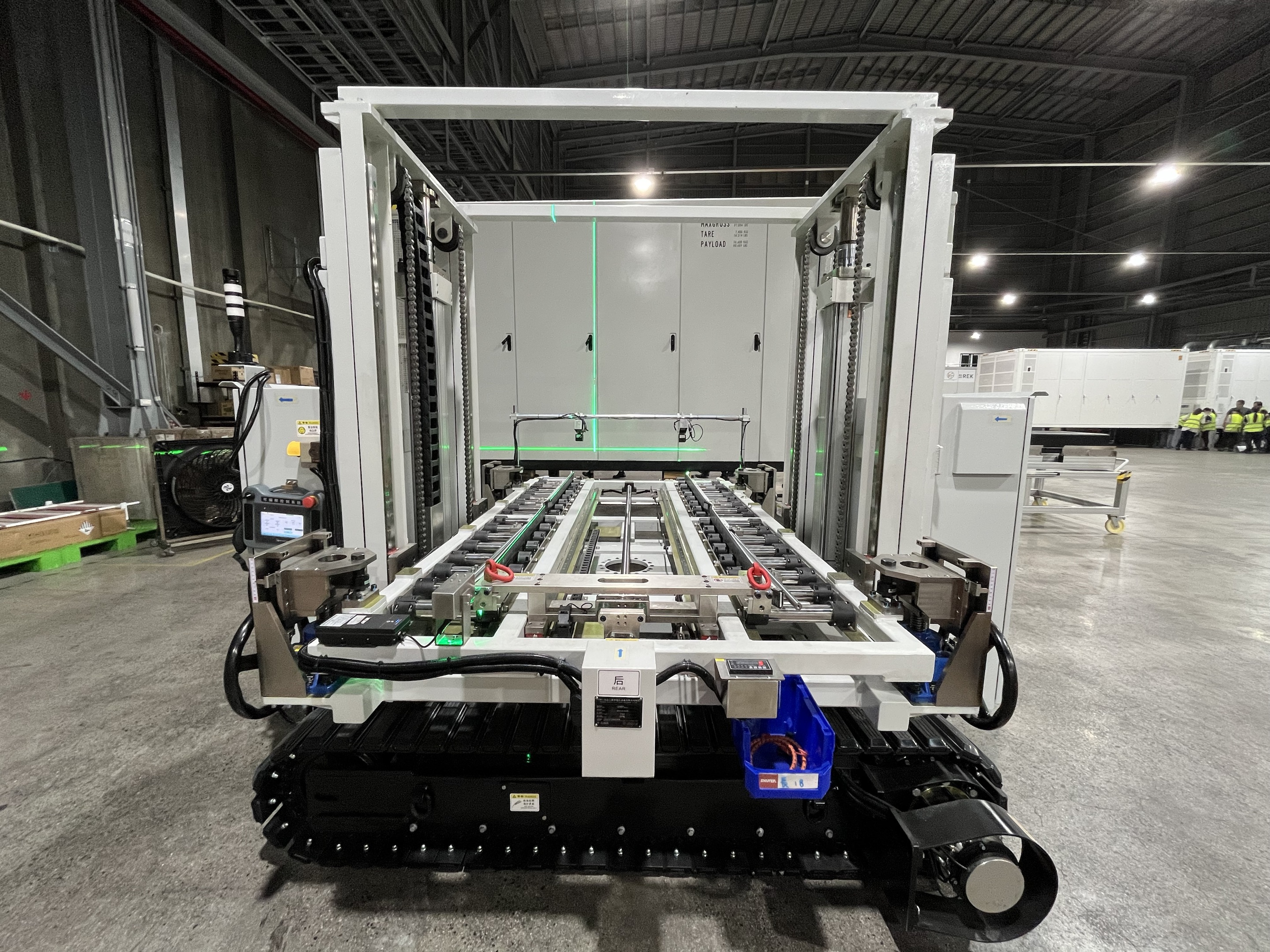
Crawler-driven battery PACK insertion and removal equipment designed for all-terrain container energy storage projects.
The global Battery Energy Storage System (BESS) market was valued at approximately USD 50.81 billion in 2025 and is projected to reach USD 105.96 billion by 2030, according to MarketsandMarkets. Within this growth, containerized BESS solutions represented a segment of USD 11.75 billion in 2025, expanding at a compound annual growth rate of 24.1% through 2035 (Insightace Analytic). As project scales increase from pilot-level to giga-factory throughput, the physical bottleneck of loading heavy battery packs into ISO containers has become a critical area for automation.
Traditional manual or forklift-assisted insertion methods cannot keep pace with the precision, speed, and safety demands of modern containerized energy storage lines. Labor-intensive operations are prone to alignment errors, pack damage, and inconsistent cycle times. Automated ESS battery pack insertion robots have emerged as a targeted solution to this assembly-stage constraint.
The Automation Opportunity in Container Assembly
For energy storage integrators and lithium battery manufacturers, inserting battery packs into container racks is a repetitive, high-weight, high-precision task. Manual methods typically require multiple workers, frequent lifting, and careful alignment to avoid damaging cells. An analysis by Zonzsin in its 2026 buyer guide notes that implementing automated battery pack loading robots can reduce manpower by 30% and improve container assembly cycle time by 20% compared to manual methods. These gains are especially critical as containerized BESS deployments accelerate globally.
Shanghai Zonzsin’s Product Family for Container Insertion
Shanghai Zonzsin Intelligent Equipment Co., Ltd., established in 2019, specializes in intelligent battery PACK assembly lines and ESS battery pack insertion robots for containers. The company employs approximately 90 staff, operates a 6,000 m² manufacturing facility, and has an annual production capacity of 40 units. Zonzsin’s dedicated R&D team of 43 engineers delivers customized automation solutions for energy storage and C&I applications.
The company offers four primary models covering three chassis architectures:
- RD16 – AGV-driven battery pack insertion robot for containers. Dimensions: 3,100 mm × 2,600 mm × 3,800 mm. Hoisting range: 1.05 – 3.4 m (customizable) at 100 mm/s. Compatible with 280/314/587 Ah cells and 1P52S/1P104S packs. Constructed from carbon steel.
- ZZX2524 – rail-fixed battery pack insertion robot. Load capacity: 1,500 kg. Door open angle ≥150°. Gripper changeover time <1 min. Space-saving double-layer rack design. Carbon steel/Q235.
- ZZX2508 – rail-fixed battery pack insertion robot. Compatible container dimensions: L 6058 – 7000 mm, W 2438 – 2700 mm, H 2896 – 3000 mm. Compatible pack dimensions: L 1100 – 2200 mm, W 780 – 1260 mm, H 230 – 260 mm. Power: AC 380 V±10%, 50±2 Hz.
- ZZX2522 – crawler-driven battery pack insertion and removal robot. Hoisting range: 0.8 – 3.4 m (customizable). All-terrain working floor. Manual handwheel leveling. Load capacity: 1,500 kg. Carton steel/Q235.
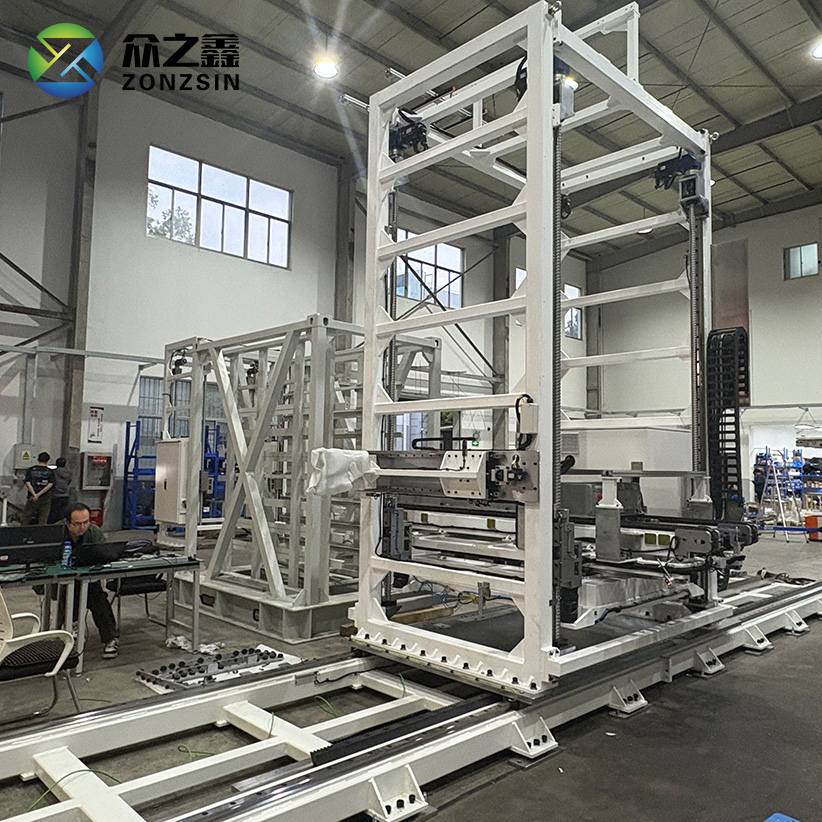
The rail-fixed ZZX2508 model is designed for high-precision insertion into standard 20 ft and 40 ft container racks.
Technical Architecture and Operation
Each Zonzsin insertion robot integrates a programmable logic controller (PLC) and can be optionally linked to a manufacturing execution system (MES) for full traceability. The rail-fixed models (ZZX2524/ZZX2508) use a rigid guide rail system that ensures repeatable positioning inside the container. The AGV-driven RD16 navigates via magnetic tape or laser SLAM to autonomously dock at the container opening. The crawler-driven ZZX2522 uses tracked drive to operate on uneven outdoor terrain, with manual handwheel leveling to adjust the platform height before insertion.
All models feature a door opening angle of ≥150°, allowing the insertion gripper to reach the deepest rack cells. The gripper itself can be swapped in under one minute, enabling quick changeovers between different pack geometries. Safety features include ESD protection, fire prevention measures, and temperature/humidity/cleanliness monitoring, as required in the application scenario environment.
Application Scenarios Across Markets
Zonzsin robots are deployed in ESS and C&I energy storage projects across countries including China, France, South Korea, Sweden, Taiwan, and the United States. Typical operating conditions are all-terrain with a temperature range of 20–30 °C, supporting continuous or shift production. The robots perform fully-automated moving and pack insertion, enabling intelligent production lines for batch and continuous output. Operation can be done via local manual panel or remote controller.
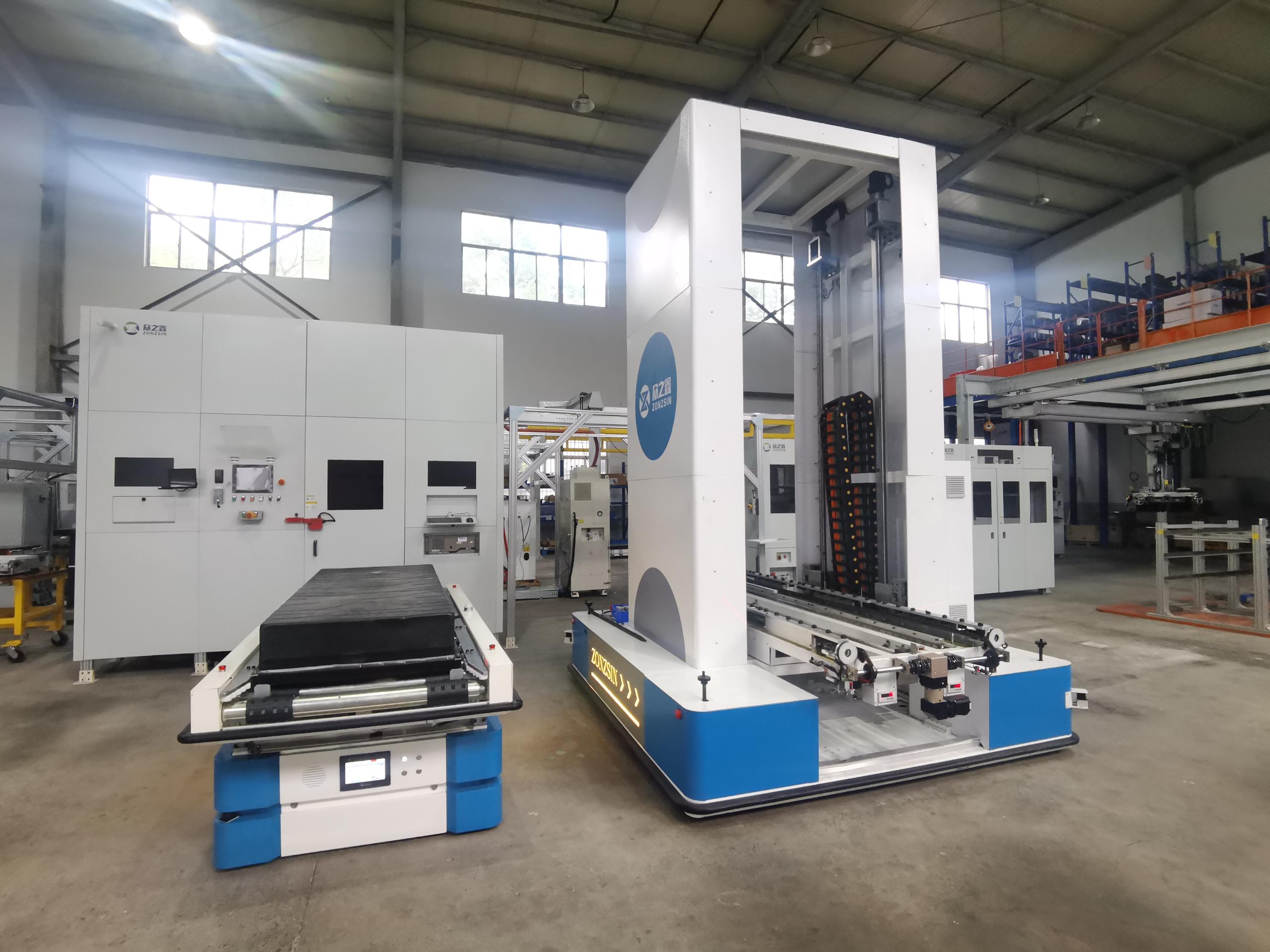
The AGV-driven RD16 autonomously approaches the container opening and inserts packs with hoisting precision of 100 mm/s.
Matched equipment includes containers, docking rollers, transfer AGVs, working desks, material racks, and platform ladders. The system can handle from single-container pilot lines to multi-station production plants. Special project requirements such as ESD protection and fire prevention are addressed through configurable options.
Market Trend: Automation Scales with Containerized BESS
▶ Containerized BESS market: USD 11.75 B (2025) → CAGR 24.1% through 2035
Source: Insightace Analytic
This rapid growth is driving a shift from manual or semi-automated insertion to fully robotic solutions. Integrators increasingly specify robots that can handle multiple pack sizes without mechanical reconfiguration. Zonzsin’s gripper changeover under one minute and customizable hoisting ranges align with this trend.
Comparison with Traditional Methods
Compared to manual forklift-and-push operations, automated insertion robots offer repeatable positioning accuracy, consistent cycle times, and reduced labor costs. The Zonzsin 2026 buyer guide reports a 30% reduction in manpower and a 20% improvement in cycle time. A limitation worth acknowledging: the initial capital expenditure for a robotic insertion station is higher than a manual workbench. For very low-volume prototyping or repair lines, the investment may take longer to amortize. However, for continuous production of 100+ containers per year, the payback period typically falls within 12–18 months based on industry benchmarks.
Future Outlook
As battery pack weights and dimensions evolve with high-capacity cells (587 Ah and beyond), insertion robots must adapt with greater load capacity and extended hoisting ranges. Zonzsin’s modular design approach allows customization of hoisting height and gripper geometry, positioning the company to serve next-generation 20 ft and 40 ft container racks. Integration with MES and real-time quality data feedback will become standard, enabling closed-loop production control for ESS assembly.
Frequently Asked Questions (FAQ)
Shanghai Zonzsin Intelligent Equipment Co., Ltd.
Specializing in ESS battery pack insertion robots for containers & automatic battery pack assembly lines.
www.zonzsin.com | Contact: Katty.liu – katty.liu@zonzsin.com | +86 134‑8282‑9368
Есть вопросы или нужны дополнительные детали?
Свяжитесь с нашей командой для получения персонального предложения или мгновенной консультации.
Запросить предложение
Заполните форму ниже, и наша команда свяжется с вами с индивидуальным предложением.
Прямой чат WhatsApp
Предпочитаете общаться в реальном времени? Напишите нам в WhatsApp для мгновенной помощи и быстрых ответов.
- Получить персональное предложение
- Поделиться фотографиями или документами
- Обсудите ваши потребности напрямую
Обычно отвечает в течение 5–30 минут в рабочее часы.