
EU Compliance for Teeth Whitening Kits: Decoding Certification Questions
EU Compliance for Teeth Whitening Kits: Decoding Certification Questions
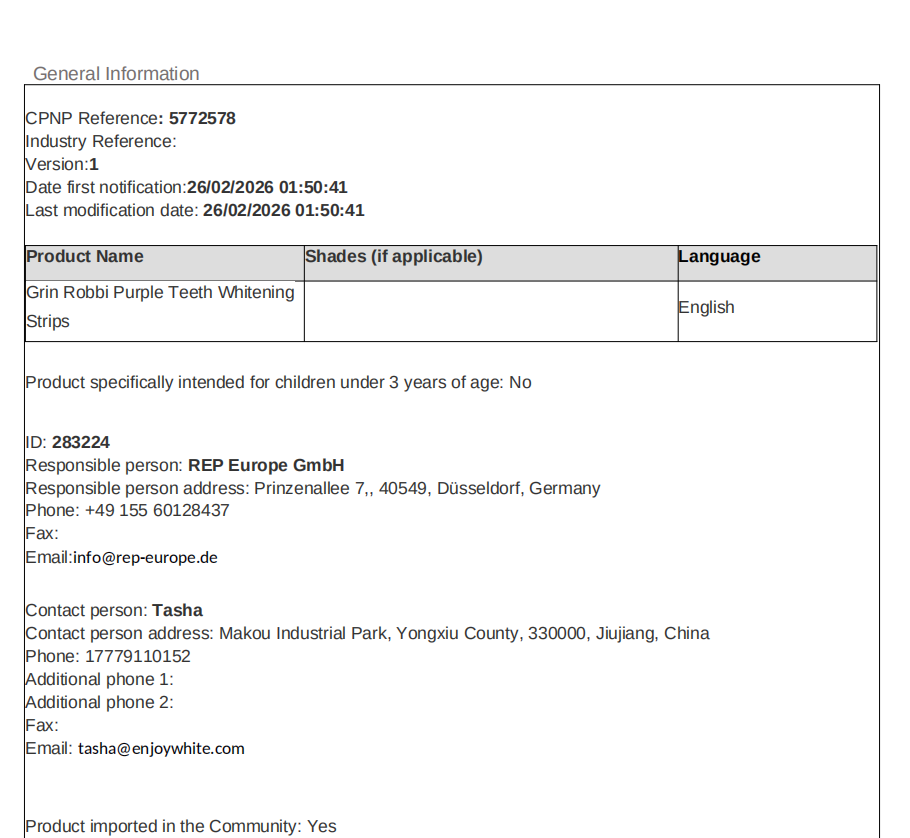
A teeth whitening kit entering the European Union is not approved as a single product on a single certificate. It is classified, documented and notified, and which documents are required depends on decisions taken long before the shipment is booked.
Two kits can leave the same production line, look identical on the shelf and still enter Europe under two different regulatory routes. One is placed on the market as a cosmetic. The other is placed as a medical device. The dividing line is not the carton and not the brand name; it is the formulation, the intended use and the claims printed on the label. That is why procurement due diligence on whitening kits so often stalls at the same point: the buyer asks for the CE certificate, and the supplier answers with a document that covers something else entirely.
The category is large enough that the question is worth getting right. Fortune Business Insights valued the global teeth whitening market at USD 8.93 billion in 2025 and projects USD 14.31 billion by 2034, while Straits Research reported that the individual and at-home segment accounted for 68.67% of the market in 2024. The EU is one of the principal export markets for Jiangxi Dentalbright Technology Co., Ltd., which operates as Glorysmile Factory from Nanchang, Jiangxi Province, China, and exports to 102 countries. EU documentation questions typically surface at the point where a buyer moves from comparing suppliers to committing to a purchase order, which is exactly where the questions in this article belong.
Why Certification Questions Surface Late
Compliance is rarely the first filter in a sourcing project. Buyers normally screen suppliers on price, minimum order quantity, lead time and product range, then return to documentation once a shortlist exists. The result is a familiar pattern: the product is agreed, the packaging artwork is agreed, and only then does someone ask whether the formulation can legally be sold in the intended EU channel.
At that stage, the useful questions are about artefacts rather than reputation. Which classification applies to this specific SKU? Which safety report exists? Has a notification been filed, and who is the named responsible person in the EU? Is a safety data sheet available on request? Each of these has a document-based answer, and each is better asked before a deposit is paid than after artwork is committed to print.
Cosmetic or Medical Device? The Classification Question Comes First
The first question is not what certificates a supplier holds, but under which route the product is placed on the EU market. A whitening gel, a whitening strip or an LED whitening light can be treated as a cosmetic product or as a medical device, and the two routes generate different documentation sets.
For cosmetic products, EU rules require a Cosmetic Product Safety Report (CPSR), a Product Information File (PIF), a CPNP notification and an appointed EU Responsible Person. For medical devices, the applicable route is MDR: MDR-CE certification, a complete Technical File and an appointed EU Responsible Person. The two sets overlap in one place, the responsible person, and diverge everywhere else.
Concentration is often the variable that decides the route. Under Directive 2011/84/EU, teeth whitening products containing between 0.1% and 6% hydrogen peroxide require a first treatment by a dentist. That single threshold influences who may apply the product, what the label may say and which channel the product can be sold through, which makes it a commercial decision as much as a regulatory one.
The Document Set: What to Request and What Each Item Covers
Buyers who ask for a flat list of certificates tend to receive a folder and learn little from it. It is more efficient to request named documents and to understand the function of each one.
| Document | What it covers | What it does not cover |
|---|---|---|
| CPSR (Cosmetic Product Safety Report) | Safety assessment of a cosmetic formulation, supported by microbiological limit testing, heavy-metal testing for Pb, As, Hg and Cd, skin irritation testing and stability testing | Does not apply to products placed as medical devices |
| PIF (Product Information File) | The maintained technical file behind a cosmetic product | Does not replace a notification or a responsible person |
| CPNP notification | Notification of the cosmetic product on the EU portal | Is not a licence and does not validate label claims |
| EU Responsible Person | The legal entity in the EU that authorities can address | Does not transfer the importer's own obligations |
| MDR-CE certificate and Technical File | Medical-device conformity for a defined device scope | Does not automatically extend to non-registered SKUs |
| MSDS | Hazard and handling information for the formulation | Is not a market-authorisation document |
| COA and product specification | Batch and specification reference for raw materials and finished goods | Does not demonstrate regulatory classification |
| MDSAP, ISO 13485, ISO 22716, GMP, BSCI | Manufacturing and quality-system credentials of the site | Site credentials are not product approvals |
This structure reflects the documentation set used for EU market entry by Glorysmile Factory: CPNP notification, CPSR, PIF and an appointed EU Responsible Person for cosmetic products, and MDR-CE certification with a complete Technical File and appointed EU Responsible Person for medical-device products. MSDS, COA and product specification documents are available alongside those items, and those three are frequently the first files an importer asks to see.
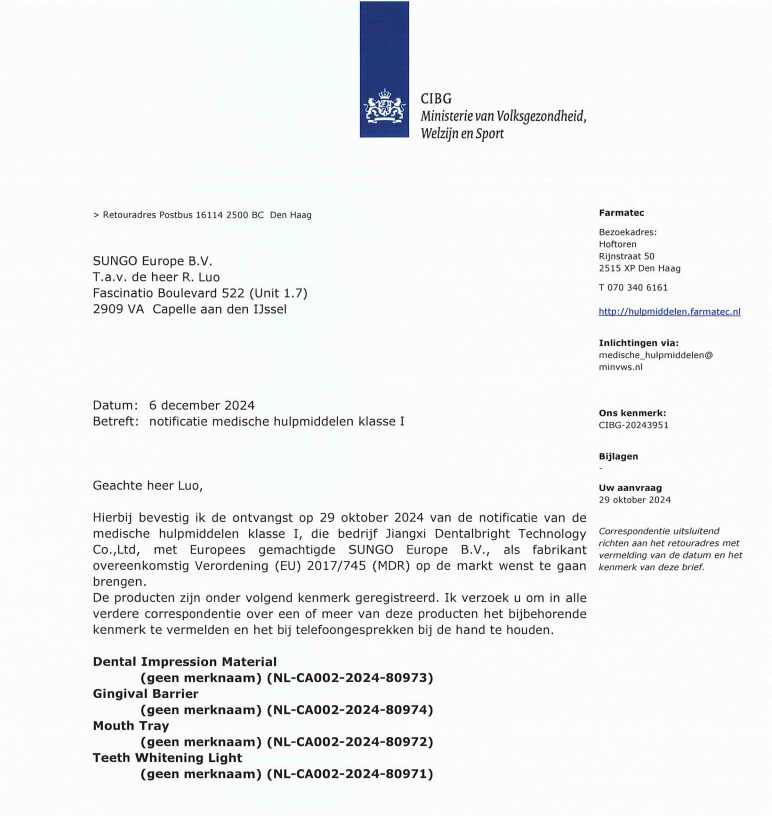
Reading Certificates Correctly: Scope Beats Volume
A certificate image proves very little on its own. Four attributes matter more than the logo in the header: the legal entity named on the document, the manufacturing site it refers to, the product scope it defines, and the period for which it is valid.
This is where classification boundaries become visible in practice. An MDR-CE certificate is issued for a defined device scope and does not automatically cover every kit in a catalogue. A buyer ordering a professional clinic kit containing 35% hydrogen peroxide and a home LED kit from the same factory may be ordering two products that sit in different documentation frameworks. Both can be legitimate; they are simply not evidenced by the same piece of paper.
The same logic applies to quality-system certificates. ISO 13485 and ISO 22716 are different standards with different scopes, one oriented to medical devices and the other to cosmetic good manufacturing practice. A site that holds both demonstrates a broader capability than a site that holds one, but neither certificate authorises a specific product for sale.
Where GlorySmile Factory Sits in This Landscape
Jiangxi Dentalbright Technology Co., Ltd., operating as Glorysmile Factory, is an oral care manufacturer based in the Makou Industrial District, Yongxiu Town, Nanchang, Jiangxi Province, China. The company was founded in 2008 and completed its current factory in 2013. The facility covers 36,000 m2, including 20,000 m2 of 100,000-class cleanrooms and a 1,000-square-metre laboratory with a 100-class cleanroom dedicated to microbiological testing, which supports in-house verification of raw materials, semi-finished goods and finished products.
The site employs 256 people, including a 17-member R&D team, an 11-member quality team, an 8-member production management team and a 6-member packaging design team. The manufacturer holds both medical device and cosmetics production licences and is certified to MDSAP, ISO 13485, ISO 22716, US GMP, BSCI, HALAL and VEGAN. Its products are stated to comply with FDA, CE, CPSR, PIF and CPNP requirements, and the company reports exports to 102 countries with the EU, the USA and the UK among its main markets, accounting for around 90% of output.
On the EU file specifically, the company reports completed CPNP notification, a prepared CPSR and an appointed EU Responsible Person for cosmetic products, and MDR-CE certification with a complete Technical File and appointed EU Responsible Person for its medical-device products. This is the kind of structure that allows a buyer to map a specific SKU to a specific route, rather than accepting a general statement of compliance that may not survive an importer's review.
The product families carrying these documents include LED whitening kits such as GS-001B and GS-001Y, both certified to MDSAP, ISO 13485, ISO 22716, GMP and BSCI, the rechargeable GS-001X with a charging and sterilisation case, the plug-and-play GS-001J powered through iPhone, Android, Type-C and USB adapters, the non-branded DB-001M, and the clinic-format GS-001L built around a 35% hydrogen peroxide gel with gum protector and cheek retractor. Formulation options across the range include hydrogen peroxide, carbamide peroxide, PAP, sodium phytate, sodium bicarbonate and charcoal.
Technical Explanation: Formulation Chemistry Drives the Documentation Route
The reason two visually identical kits can require different paperwork is chemistry. Hydrogen peroxide and carbamide peroxide are small-molecule penetrating agents: they move through the enamel into the dentin and break down deeper pigments through free-radical oxidation. PAP, or phthalimidoperoxycaproic acid, is a large-molecule surface-acting agent; its molecular size prevents it from penetrating the tooth structure, so it oxidises surface stains instead. Peroxide systems tend to act faster and are more likely to cause temporary sensitivity, while PAP systems are gentler and slower to show visible results.
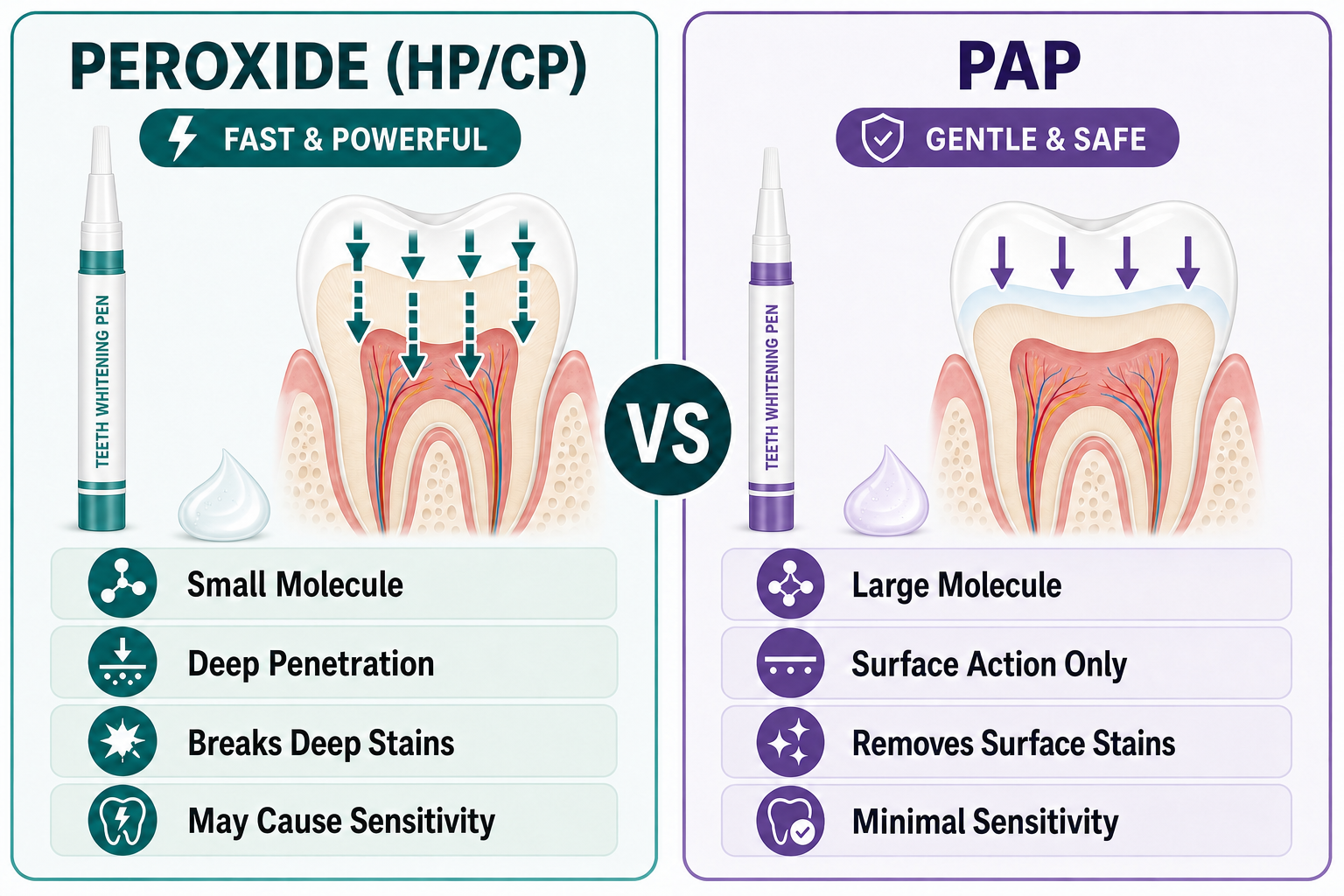
That technical difference carries a regulatory consequence. A peroxide formulation at or above the 0.1% hydrogen peroxide level falls inside the scope of Directive 2011/84/EU and its dentist first-treatment requirement. A peroxide-free PAP formulation avoids that specific threshold, which is one reason PAP-based kits are easier to place as cosmetic products in many markets. Third-party commentary from The Insight Partners notes that global demand for PAP+ peroxide-free whitening kits is rising as an alternative to traditional peroxide, driven largely by sensitivity concerns.
| Formulation family | Typical EU placement | Buyer-facing implication |
|---|---|---|
| Hydrogen peroxide, 0.1% to 6% | Cosmetic route, subject to the first-treatment-by-a-dentist requirement under Directive 2011/84/EU | Channel selection and instructions for use must reflect the practitioner step |
| Peroxide systems placed as devices | MDR route: MDR-CE certification, complete Technical File, EU Responsible Person | Certificate scope must be matched to the exact device configuration |
| PAP and peroxide-free formats | Generally positioned within the cosmetic route | Still requires CPSR, PIF, CPNP notification and an EU Responsible Person |
Application: Where These Questions Decide the Deal
Different end channels load the documentation differently, and the practical requirements show up in the way applications are specified.
For daily home whitening, a typical configuration combines a whitening light, whitening gel, shade guide and user manual, used once a day for 10 to 30 minutes per treatment, with removal of exogenous stains from coffee, tea and tobacco as the core function and anti-sensitivity protection as a supporting claim. The compliance conditions attached to that scenario are specific: formulations labelled strictly for adults and children aged 16 and over, BPA-free tray material, and certification referencing FDA, CE and CPSR requirements.
For retail and FMCG private label, requirements shift toward enamel-safe formulas, a zero-peroxide option, individually wrapped strips and safety-sealed bottles, with the same 16-and-over labelling condition and an alcohol-free formulation where the product is a rinse. For professional clinic formats, the kit itself changes: a 35% hydrogen peroxide gel supplied with a gum protector and curved needles, cheek retractor, brush-ups, vitamin-E swabs, saliva towels, face gauze and bibs. There, the documentation question becomes one of device-route evidence rather than retail labelling.
In all three cases, the same three questions determine whether an order proceeds: which route applies, which documents evidence that route, and whether the certificate scope matches the exact model code being purchased.
Market Trend Analysis
Three trends shape how EU documentation questions will be asked over the next several years.
The first is scale. The global teeth whitening market was valued at USD 8.93 billion in 2025 and is projected to reach USD 14.31 billion by 2034, according to Fortune Business Insights. Growth of that order keeps new brands entering the category, and new brands are frequently the buyers least prepared for classification questions at the point of purchase.
The second is formulation migration. PAP+ peroxide-free kits are gaining ground because they reduce sensitivity and simplify cosmetic positioning, a shift noted by The Insight Partners. As more of the category moves toward peroxide-free formats, the dentist first-treatment threshold evolves from a universal condition into a differentiator between product lines.
The third is standards alignment. The US FDA recognises ISO 28399:2021 as a consensus standard for external tooth bleaching products, which signals movement toward a common technical reference for testing and labelling across markets. Customs treatment is also being clarified in practice: US Customs and Border Protection ruled under GRI 3(b) that teeth whitening strips imported from China take their essential character from the strips themselves, classifying them under subheading 3306.90.0000. Disputes of that kind are settled on documentation, not on product appearance.
Comparison with Traditional Solutions
The traditional sourcing pattern for whitening kits runs through trading intermediaries that aggregate products from multiple factories. That model can be efficient on price and range, but it separates the party holding the documents from the party signing the sales contract. When an EU importer asks for a Technical File, a CPNP record or a named EU Responsible Person, the intermediary frequently has to go back to the factory, and the answer takes as long as the factory takes.
| Dimension | Trading intermediary model | Manufacturer with in-house regulatory scope |
|---|---|---|
| Source of certificates | Forwarded from third-party factories | Held and issued by the site that manufactures the product |
| Technical File and MDR-CE | Availability depends on the upstream supplier | Held for registered medical-device products |
| EU Responsible Person | Must be sourced or confirmed case by case | Appointed as part of the EU documentation route |
| MSDS, COA, specification | Provided only if the upstream factory supplies them | Provided from the manufacturing and QC system |
| Response to a formulation change | New supplier chain, new document cycle | In-house R&D and QC update the affected documents |
| Accountability | Split across two or more legal entities | Single entity holding production and quality licences |
A published comparison of certification matrices shows how coverage can differ between suppliers facing the same market requirements. GlorySmile's listed matrix covers CE, UKCA, FCC, RoHS, MDSAP, GMP, ISO 22716, ISO 13485, CPSR, MoCRA, CPNP and PIF. IVISMILE's listed matrix covers CE, GMP, ISO 22716, CPSR and RoHS. On the same comparison, formulation ranges are broadly comparable, with both offering HP 0.1 to 35%, CP 0.1 to 44% and peroxide-free PAP options. That is precisely the point: similar products can arrive with different documentation depth, and the buyer's task is to match depth and scope to the intended market.
Limits and boundaries buyers should expect
- A longer certificate list is not automatically a stronger file. The relevant test is whether the listed scope covers the exact model, configuration and formulation being purchased.
- No supplier can absorb the EU importer's own obligations. The importer remains responsible for placing a compliant product on the market, and the EU Responsible Person must be appointed and named in the applicable notification.
- MDR-CE certification is scoped. Adding a new device configuration, a new claim or a new sterilisation format generally requires conformity work before that configuration can be sold under the existing certificate.
- Cosmetic documents follow the product. A CPSR and PIF reflect a specific formulation, packaging material and labelling claim set; when any of those changes, the documents must be updated rather than superseded by an older version.
- Documentation cannot repair a wrong classification. If a product is placed as a cosmetic when its claims and concentration place it in the medical-device route, the gap is a market-entry risk rather than a missing file.
Execution Stage: Commercial Terms That Sit Alongside the Documentation
Once the document set is understood, the remaining variables are the commercial terms that govern how documentation is delivered alongside goods. GlorySmile's published purchasing terms set the standard-packaging minimum order quantity at 5 boxes, with OEM orders ranging from 100 to 1,000 boxes depending on the custom packaging minimum. Delivery terms include EXW, FCA, FOB and CFR. Payment terms are 30% deposit in advance with the 70% balance before shipment, and acceptance is supported through on-site inspection or pre-shipment random inspection carried out by the supplier's quality department.
For a multi-year distribution agreement, these terms matter because compliance is not a one-time purchase. A formulation update, a packaging change or a new market listing can each trigger a fresh documentation cycle, and a supplier's lead time on documents affects continuity as much as its lead time on goods.
Future Outlook
The direction of travel is toward documented, scope-matched compliance rather than certificate collection. Three developments are worth tracking. First, peroxide-free PAP+ formats will continue to expand, shifting more of the category into the cosmetic route and reducing the number of products affected by the first-treatment threshold. Second, standards alignment around references such as ISO 28399:2021 will make it easier for buyers to compare test evidence between suppliers rather than comparing logos. Third, distributors will increasingly verify document scope at each contract renewal, because the party carrying the EU-market risk is the importer, not the factory.
For buyers, the practical implication is a shift in what a long-term supplier relationship means. The durable partnerships tend to be those in which the manufacturer can reproduce the same documentation set for the same model series year after year, and can answer a classification question with a document rather than an assurance. A detailed product and packaging catalogue covering the GlorySmile range is available for download: GlorySmile product and packaging catalogue (PDF).
FAQ
Which EU documents apply to a teeth whitening kit placed as a cosmetic?
Cosmetic products for the EU market are supported by a CPSR (Cosmetic Product Safety Report), a CPNP notification and a PIF, with an EU Responsible Person appointed as required by EU cosmetic regulations. Supporting documents typically requested alongside these include the product specification, MSDS and COA of raw materials.
Do teeth whitening kits require MDR registration in the European Union?
It depends on how the product is classified. Medical-device products hold MDR-CE certification, supported by a complete Technical File and an appointed EU Responsible Person. Products placed as cosmetics follow the cosmetic route, with CPSR, CPNP notification and an EU Responsible Person, rather than MDR registration.
Can a buyer receive an MSDS for the whitening gel?
Yes. An MSDS is available for the whitening formulations. It is normally requested together with the COA of raw materials and the product specification, which together describe the hazard profile, batch reference and technical parameters of the formulation.
What is the difference between factory certificates and product certificates?
Factory-level certificates in the GlorySmile documentation set include CE, FDA, CPSR, CPNP, PIF, SCPN, MSDS, COA, RoHS, HALAL and Vegan. Product-level certificates include GMP, ISO 22716, ISO 13485, MDSAP and BSCI. Factory certificates describe the manufacturing and quality system, while product certificates relate to the manufacturing standards applied to the product itself.
What changes if a whitening formula contains between 0.1% and 6% hydrogen peroxide?
Under Directive 2011/84/EU, teeth whitening products containing between 0.1% and 6% hydrogen peroxide require a first treatment by a dentist. In practice, this affects the distribution channel, the instructions for use and the labelling claims, not only the formulation sheet.
What commercial terms usually accompany compliance documentation at the execution stage?
For standard packaging, the minimum order quantity is 5 boxes; for OEM orders with customized packaging, the MOQ ranges from 100 to 1,000 boxes depending mainly on the packaging minimum. Delivery terms include EXW, FCA, FOB and CFR. Payment terms are 30% deposit in advance with the 70% balance before shipment, and acceptance is supported through on-site inspection or pre-shipment random inspection by the supplier's quality department.