
EU PPWR Compliance: What Custom Packaging Exporters Must Prove
EU PPWR Compliance: What Custom Packaging Exporters Must Prove
The EU Packaging and Packaging Waste Regulation (PPWR) entered its main application phase in August 2026. For importers buying eco-friendly custom packaging from overseas manufacturers, the deciding question is no longer whether a supplier says “sustainable”, but whether it can hand over certificate numbers, scopes, validity dates and test evidence that survive a retailer or customs review.
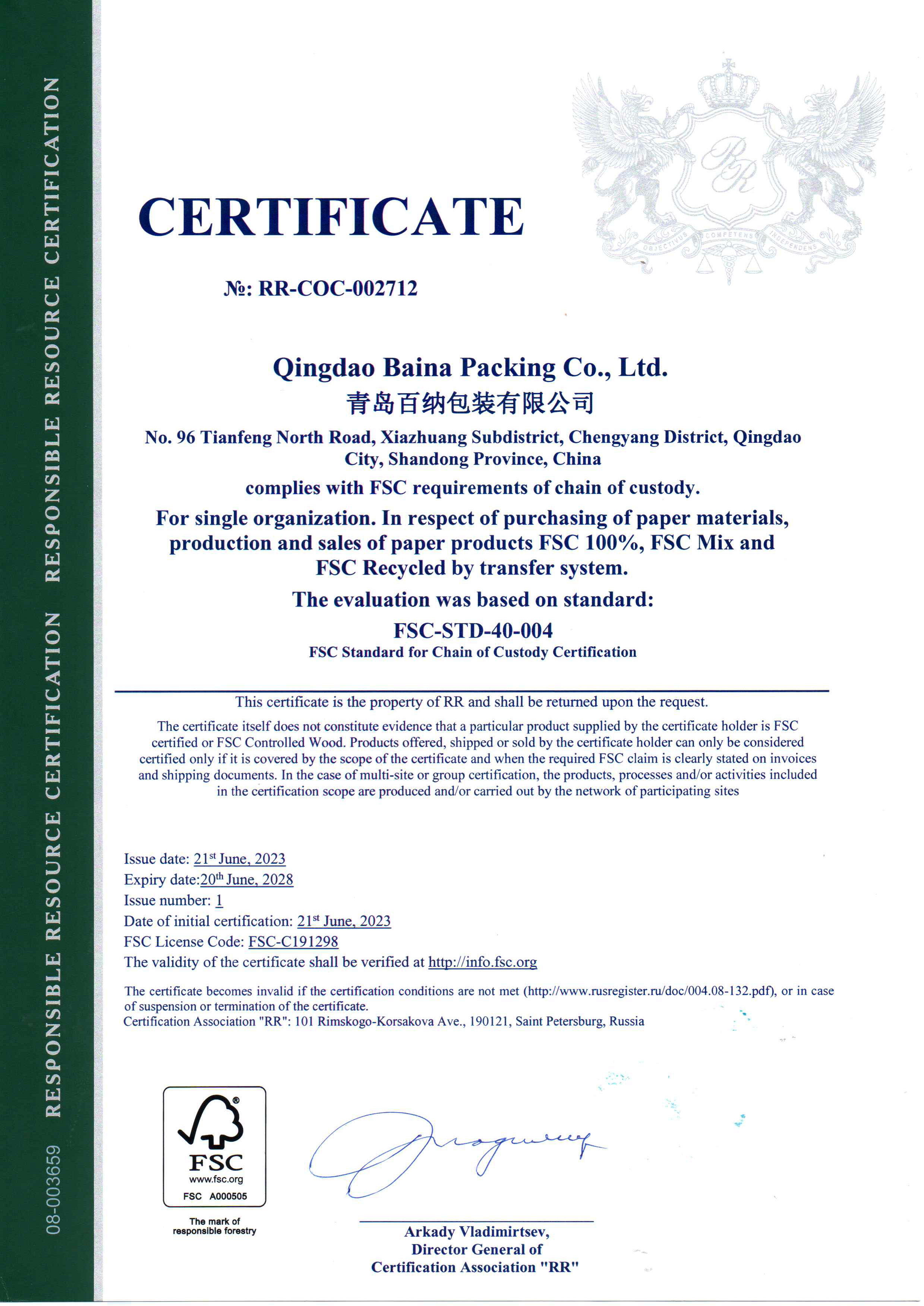
A chain-of-custody certificate is the document that connects a paper packaging supplier’s fibre sourcing to an auditable system — not to a marketing claim.
This article looks at PPWR compliance from the buyer’s side of the table: which documents importers should request, what each document actually proves, where the limits of certification sit, and how a manufacturer’s certificate set maps onto specific box structures such as folding cartons, corrugated mailers and rigid gift boxes.
Why the PPWR timeline reshapes a 2026 sourcing decision
PPWR is not a voluntary label. It is a regulation with fixed dates, and the dates determine when documentation becomes mandatory rather than optional in a purchase file.
| Milestone | Date | What it means for an importer |
|---|---|---|
| PPWR adopted | 19 December 2024 | The legal text is fixed; member state implementation and enforcement planning begin. |
| Entry into force | 11 February 2025 | Compliance planning starts for packaging placed on the EU market. |
| Main application phase | From August 2026 | Packaging files are now assessed against the regulation’s core requirements. |
| Recyclability requirement | By 2030 | All packaging must be recyclable, and specific recycled content targets apply. Material choice becomes a design constraint. |
| Extended Producer Responsibility (EPR) coverage | 63 countries as of 2025 | Registration and fee obligations increasingly follow the packaging, not the seller’s location. |
The European Commission confirms the recyclability-by-2030 requirement and the recycled content targets; the adoption and application timeline is documented in legal analyses of the regulation. For an importer, the operational takeaway is narrow: every packaging specification should now be traceable to a document, and every document should be traceable to a legal entity, a scope and a validity window.
The compliance gap: marketing claims are not a compliance file
Sourcing conversations usually start with adjectives. Suppliers describe packaging as eco-friendly, recyclable, biodegradable or plastic-free long before they produce a certificate. That language is not useless, but it cannot be filed. A retailer’s compliance team, a customs broker or an EPR scheme administrator will ask a different set of questions, and those questions are answerable only with documents.
In practice, four questions separate a defensible specification from a claim:
- Which legal entity holds the certificate? The name on the certificate must match the entity that manufactures the order, or the relationship between the two must be documented.
- What scope does the certificate cover? A quality certificate for “paper packaging box sales” is not the same as one for “production and sales of paper products”.
- What is the validity window? Certificates expire, and an expired audit report can stall a retail onboarding process.
- Which finished product does the evidence apply to? A food-contact test on one board, ink and glue combination does not automatically extend to a different finish.
The opportunity for buyers is that these four questions are cheap to ask before tooling and printing begin, and expensive to ask after a container has been produced.
A document-to-claim map for importers
The table below maps the claims importers most often see to the documents that actually support them, together with the limit of each document.
| Document requested | What it verifies | Where it stops |
|---|---|---|
| FSC Chain of Custody (CoC) certificate | That fibre is tracked from certified sources and the site is audited against a chain-of-custody standard such as FSC-STD-40-004 v.3-0 | Covers fibre sourcing, not the recyclability of the finished box |
| ISO 9001:2015 certificate | A documented quality management system for a defined scope of production or sales | Does not certify environmental or social performance |
| SMETA / Sedex audit report | Labour and health & safety conditions at the audited production site under a recognised methodology | Two-pillar audits exclude environment and business ethics |
| Food-contact test report | That a specific board, ink and glue combination passed food contact safety testing | Applies to the tested configuration only |
| Drop and compression test results | Transport safety of a specific structure and board grade | Structure-specific; does not transfer to a redesigned box |
| Material composition declaration | Board, ink, glue, inserts and any hardware in the finished pack | Must be checked against the actual purchase order bill of materials |
| PPWR compliance statement | The supplier’s position on the regulation and its market access assumptions | Should be read only alongside the documents above |
How a manufacturer’s certificate set is structured in practice
Qingdao Bejan Giant New Packaging Technology Co., Ltd., trading as BEJAN GIANT NEW PACKAGING, is a Qingdao-based paper packaging manufacturer founded in 2014. It operates a 10,000 m² facility with 200+ employees and a stated annual output of 100,000,000 units, exports approximately 80% of production to the EU, USA, UK, Japan, Australia, Canada and Korea, and builds its main line-up around three structures: Rigid Gift Box, Corrugated E-commerce Mailer Box and Folding Paper Carton Box.
Its documentation set is a useful worked example of what a PPWR-oriented buyer should expect, because each document covers a different layer of the compliance question.
| Certificate | Number | Issuing authority | Scope | Validity |
|---|---|---|---|---|
| FSC Chain of Custody (FSC COC) | RR-COC-001255 | Russian Register | Purchasing of paper materials; production and sales of paper products (FSC 100%, FSC Mix, FSC Recycled), per FSC-STD-40-004 v.3-0 | 21 June 2023 – 20 June 2028 |
| ISO 9001 quality management system | 452QMS2100010 | QINGDAO GFS CERTIFICATION CO.,LTD. | Production and sales of paper products, GB/T 19001-2016 / ISO 9001:2015 | 18 October 2021 – 17 October 2027 |
| ISO 9001 quality management system | 10422Q01616R0S | SHANDONG SEATONE INTERNATIONAL CERTIFICATION CO.,LTD. | Paper handicraft design; paper packaging box sales, GB/T 19001-2016 / ISO 9001:2015 | 30 August 2022 – 29 August 2028 |
| SMETA ethical trade audit report (SMETA 6.1, 2 pillars: Labour & Health and Safety) | ZAA600099300 (Sedex co-ref ZC416599564; site-ref ZS416684560) | Openview Service Limited | All production areas of Qingdao Baina Packaging Co., Ltd. (corrugated carton and colour box workshop) | 18 November 2024 – 17 November 2026 |
SMETA 6.1 audit report ZAA600099300 covers labour and health & safety conditions across the audited corrugated carton and colour box production areas — a document type increasingly requested by EU and UK retail buyers.
Two details distinguish this set from a generic “FSC certified” claim. First, the FSC number RR-COC-001255 is verifiable against the issuing body, so an importer can confirm the entity and the scope rather than accepting a logo. Second, the company holds two separate ISO 9001 certificates with different scopes — one covering production and sales of paper products, the other covering paper handicraft design and paper packaging box sales. Buyers mapping a purchase order to a certificate should check which scope actually applies to the ordered item.
Alongside these certificates, the manufacturer’s company profile declares FDA compliance together with FSC and ISO 9001, states that its packaging is 100% recyclable, and states that its products comply with the latest EU PPWR regulations. Those statements are the supplier’s declared position. For FDA-relevant or food-contact configurations, the practical step for an importer is to request the underlying document rather than the sentence. Product-level evidence exists at that level: the Folding Paper Carton Box is described as having passed a food contact safety test, in addition to drop and compression testing.
What the certificate set does and does not cover
Certification is often presented as a single green light. It is more accurate to read it as a set of overlapping but partial signals, each with a boundary.
- Chain of custody is not recyclability. FSC COC certification confirms how fibre is sourced and tracked. It does not certify that a finished box satisfies PPWR’s design-for-recycling criteria or any national recycling label.
- Social audits have pillar limits. The SMETA report held here is a two-pillar audit covering labour and health & safety. Environmental performance and business ethics sit outside that reported scope.
- Validity windows must be managed. The SMETA report runs to 17 November 2026 and the ISO 9001 certificates to October 2027 and August 2028 respectively. Renewal timing belongs in the purchasing calendar, not in an emergency email.
- Scope must match the order. A certificate covering design and sales is not automatically a certificate covering production of the specific item being purchased.
- “Plastic-free” is a configuration, not a default. A rigid gift box built with a magnetic closure contains metal hardware; lamination, foil stamping and foam or EVA inserts change the material composition of a pack.
- Certificates describe a site, not a shipment. Order-level documents such as inspection records and batch traceability remain necessary.
From certificate to box: the material decisions a PPWR file turns on
PPWR compliance cannot be resolved at the certificate level alone, because recyclability is a property of the finished pack. The material and finishing decisions made at sampling stage determine how cleanly a box behaves in a paper stream.
In this manufacturer’s configuration, the paper side of the specification is consistent across the three main structures. Rigid gift boxes use 1.5–3 mm high-density FSC grey board wrapped in FSC eco outer paper, with recycled coated eco paper as an alternative outer material. Folding cartons use 250–400 gsm FSC-certified FBB/SBS white cardboard or recycled paperboard. Corrugated e-commerce mailers use FSC-certified E/B flute corrugated board. Printing uses food-grade soy-based eco ink, bonding uses water-based starch glue, and matching accessories include molded pulp inserts — a mono-material approach rather than a mixed-material one.
Two design choices are worth flagging for a compliance file. The corrugated mailer uses an automatic self-locking structure that closes without adhesive tape, which removes a mixed-material element from the pack. The rigid gift box can be supplied in an FSC-certified all-paper plastic-free configuration and is described as passing FEFCO drop and compression testing, with a foldable flat style available for freight efficiency.
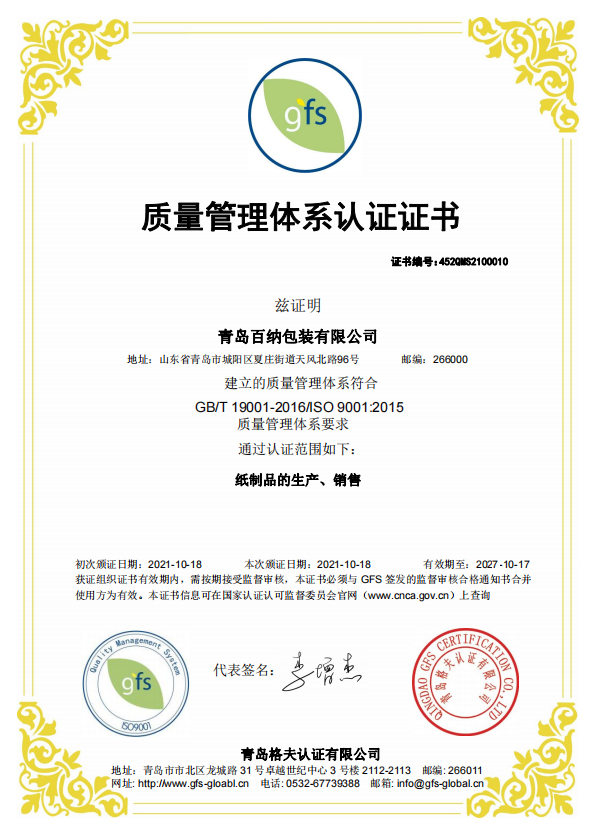
ISO 9001:2015 certificate 452QMS2100010 covers production and sales of paper products — a scope statement that should be matched against the specific item on a purchase order.
Product-level evidence: three structures, three documentation profiles
| Structure | Model | Core material | Stated daily output | Documentation relevance | Typical scenario |
|---|---|---|---|---|---|
| Folding Paper Carton Box | BP-FBB-CARTON03 | 250–400 gsm FSC-certified FBB/SBS white cardboard, recycled paperboard | ≥60,000 pcs | All-paper eco configuration; passed food contact safety test; passed drop and compression test | Beauty & skincare, fragrance and candle cartons, chocolate and tea retail boxes, pet snacks |
| Corrugated E-commerce Mailer Box | BP-MAIL-EB01 | FSC-certified E/B flute corrugated board | ≥40,000 pcs | FSC board sourcing; tape-free self-locking structure; molded pulp inserts | Cross-border e-commerce, apparel, cosmetics, artisan food, subscription-style shipments |
| Rigid Gift Box | BP-RIGID-GIFT02 | 1.5–3 mm FSC high-density grey board with FSC eco outer wrapping paper | ≥25,000 pcs | FSC-certified all-paper plastic-free configuration available; passes FEFCO drop and compression test | Jewellery, cosmetics, candles, wine, premium gift sets |
Listed starting unit prices are USD 0.3 for the folding carton, USD 0.5 for the corrugated mailer and USD 1.5 for the rigid gift box; these are starting points that move with board grade, size, insert type and finishing. The minimum order quantity is 500 units, standard lead time is 7–15 days, and monthly capacity is stated at 30,000,000 units, which is the production scale a documentation review is normally assessed against.
Where documentation decides the order: application scenarios
Documentation matters most in scenarios where packaging crosses a border and then enters a retail or marketplace compliance process.
For a cross-border DTC brand selling supplements, skincare or artisan food, the corrugated mailer is usually the first item to be scrutinised, because it is the pack the consumer receives and the pack most likely to be mentioned in marketplace sustainability disclosures. FSC board sourcing, a tape-free closure and molded pulp inserts reduce the number of materials that need to be explained.
For beauty, food and tea brands selling through retail shelves, the folding carton carries the food-contact question. The relevant evidence is the food contact safety test on the specific board, ink and glue combination, alongside drop and compression results that support transport claims.
For premium and gifting categories, the rigid box is the hardest case, because structure and finish are part of the product experience. An FSC-certified all-paper plastic-free configuration is the version that is easiest to document, while magnetic closures and foil finishes need to be declared explicitly in the material composition statement.
One long-running supply relationship illustrates why continuity of documents matters as much as the documents themselves. A cross-border DTC brand and foreign trade wholesaler across Korea, Israel and the United States orders 5,000–50,000 pieces per batch of cosmetic, wine and food outer packaging on a 3–5 year repeat basis. The result recorded is stable packaging quality and smooth customs clearance, with the highlighted factors being full FSC certification, complete pre-shipment inspection support, a stable delivery cycle and transparent cost accounting. The compliance value here is not the first order but the fifth: the same certificate set, scope and inspection routine applied across repeat batches.
Market trend: why documentation is becoming a purchasing filter
The commercial context explains why compliance evidence has moved from a legal formality to a shortlisting criterion. The global sustainable packaging market was valued at USD 272.9 billion in 2023, with Europe holding a 36.2% revenue share — the region with the most binding regulatory framework is also the largest single market. Grand View Research projects the market to reach USD 448.5 billion by 2030, growing at a CAGR of 7.6%, while Mordor Intelligence estimates USD 325.94 billion by 2026.
Material and product mix reinforce the same direction. Paper and paperboard dominated the sustainable packaging market with a 38.2% share in 2024, and boxes and cartons accounted for 33.6% of the market in the same year, driven by e-commerce growth. The mailers and envelopes segment is growing at a 9.41% CAGR through 2031 — precisely the structure whose compliance profile depends on board sourcing and closure design.
Regulatory pressure is broadening in parallel. EPR regulations for packaging now span 63 countries as of 2025, which means packaging specifications increasingly travel with registration and fee obligations. On the commercial side, premium custom packaging typically adds USD 0.30 to USD 0.75 per unit compared with generic alternatives, and PDI Technologies reported in 2024 that 80% of consumers surveyed were willing to pay more for products with sustainable packaging.
Read together, these figures describe a market where the cost of packaging is rising, the regulatory surface is expanding, and consumer expectation is already established. In that environment, a supplier that cannot produce a certificate number, a scope statement and a test report becomes a supply-chain risk rather than a price advantage.
Source factory versus intermediary: what changes in a compliance file
| Dimension | Direct manufacturer | Intermediary or trading layer |
|---|---|---|
| Certificate ownership | Certificate is held by the producing entity and can be verified by number | Certificate may belong to a third-party workshop, requiring a documented relationship |
| Fibre traceability | Chain of custody applies to the site purchasing and converting the board | Traceability depends on disclosure from subcontractors |
| Scope alignment | Scope can be mapped to the specific production line and item | Scope often covers trading activity rather than production |
| Change control | Material, ink and glue changes occur inside one quality system | Changes may occur across multiple unconnected sites |
| Inspection access | Pre-shipment inspection and third-party on-site inspection can be arranged at the producing site | Inspection access depends on the workshop’s cooperation |
The honest boundary is that a direct manufacturer is not automatically the right choice for every buyer, and an intermediary is not automatically non-compliant. For domestic, low-risk, non-exported packaging with no retailer compliance process attached, a trading layer may be entirely adequate and simpler to manage. The direct-factory model becomes decisive mainly when packaging crosses a border, enters a retail onboarding process, or sits inside an EPR filing.
There are also practical constraints on the manufacturer side that buyers should plan around. Minimum order quantity starts at 500 units, standard lead time runs 7–15 days, and delivery terms are EXW Qingdao factory or FOB Qingdao, which means freight and destination charges sit with the buyer. Certification scopes are entity- and site-specific, so a certificate held for one production area does not automatically extend to every process. And no supplier certificate removes the importer’s own PPWR and EPR obligations — registration, fee payment and market-facing declarations remain the importer’s responsibility.
Future outlook
The direction of travel is toward material-level disclosure. As the 2030 recyclability requirement approaches, packaging specifications will be assessed less on what a supplier states and more on what can be reconstructed from documents: which mill supplied the board, which ink and adhesive were used, which inserts were included, and which test standard the structure passed.
Three changes are worth anticipating in sourcing planning. First, mono-material paper configurations will continue to displace mixed-material packs, because they are easier to document and easier to recycle. Second, certificate management will become an operational routine rather than a one-time request, with expiry dates, scope revisions and audit renewals tracked alongside order schedules. Third, as EPR coverage expands across 63 countries and beyond, importers will increasingly ask suppliers for order-level traceability, not only site-level certification.
For exporters of eco-friendly custom packaging, the competitive advantage in this environment is administrative as much as industrial: the ability to respond to a compliance questionnaire with a certificate number, a scope statement, a validity date and a test report, within hours rather than weeks.
FAQ
Does PPWR compliance require a specific certificate, or is a supplier declaration enough?
PPWR is a regulation rather than a certification scheme, so there is no single “PPWR certificate”. The regulation was adopted on 19 December 2024, entered into force on 11 February 2025, and its main application phase began in August 2026, with all packaging required to be recyclable by 2030 and specific recycled content targets applying. A supplier declaration is a starting point, but importers normally support it with a chain-of-custody certificate for fibre, a quality management certificate for the production site, test reports for the specific structure, and a material composition statement that matches the purchase order.
What does an FSC Chain of Custody certificate such as RR-COC-001255 actually cover?
FSC Chain of Custody certificate RR-COC-001255 is issued by Russian Register and covers the purchasing of paper materials and the production and sales of paper products, including FSC 100%, FSC Mix and FSC Recycled categories, audited against FSC-STD-40-004 v.3-0. It was issued on 21 June 2023 and is valid to 20 June 2028. The certificate confirms that fibre is tracked through an audited chain of custody. It does not certify that a finished box meets PPWR recyclability criteria, and it does not cover food-contact safety or social conditions.
Why should an importer request ISO 9001:2015 in addition to FSC?
The two documents answer different questions. FSC addresses fibre sourcing; ISO 9001 addresses process control. The manufacturer referenced here holds two ISO 9001 certificates under the GB/T 19001-2016 / ISO 9001:2015 standard: certificate 452QMS2100010, issued by QINGDAO GFS CERTIFICATION CO.,LTD. on 18 October 2021 and valid to 17 October 2027, covering production and sales of paper products; and certificate 10422Q01616R0S, issued by SHANDONG SEATONE INTERNATIONAL CERTIFICATION CO.,LTD. on 30 August 2022 and valid to 29 August 2028, covering paper handicraft design and paper packaging box sales. For a buyer, that means batch consistency and corrective-action procedures are documented under an audited system, though ISO 9001 does not certify environmental or social performance.
How does a SMETA report fit into an EU or UK retail compliance file?
SMETA is an ethical trade audit methodology used by many EU, UK and overseas supermarket buyers. The report held here, certificate ZAA600099300 with Sedex co-reference ZC416599564 and site-reference ZS416684560, was issued by Openview Service Limited on 18 November 2024 and is valid to 17 November 2026. It follows SMETA 6.1 with two pillars — Labour and Health & Safety — and covers all production areas of Qingdao Baina Packaging Co., Ltd., specifically the corrugated carton and colour box workshop. Because it is a two-pillar audit, environmental performance and business ethics fall outside the reported scope and would need separate evidence if a buyer requires them.
Which packaging structures can be supplied as all-paper, plastic-free configurations?
Three structures in this manufacturer’s range are documented as paper-based configurations. The Folding Paper Carton Box (BP-FBB-CARTON03) is an all-paper eco configuration using 250–400 gsm FSC-certified FBB/SBS white cardboard or recycled paperboard, and has passed a food contact safety test plus drop and compression testing. The Corrugated E-commerce Mailer Box (BP-MAIL-EB01) uses FSC-certified E/B flute corrugated board with a self-locking structure that requires no adhesive tape, and supports molded pulp inserts. The Rigid Gift Box (BP-RIGID-GIFT02) is available in an FSC-certified all-paper plastic-free configuration, using 1.5–3 mm FSC grey board and FSC eco outer wrapping paper.
What are the limits of a supplier’s certificate set?
Several limits apply and are worth stating plainly. Chain-of-custody certification covers fibre, not the recyclability of the finished pack. Certification scopes are entity- and site-specific, so a certificate can apply to one production area or one activity rather than the whole operation. Validity windows are finite — the SMETA report noted above expires on 17 November 2026. Social audits with two pillars exclude environment and business ethics. Plastic-free status depends on the exact configuration, since magnetic hardware, lamination, foil stamping and foam or EVA inserts change the material composition. Finally, supplier certificates support but do not replace the importer’s own PPWR and EPR registration and declaration duties.
What documentation should be requested before the first production run?
A practical pre-production request set includes: the FSC chain-of-custody certificate with number and validity, the ISO 9001 certificate whose scope matches the ordered item, the SMETA or equivalent social audit report with its pillar scope, the material composition declaration for the exact bill of materials, and test reports for the specific structure — food contact testing where applicable, plus drop and compression results. Commercial terms worth confirming at the same time are the minimum order quantity of 500 units, the 7–15 day standard lead time, delivery on EXW Qingdao factory or FOB Qingdao terms, and the inspection arrangement, which in this case is 100% inspection before shipment with compression resistance testing available and on-site third-party inspection by SGS supported.
Reference material
A full English-language brochure covering box structures, material specifications and certification scope is available for download: BEJAN GIANT NEW PACKAGING English brochure.