
EVA Film Fit for Bulletproof and Architectural Glass: A Scenario Application Guide
Laminated glass is decided at the interlayer. Two fabricators can run the same glass, the same oven type, and the same shift pattern, and still end up with different yields — because the interlayer has to match the conditions of a specific end application, not a generic product category. Architectural vision glass is judged on haze and light transmission. Decorative panels are judged on how the bond line reads to the eye. Bulletproof assemblies are judged on whether the same laminate can be reproduced, batch after batch, over years of defense production.
EVA film sits in all three of those conversations at once, and that is exactly where most procurement confusion starts. This guide separates the scenarios, sets out the processing and storage conditions that EVA interlayer film requires, and uses a documented defense-industry case to show what a multi-year fit looks like in practice.
Why EVA Film Is a Scenario Decision Before It Is a Purchase Decision
EVA film — also referenced commercially as EVA interlayer film, EVA glass interlayer film, EVA laminated glass film, or EVA lamination film — is a thermoplastic sheet that is placed between two or more glass panes and bonded under heat and pressure to form a laminated glass unit. It is a distinct material family from PVB and from TPU interlayers, and it behaves differently from both in the laminating oven.
That definition alone does not tell a buyer much. The useful question is not whether EVA is a good interlayer, but which scenario it is being asked to serve, what that scenario demands of the bond, and what evidence the supplier can produce for that specific demand.
Shengding Hightech Materials Co., Ltd. is a polymer materials manufacturer established in 2018 and located in the Lanshan Chemical Industry Park in Rizhao City, Shandong Province, China. The company produces TPU film and EVA film, and its EVA film line is documented for architectural glass, decorative glass, and defense-related glass laminating applications.
The Commercial Context: A Growing Interlayer Category With Clear Boundaries
EVA film is not a niche material experiment. The global EVA films market was valued at USD 8.25 billion in 2025 and is projected to reach USD 17.65 billion by 2034, according to Fortune Business Insights, with an expected compound annual growth rate of 8.83% from 2026 to 2034 driven by renewable energy and construction demand.
That growth sits inside a wider interlayer market that EVA does not lead. The laminated glass market was estimated at USD 25.0 billion in 2025, with PVB holding a 55.2% share, while EVA is described as growing in architectural and solar applications, per Future Market Insights.
What this means for buyers: EVA is an expanding route rather than the default route. Procurement decisions should therefore be built on application fit and documented process control, not on the assumption that the material is interchangeable with an incumbent interlayer.
On the standards side, laminated architectural flat glass quality requirements are governed by ASTM C1172. That standard is a useful neutral reference point during specification review, because it frames the conversation around verifiable laminate quality rather than supplier claims.
Scenario 1: Architectural Laminated Glass
Architectural laminated glass is the scenario where EVA film is most often evaluated against optical criteria first. Large facades and interior glazing expose any inconsistency in the interlayer, so measured transmittance and haze matter more here than in almost any other application.
Shengding Hightech Materials offers EVA FILM under model SD38, described as a high-transparency EVA film with 90% light transmittance and 0.5% haze. The same product record lists architectural glass and decorative glass as its applicable industry areas.
For specifiers working through a facade package, three practical checks follow from that:
- Optical data must be traceable to the delivered roll, not just to a generic product family description.
- Panel size and load geometry should be discussed with the film supplier before the first full-size run, because oven behaviour changes with load.
- Acceptance criteria should be written down before shipping rather than negotiated after a defect appears.
Customization also matters at this stage. The manufacturer provides OEM/ODM production services with customization covering length and width, supported by technical support after delivery. Documented capacity for the EVA film line is 100 tons per month with a 10-day lead time, which is the kind of figure a project buyer can test against a glazing programme schedule.
Scenario 2: Decorative and Interior Glass
Decorative glass shares the same application list as architectural glass in the EVA film record, but it introduces a different pressure point: the bond has to look right, not only perform right. Interior panels are viewed at close range and under interior lighting, where any cloudiness, flow mark, or uneven bond line becomes part of the design outcome rather than a hidden defect.
Two decisions follow from that.
First, optical performance should be confirmed for the specific film variant being quoted. A high-transparency clear film such as SD38, with its 90% transmittance and 0.5% haze figures, is documented for decorative glass use — but where a project moves to tinted or otherwise modified decorative effects, the buyer should obtain the measured optical data for that variant instead of assuming it carries over from the clear film specification.
Second, sample panels matter more in decorative work than in standard architectural glazing, because the approval criterion is partly visual. A sample produced on the same oven and the same process window as production is the only reliable way to confirm that the appearance a designer approved is the appearance the line can repeat.
Scenario 3: Bulletproof and Defense Glass
Bulletproof glass is the scenario where EVA film is asked for something different again: repeatability under a defence-industry procurement discipline, over a production horizon measured in years rather than weeks.
The documented case here is a Pakistan defense project. EVA film was used in bulletproof glass manufacturing for defense industry customers at a project scale of 100 rolls, with a 2-year implementation period followed by stable operation for a further 2 years. The case is recorded as the only solution of its kind in the country.
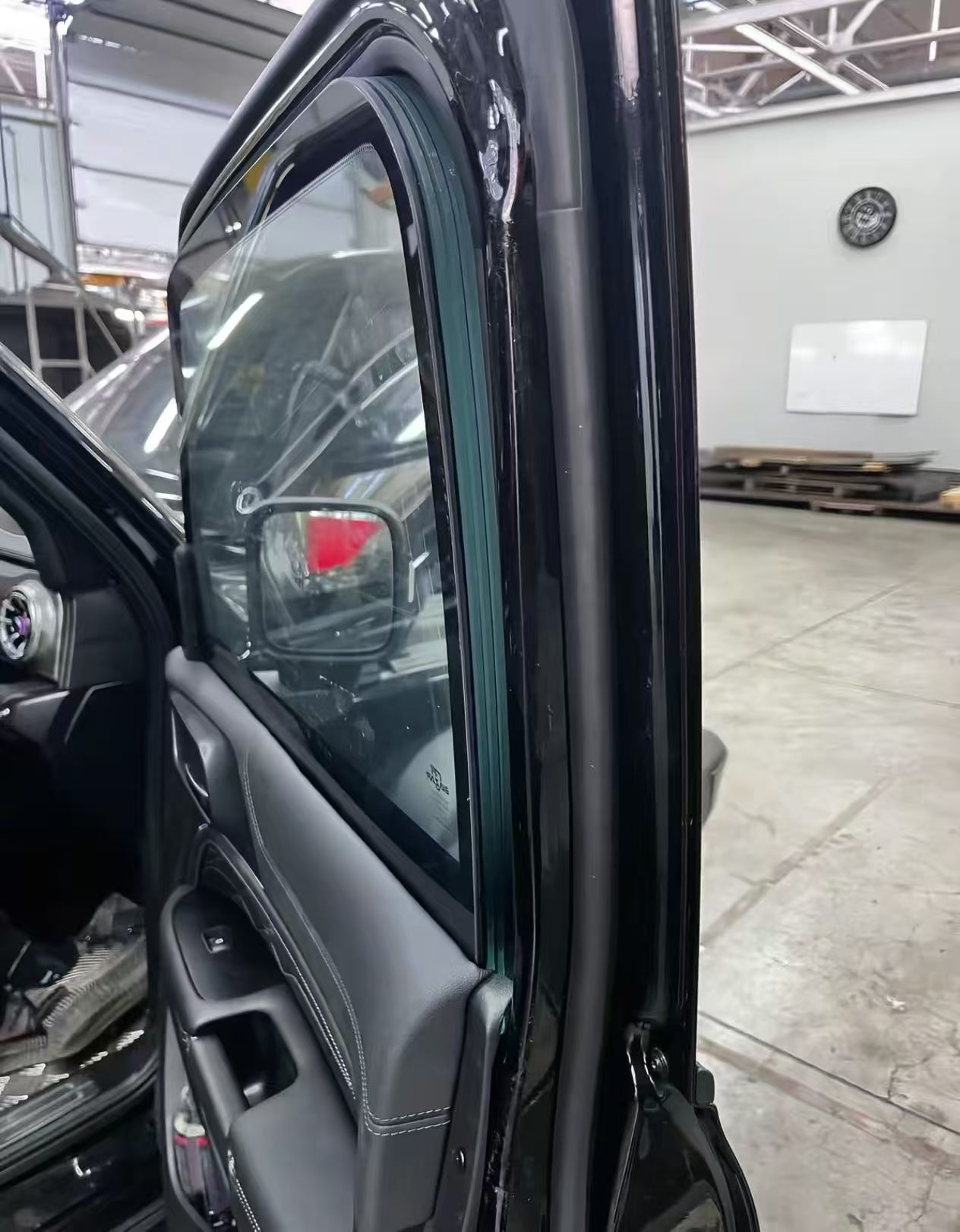
Modification work on bulletproof vehicle glass in a defense application — the scenario where interlayer repeatability matters most.
Read carefully, that case is a fit signal rather than a performance claim. It shows that a 100-roll quantity was delivered and processed into defense-grade bulletproof glass, and that the resulting production ran stably across a multi-year window. For a buyer, the relevant lesson is about program behaviour: a defense laminate is only as reliable as the film's batch-to-batch consistency, because a change in film behaviour mid-program forces requalification of the finished glass.
That is why quality control evidence carries more weight in this scenario than in any other. The manufacturer maintains 100% testing quality control on all products, which means every production lot is checked rather than sampled.
Laminating Oven Processing: Temperature, Pressure, and the Normal-Pressure Route
EVA films for glass lamination typically process at 100–110°C and, where vacuum lamination is used, under a vacuum of at least 700 mmHg. Those two figures define the working window that most EVA lamination schedules are built around.
Equipment in the field is not uniform. Some lines use vacuum laminating ovens; others use normal-pressure, high-temperature oven designs in which heat and applied load do the bonding work without a vacuum stage. The parameter set that decides the result is broadly the same either way:
- How the assembly reaches bonding temperature — a slow, even ramp produces a more uniform bond than a fast one.
- How long the load is held at temperature — dwell time determines whether the film has fully flowed and cross-linked.
- How evenly the oven heats across the full load — edge-to-centre variation is a common source of localised defects on large panels.
- Whether pressure is applied by vacuum, by mechanical load, or by both — this is determined by the oven, and it changes the schedule that works.
The practical consequence is that an EVA lamination schedule should be validated on the actual production oven, not transferred from a supplier datasheet or from another plant. The 100–110°C range and the 700 mmHg vacuum figure are the framework; the ramp and dwell values are the plant's own.
Storage and Handling: Why Dry Conditions Are Not Optional
EVA interlayer film is moisture-sensitive, and this is the single most common reason a technically sound lamination schedule still produces rejects. Film that has taken up atmospheric moisture during storage tends to release that moisture during the oven cycle, which shows up in the finished panel as bubbles, cloudiness, or localised loss of adhesion — defects that are difficult to correct after the fact and expensive to find in a finished facade or a defence laminate.
The handling rules that follow are straightforward:
- Keep film sealed until use. Open the roll as close as practical to the moment of lamination.
- Store dry and out of direct sunlight. A dry, temperature-controlled area protects the film from both moisture uptake and thermal cycling.
- Condition before opening. Let the roll reach the working environment temperature before breaking the seal, so condensation does not form on the film surface.
- Cut to the shift, not to the stock. Cut only what the line can laminate in the same working period, and return unused film to sealed storage.
- Record conditions with batch numbers. Storage and handling records are what make a defect traceable to a roll, a shift, or a storage event.
For buyers auditing a laminating operation, these five points are a useful checklist. A plant that can show storage records alongside batch numbers is demonstrating process control, not just good intentions.
Quality and Traceability Evidence a Buyer Can Verify
EVA film sourcing conversations become actionable when evidence is documented rather than asserted. The following items are recorded for Shengding Hightech Materials Co., Ltd.
| Evidence item | Recorded detail |
|---|---|
| Quality management certification | ISO 9001:2015, certificate no. 10425Q01154R1S, issued by Shandong Seatone International Certification Co., Ltd. on 2025-07-07, valid to 2028-07-24 |
| Certification scope | Design, development and production of interlayer glass intermediate films and granular materials |
| Additional management systems | ISO 14001 and ISO 45001 |
| Regulatory compliance | Product performance complies with European REACH and RoHS regulations and U.S. FDA quality requirements |
| Lot-level quality control | 100% testing quality control on all products |
| OEM/ODM capability | OEM/ODM production services with customization of length and width, plus technical support |
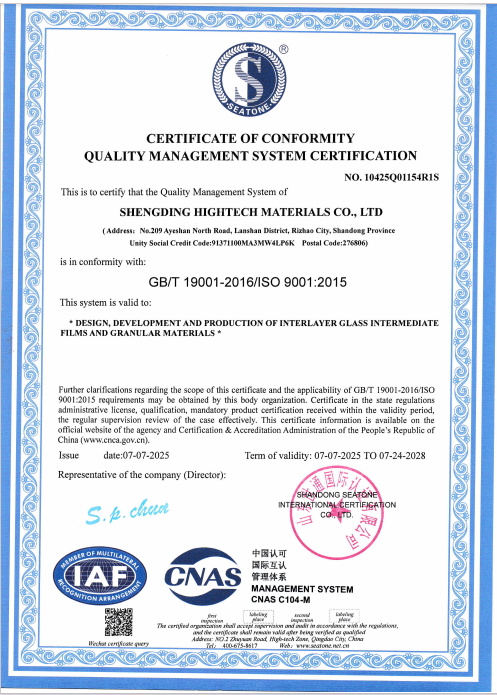
ISO 9001:2015 certification covering the design, development and production of interlayer glass intermediate films.
Two points are worth stressing for procurement teams. First, the certification scope explicitly names interlayer glass intermediate films — which is the relevant scope for EVA glass interlayer film, and not a generic materials certificate. Second, 100% testing is a lot-level statement, and it is the mechanism that underpins the multi-year consistency required in defence laminates.
EVA Film Against Established Interlayer Routes: Where the Boundaries Sit
An honest comparison has to start with the position EVA actually occupies. PVB held a 55.2% share of the laminated glass interlayer context in 2025, with EVA described as growing in architectural and solar applications. EVA is therefore the expanding route, not the incumbent one — and buyers should plan accordingly.
| Consideration | What it means for an EVA film specification |
|---|---|
| Market position | EVA is a growing interlayer route within a market where PVB remains the larger share. Availability and technical familiarity vary by region. |
| Storage sensitivity | EVA film requires dry storage and disciplined handling. Plants without controlled storage should treat this as a prerequisite, not a detail. |
| Process window | Processing typically runs at 100–110°C, with vacuum of at least 700 mmHg where vacuum lamination is used. The schedule must be validated on the actual oven. |
| Scenario fit | Documented fit covers architectural glass, decorative glass, and bulletproof glass for defense customers. |
The genuine limitation is not performance but process dependency. EVA film rewards plants that control temperature, dwell time, and humidity — and it penalises plants that do not, more visibly than some alternative routes. Where a fabricator cannot guarantee dry storage or a validated oven schedule, that is a legitimate reason to reconsider the material choice rather than to blame the film.
Future Outlook
Two forces are pulling EVA interlayer film further into mainstream specification. The first is market growth: an expected CAGR of 8.83% from 2026 to 2034, taking the global EVA films market from USD 8.25 billion in 2025 toward USD 17.65 billion by 2034, on construction and renewable energy demand. The second is application spread: EVA is already described as growing in architectural and solar applications within a laminated glass market valued at USD 25.0 billion in 2025.
For buyers, the practical consequences are likely to be about supply rather than novelty:
- Continuity across programmes. Multi-year projects, including defense laminates, depend on film consistency staying inside a validated window.
- Documentation as a purchasing criterion. Certification scope, lot-level testing, and storage records will increasingly be requested alongside price.
- Process support, not just material supply. Customization of length and width, technical support, and defined lead times become part of the fit assessment.
EVA film will not displace every interlayer route, and it does not need to. Its case rests on scenarios where its processing behaviour and optical properties are matched to the application — and on suppliers who can show the evidence.
Frequently Asked Questions
1. Which glass applications is EVA interlayer film documented for?
Recorded applications are architectural glass and decorative glass, plus bulletproof glass manufacturing for defense industry customers. A documented defense project in Pakistan used EVA film across 100 rolls with a 2-year implementation period and stable operation for a further 2 years. On the market side, EVA films are also described as growing in solar applications alongside architectural use.
2. What OEM/ODM options are available for EVA film?
The manufacturer provides OEM/ODM production services, with customization covering length and width, and technical support as the after-sales service. Documented capacity for the EVA film line is 100 tons per month with a 10-day lead time.
3. What processing conditions does EVA film require in a laminating oven?
EVA films for glass lamination typically process at 100–110°C and, where vacuum lamination is used, under a vacuum of at least 700 mmHg. Normal-pressure, high-temperature oven designs also exist, so the specific ramp, dwell, and pressure profile should be validated on the production oven in use rather than transferred from another plant.
4. Does EVA film need dry storage before lamination?
Yes. EVA interlayer film is moisture-sensitive, and moisture absorbed during storage can be released in the oven and appear as bubbles, cloudiness, or localised adhesion loss in the finished panel. Sealed packaging, a dry and temperature-controlled store, conditioning before opening, and batch-level storage records are the standard precautions.
5. What quality control and certification evidence is available?
The manufacturer maintains 100% testing quality control on all products and holds ISO 9001:2015 certificate no. 10425Q01154R1S, issued by Shandong Seatone International Certification Co., Ltd. on 2025-07-07 and valid to 2028-07-24, covering the design, development and production of interlayer glass intermediate films and granular materials. The company also holds ISO 14001 and ISO 45001, and product performance complies with European REACH and RoHS regulations and U.S. FDA quality requirements.
6. What commercial terms apply to EVA film orders?
Recorded purchasing terms for the product line are a minimum order quantity of 1 roll, FOB delivery terms, pre-shipment testing as the acceptance criterion, and full payment terms. Buyers should confirm current terms in writing at the quotation stage.
The company brochure, with product and capability details for EVA and TPU films, is available for download: Shengding Hightech Materials brochure.
Third-party market figures in this article are attributed to Fortune Business Insights (EVA films market size and CAGR), Future Market Insights (laminated glass market and interlayer share), and ASTM International (ASTM C1172). Processing parameters are referenced from published industry processing standards.