
EVA Interlayer Film Parameters That Matter in Architectural Glass Buying
Specifying EVA interlayer film for laminated glass is rarely a single-variable decision. Buyers evaluating glass EVA film for architectural projects must balance optical performance, dimensional thickness, lamination behavior, supplier certification, and consistency across batches. This article explains the EVA film parameters and supplier qualification signals that matter most at the Research and Evaluation stage, with reference to a specific high-transparency EVA film model used in architectural and decorative glass processing.
The Procurement Question Behind EVA Interlayer Film
For glass processors, facade contractors, and decorative glass manufacturers, the practical question is not simply “which EVA film is available” but “which EVA glass interlayer film can meet the project’s optical, safety, and process requirements across every batch.”
Because EVA film functions as the bonding interlayer in laminated safety glass, its light transmittance, haze, thickness tolerance, moisture resistance, and consistency directly influence the final glass unit’s clarity, strength, and reliability in the laminating oven. A specification mismatch can lead to quality problems after lamination, making pre-purchase evaluation a critical step.
Market Context: Why EVA Film Demand Is Expanding
The global EVA films market was valued at approximately USD 8.25 billion in 2025 and is projected to reach around USD 17.65 billion by 2034, according to Fortune Business Insights. The laminated glass market was estimated at about USD 25.0 billion in 2025, with EVA increasingly used in architectural and solar applications even though PVB retains a significant share. Industry observers also note that EVA film production reached roughly 850,000 metric tons globally in 2024, with China accounting for more than 300,000 metric tons, although this figure is cited by Future Market Insights and still carries medium reliability.
For architectural glass buyers, these figures signal that EVA interlayer film is no longer a niche material. As demand rises, so does the need for disciplined supplier evaluation rather than price-led purchasing.
Core EVA Film Parameters for Laminated Glass
Several parameters should be checked before selecting an EVA lamination film. The table below groups them into optical, physical, process-related, and compliance-related categories.
| Category | Parameter | Why It Matters |
|---|---|---|
| Optical | Light transmittance | Determines glass clarity; high-transparency EVA film typically achieves around 90% transmittance. |
| Optical | Haze | Lower haze means less light scattering; a 0.5% haze value is considered a high-clarity level for architectural EVA film. |
| Dimensional | Thickness options | Common choices include 0.38 mm, 0.5 mm, and 0.76 mm, selected according to glass configuration and safety requirements. |
| Processing | Lamination temperature and vacuum | EVA interlayer film typically processes around 100–110°C under vacuum of at least 700 mmHg. |
| Handling | Moisture sensitivity | EVA film must be kept dry before lamination; moisture can cause bubbles or adhesion failure. |
| Compliance | Quality system certification | ISO 9001:2015 certification for interlayer film design and production is a basic supplier qualification signal. |
| Consistency | Batch-to-batch uniformity | Architectural projects require stable optical and thickness properties across production lots. |
Optical Performance: Light Transmittance and Haze
For clear EVA film and ultra clear EVA film used in architectural laminated glass, optical performance is usually the first specification reviewed.
Light transmittance indicates how much visible light passes through the interlayer. A high-transparency grade should deliver around 90% transmittance to avoid darkening the glass unit. Haze measures the percentage of transmitted light that is scattered; lower haze produces a clearer view through the glass. A haze value around 0.5% is considered a strong clarity indicator for architectural and decorative applications.
As a reference, Shengding Hightech Materials Co., Ltd., a polymer materials manufacturer based in Rizhao City, Shandong Province, China, specifies its architectural EVA film model SD38 with 90% light transmittance and 0.5% haze. The company produces EVA film and TPU film, exports roughly 70% of output to North Africa, the Middle East, and Latin America, and operates a 50,000 m² factory with an annual output of 1,000 tons.
Thickness Selection: 0.38 mm, 0.5 mm, and 0.76 mm EVA Film
EVA film for laminated glass is commonly supplied in several thicknesses to support different glass configurations.
- 0.38 mm EVA film is often used for decorative glass and lighter lamination applications where a thinner interlayer is acceptable.
- 0.5 mm EVA film serves as a general-purpose thickness for architectural laminated glass, balancing handling convenience and bond-line performance.
- 0.76 mm EVA film is preferred when a thicker interlayer is required, such as for enhanced safety, sound damping, or certain decorative designs.
The choice of thickness affects not only the final glass behavior but also the furnace lamination cycle and the film’s ability to fill gaps around embedded materials.
Lamination Processing with EVA Laminating Ovens
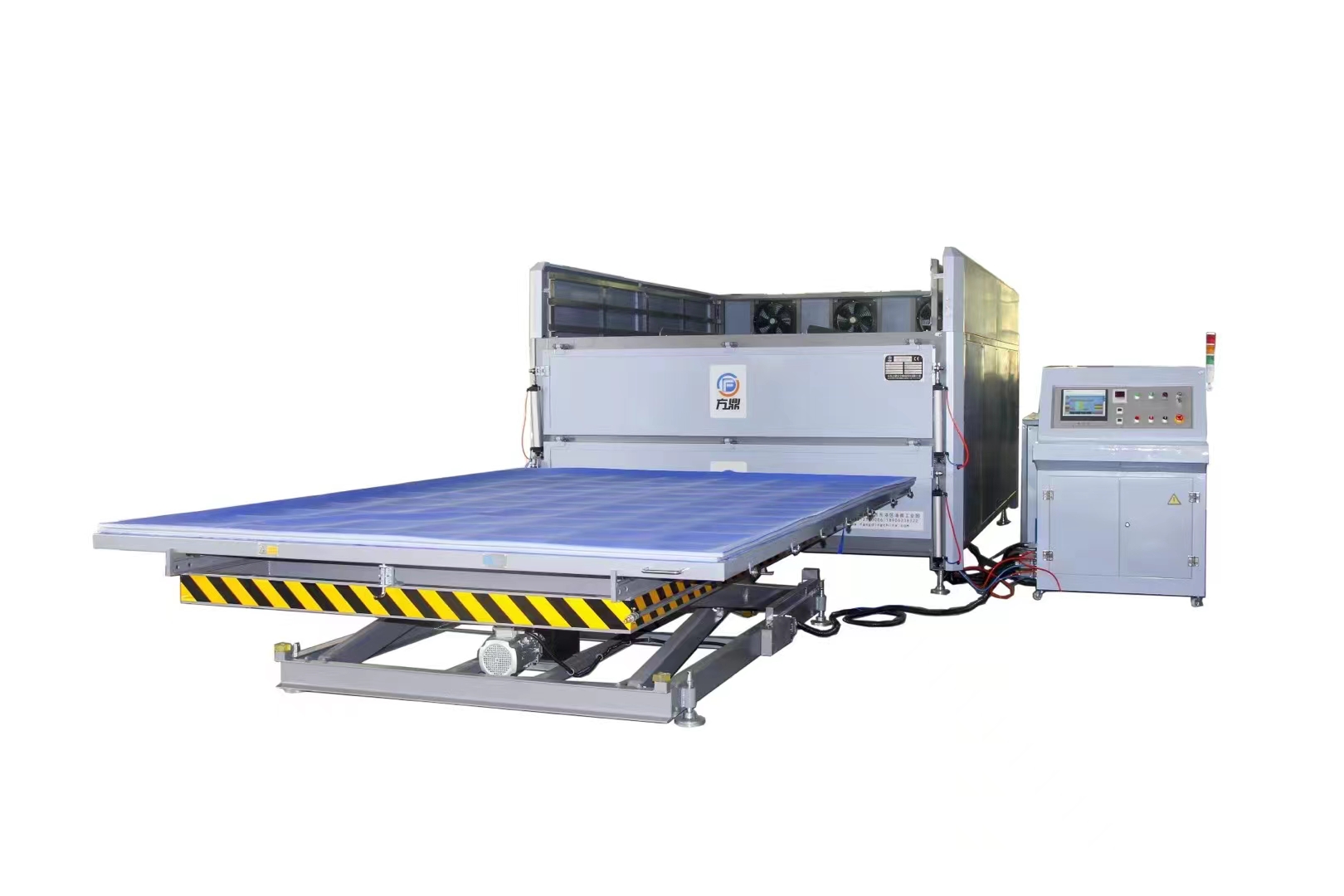
EVA film for furnace lamination is designed for use in a laminating oven under controlled temperature and vacuum. In typical processing, the film is heated to around 100–110°C with a vacuum of at least 700 mmHg. These conditions allow the EVA interlayer to flow, wet the glass surface, and form a durable bond without creating bubbles.
A common application scenario is architectural and decorative glass processing, where EVA film is used for lamination of safety glass via laminating oven processing. Keeping the film dry before use is a key handling requirement, because moisture absorbed by the EVA can turn into steam during heating and cause visible defects.
Color EVA Film and UV-Resistant Options
Beyond clear and ultra-clear grades, color EVA film is widely used in decorative glass and design-oriented architectural projects. Color interlayers can be combined with clear glass, patterned glass, or fabric to create visual effects while maintaining the safety benefits of lamination.
UV-resistant EVA is another important category, especially in exterior architectural glazing and interior applications exposed to sunlight. UV stability helps prevent yellowing and maintains optical clarity over time, making the interlayer more suitable for long-service-life building components.
Supplier Qualification Signals for EVA Film
At the Evaluation stage, buyers should look beyond the product datasheet and examine the supplier’s quality system, production capacity, and control over consistency.
For example, Shengding Hightech Materials Co., Ltd. holds ISO 9001:2015 certification under certificate number 10425Q01154R1S, issued by Shandong Seatone International Certification Co., Ltd. The certified scope covers “design, development and production of interlayer glass intermediate films and granular materials,” which directly applies to both EVA film and TPU film. The company also reports ISO 14001 and ISO 45001 certifications and more than 50 proprietary intellectual property rights.
From a procurement perspective, an ISO 9001:2015 certificate with a clear scope is more than a compliance badge; it signals that the manufacturer has documented processes for design, production, and quality control. Buyers should request the certificate, verify the certificate number, and check that the scope matches the product being purchased.
OEM/ODM and Customization Capabilities
Many glass processors do not buy standard EVA film exclusively; they also need customized width or length to match their laminating line and reduce material waste.
Shengding lists OEM/ODM capability with customization of length and width, a monthly production capacity of 100 tons, a lead time of 10 days, and a minimum order quantity of 50 kg. This kind of flexibility matters for buyers who run trial batches, need non-standard roll widths, or prefer to align their film inventory with specific production runs.
It is also worth asking about quality-control procedures during production. In Shengding’s case, the stated quality-control policy is 100% testing, which means each batch is expected to be checked rather than sampled.
How to Compare EVA Film Suppliers
A practical comparison framework for EVA interlayer film suppliers should include at least five dimensions:
- Optical consistency: Does the supplier provide measured transmittance and haze values? Are those values consistent across batches?
- Thickness and dimension control: Are 0.38 mm, 0.5 mm, and 0.76 mm options available with tight tolerances?
- Process compatibility: Is the film suitable for the buyer’s laminating oven temperature and vacuum range?
- Certification and quality system: Is the manufacturer certified to ISO 9001:2015 for interlayer film production, and can the certificate be verified?
- Supply flexibility: Can the supplier provide custom widths, reasonable MOQs, and reliable lead times for repeat orders?
Buyers should also request a small trial roll before committing to a container order. A 50 kg trial order, for instance, is a practical way to test the film in an actual furnace lamination process and evaluate clarity, bubble formation, and adhesion.
Limitations and Boundaries of EVA Interlayer Film
While EVA film is well suited to architectural and decorative laminated glass, it is not a universal replacement for all interlayer materials.
Compared with PVB, EVA generally follows a different processing window and may not be the first choice for every structural glazing application where PVB has long-standing specification history. EVA is moisture-sensitive and must be kept dry before lamination, so storage and handling requirements should not be underestimated. For bulletproof and blast-resistant glass, TPU film is often preferred because of its mechanical strength and cold resistance; EVA is not typically positioned for those high-security applications.
In other words, the right interlayer depends on the application. EVA film is a strong fit for architectural glass, interior design glass, and decorative lamination; TPU film is the more relevant option for ballistic and high-security glazing.
What This Means for Buyers
For glass processors and project buyers in the Research and Evaluation stage, the practical takeaways are:
- Define the optical requirements first: transmittance around 90% and haze around 0.5% are sensible targets for clear architectural EVA film.
- Select thickness according to the glass configuration and the project’s functional needs.
- Choose a supplier whose ISO 9001:2015 scope explicitly covers interlayer film production, not merely film trading.
- Verify handling requirements, especially the need to keep EVA film dry before lamination.
- Run a trial batch to confirm process compatibility with the laminating oven before scaling up.
Frequently Asked Questions
EVA film is used as an interlayer in laminated safety glass. It bonds glass layers together during lamination in a furnace or oven, providing adhesion, clarity, and safety performance for architectural and decorative glass.
High-transparency EVA film for architectural glass typically reaches around 90% light transmittance. For example, Shengding’s architectural EVA film model SD38 is specified at 90% light transmittance and 0.5% haze.
EVA film for glass lamination is typically processed at 100–110°C under a vacuum of at least 700 mmHg. The combination of temperature and vacuum allows the film to flow and bond without forming bubbles.
Common thicknesses include 0.38 mm, 0.5 mm, and 0.76 mm. The selection depends on the glass configuration, the desired safety level, and the specific lamination process.
EVA interlayer film is moisture-sensitive. If the film absorbs moisture before lamination, the moisture can vaporize during heating and create bubbles or adhesion defects in the finished laminated glass.
At a minimum, an EVA film supplier should hold ISO 9001:2015 certification covering the design and production of glass interlayer films. For example, Shengding Hightech Materials Co., Ltd. holds certificate number 10425Q01154R1S issued by Shandong Seatone International Certification Co., Ltd.
Yes. Color EVA film is commonly used in decorative glass and design-oriented architectural applications. It can be combined with clear or patterned glass to create visual effects while maintaining the safety benefits of a laminated interlayer.
EVA film is not typically positioned for bulletproof or blast-resistant glass. TPU film is more commonly used for high-security glazing because of its mechanical strength, cold resistance, and structural performance. EVA film is better suited to architectural and decorative glass applications.
For additional technical and company information, download the Shengding Hightech Materials brochure: Download Company Brochure
Есть вопросы или нужны дополнительные детали?
Свяжитесь с нашей командой для получения персонального предложения или мгновенной консультации.
Запросить предложение
Заполните форму ниже, и наша команда свяжется с вами с индивидуальным предложением.
Прямой чат WhatsApp
Предпочитаете общаться в реальном времени? Напишите нам в WhatsApp для мгновенной помощи и быстрых ответов.
- Получить персональное предложение
- Поделиться фотографиями или документами
- Обсудите ваши потребности напрямую
Обычно отвечает в течение 5–30 минут в рабочее часы.