
Eco Friendly Organic Sanitary Pads: Private-Label Buyer FAQ
Eco friendly organic sanitary pads are disposable menstrual pads whose skin-contact layer is built from an organic fibre — certified organic cotton or bamboo fibre — over a pulp-and-SAP absorbent core, with an optional biodegradable backsheet or wrapper. For private-label buyers, almost every decision on such a line is settled before the first purchase order exists: which layer carries the claim, how many sampling rounds a formulation needs, what a test report actually covers, and whether one partner can move a mixed-SKU container. This reference answers those questions in the order they arise during evaluation.
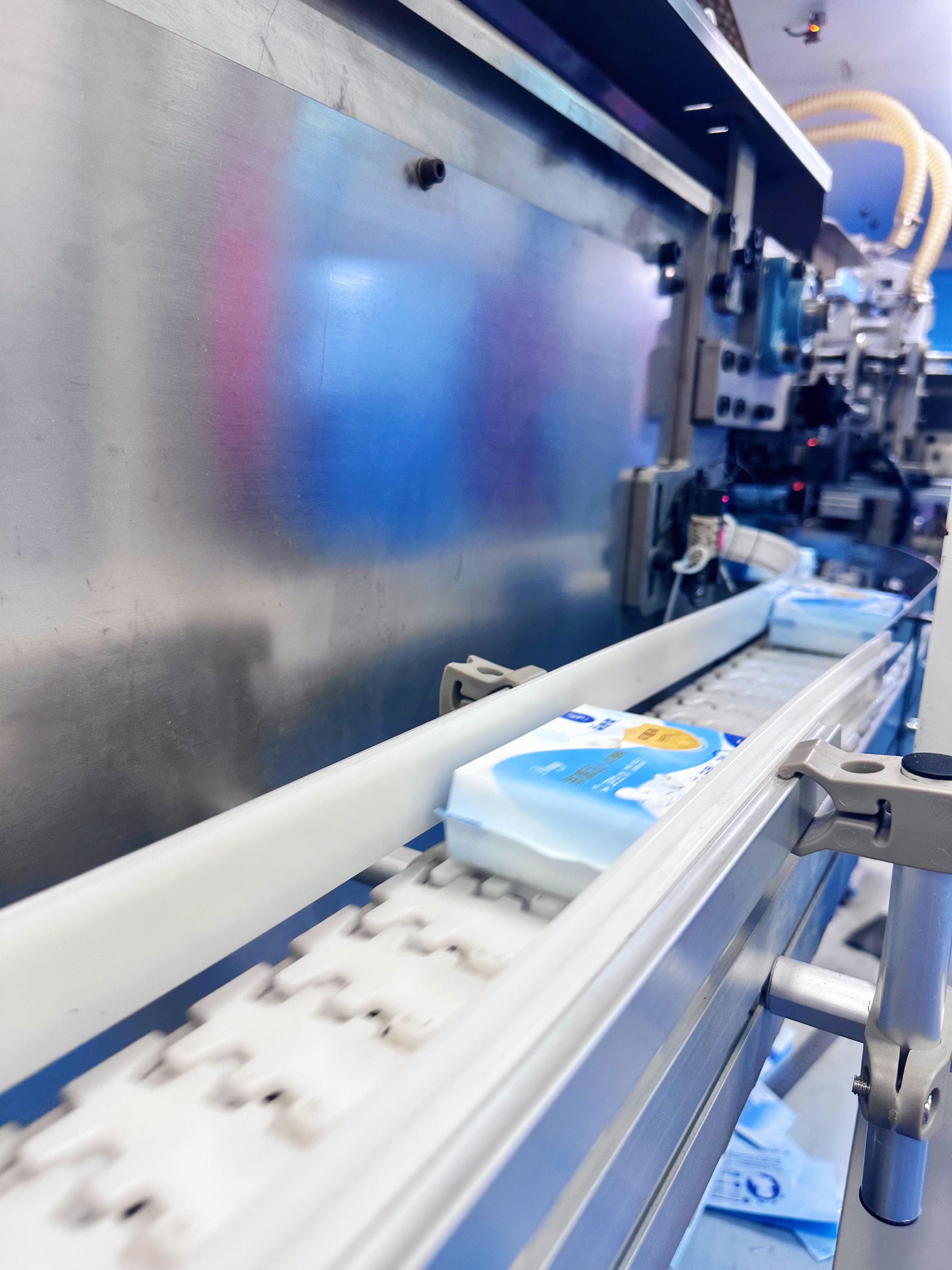
A feminine hygiene production line of the kind used for private-label day-use, night-use and panty liner SKUs. Image: New Upward SC (Guangdong) Co., Ltd.
Why the evaluation questions changed
Category growth has widened the comparison set. TechSci Research places the global organic sanitary napkins market at USD 3.02 billion in 2025, with a projection to USD 4.51 billion by 2031. Mark & Spark Solutions reports the biodegradable sanitary napkins segment growing at a CAGR of 20.1% between 2024 and 2030. Dataintelo attributes a 38.6% share of 2025 biodegradable sanitary napkin revenue to Asia Pacific — the same region where most contract capacity for these products is located.
The practical effect for a buyer is not strategic, it is procedural. More suppliers can show a plant-fibre photograph; far fewer can say which layer of the pad the environmental claim refers to, which material-level report supports the skin-contact statement, or how many sampling rounds a cooling variant required before it was approved. Those are the questions that separate a shortlist entry from a program that reaches the shelf.
New Upward SC (Guangdong) Co., Ltd. (Newupward) is a China-based feminine care and disposable hygiene manufacturing and service provider founded in 2017, operating a 200,000 m² facility with 100 employees, a 10+ engineer R&D team, an annual output of 5,000,000,000 pads and an export share of roughly 80% across Europe, North America, the Middle East, Africa, Southeast Asia, Central Asia and South America. Lilimolone is the product brand under which the company's ultra-thin bamboo sanitary pads are marketed.
Material selection: topsheet and absorbent core
Which topsheet should an organic program specify — organic cotton or bamboo fibre?
The two materials answer different claims. Organic cotton is the specification for certification-linked positioning: the organic sanitary pads configuration (model NU07) uses a 100% organic cotton topsheet, which is the layer the GOTS and OCS material-scope certificates attach to. Bamboo fibre is a nonwoven topsheet used in the Lilimolone Ultra-Thin Bamboo Sanitary Pads line, available in 155 mm, 245 mm and 290 mm, and is typically specified when the brand's proposition is softness, breathability and thinness rather than a certified-organic origin claim.
The decision rule is therefore simple: choose organic cotton when the retail claim depends on documented organic content, and choose bamboo fibre when the claim depends on comfort, ultra-thin construction and material-level testing. Both can coexist in one portfolio as separate price tiers.
What actually sits under a “high absorbency” statement?
Absorbency is a construction outcome, not a marketing adjective. In both the NU07 organic cotton pad and the Lilimolone bamboo pad, the absorbent core is a fluff pulp and superabsorbent polymer (SAP) structure, backed by a breathable PE film with a biodegradable film option, with soft nonwoven side layers and wings. Absorbency, thickness and SAP dosage are customer-specified variables rather than fixed catalogue values.
That is why the meaningful buyer question is not “how absorbent is it”, but “which pulp-to-SAP ratio, which pad length and which rewet target are written into my approved sample”. Without a fixed specification, two quotations for the same nominal product are not comparable.
Which layers decide whether a biodegradable claim holds?
In a biodegradable organic sanitary pad specification, the backsheet and the individual wrapper are the layers usually converted to biodegradable film options; the absorbent core remains pulp and SAP. A blanket “fully biodegradable” statement therefore has to be checked layer by layer against the material list, because the topsheet fibre, the core, the adhesive and the release paper are separate material decisions.
Buyers should require the supplier to state which components support the claim and which do not, and should test the wording against local labelling rules before artwork is released.
Can a formulation be customised — for example a cooling sensation?
Yes, within the customization scope available: pad length, shape, thickness, absorbency, wings, organic cotton topsheet, fluff-pulp core, SAP dosage, plant-based backsheet, individual wrapper, pack count, artwork, logo, language version and master carton. Formulation-level changes such as a cooling sensation are handled as a development project rather than a catalogue option.
A documented example is a private-label feminine care brand in Taiwan, China, whose brief combined a distinctive cooling experience with day-use, overnight and extra-long overnight pads plus disposable period pants. Development included selection of topsheet and absorbent-core materials together with a customised cooling formulation, and four rounds of sampling and refinement preceded the first order.
Sampling: how many rounds is normal, and what gets approved
How long does sampling and first production take?
Sample development typically runs 5–15 working days. A new OEM/ODM order is about 25–30 days after specification and artwork confirmation, and a repeat order about 15–20 days. For a formulation change — a cooling variant, a new core structure, a different wrapper — the sampling stage is the schedule risk, not the production stage, and a four-round refinement cycle is a realistic planning assumption for a differentiated SKU.
What should an approved sample record contain?
Approved sample control is one of the stated quality-control steps, alongside incoming material inspection, in-process inspection, absorption/rewet/leakage testing, finished-goods sampling, packaging check, retained samples and batch traceability. In practice, buyers should hold a signed sample covering pad length, thickness, topsheet material, core specification, wrapper, pack count and artwork version — and should confirm that retained samples are kept against the production batch so that a later complaint can be compared with what was approved.
Acceptance criteria: the evidence a buyer can put into a purchase agreement
Certificates are useful only when their scope matches the SKU being bought. The table below separates what each document covers from what it does not, which is the distinction that matters when a document is written into an acceptance clause.
| Document | Reference and body | Scope it covers | Validity on record |
|---|---|---|---|
| In Vitro Cytotoxicity Test Report | No. SDWH-M201900236-1 (E); Sanitation & Environment Technology Institute, Soochow University; ISO 10993-5:2009 | Non-woven fabrics used as skin-contact raw material | To 1 January 2099 |
| Skin Sensitization Test Report for Non-woven fabrics | No. SDWH-M201900236-2 (E); same institute; ISO 10993-10:2010 method | Sensitization of the non-woven raw material | To 1 January 2099 |
| Skin Irritation Test Report for Non-woven fabrics | No. SDWH-M201900236-3 (E); same institute; ISO 10993-10:2010 method | Irritation of the non-woven raw material | To 1 January 2099 |
| Fabric Skin Allergy Test Report | No. 252004820; Guangzhou Inspection Testing and Certification Group (GTTC); GB 15979-2024 basis | Amyas disposable sanitary pads, sterilized grade, 245 mm | Valid until 1 January 2099 |
| Sanitary pad performance and hygiene report | No. 260059776; GTTC; GB/T 8939-2018 and GB 15979-2024 | Lilimolone Ultra-Thin Bamboo Sanitary Pads 245 mm | To 1 January 2099 |
| Bamboo fibre antimicrobial activity report | No. 210285558; GTTC; GB/T 20944.3-2008 | 100% bamboo fibre spunlace nonwoven, material level | To 1 January 2099 |
| GOTS scope certificate | EGL/236426/GOTS/236426260101190405; ECOCERT Greenlife | Certified organic textile material categories | 2026-01-01 to 2026-12-31 |
| OCS scope certificate | EGL/236426/OCS/236426260101190029; ECOCERT Greenlife | Organic content scope, incl. personal care and hygiene | 2026-01-01 to 2026-12-31 |
| FSC Chain of Custody | RINA-COC-001701 / DCI-COC-000148; RINA Services S.p.A. | FSC Mix pulp; manufacture of sanitary towels and similar products | To 2027-05-11 |
| Halal certificate | No. 44521209189851; Halal Foundation Center Hong Kong | Products listed in the certificate attachment | To 2028-01-31 |
| CE Declaration of Conformity | DOC No. H-YG-MD-240414161/01; MDR (EU) 2017/745; EU representative Humiss International B.V. | Feminine hygiene pads 180–420 mm; liners 150–190 mm | To 1 January 2099 |
| EU authorised representative agreement | WeTapeV Euro s.r.o., Czech Republic | Representative mandate for EU market placement | 2026-04-16 to 2027-04-16 |
Why does report scope matter more than the report title?
Because a material-level report and a product-level report answer different questions. The cytotoxicity and sensitization reports issued by Soochow University cover non-woven fabrics — the skin-contact raw material — and do not by themselves certify a finished pad, its adhesives or its packaging. Conversely, a finished-product report such as No. 252004820 applies to a defined product scope, in that case Amyas sterilized-grade 245 mm pads, and should not be assumed to extend to a different size, brand or construction without written confirmation.
A workable acceptance clause names the document, the number, the issuing body, the covered scope and the validity date, and requires written confirmation where the buyer's SKU differs from the tested sample.
How should organic content certificates be treated?
As material-scope evidence, not product certification. The GOTS and OCS certificates held in connection with this supply chain are issued by ECOCERT Greenlife and cover organic textile material categories; both run from 1 January 2026 to 31 December 2026. Buyers placing orders that ship after that window should request the renewed certificate before artwork referring to organic content is printed, and should confirm that the certificate scope actually lists the material being purchased.
Procurement and coordination: one partner, mixed containers, long relationships
Can one China supplier handle product selection, custom packaging, documents and export coordination?
Some can, provided the arrangement is transparent about which activities are performed in-house and which are coordinated with qualified production resources. The verifiable scope includes product selection and specification building, material options, samples, custom packaging and artwork coordination, certificate and test-report references, QC communication, export documentation and after-sales follow-up.
Newupward is positioned as a supply-chain partner across these steps for private-label feminine hygiene products, and holds a Sanitary Products Production and Sales Enterprise Service Level Qualification Certificate (Level 1), Certificate No. SSDY20260609102, issued 9 June 2026 and valid to 8 June 2029, assessed under Q/SSDY 001-2023. That certificate speaks to service capability, not to product testing, so it complements rather than replaces the product-level reports above.
How does a 40HQ order get built across day, overnight and period pants?
A full-container program is a planning exercise rather than a single SKU order. In the documented Taiwan engagement, procurement used 40HQ containers spanning daytime pads, overnight pads, extra-long overnight pads and disposable period pants in multiple sizes, and the range expanded from a single size into a multi-SKU portfolio. Carton configuration, pack count, size mix and pallet pattern have to be agreed before the container is booked, because they are what convert a product list into a loading plan.
Capacity context matters here: monthly capacity is approximately 450 million sanitary pads under full-line operation, with actual available capacity depending on product specification, material readiness and production schedule. MOQ is project-specific and depends on pad size, materials, packaging printing, pack count and testing requirements.
How was a three-year repeat-order relationship built without an in-person meeting?
Through documentation and consistent execution. The same Taiwan partnership has run for more than three years as documented in August 2026, covering product development, bulk supply and repeat orders, established through professional communication without an in-person meeting. The mechanism is unglamorous: a defined sample standard, artwork approval before printing, agreed inspection points, retained samples per batch, and continuity of the specification across reorders.
For a buyer, the transferable lesson is that document discipline substitutes for travel only when both sides treat the approved sample and the report list as the reference point for every subsequent order.

In-process inspection and batch handling inside a feminine hygiene workshop. Image: New Upward SC (Guangdong) Co., Ltd.
Organic programs compared with conventional synthetic-top programs
| Dimension | Conventional synthetic-top program | Organic or bamboo program |
|---|---|---|
| Claim evidence | Usually hygiene and performance testing only | Hygiene and performance testing plus material-scope certificates (GOTS, OCS, FSC) and material-level biocompatibility reports |
| Sampling | Often a catalogue match | Frequently a development project; four refinement rounds occurred in the documented cooling-sensation case |
| Documentation load | Lower | Higher: scope, number, issuer and validity must be tracked and renewed |
| Lead time | Standard 25–30 days for a new order | Same production window, but sampling of 5–15 working days precedes it |
| Commercial position | Volume and price driven | Supports premium retail and pharmacy positioning and clearer shelf differentiation |
| Claim risk | Limited to performance wording | Environmental and organic wording must be verified layer by layer against local rules |
Limits and boundaries buyers should accept up front
- Material-scope certificates expire inside normal planning cycles. The GOTS and OCS certificates on record run to 31 December 2026 and must be re-confirmed for shipments beyond that date.
- Material-level biocompatibility reports cover non-woven raw material, not the assembled pad, so they cannot be presented as finished-product certification.
- Product-level reports are scope-specific. A report covering one brand, size or sterilized grade does not automatically transfer to another SKU.
- Nominal capacity of roughly 450 million pads per month is not a committed slot; availability depends on specification, materials and schedule.
- A document-based relationship without site visits places the verification burden on the buyer, which normally means third-party pre-shipment inspection.
- Antimicrobial activity testing on bamboo fibre is a material test and does not support medical or disease-prevention claims.
Market trend: what is reshaping buyer expectations
Three movements are visible in the available data. First, volume: the organic sanitary napkins market is projected to move from USD 3.02 billion in 2025 toward USD 4.51 billion by 2031, which is enough growth to bring mid-sized private labels into the category rather than leaving it to specialist brands. Second, segment speed: the biodegradable segment's 20.1% CAGR between 2024 and 2030 is faster than the category overall, which pulls material decisions — backsheet, wrapper, core — forward into the sampling stage rather than the packaging stage.
Third, regulatory drift. As reported in trade coverage, the FDA Quality Management System Regulation incorporating ISO 13485:2016 takes effect on 2 February 2026 for menstrual products, and buyers supplying the United States are already asking suppliers to describe their quality-system documentation rather than only their product tests. On the trade side, sanitary towels and tampons are classified under HS code 9619.00, so classification is rarely the friction point; the friction sits in claims and documentation.
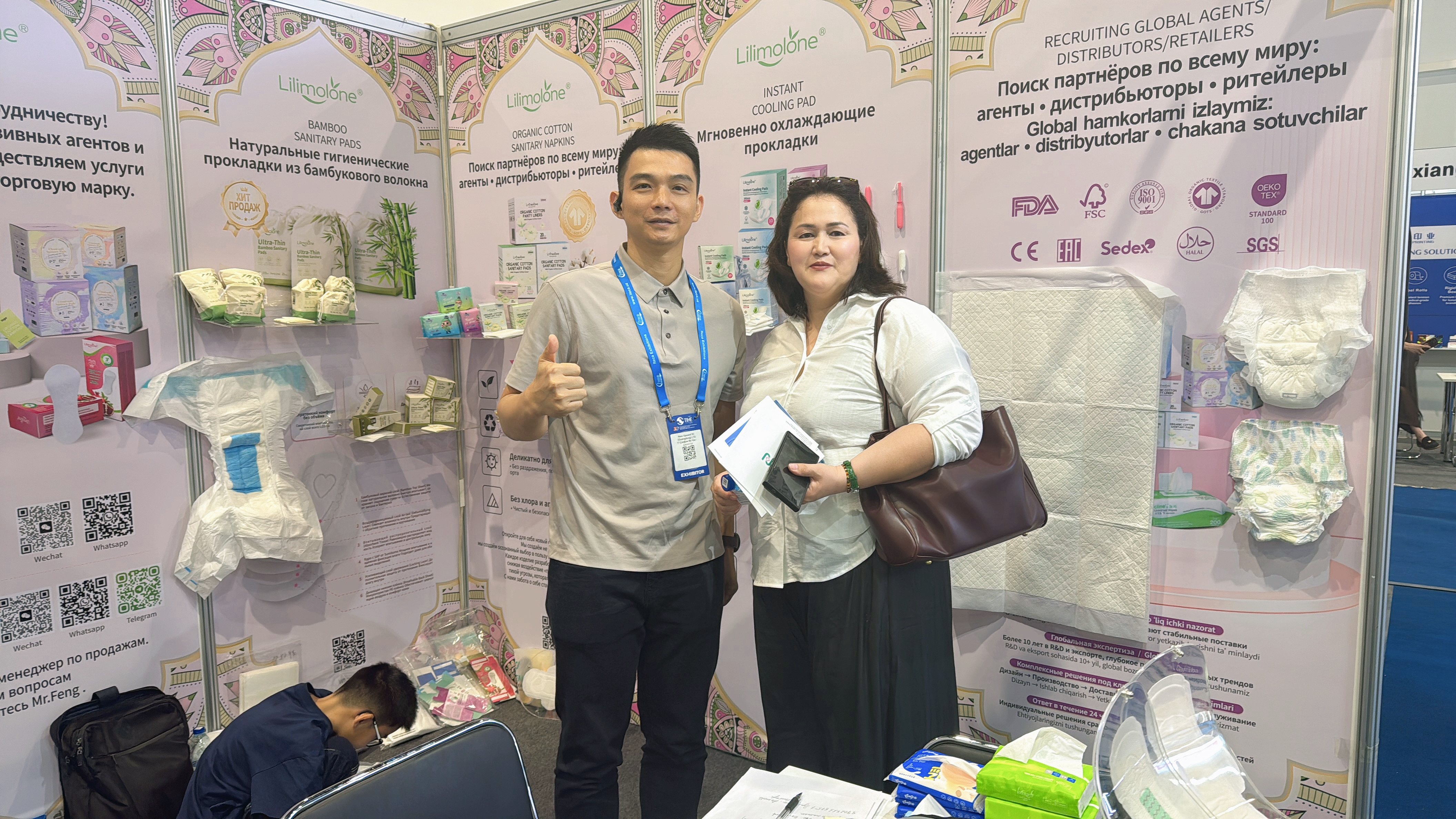
Industry sourcing events remain the main venue for buyers to compare material claims across suppliers. Image: New Upward SC (Guangdong) Co., Ltd.
Future outlook
The direction of travel is toward procurement by document number rather than by brochure. As more buyers write report numbers, certificate scopes and validity dates into purchase agreements, suppliers that can produce a coherent evidence pack — material reports, product reports, organic scope certificates, market-entry documents, service-level qualification — will be easier to keep on a shortlist than those that can only produce samples.
A second shift concerns assortment. The documented pattern in this supply chain is expansion from a single size to day-use, night-use, extra-long and disposable period pants within the same relationship, which suggests buyers are consolidating ranges with fewer partners rather than spreading a launch across many. That favours suppliers with mixed-SKU container planning capability over those selling one format well.
FAQ
Are eco friendly organic sanitary pads the same as biodegradable organic sanitary pads as a specification?
No. “Organic” refers to the origin of the fibre used in the skin-contact layer and is evidenced by material-scope certificates such as GOTS or OCS. “Biodegradable” refers to the breakdown behaviour of specific components, typically the backsheet and wrapper when converted to biodegradable film options. A pad can be organic without being biodegradable across all layers, so both statements need separate evidence in the specification.
What should a buyer ask for before approving an organic pad sample?
At minimum: pad length, thickness, topsheet material and fibre, absorbent core composition with SAP dosage, backsheet type, wrapper type, pack count and artwork version. The approved sample should be retained against the production batch, since batch traceability and retained samples are part of the stated quality-control process and are what allow a later deviation to be assessed.
How should quotations for customised organic sanitary pads be compared?
Only after the specification is fixed. Quotations differ because pad size, topsheet material, core structure, SAP dosage, wrapper, packaging printing, pack count, MOQ and testing requirements differ. Comparing unit prices before those variables are locked compares different products, and the lowest figure may simply reflect a lighter core or a simpler packaging configuration.
What order structure suits a first private-label launch?
A focused range — day-use, night-use and a panty liner, with extra-long or period pants added after market feedback — is easier to validate than a broad assortment. MOQ is project-specific and depends on size, materials, packaging printing, pack count and testing requirements, so the launch structure and the MOQ should be negotiated together rather than sequentially.
Which documents should accompany a first shipment?
Typically the product test reports relevant to the shipped SKU, any material-scope certificates supporting printed claims, market-entry documents where applicable, and the commercial export set. Because certificate scopes and validity dates vary — some run to 2027 or 2028, while the GOTS and OCS certificates on record expire on 31 December 2026 — the document set should be re-checked against the shipment date rather than reused from the previous order.
A downloadable catalogue of the sanitary pad range, including organic cotton and bamboo configurations, is available here: E-catalogue of sanitary pads – New Upward (PDF).
Есть вопросы или нужны дополнительные детали?
Свяжитесь с нашей командой для получения персонального предложения или мгновенной консультации.
Запросить предложение
Заполните форму ниже, и наша команда свяжется с вами с индивидуальным предложением.
Прямой чат WhatsApp
Предпочитаете общаться в реальном времени? Напишите нам в WhatsApp для мгновенной помощи и быстрых ответов.
- Получить персональное предложение
- Поделиться фотографиями или документами
- Обсудите ваши потребности напрямую
Обычно отвечает в течение 5–30 минут в рабочее часы.