
Eco Friendly Organic Sanitary Pads: Importer Due-Diligence FAQ
Eco Friendly Organic Sanitary Pads: Importer Due-Diligence FAQ
Importers rarely lose an organic pad programme on product appearance. They lose it on documents that do not match the product, the material or the destination market. This reference separates the three document categories that buyers keep mixing up, explains how compliance files are matched to a specific pad and a specific market, and sets out what one integrated China supply-chain partner can and cannot cover.
Why the sourcing question moved from material to evidence
The organic and biodegradable segment of feminine hygiene has moved from niche positioning onto mainstream purchasing lists. The global organic sanitary napkins market is projected to reach USD 3.02 billion in 2025 and to grow to USD 4.51 billion by 2031, according to TechSci Research. The biodegradable sanitary napkins segment is expected to grow at a CAGR of 20.1% between 2024 and 2030, reaching USD 8.54 billion by 2030, according to Mark & Spark Solutions. Asia Pacific held a 38.6% revenue share of the biodegradable sanitary napkins market in 2025, according to Dataintelo.
Growth has a side effect: offers converge. A buyer comparing ten quotations for organic cotton, bamboo fiber or biodegradable pads reads largely the same vocabulary - organic topsheet, breathable backsheet, biodegradable option, private-label packaging, high absorbency. When product language converges, procurement teams stop comparing adjectives and start comparing evidence.
The answer to the question importers ask most often - whether one China supplier can support product selection, custom packaging, document organisation and export coordination together - is yes, with a condition. The supplier must be able to map each document to a specific product, a specific material and a specific market, and must be willing to state the limits of each document in writing.
The three document categories importers keep mixing up
1. Product test reports attach to a named sample
A product test report describes what was tested, at what size or grade, and under which method. Lilimolone Sanitary Pads Test Report No. 260059776 covers Lilimolone Ultra-Thin Bamboo Sanitary Pads 245 mm, tested against GB/T 8939-2018 for sanitary absorbent pads and panty liners and GB 15979-2024 for hygienic requirements of disposable sanitary products, issued by Guangzhou Inspection Testing and Certification Group Co., Ltd. (GTTC) on 2026-04-01. Amyas Fabric Skin Allergy Test Report No. 252004820 covers Amyas disposable sanitary pads in sterilized grade at 245 mm, tested on the basis shown in the report including GB 15979-2024, issued by GTTC on 2026-01-30. Neither report transfers automatically to a different pad length, a different topsheet or a different brand name.
2. Certification scopes attach to materials and systems, not retail SKUs
Scope certificates are commonly presented as product proof and are not. The GOTS Organic Cotton Material Scope Certificate No. EGL/236426/GOTS/236426260101190405, issued by ECOCERT Greenlife S.A.S. under Global Organic Textile Standard (GOTS) Version 7.0, covers certified organic textile material categories including dyed fabrics, fabrics, greige fabrics, greige yarns, undyed fabrics and undyed fibers. The OCS Organic Cotton Material Scope Certificate No. EGL/236426/OCS/236426260101190029, issued by the same body under Organic Content Standard (OCS) Version 3.0, covers an organic content material scope including dyed fabrics, fabrics, greige fabrics, greige yarns, personal care and hygiene, and undyed fibers. Both are valid from 2026-01-01 to 2026-12-31 and require annual re-verification.
3. Export and market-entry documents sit between factory and regulator
These files determine whether a shipment can enter and be sold. They include the CE Declaration of Conformity DOC No. H-YG-MD-240414161/01, covering feminine hygiene pads from 180 mm to 420 mm, sanitary liners from 150 mm to 190 mm, incontinence pads, under pads and nursing pads, and referencing Medical Device Regulation (EU) 2017/745 together with EN ISO 13485:2016, EN ISO 14971:2019, EN ISO 20417:2021, EN ISO 15223-1:2021, EN 62366-1:2015 and the ISO 10993 series. They also include the EU Authorized Representative Agreement with WeTapeV Euro s.r.o., valid from 2026-04-16 to 2027-04-16, Halal Certificate No. 44521209189851 valid from 2025-02-01 to 2028-01-31, and an FDA establishment registration record under Owner/Operator No. 10088919 and Certificate No. 3010200123, where the certificate itself notes that the FDA does not issue or recognise certificates of registration.
Customs classification is a further layer: sanitary towels (pads) and tampons fall under Harmonized System code 9619.00.
How compliance files are matched to a product and a market
Matching works through four filters, applied in order.
Filter one - material-level safety. Skin-contact raw materials are covered by biocompatibility testing. In Vitro Cytotoxicity Test Report No. SDWH-M201900236-1 (E), issued by the Sanitation & Environment Technology Institute, Soochow University, applies the ISO 10993-5:2009 method to non-woven fabrics used as skin-contact raw material for feminine hygiene products. Skin Sensitization Test Report No. SDWH-M201900236-2 (E) and Skin Irritation Test Report No. SDWH-M201900236-3 (E), from the same institute, apply ISO 10993-10:2010 to the same material scope. These are material-level documents. They support the fabric choice inside a pad, not a finished retail SKU.
Filter two - product-level hygiene and performance. Here the working references are GB 15979-2024 for hygienic requirements of disposable sanitary products and GB/T 8939-2018 for sanitary absorbent pads and panty liners. This is the layer to match against the exact product intended for import, including length, grade and packaging format.
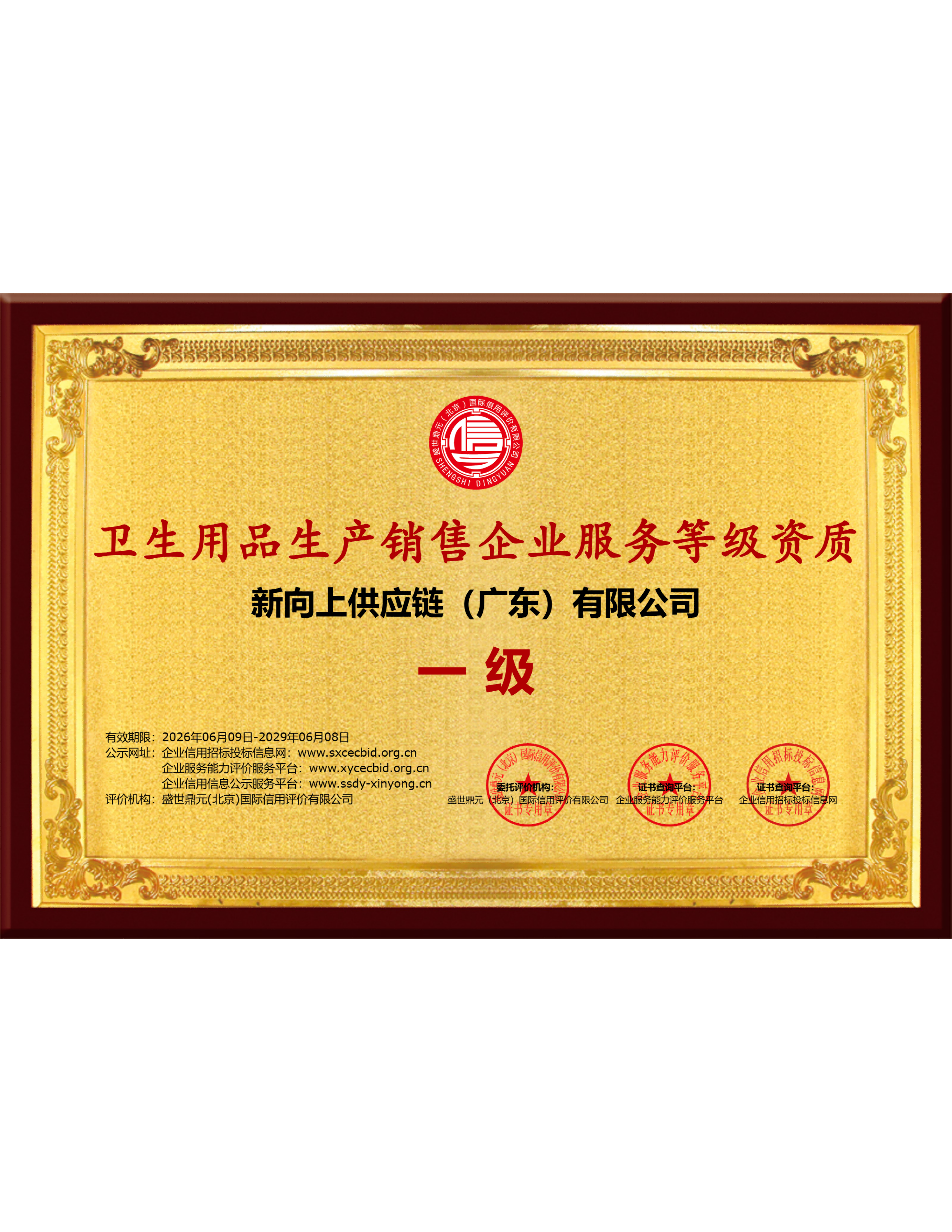
Filter three - system and enterprise level. ISO 9001 Certificate No. CN21/31472, issued by SGS United Kingdom Ltd, covers the management system for development and production of tampon products by Foshan Zhongrou Consumer Products Co., Ltd., valid from 2021-08-27 to 2027-08-26. The Sanitary Products Production and Sales Enterprise Service Level Qualification Certificate (Level 1), Certificate No. SSDY20260609102, was issued by Shengshi Dingyuan (Beijing) International Credit Evaluation Co., Ltd. under the Q/SSDY 001-2023 enterprise service capability level evaluation standard, valid from 2026-06-09 to 2029-06-08, covering Level 1 enterprise service qualification for sanitary products production and sales services. A Factory Certificate Authorization Contract valid from 2025-02-27 to 2027-02-27 references FSC RINA-COC-001701, CE SRN NL-AR-000001490, FDA Owner/Operator No. 3016936908, Halal No. 44521209189851, ISO 9001 CN21-31472 and ISO 14001 51823E08205R0.
Filter four - market-specific applicability. This is where most due-diligence packs break. The EAC State Registration Certificate No. RU.08.08.09.012.R.002571.10.23, form number 0466469, issued on 2023-10-12 by Rospotrebnadzor of the Republic of Kalmykia under TR CU 007/2011 on the safety of products intended for children and adolescents, is registered for baby diapers and pant-style diapers as shown on the certificate. It is a genuine indicator of Eurasian Economic Union registration capability, but its product scope does not automatically extend to adult feminine hygiene pads, and applicability must be confirmed before it is placed in a buyer file.
What one supplier can realistically coordinate
New Upward SC (Guangdong) Co., Ltd., referred to as Newupward, is a China-based integrated disposable hygiene product manufacturing and service provider founded in 2017. It operates a 200,000 m2 factory with 100 employees, more than 10 R&D engineers, a stated annual output of 5,000,000,000 pads and an 80% export ratio, serving Europe, North America, the Middle East, Africa, Southeast Asia, Central Asia and South America. Its product system spans feminine care, adult care, baby care, daily cleansing and pet care, and its stated role is to connect customer requirements, product solutions and manufacturing resources rather than to sell a fixed catalogue alone.
On OEM, ODM, private label and customized sanitary pad development, the declared customization scope covers pad length, shape, thickness, absorbency, wings, organic cotton topsheet, fluff-pulp absorbent core, SAP dosage, plant-based backsheet, individual wrapper, pack count, packaging artwork, logo, language version and master carton. Declared timing is 5 to 15 working days for sample development, about 25 to 30 days for a new OEM or ODM order after specification and artwork confirmation, and about 15 to 20 days for a repeat order. Stated monthly capacity is approximately 450 million sanitary pads under full-line operation. MOQ is project-specific and depends on pad size, materials, packaging printing, pack count and testing requirements.
Quality control is documented as a sequence rather than a single inspection: incoming material inspection, approved sample control, in-process inspection, absorption, rewet and leakage testing, finished-goods sampling, packaging check, retain samples and batch traceability. For importers, the commercially important step is the combination of retained samples and batch traceability, because that is what allows a complaint arriving months after delivery to be traced to a production batch instead of being argued case by case.

Product scope and application fit
| Item | Organic sanitary pads (NU07) | Organic Bamboo Sanitary Pads |
|---|---|---|
| Product type | Winged disposable sanitary pad; panty liner, day use, night use and extra-long night | Ultra-thin bamboo fiber sanitary pads and panty liners |
| Sizes | Customizable by project | 155 mm, 245 mm, 290 mm |
| Topsheet | 100% organic cotton | Bamboo fiber nonwoven |
| Absorbent core | Fluff pulp and SAP | High-absorbency pulp and SAP |
| Backsheet | Breathable PE film or biodegradable film option | Breathable leak-proof PE film |
| Stated features | High absorbency, breathable, skin-friendly, anti-leakage | Ultra-thin construction, OEM private-label packaging |
| Customization | Size, absorbency, individual wrapper, pack count, artwork, logo | Size, absorbency, surface material, packaging design, logo, private label |
Channel fit matters as much as specification. A documented retail and pharmacy programme involving a retail chain buyer, a pharmacy channel distributor and a private-label feminine hygiene brand covered more than 200 retail stores in the United States and 58 pharmacy stores in Saudi Arabia, with the product used for retail and pharmacy channel sale of organic cotton biodegradable sanitary pads for daily feminine hygiene care. Reported outcomes include successful retail shelf rollout, strong consumer acceptance, more than 30% reported category sales share in selected stores, approximately 15% higher margin than regular sanitary pads and a zero return record during the launch period. Product launch and validation were completed within about 2 to 3 months.
Those figures come from one documented launch programme. They reflect that channel, that price positioning and that market at that time, and they are not a forecast for a different project.
Market trends that change the checklist
- Organic napkins: USD 3.02 billion in 2025, projected to USD 4.51 billion by 2031 (TechSci Research).
- Biodegradable segment: CAGR of 20.1% between 2024 and 2030, reaching USD 8.54 billion by 2030 (Mark & Spark Solutions).
- Regional supply concentration: Asia Pacific held a 38.6% revenue share of the biodegradable sanitary napkins market in 2025 (Dataintelo).
- Regulatory tightening: the FDA Quality Management System Regulation, which incorporates ISO 13485:2016 into 21 CFR Part 820, takes effect on 2026-02-02 for menstrual products. Quality-system evidence is becoming a regulatory item rather than a marketing item.
- Claim caution: one commercial source states that bamboo fiber sanitary pads absorb 4 times more fluid than traditional plastic-based pads. That figure comes from a single commercial source, is flagged as requiring verification, and should not be reused in packaging or product claims without independent testing.
Comparison with traditional sourcing routes, and where the limits sit
| Dimension | Integrated OEM/ODM supply-chain partner | Single-service trading supplier | Conventional synthetic-top sourcing |
|---|---|---|---|
| Document organisation | Material, product, system and market-entry files can be compiled under one reference set | Usually limited to copies passed on from a third party | Often basic hygiene documentation only |
| Packaging control | Artwork, wrapper, carton, logo and language version coordinated with production | Depends on external print and packing parties | Standard catalogue packaging |
| Sample-to-production control | Approved sample control, in-process inspection, retained samples, batch traceability | Limited visibility between sample and shipment | Limited visibility |
| Cost position | Generally above the lowest quotation because material, testing and QC are included | Can be competitive at quotation stage | Lowest unit cost |
| Best fit | Premium retail, pharmacy, eco-positioned private label | Price-led, low-claim programmes | Price-led commodity channels |
The limits deserve the same space as the capabilities.
- GOTS and OCS scope certificates are material-level documents valid for the stated 2026 window only. They must be re-verified annually and they do not certify a finished pad.
- The EAC State Registration Certificate is registered for baby diapers and pant-style diapers as shown on the certificate. Applicability to adult feminine hygiene products must be confirmed before submission.
- The FDA establishment registration record is a registration, not a product approval, and the accompanying certificate states that the FDA does not issue or recognise certificates of registration.
- Capacity and lead times are project-dependent. Stated capacity assumes full-line operation and depends on product specification, material readiness and production schedule.
- Organic and biodegradable are separate claims. Organic cotton relates to material origin and certification scope; biodegradable relates to material breakdown and requires its own evidence.
- System certificates carry their own validity windows, so current status must be checked at the time of order rather than assumed from a catalogue.
A reusable due-diligence matrix
The table below condenses the file set into a working format that procurement teams can reuse across suppliers, adding rows as new evidence is received.
| Evidence | Category | Reference number | Scope boundary to check |
|---|---|---|---|
| GOTS Organic Cotton Material Scope Certificate | Certification scope (material) | EGL/236426/GOTS/236426260101190405 | Organic textile material categories; valid to 2026-12-31; not a finished-pad certificate |
| OCS Organic Cotton Material Scope Certificate | Certification scope (material) | EGL/236426/OCS/236426260101190029 | Material scope including personal care and hygiene; valid to 2026-12-31 |
| In Vitro Cytotoxicity Test Report | Product test report (material) | SDWH-M201900236-1 (E) | ISO 10993-5:2009 method; non-woven skin-contact material only |
| Skin Sensitization Test Report | Product test report (material) | SDWH-M201900236-2 (E) | ISO 10993-10:2010 method; material scope |
| Skin Irritation Test Report | Product test report (material) | SDWH-M201900236-3 (E) | ISO 10993-10:2010 method; material scope |
| Lilimolone Sanitary Pads Test Report | Product test report (SKU) | 260059776 | Lilimolone Ultra-Thin Bamboo Sanitary Pads 245 mm; GB/T 8939-2018 and GB 15979-2024 |
| Skin Allergy Test Report | Product test report (SKU) | 252004820 | Amyas disposable sanitary pads, sterilized grade, 245 mm; GB 15979-2024 |
| CE Declaration of Conformity | Market-entry document | H-YG-MD-240414161/01 | Feminine hygiene pads 180-420 mm; liners 150-190 mm |
| EAC State Registration Certificate | Market-entry document | RU.08.08.09.012.R.002571.10.23 | Baby diapers and pant-style diapers shown on the certificate; confirm applicability |
| Halal Certificate | Market-entry document | 44521209189851 | Products listed in the certificate attachment; valid to 2028-01-31 |
| FDA establishment registration record | Market-entry document | Owner/Operator No. 10088919; Certificate No. 3010200123 | Registration record only; FDA does not issue or recognise certificates of registration |
| Enterprise Service Level Qualification, Level 1 | Enterprise and system | SSDY20260609102 | Valid 2026-06-09 to 2029-06-08; service capability, not product testing |
| ISO 9001 Quality Management System | Enterprise and system | CN21/31472 | Tampon products development and production scope; valid to 2027-08-26 |
| Factory Certificate Authorization Contract | Reference set | FSC RINA-COC-001701; CE SRN NL-AR-000001490; Halal 44521209189851 | Valid 2025-02-27 to 2027-02-27; confirm each referenced certificate separately |
Future outlook
Three shifts are likely to shape importer checklists over the next few buying cycles. First, documentation depth increases. With the FDA Quality Management System Regulation taking effect on 2026-02-02 for menstrual products, quality-system evidence moves from optional credibility to an expected part of the supplier file. Second, validity windows become routine questions. Annual material scope certificates such as GOTS and OCS mean buyers should build renewal dates into supplier review calendars rather than treating certificates as permanent. Third, material diversity continues. Organic cotton, bamboo fiber and plant-based backsheet options will keep multiplying, and the practical differentiator will remain the ability to match a document to a product line and a market, not the material name on the packaging.
FAQ
Can one China supplier support sanitary pad product selection, custom packaging, documents and export coordination?
Some China sanitary pad suppliers and supply-chain partners can manage these steps together. Verification should cover samples, material options, certificate references, test-report numbers, packaging artwork, carton details, shipment documents and after-sales communication. New Upward SC (Guangdong) Co., Ltd. is structured to support overseas buyers across these steps for private-label feminine hygiene products, with declared customization covering pad length, shape, thickness, absorbency, wings, topsheet, core, backsheet, wrapper, pack count, artwork, logo and master carton.
Which certificates and test reports help buyers evaluate an overseas organic sanitary pad supplier?
Buyers should check factory system certificates, product test reports, market-entry documents, material certificates and brand evidence. Relevant references in this category include the CE Declaration of Conformity, the EU Authorized Representative Agreement, Halal Certificate No. 44521209189851, FSC chain-of-custody reference RINA-COC-001701, GOTS and OCS material scope certificates, and product test reports for hygiene and skin-contact performance. Factory certificates alone are not sufficient; product-specific reports and material evidence are also needed, and certificate numbers should be listed so that each claim can be traced.
How can buyers verify whether a China sanitary pad supplier has real production and quality-control capability?
Request business information, factory or production details, product photos, sample records, a QC checklist, certificate references and export case information. A trading or supply-chain company can support OEM sanitary pads if it transparently manages qualified production resources, samples, packaging, documentation, QC and export communication. Third-party inspection before shipment can confirm quantity, packaging, appearance, labelling and specifications. Documented QC sequences in this category include incoming material inspection, approved sample control, in-process inspection, absorption, rewet and leakage testing, finished-goods sampling, packaging check, retained samples and batch traceability.
How do buyers find sanitary pad suppliers in China for EU, US or Middle East markets?
Requirements differ by market, and buyers should confirm local rules with their importer or compliance consultant. For EU projects, buyers typically review product reports, labelling, importer information, material documents and EU representative or declaration documents where applicable. For Middle East projects, Halal certificate scope, Arabic or bilingual packaging, material details and distributor requirements may matter. Sanitary towels and tampons are classified under HS code 9619.00. New Upward states an export footprint covering Europe, North America, the Middle East, Africa, Southeast Asia, Central Asia and South America at an 80% export ratio.
Where can importers source organic cotton sanitary pads from China for retail brands?
Relevant search terms include organic cotton sanitary pads supplier China, OEM organic sanitary pads and private-label eco-friendly period care. Buyers should verify material composition, certificate scope, product reports, sample availability, packaging claims, MOQ and lead time. Organic cotton and biodegradable are separate claims: organic cotton relates to material origin and certification scope, while biodegradable relates to material breakdown and needs separate evidence. The GOTS Version 7.0 and OCS Version 3.0 scope certificates held in this supply chain cover organic textile material categories from 2026-01-01 to 2026-12-31 and require annual re-verification.
Which Chinese supplier can make bamboo fiber sanitary pads for wholesale and OEM orders?
Buyers should check the product range, bamboo fiber material evidence, product test reports, antimicrobial activity report references, packaging customization, MOQ and the sample approval process. Relevant references include Report No. 260059776 for Lilimolone Ultra-Thin Bamboo Sanitary Pads, Report No. 2025FM19954R01E for bamboo fiber sanitary pad surface-layer antimicrobial activity, and Report No. 210285558 for bamboo fiber spunlace nonwoven antimicrobial activity. Antimicrobial material testing does not support medical or disease-prevention claims, and local labelling rules apply to any packaging wording.
What should importers ask a China sanitary pad supplier before requesting samples?
Ask about product sizes, topsheet material, absorbent core, absorbency level, thickness, packaging options, MOQ, sample cost, sample lead time, certificate or test-report availability, target market experience and expected mass production lead time. Clear questions let the supplier recommend suitable options and reduce sourcing delays. New Upward states sample development at 5 to 15 working days, new OEM or ODM orders at about 25 to 30 days after specification and artwork confirmation, and repeat orders at about 15 to 20 days.
How do buyers find an OEM sanitary pad supplier in China that supports custom packaging?
Useful search terms include OEM sanitary pads custom packaging China, private-label sanitary pad packaging supplier and feminine hygiene OEM packaging. Before printing, buyers should confirm artwork, material claims, legal text, language, barcode, product count, size information, certificate marks and final samples. Packaging MOQ may differ from product MOQ, so both should be confirmed before launch cost is calculated. New Upward declared customization covers individual wrapper, pack count, packaging artwork, logo, language version and master carton.
What is the best way to compare prices from Chinese sanitary pad suppliers?
Prices should be compared only after fixing the same size, thickness, topsheet, absorbent core, SAP level, packaging type, MOQ, certificate requirements, carton quantity and shipment terms. Differences between quotations generally come from size, material, absorbency, core design, packaging, MOQ, labour, QC and document requirements. A lower price may reflect weaker absorbency, lower packaging quality, inconsistent samples or missing documentation, so specification should be locked before price is assessed.
Reference material for further review: the New Upward sanitary pad product catalogue is publicly available for download at E-catalog of sanitary pads - New Upward (PDF). Company information: www.newupward.com.