
Edge Banding, Side Drilling and Panel Saw: A Buyer Comparison
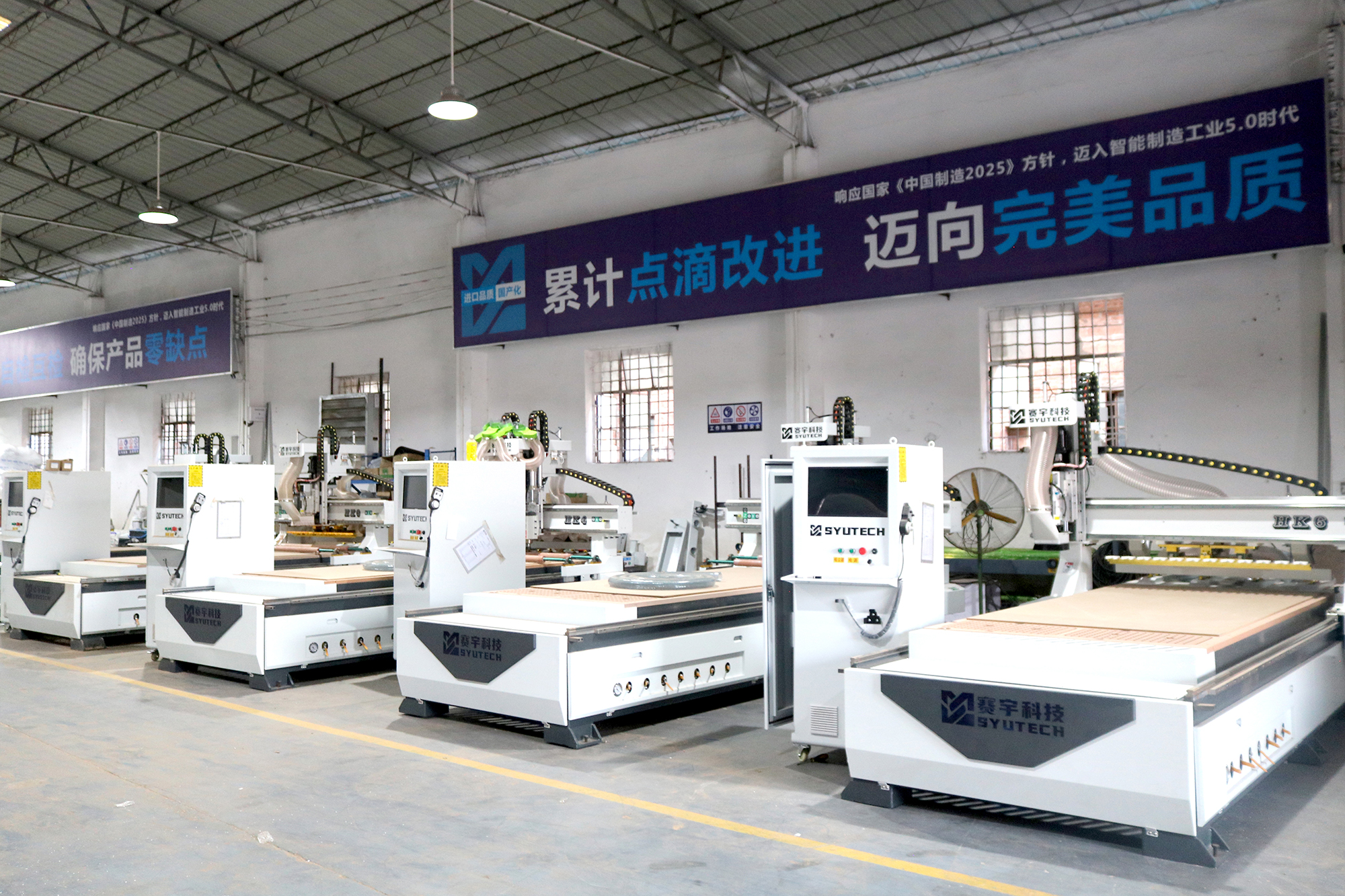
Panel furniture production depends on three separate machine decisions, not one. Image: SYUTECH panel processing workshop.
Panel furniture production is decided by three operations, and each one fails in a different way. Cutting decides whether parts are dimensionally accurate and whether material is wasted. Drilling decides whether cabinets assemble squarely and whether hardware lines up. Edge finishing decides what the customer sees and touches on the finished product. Because these three failures look unrelated on the shop floor, buyers often evaluate an edge banding machine, a side drilling machine and a computer panel saw as three separate purchases — and then discover that the units do not balance against each other once production starts.
This comparison looks at the three machine types as one purchasing decision for panel furniture production. It uses published specifications for the SYUTECH edge banding machine range, the HK612B side drilling machine and the HK330 computer panel saw, together with field evidence from a Greek edge banding workshop and a Kenyan production site, to show what each machine actually decides and where the boundaries of a single-supplier approach sit. SYUTECH is the brand of Foshan Shunde Saiyu Technology Co., Ltd., a panel furniture machinery manufacturer based in Shunde District, Foshan, China, established in 2013 and exporting to Russia, the Middle East, South America, Europe and Southeast Asia.
Why the three-machine decision is usually made together
A panel furniture workshop rarely buys one machine in isolation. Once a buyer has confirmed a product range — wardrobes, cabinet doors, shelving, office storage — the three operations have to reach a common output rate. If the saw can cut faster than the edge bander can finish, panels accumulate between stations. If drilling is the slowest step, the line runs on inventory rather than on schedule. The most common procurement mistake is not buying a poor machine; it is buying three adequate machines that were each specified against a different production assumption.
At the Decision-to-Execution stage, buyers usually already have a shortlist. The remaining work is not discovery but fit: confirming that the published specification of each unit matches the actual panel mix, and that one supplier can carry the whole set through delivery, commissioning and later expansion. That is where a line-level comparison pays for itself.
What each machine actually decides
The three machines are not interchangeable, and they are not sequential in a strict order. Cutting produces the part; drilling produces the joint; edge banding produces the finished surface. Each one carries a different specification logic, and each specification answers a different buyer question.
Edge banding machine: finishing function and published range
An automatic edge banding machine replaces manual edge finishing with a continuous mechanical sequence: conveying, gluing and welding the band, cutting the band to length, front and rear end alignment, upper and lower trimming, upper and lower scraping, and polishing. That workflow is declared for the SYUTECH automatic edge banding range and is the functional difference between an automatic unit and manual or semi-automatic alternatives.
For the HK868 automatic edge banding machine, SYUTECH publishes a minimum panel width of 40 mm, edge band width of 10–60 mm, edge band thickness of 0.4–3 mm, and a feeding speed of 18–22–25 m/min. For a buyer, those four values answer four practical questions: whether small drawer fronts and door rails can run on the machine at all, which band widths are supported without changing setup, whether standard 0.4–3 mm PVC and ABS banding stock is covered, and roughly what throughput to expect once panel length and handling time are added. A compact automatic model in the same range is listed with seven functions and a feeding speed of 18–23 m/min, which positions smaller workshops differently from high-volume cabinet producers.
HK612B side drilling machine: tool count and axis speeds
The HK612B side drilling machine is specified with 10 top drilling tools, 9 bottom drilling tools and 8 horizontal drilling tools, with maximum X/Y/Z feed speeds of 120/80/30 m/min. Tool count is the specification that determines pattern complexity: a larger number of available positions reduces re-tooling between cabinet models, while horizontal tools address the side and end holes that dowel and cam assemblies depend on. Axis speed determines motion efficiency, but the three axes are not equal — the Z axis moves at a materially lower maximum speed than X and Y, because vertical drilling strokes are short and depth-controlled rather than travel-controlled. Buyers who compare only the highest axis figure are comparing the least useful number on the sheet.
HK330 computer panel saw: width, height and saw power
The HK330 computer panel saw is specified with a maximum cutting width of 3300 mm, a maximum cutting height of 100 mm and a 16.5 kW main saw motor. Maximum width defines the largest panel the machine can handle in a single orientation. Maximum cutting height defines the stack that can be cut in one pass, which is the real driver of saw throughput in repetitive panel cutting. Main saw power is a cutting-capability indicator rather than a speed figure: it determines how comfortably the machine works through dense or thick material at production feed rates.
Comparison table: three machines, three decision logics
| Machine | Primary production task | Published specification to verify | Boundary to plan for |
|---|---|---|---|
| Edge banding machine (HK868 range) | Edge finishing: conveying, gluing, end trimming, top/bottom trimming, scraping, polishing | Min. panel width 40 mm; band width 10–60 mm; band thickness 0.4–3 mm; feeding speed 18–22–25 m/min | Does not size or drill; parts outside the panel-width and band-width range need a different setup |
| HK612B side drilling machine | System and side hole drilling for assembly | 10 top, 9 bottom, 8 horizontal tools; X/Y/Z max 120/80/30 m/min | Fixed tool positions limit how many patterns run without changeover |
| HK330 computer panel saw | Sizing and cutting of panels from stock | Max. width 3300 mm; max. height 100 mm; 16.5 kW main saw | Cutting height caps the stack that can be processed per pass |
Field evidence: a Greek edge banding workshop and a Kenyan production site
Two reference cases are reported by the supplier and are worth reading as fleet evidence rather than as a single installation. In Greece, an edge banding workshop operates ten SYUTECH edge banding units, reported in stable operation for three years. In Kenya, a production site combining edge banding with CNC router work reports two years of operation with improved edge quality and increased output.
The Greek case is the more informative of the two for buyers evaluating a line. A workshop that runs ten identical units is not reporting one machine that performed well on commissioning day; it is reporting repetitive output across a fleet, which is what a panel furniture producer actually needs when a second shift or a new cabinet series is added. It also shortens the buyer's verification path: the questions shift from whether the machine can band an edge to how consistently ten of them do it over three years, and how spare parts and service reach a multi-unit site.
The Kenyan case addresses a different question. Edge quality is usually judged downstream — by assembly, by packaging, by the customer. A site reporting improved edge quality and higher output after two years, and running edge banding alongside CNC router work, indicates that the edge finishing step was the quality constraint rather than the cutting step. For buyers building a mixed production profile that includes shaped or nested parts, that combination is closer to a real workshop than a single-machine demonstration.
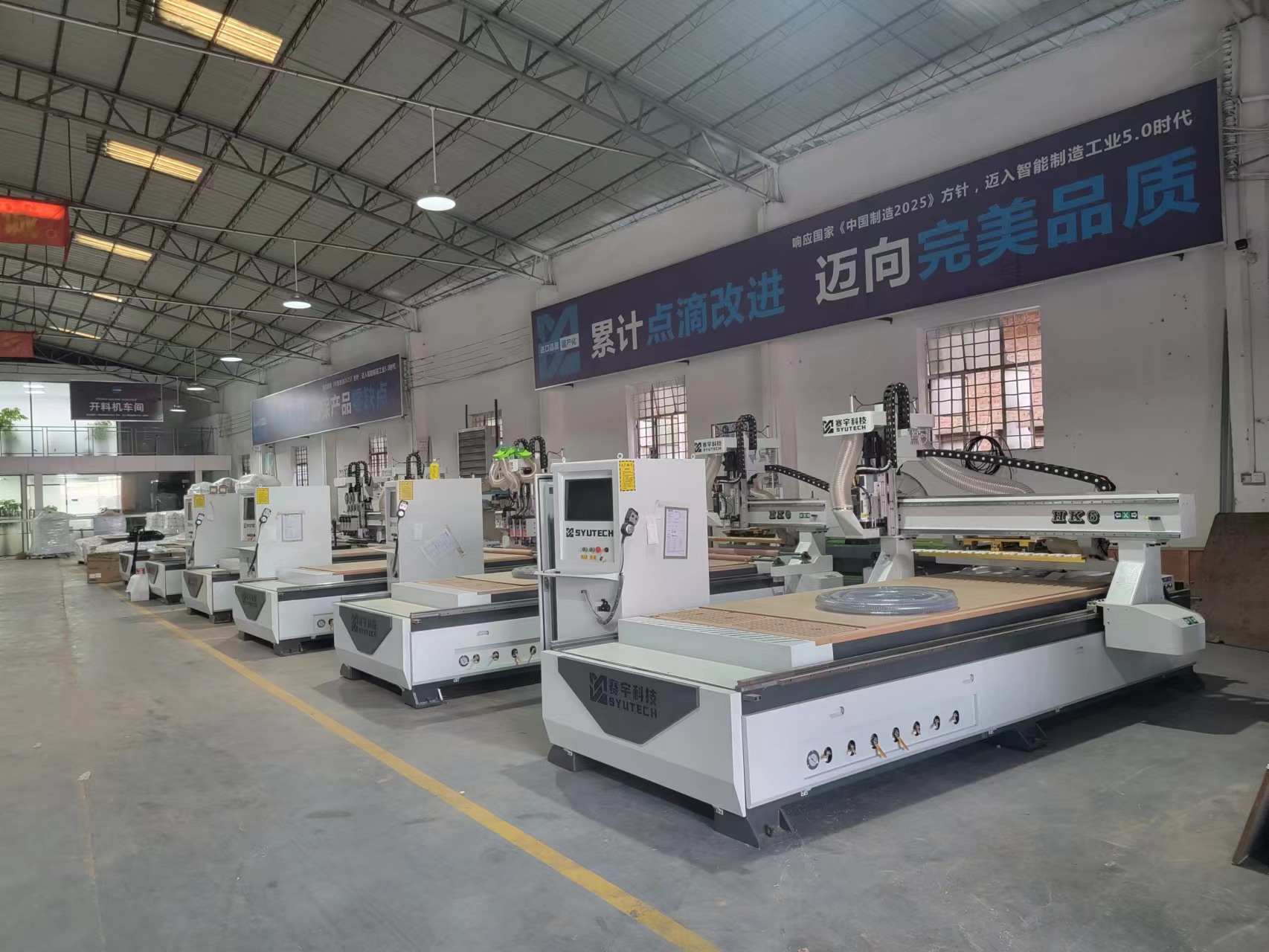
Edge banding is often evaluated alongside CNC router work, as in the Kenya reference case. Image: SYUTECH workshop.
Supporting equipment and site readiness
Three machines do not make a production line on their own. Before signing, buyers should confirm the interfaces between the units and the building: air supply for clamping and pneumatic functions, dust and chip extraction at the cutting and edge finishing stations, electrical capacity for the installed motor load, floor space for panel handling at both ends of the saw, and the material flow path between cutting, drilling and edge banding. These requirements are configuration-specific, so the practical approach is to request a site requirement list per model rather than assume that one utility specification covers the whole set.
Training is the second interface item. An automatic edge banding machine produces a finished edge only when band thickness, temperature and feed settings match the banding stock in use; the 0.4–3 mm thickness range stated for the HK868 covers a wide envelope, and the setup knowledge to move within that envelope is transferred during commissioning, not from a datasheet.
EU safety requirements in a three-machine purchase
For European delivery, compliance is checked per machine and per configuration, not per catalogue page. SYUTECH states that its HK series machinery is CE certified under certificate HTT202405661L, referencing EN 60204-1:2018 for electrical safety and EN ISO 12100:2010 for risk assessment principles.
Two further standards are relevant when reading a specification sheet. ISO 18217:2015 sets out significant hazards for edge banding machines fed by chains with manual loading and unloading and a maximum work-piece height capacity of 100 mm — a scope that defines which machine configurations fall under it. EN ISO 19085-17:2021 addresses safety for chain-fed edge banding machines. A buyer should therefore confirm that the certificate and declaration on file name the exact model and serial number being shipped, that the referenced standard versions are current, and that the machine configuration supplied matches the certified configuration. The same discipline applies to the HK612B and HK330: certification follows the delivered unit, not the product family name.
Where this comparison stops: limits and trade-offs
An honest comparison has to state its boundaries, and there are four that matter here.
First, specification ranges are not performance guarantees. The HK868, HK612B and HK330 figures used above are manufacturer-published specifications. Independent benchmark testing of throughput, uptime or failure rates is not part of the public evidence used in this comparison, so buying decisions should rely on published specification plus reference visits, not on specification alone.
Second, single-supplier sourcing trades breadth for coherence. SYUTECH supplies fully automatic edge banding machines, laser edge banding machines, CNC six-sided drilling machines, computer panel saws and complete panel furniture equipment and production lines, which reduces interface risk between units. It does not follow that every unit in a mixed portfolio is the strongest available in its category. Buyers who need a specialist configuration in one operation may reasonably split the order.
Third, each machine has a hard envelope. The HK330 cuts to a maximum height of 100 mm, so thicker stacks require a different pass strategy. The HK868 works within a minimum panel width of 40 mm and a band width of 10–60 mm, so very narrow parts or band stock outside that range are not standard work for this unit. The HK612B has a fixed number of top, bottom and horizontal tool positions, so pattern variety on a single machine is finite.
Fourth, the three machines solve different problems and cannot substitute for each other. Adding a second edge banding machine does not increase cutting output, and upgrading the saw does not improve edge quality. Line balancing is a separate engineering task from machine selection.
Market context: why line-level buying is being revisited
The automatic edge banding machine segment was estimated at USD 3.658 billion globally for 2024, with a projected compound annual growth rate of 4.56% between 2025 and 2035, according to a 2026 market report. Chinese manufacturers account for approximately 40% of global edge banding machine shipments. For buyers, that context explains a shift in how equipment is purchased: a fragmented supply base with a dominant manufacturing origin makes supplier verification and traceable specifications more important than brand familiarity.
SYUTECH illustrates the profile of a mid-sized exporter in that market. The company operates a 10,000 m² facility with annual production capacity of 500 units, employs around 100 staff, maintains a two-engineer R&D team, and derives roughly 80% of sales from export. It was originally established in 2013 as a precision machinery factory in Shunde, Foshan, and states that it has worked with the Italian company TEKNOMOTOR to integrate European technology. Capacity of this scale means buyers should expect to plan orders rather than draw from standing stock — a normal condition for a 500-unit annual output.
Long-term ownership: what a multi-machine supplier relationship should deliver
When the edge banding machine, side drilling machine and panel saw come from one supplier, the relationship moves from a transaction to an operating dependency. The useful questions change. Spare parts availability is no longer an afterthought but a scheduling input. Service response time matters more than the discount on the first order. Model continuity matters when a second line is added two years later and the same settings and operator habits should carry over.
The Greek fleet case is the practical argument here: ten units running for three years implies a parts and support arrangement that survived beyond the warranty period. For a buyer planning expansion, the checklist for a long-term supplier is therefore concrete rather than aspirational — documented certification per model, a service route into the destination market, configuration lists for each unit in the order, and a clear statement of which parts are consumables. Buyers at the execution stage can reasonably ask for a factory reference list and a visit to a site running a comparable configuration before committing a full line.
SYUTECH publishes a factory and product brochure covering its panel furniture equipment range, which buyers can use as a starting point for a formal specification request: SYUTECH factory promotional paper (PDF).
Frequently asked questions
Can one supplier provide an edge banding machine, a side drilling machine and a panel saw for the same panel furniture line?
Some suppliers can. SYUTECH states that it supplies fully automatic edge banding machines, laser edge banding machines, CNC six-sided drilling machines, computer panel saws, and complete sets of panel furniture equipment and automated production lines. Ordering all three types from one supplier reduces interface risk between units and simplifies service contact. It does not automatically make each machine the strongest option in its category, so buyers should still verify published specifications and references for each model in the order.
Which specifications should be confirmed before ordering an edge banding machine for a panel line?
Four values determine whether an automatic edge banding machine fits a given part mix. For the HK868, SYUTECH publishes a minimum panel width of 40 mm, edge band width of 10–60 mm, edge band thickness of 0.4–3 mm and feeding speed of 18–22–25 m/min. These define the smallest part that can run, which band stock is supported, and the approximate throughput once handling time is added. The functional sequence — conveying, gluing, band cutting, end alignment, top and bottom trimming, scraping and polishing — indicates whether manual finishing steps remain.
How does the HK612B side drilling machine differ from a stand-alone drilling station?
The HK612B is specified with 10 top drilling tools, 9 bottom drilling tools and 8 horizontal drilling tools, with maximum X/Y/Z feed speeds of 120/80/30 m/min. The tool count sets how many hole patterns can be produced before changeover, and the horizontal tools cover side and end holes used in dowel and cam assembly. The lower maximum speed on the Z axis reflects short, depth-controlled vertical strokes rather than long travel, so axis speed comparisons should be read per axis rather than as a single headline number.
What do the HK330 computer panel saw figures mean in production terms?
The HK330 is specified with a maximum cutting width of 3300 mm, a maximum cutting height of 100 mm and a 16.5 kW main saw motor. Maximum width defines the largest panel handled in one orientation. Maximum cutting height defines the stack thickness that can be cut per pass, which is the main throughput variable in repetitive cutting. Main saw power indicates cutting capability on dense or thick material rather than a speed rating.
What safety documentation should a buyer verify for EU delivery?
SYUTECH states that its HK series machinery is CE certified under certificate HTT202405661L, referencing EN 60204-1:2018 for electrical safety and EN ISO 12100:2010 for risk assessment. Buyers should confirm that the certificate and declaration name the exact model and serial number shipped, that referenced standard versions are current, and that the delivered configuration matches the certified one. ISO 18217:2015 defines the hazard scope for chain-fed edge banding machines with manual loading and unloading and a maximum work-piece height capacity of 100 mm; EN ISO 19085-17:2021 covers safety for chain-fed edge banding machines.
What field evidence exists for long-term operation of these machines?
Two reference cases are reported by the supplier. In Greece, an edge banding workshop operates ten SYUTECH edge banding units that have run in stable operation for three years. In Kenya, a production site combining edge banding with CNC router work reports two years of operation with improved edge quality and increased output. Both are supplier-reported references; buyers should confirm them through direct site contact or a visit before committing to a multi-machine order.
Where does an automatic edge banding machine stop and the other two machines begin?
Each machine performs a separate operation and cannot substitute for another. The edge banding machine finishes exposed edges; it does not cut panels to size or drill assembly holes. The HK330 computer panel saw performs sizing and cutting. The HK612B side drilling machine produces system and side holes. Because of this division, a bottleneck in one operation cannot be resolved by adding capacity in another, and a line-level purchase should balance output across all three rather than optimise a single unit.
Specifications and reference cases in this article are as published by SYUTECH (Foshan Shunde Saiyu Technology Co., Ltd.) and by the market and standards sources cited. Independent third-party performance benchmarking of these models was not available for this comparison.
Есть вопросы или нужны дополнительные детали?
Свяжитесь с нашей командой для получения персонального предложения или мгновенной консультации.
Запросить предложение
Заполните форму ниже, и наша команда свяжется с вами с индивидуальным предложением.
Прямой чат WhatsApp
Предпочитаете общаться в реальном времени? Напишите нам в WhatsApp для мгновенной помощи и быстрых ответов.
- Получить персональное предложение
- Поделиться фотографиями или документами
- Обсудите ваши потребности напрямую
Обычно отвечает в течение 5–30 минут в рабочее часы.