
Electric Actuator Certification Roadmap: ATEX, IP, Insulation
Certification is the first filter an electric actuator must pass before torque and control mode are even discussed. In oil & gas, chemical, and water applications, the compliance file — not the datasheet — determines whether a model can be installed, inspected, and kept in service. This roadmap sets out the three layers that matter most for global projects: hazardous-area protection (ATEX and IECEx Ex d, including the BT4 and CT4 temperature classes), ingress protection (IP65, IP67, IP68), and insulation and thermal class. It then explains what buyers should verify at the decision and execution stage, using Chenglei's CLZXC4000 explosion-proof platform as a worked reference.
The Certification File Is Now a Supply-Chain Document
The electric actuator market is large enough that certification differences translate directly into sourcing decisions. Zion Market Research estimates the global electric actuator market at approximately USD 11.5 billion in 2024, with growth projected at a CAGR of 6.5% to 7.2% through 2034. Dataintelo places Asia-Pacific at a 38.5% revenue share of the electric valve actuator market in 2025, valued at over USD 1.8 billion. Behind those figures sits a practical change: as more actuator capacity shifts toward Asia and more projects are assembled from multi-region supply chains, the compliance document has become the object buyers actually audit.
Two failure modes repeat with striking regularity. The first is assumed scope — a certificate covers a defined model, gas group, and temperature class, while a visually similar variant may sit outside that scope. The second is treating certification as a one-time purchase event rather than a lifecycle condition. Both problems surface late: during factory acceptance, site inspection, or an operational audit, when re-approval delays the project rather than the supplier.
That is why certification belongs in the same conversation as long-term supplier evaluation. The operative question is not simply whether an actuator is certified today, but whether the supplier can keep that certification valid across model families, repeat orders, and spare-part cycles over the years the unit stays in service. A certificate that cannot be sustained across a partnership is a one-off document, not a procurement asset.
Three Compliance Layers, One Acceptance File
A complete actuator acceptance file answers three separate questions, and each one is governed by a different standard set. Buyers who collapse them into a single "certified" check are the ones who discover gaps at the wrong moment.
| Layer | What it governs | Evidence a buyer should see |
|---|---|---|
| Hazardous-area protection | Ignition containment and surface temperature in explosive atmospheres; standardized under IEC 60079-0 and IEC 60079-1 | Certificate naming the model, gas group (IIA/IIB/IIC) and temperature class (T1–T6, or BT4/CT4 shorthand) |
| Ingress protection | Entry of solids and liquids into the enclosure; IP coding defined by IEC 60529 | IP rating on the nameplate plus the test condition behind it |
| Insulation and thermal class | Maximum continuous winding temperature the insulation system is designed for; thermal classes defined under IEC 60085 | Thermal class statement plus the measures protecting the winding in service |
Layer 1 — Explosion Protection: ATEX, IECEx, Ex d, BT4 and CT4
Explosion-proof electric actuators are standardized under IEC 60079-0 (General Requirements) and IEC 60079-1 (Flameproof Enclosures 'd') for hazardous environments. Together these standards define how an enclosure contains an internal ignition and how surface temperatures are limited so that surrounding gas cannot be ignited.
Two classification axes then decide whether a specific model fits a specific area: gas group and temperature class. Actuators are classified into Gas Groups IIA, IIB and IIC, and Temperature Classes T1 through T6, with Group IIC required for hydrogen environments. In many project documents the same information is compressed into shorthand: BT4 means Group IIB with a T4 temperature class, and CT4 means Group IIC with a T4 class. The shorthand is convenient, and it is also where mismatches appear, because BT4 and CT4 are not interchangeable where hydrogen or other IIC gases are present.
For that reason, Chenglei treats hazardous-area compliance as an engineering control rather than a documentation formality: actuators used in explosion-proof areas must hold national explosion-proof certificates such as Ex d / Ex e together with 3C certification before release. The practical consequence for buyers is straightforward — a unit marked for one gas group and temperature class cannot be substituted for another duty without re-checking the certificate that covers it.
Layer 2 — Ingress Protection: What IP65, IP67 and IP68 Certify
Ingress protection answers a different question from explosion protection: can water and dust reach the internal electronics? The IP code is defined by IEC 60529, where the first digit covers solids and the second covers liquids. IP65 resists dust ingress and water jets; IP67 tolerates temporary immersion; IP68 covers sustained submersion under defined test conditions.
In process plants the two protection concepts are frequently confused because both appear on the same nameplate. They are not substitutes. An IP68 enclosure is not automatically flameproof, and a flameproof enclosure is not automatically rated for washdown or flooding. Projects that require both must verify both.
Chenglei's intelligent electric actuator platform is specified at IP68 with submersion tested for 48 hours. For chemical duty, the internal protection measures matter as much as the external rating: input and output interfaces use optocoupler isolation, and the mainboard carries a conformal coating for moisture, salt-spray and mold resistance. The enclosure is also fitted with independent internal and external grounding bolts. Those measures are what keep an IP rating meaningful after years of humid, saline or corrosive service rather than only at the factory gate.
Layer 3 — Insulation and Thermal Class Under Real Duty Cycles
Insulation class describes the maximum continuous temperature a winding insulation system is designed to withstand. Under IEC 60085, Class F corresponds to a 155 °C rating and Class H to 180 °C. F-class insulation is a common requirement for actuators mounted in hot process areas, because the winding absorbs ambient heat plus heat generated by the motor itself and by the enclosure around it.
Insulation compliance cannot be judged from the class label alone. Two conditions decide the outcome in the field: whether the duty cycle allows the winding to stay inside its thermal ceiling, and whether moisture or contamination degrades the insulation system long before it ever reaches that ceiling. The second condition is the one that quietly ends actuator life in chemical plants and coastal installations.
That is why insulation protection is as much a maintenance-design question as a materials question. Non-invasive commissioning — setting limits and parameters through an infrared remote control or a rotary knob without opening the electrical cover — protects the insulation indirectly, because every time an enclosure is opened on site, moisture and dust enter with it. Combined with conformal coating, optocoupler isolation and dual grounding provisions, the winding is protected against the failure path that the thermal class number alone does not describe.
How CHENGLEI Structures Certification and Verification
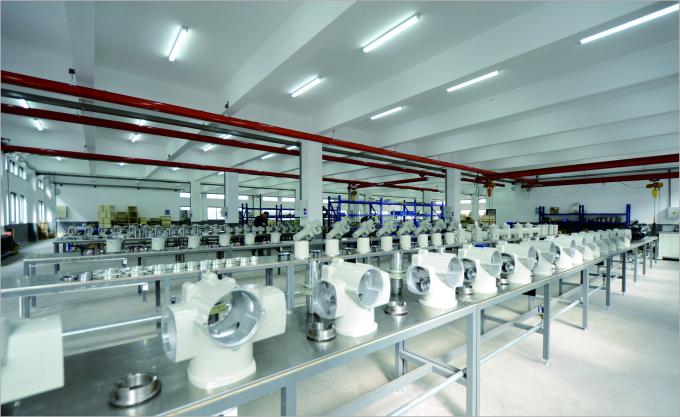
Changzhou Chenglei Valve Technology Co., Ltd. is an electric actuator manufacturer based in Changzhou, China, founded in 2016, operating a 20,000 m² facility with around 100 employees, including a 25-engineer research and development team. Its CL series valve electric actuators are used in Oil & Gas, Water & Power, and Chemical, Process & Industrial applications, with roughly 80% of output exported to global markets. Annual output is 120,000 units, equivalent to a monthly production capacity of 8,000 units, supported by more than 50 CNC machining centers and lathes along with a range of inspection equipment.
Around that manufacturing base, compliance is handled through a defined set of controls rather than a single certificate:
- Certification as a release gate. Actuators destined for explosion-proof areas must hold national explosion-proof certificates such as Ex d / Ex e together with 3C certification. European-market documentation is handled through CE marking.
- Electrical isolation and coating. Input and output interfaces use optocoupler isolation, and the mainboard carries a conformal coating for moisture, salt-spray and mold resistance.
- Grounding protection. The enclosure is equipped with independent grounding bolts, both internal and external, for safe discharge in the event of leakage.
- Selection validation. A selection database requires mandatory input of medium characteristics, maximum differential pressure and pipe diameter, and automatically matches actuators with a safety factor of 1.5× or higher.
- Technical review. For large projects or non-standard conditions such as high temperature or explosion-proof areas, documents must be countersigned and confirmed by the sales, technical and production departments.
- Error-proofing on site. Voltage-level labels and wiring schematics are added at the junction box to prevent incorrect power connections.
- Commissioning safeguards. One-click non-invasive setting avoids opening the electrical cover; built-in phase-sequence detection and self-correction protects three-phase asynchronous motors if live wires are connected in reverse; and full-open/full-close self-learning memory prevents over-torque caused by inaccurate manual limit setting.
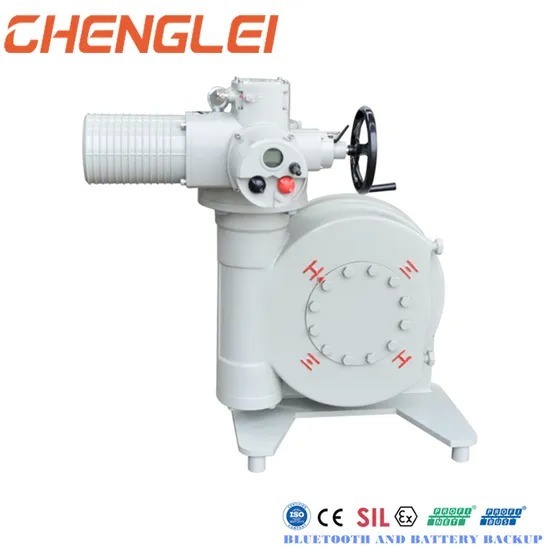
Chenglei's CLZXC4000 explosion-proof intelligent actuator is used here as the worked reference for the three layers above. The platform-level protection measures described in this article — flameproof construction, IP68 sealing with 48-hour submersion testing, and the winding-protection set — apply to the same intelligent actuator family, including configurations built for extreme cold and corrosive duty.
Certification Fit by Application
Certification requirements differ by industry because the dominant risk differs. The table below maps the three layers to the applications where each one usually decides the selection.
| Application | Dominant compliance driver | Typical configuration focus |
|---|---|---|
| Oil & gas pipelines | Hazardous-area classification, gas group and temperature class | Emergency shut-off and regulating-valve flow control; Group IIC capability where hydrogen service is involved |
| Chemical and process | Corrosion plus hazardous-area protection | Conformal-coated mainboard, optocoupler isolation, IP68 sealing for washdown and corrosive atmospheres |
| Water and power | Ingress protection and long service intervals | Remote monitoring and predictive maintenance for unmanned or widely distributed sites |
| Extreme environments | Temperature range and vibration | Operation from −40 °C to +70 °C, extendable to −60 °C, for strongly vibrating or high-temperature plants |
| Intelligent plants | Control-system integration | Bus communication (Profinet / Modbus / Profibus) with DCS/PLC integration for diagnostics and predictive maintenance |
In practice these drivers overlap. A Middle East oilfield combines hazardous-area classification with high corrosion; an alumina plant combines high temperature with strong vibration; a Russian installation combines an extreme-cold requirement with standard hazardous-area rules. The certification roadmap function is to identify which layer is non-negotiable in each case, so that the remaining specification work is not built on an assumption that later fails inspection.
How the Market Is Moving
Two industry trends are changing what certification means in practice. The first is the shift of intelligent electric actuators toward Industrial Ethernet protocols such as Profinet and EtherNet/IP, with 5G edge connectivity discussed for digital-twin integration — a development reported for the Chinese market in 2026. That matters for compliance because bus modules, split control units and remote setting functions expand the number of hardware configurations a certificate must cover. The second is capacity concentration: China's export value for electric motor parts, which includes actuator components, reached USD 6.43 billion in 2024, representing 26.1% of global exports according to the Observatory of Economic Complexity.
Combined, these trends push documentation quality up the buyer's agenda. Suppliers able to state certification scope precisely reduce the number of engineering queries per order. Buyers, in turn, increasingly treat that ability as a partnership criterion rather than a pre-sales convenience — because the same clarity that shortens an initial enquiry also shortens every spare-part and repeat-order cycle that follows.
Intelligent Certified Platforms vs. Conventional Units: Where the Boundary Sits
Certification and intelligence are separate decisions, but they are usually evaluated together. The comparison below reflects the intelligent actuator platform specification set against conventional units.
| Dimension | Conventional actuator | Intelligent certified platform |
|---|---|---|
| Initial procurement cost | Baseline | Approximately 1.5 to 2.5 times traditional models, depending on functionality |
| Installation cost | Standard point-to-point wiring | Bus systems can save cables, trays and IO cards, reducing total installation cost by 20–40% |
| Maintenance frequency | Planned intervention, enclosure opened for setting | Low — non-invasive setting, self-diagnostic reminders, maintenance as needed |
| Fault handling | Manual diagnosis | Fault codes read via bus or infrared remote control to locate issues such as power phase loss, motor overheating or valve jamming |
| Standby power consumption | Higher baseline | Less than 5 W in bus mode |
| Energy consumption | Baseline | 15–30% reduction through output torque on demand |
| Service life | Shorter intervals between overhauls | Lifespan of ≥30,000 operations without maintenance (depending on operating conditions); MTBF >50,000 hours |
| Position and torque control | Limit-switch based | Absolute encoder position acquisition with continuous torque monitoring and anti-seizure logic |
The boundary is cost and integration capability. A plant with benign, low-cycle on/off duty — no hazardous area, moderate ambient temperature, no requirement for remote diagnostics — gains comparatively little from an intelligent certified platform, and the higher initial procurement cost of approximately 1.5 to 2.5 times a traditional model may not be justified by the duty. The intelligent path also assumes the control system can use it: bus communication and DCS/PLC integration are prerequisites for the monitoring and predictive-maintenance benefits. A third boundary is certification scope itself — a certificate applies to a defined model configuration and does not transfer automatically to a different gas group, temperature class or electronics package.
A Buyer Verification Checklist for the Execution Stage
Once a supplier is selected, verification shifts from specification to evidence. The checklist below is ordered the way an acceptance review usually runs.
| Check | What to confirm |
|---|---|
| Certificate scope | The exact model, gas group (IIA/IIB/IIC) and temperature class (T1–T6, or BT4/CT4 shorthand) covered by the certificate |
| Nameplate consistency | Marking of the delivered unit matches the certificate, with no variant substitution |
| Ingress protection evidence | The IP rating and the test condition behind it (for example submersion duration), not the digits alone |
| Insulation and winding protection | Thermal class statement plus the protection set — conformal coating, optocoupler isolation, internal and external grounding bolts |
| Selection calculation | The safety factor applied to torque sizing against maximum differential pressure |
| Error-proofing documentation | Voltage-level labels and wiring schematics provided with the junction box |
| Acceptance testing | Pre-shipment test record, which is the stated acceptance criterion |
| Commercial terms | MOQ of 1 set; delivery terms FOB/CIF; payment terms L/C, T/T or Paypal — agreed in parallel with, not instead of, the compliance file |
Splitting the commercial negotiation from the compliance review is a common execution error. When certification deliverables are agreed late, they arrive late — and the factory acceptance test is usually the first point at which the mismatch becomes visible.
Future Outlook
Three directions will likely define the next phase of actuator certification. First, documentation is moving toward digital, model-level records, which rewards suppliers whose product families are documented consistently rather than case by case. Second, protocol convergence — Profinet, EtherNet/IP and edge connectivity — will keep expanding the electronics envelope under certification, so bus modules and split control units become part of the compliance conversation rather than accessories. Third, hazardous-area regulation continues to tighten around hydrogen and methane service, which favors Group IIC-capable designs over IIB-only alternatives.
For buyers, the practical implication is that certification should be evaluated as a lifecycle asset. It has to survive model updates, repeat orders and spare-part replacements across the years an actuator remains in service — which makes certification continuity one of the more reliable indicators of whether a supplier relationship will still be working five years from now.
FAQ
What does an explosion-proof certificate actually cover on an electric actuator?
It covers a defined model configuration together with a gas group and a temperature class. Explosion-proof actuators are standardized under IEC 60079-0 and IEC 60079-1, and classified into Gas Groups IIA, IIB and IIC and Temperature Classes T1 through T6, with Group IIC required for hydrogen environments. Because the certificate is tied to that combination, a unit qualified for IIB/T4 duty is not automatically acceptable in an IIC installation.
What is the difference between BT4 and CT4 explosion-proof actuators?
Both designate a T4 temperature class; they differ in gas group. BT4 corresponds to Group IIB, while CT4 corresponds to Group IIC. Group IIC is the more demanding classification and is required for hydrogen environments. The distinction matters most in chemical and oil & gas projects where the area classification specifies IIC, in which case a BT4 unit does not qualify.
Can an IP68 rating replace explosion-proof certification?
No. The two address different risks. IP ratings are defined by IEC 60529 and concern the entry of solids and liquids — IP65 for dust and water jets, IP67 for temporary immersion, IP68 for sustained submersion under defined test conditions. Explosion protection concerns ignition containment and surface temperature. A high IP rating does not make an actuator flameproof, and flameproof construction does not certify it for flooding or washdown; where both risks exist, both must be verified.
How should insulation class and winding protection be checked for high-temperature plants?
Start with the winding's thermal class under IEC 60085 — Class F corresponds to 155 °C and Class H to 180 °C — then check what protects that insulation in service. In humid or corrosive plants, insulation is usually degraded by moisture and contamination rather than by reaching its thermal ceiling, so the protection set matters: conformal coating on the mainboard, optocoupler isolation on input and output interfaces, and independent internal and external grounding bolts. Non-invasive commissioning, where limits are set without opening the electrical cover, also limits moisture and dust ingress after installation.
What compliance documentation should be verified before shipment?
The certificate scope, the nameplate marking of the delivered unit, the IP test condition rather than the rating alone, the thermal class statement, and the record of pre-shipment testing, which is the stated acceptance criterion. Voltage-level labels and wiring schematics at the junction box are part of the same file, since they prevent the wiring errors that damage insulation on site. Commercial terms — a minimum order quantity of 1 set, FOB/CIF delivery, and payment by L/C, T/T or Paypal — are separate from this documentation and should be agreed in parallel with it.
What signals that a supplier can maintain certification continuity over a long partnership?
Consistency of process rather than a single certificate. Useful indicators include whether certification is a mandatory release gate for hazardous-area products; whether non-standard or explosion-proof conditions must be countersigned by sales, technical and production departments; whether selection software enforces a torque safety factor of 1.5× or higher; and whether control modules are interchangeable with one-click copying of software parameters, so that spare-part replacement does not reopen the compliance question. Manufacturing continuity matters too — a monthly capacity of 8,000 units from a 20,000 m² facility with more than 50 CNC machining centers indicates that repeat orders come off the same base that produced the certified reference units.
Technical documentation covering actuator specifications and compliance notes is available in Chenglei's product brochure: Chenglei Electric Actuator Brochure (PDF).