
Electric Actuator Procurement FAQ: Torque, Voltage, Control
Electric actuator procurement questions tend to arrive in the same order: how much torque, at which rated voltage, and under which control method. The three answers constrain one another, and a specification that closes all three is usually the difference between equipment that commissions cleanly and equipment that returns to the workshop.
An electric actuator converts an electrical supply into mechanical movement to operate a valve: quarter-turn rotation for ball, butterfly and plug valves, multi-turn rotation for gate and globe valves, or a linear stroke for regulating valves. Because the actuator sits between the plant's electrical system and the process, its suitability is defined as much by the electrical and control environment as by the valve it drives. The category is also expanding. Zion Market Research estimates the global electric actuator market at approximately USD 11.5 billion in 2024, with a CAGR of 6.5% to 7.2% projected through 2034, while Dataintelo places Asia-Pacific at a 38.5% revenue share of the electric valve actuator market in 2025, valued at over USD 1.8 billion. Published estimates diverge widely because analysts scope the market differently — standalone actuators, valve-actuator assemblies, or the wider industrial valves and actuators category — so any single figure is best read as an indicator of scale rather than a precise number.
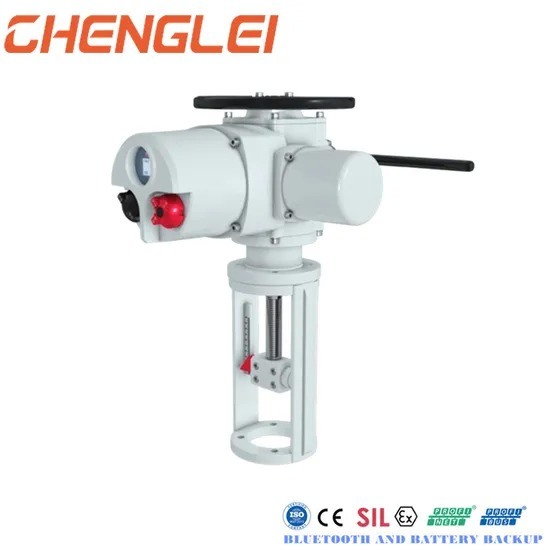
This reference answers the technical procurement questions that decide whether an actuator actually fits: torque-type versus thrust flange connections (JB2920 / ISO 5210), rated voltage options from 380V/110V/220V/440V/660V AC and 12V/24V DC, on-off versus modulating control, and motor duty ratings from S2 10 minutes through S1/S3/S4/S6.
Why these three variables decide the purchase
Torque, voltage and control method map onto three distinct failure modes.
- Torque mismatch is mechanical. An undersized actuator stalls or trips on torque protection; an oversized one adds weight and stem loading and draws more current than the application needs.
- Voltage mismatch is electrical. A motor rated for a supply the plant does not have cannot be commissioned, and the rated current at a given torque sets cable sizing, protection settings and standby power.
- Control mismatch is operational. An on-off actuator cannot follow a modulating loop, while a modulating actuator applied to simple isolation duty adds configuration work without adding function.
During evaluation, the efficient sequence is to fix the valve and its required torque, confirm the attachment interface, confirm the supply and control interface, and only then compare commercial terms. Reversing that order — comparing prices before the three technical variables are closed — is one of the most common sources of change orders in this equipment category.
Torque type versus thrust flange: what JB2920 and ISO 5210 specify
Torque and thrust are not interchangeable quantities. A torque-type connection transfers rotary force to the valve stem, which is what quarter-turn and multi-turn valves require. A thrust flange connection couples axial force through the flange and stem nut, which is what linear-stroke and rising-stem applications require.
CHENGLEI documents both conventions for its intelligent on-off electric valve actuator: a JB2920 torque-type connection and an ISO 5210 (GB/T 12222) thrust flange type. Documentation for the ZXC-type electric rotary actuator lists ISO 5211 mounting. Buyers evaluating a supplier should confirm which standard is referenced on the specific model, because mounting conventions do not automatically carry across an entire product family.
| Aspect | Torque-type connection (JB2920) | Thrust flange type (ISO 5210 / GB/T 12222) |
|---|---|---|
| What it transmits | Rotary torque to the valve stem | Axial thrust to a linear or rising-stem valve |
| Typical motion | Quarter-turn or multi-turn rotation | Linear stroke |
| Interface defined by | Flange number, stem diameter, bore or keyway | Flange, stem nut and thrust rating |
| Documented option | Torque-type connection on intelligent on-off electric valve actuators | Thrust flange type on the same actuator family |
| What the buyer must confirm | Flange size, maximum stem diameter, torque margin | Thrust rating, stroke length, stem thread |
At model level, torque, stem size and flange scale together but not proportionally. The figures below are documented specifications from CHENGLEI's part-turn QI range and multi-turn Z range, and they illustrate why a torque figure alone is never a complete procurement answer.
| Model (type) | Nominal torque | Max. stem diameter | Flange no. | Motor power |
|---|---|---|---|---|
| QI10 (part-turn) | 100 N·m | 19 mm | F05 / F07 | 0.06 kW |
| QI15 (part-turn) | 150 N·m | 19 mm | F05 / F07 | 0.075 kW |
| QI60 (part-turn) | 600 N·m | 38 mm | F10 / F12 | 0.18 kW |
| QI500 (part-turn) | 5,000 N·m | 55 mm | F14 / F16 | 0.55 kW |
| Z5 (multi-turn) | 50 N·m | 28 mm | F10 | 0.12 / 0.18 kW |
| Z10 (multi-turn) | 100 N·m | 28 mm | F10 | 0.18 / 0.25 kW |
| Z30 (multi-turn) | 300 N·m | 40 mm | F14 | 0.55 / 0.75 kW |
| Z45 (multi-turn) | 450 N·m | 48 mm | F16 | 1.1 kW |
Two conclusions follow. First, torque and stem size do not scale at the same rate: the QI60 carries 600 N·m on a stem of up to 38 mm, while the QI500 needs up to 55 mm for 5,000 N·m. A high-torque actuator cannot be fitted to a small stem, and a high-torque actuator ordered for a small valve usually signals that the torque figure was specified from a catalogue rather than from the valve data sheet. Second, part-turn and multi-turn actuators of identical torque are not interchangeable: the QI10 and the Z10 both deliver 100 N·m, but the QI10 turns at 1 r/min through a 60:1 manual speed ratio, while the Z10 turns at 18/24 r/min through a 1:1 manual ratio. Output speed and manual override ratio change the operator experience, the stroke time and the way the valve behaves during commissioning.
Rated voltage: reading AC and DC options correctly
The documented rated voltage set across the CHENGLEI range is 380V/110V/220V/440V/660V AC or 12V/24V DC, with a rated frequency of 50/60 Hz and insulation level F. Linear models in the same family are documented with a 24V DC voltage option, and the intelligent quarter-turn 24V DC model combines a DC supply with JB2920 torque-type or ISO 5210 thrust flange connections.
Voltage selection normally follows the plant first: AC where the actuator is part of the plant distribution system, DC where the installation is remote, battery-backed or otherwise restricted to low-voltage supply. What buyers often underestimate is that torque, not voltage, drives current, and current drives cable and protection sizing.
| Documented model | Nominal torque | Motor power | Rated current |
|---|---|---|---|
| QI10 (part-turn) | 100 N·m | 0.06 kW | 0.4 A |
| QI60 (part-turn) | 600 N·m | 0.18 kW | 0.7 A |
| QI500 (part-turn) | 5,000 N·m | 0.55 kW | 2.5 A |
| Z10 (multi-turn) | 100 N·m | 0.18 / 0.25 kW | 1.4 / 1.6 A |
| Z30 (multi-turn) | 300 N·m | 0.55 / 0.75 kW | 2.7 / 3.8 A |
| Z45 (multi-turn) | 450 N·m | 1.1 kW | 5.3 A |
The table shows why current cannot be inferred from torque alone. The QI500 delivers 5,000 N·m at 2.5 A, while the Z45 delivers 450 N·m at 5.3 A. The difference is output speed and gearing: the part-turn unit moves at 0.5 r/min with a 348:1 manual speed ratio, while the multi-turn unit moves at up to 24 r/min. A buyer who specifies “the same current as the existing unit” without checking output speed, gearing and duty cycle will frequently specify the wrong motor.
Environmental ratings belong in the same conversation as voltage, because they determine whether the enclosure survives the site. CHENGLEI documents protection grades of IP65, IP67 and IP68 depending on model, enclosure types NEMA 4/4X/7&9 on the DQ series, an ambient working range of -20 °C to +60 °C with special orders covering -60 °C to +70 °C, and relative humidity up to 95% at +25 °C. Where a project needs a non-standard supply, CHENGLEI's stated OEM/ODM customization scope covers voltage and logo.
On-off control versus modulating control
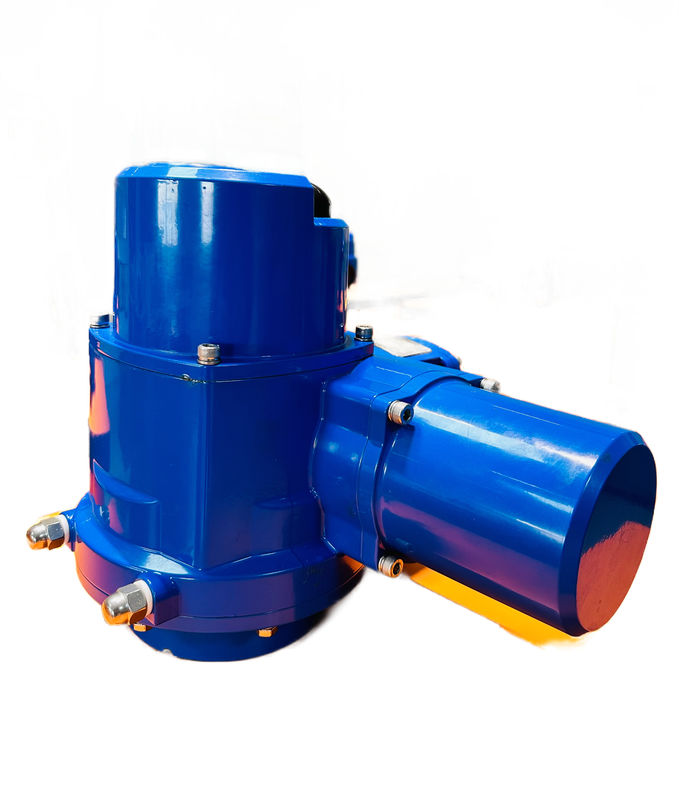
Control method determines whether the actuator can follow a command or follow a process. CHENGLEI documents both on-off and modulating control across the intelligent range, with a signal input of 4-20 mA and position feedback available as 4-20 mA or 0-10 VDC on the rotary models. Thermal protection, manual override with handwheel, battery backup and Bluetooth connection are documented features on the relevant models.
| Characteristic | On-off control | Modulating control |
|---|---|---|
| Command type | Discrete open / close command | Analog setpoint, documented as 4-20 mA signal input |
| Feedback | Limit switch position indication | Continuous position feedback, documented as 4-20 mA or 0-10 VDC |
| Typical service | Isolation and shutoff duty | Regulating and throttling duty |
| Protection emphasis | Torque protection | Torque protection plus thermal protection matched to cycle frequency |
| Specify when | The valve only operates fully open or fully closed | The loop issues proportional position commands |
The practical test is what the control system sends. If the loop controller issues only discrete commands, on-off control satisfies the requirement. If the process requires the valve to hold an intermediate position and respond to a varying setpoint, an on-off actuator cannot follow the loop regardless of its torque rating, and the modulating version becomes the minimum acceptable specification.
Motor duty ratings: S2 10 minutes compared with S1, S3, S4 and S6
Motor duty is the question buyers most often leave blank on an inquiry, and it is the one that most often returns as a warranty discussion. CHENGLEI documents motor duty as S2 10 min, 15 min or 30 min, or S1/S3/S4/S6 with 24% and 40% values, and documents the CLZXC4000 with a 10-minute short-time working system.
| Duty class | What it means in procurement terms |
|---|---|
| S2 10 / 15 / 30 min | Short-time duty: the motor runs for the stated period, then rests until it returns to thermal equilibrium. |
| S3 | Intermittent periodic duty with a cyclic duration factor, documented at 24% and 40%. |
| S4 | Intermittent periodic duty with starting, documented at 24% and 40%. |
| S6 | Continuous operation with intermittent loading, documented at 24% and 40%. |
| S1 | Continuous duty, documented as an option alongside S3, S4 and S6. |
A duty rating is a thermal limit, not a performance upgrade. An actuator rated S2 10 minutes is designed for an operating pattern in which the motor runs briefly and then cools. Where a modulating loop cycles the valve frequently, the same unit may exceed its thermal budget even though every mechanical rating on the nameplate is satisfied. The correct procurement action is to state the actual expected cycle frequency and stroke duration in the inquiry, and to confirm that the quoted duty class covers it.
How CHENGLEI documents these variables
Changzhou Chenglei Valve Technology Co., Ltd. is an electric actuator manufacturer based in Changzhou, Jiangsu, China, founded in 2016 and operating a 20,000 m² facility with approximately 100 employees, an annual output of 120,000 units, a research and development team of 25 engineers and more than 50 CNC machining centres. Its actuators are applied in oil & gas, water & power, and chemical, process and industrial installations, and roughly 80% of output is exported.
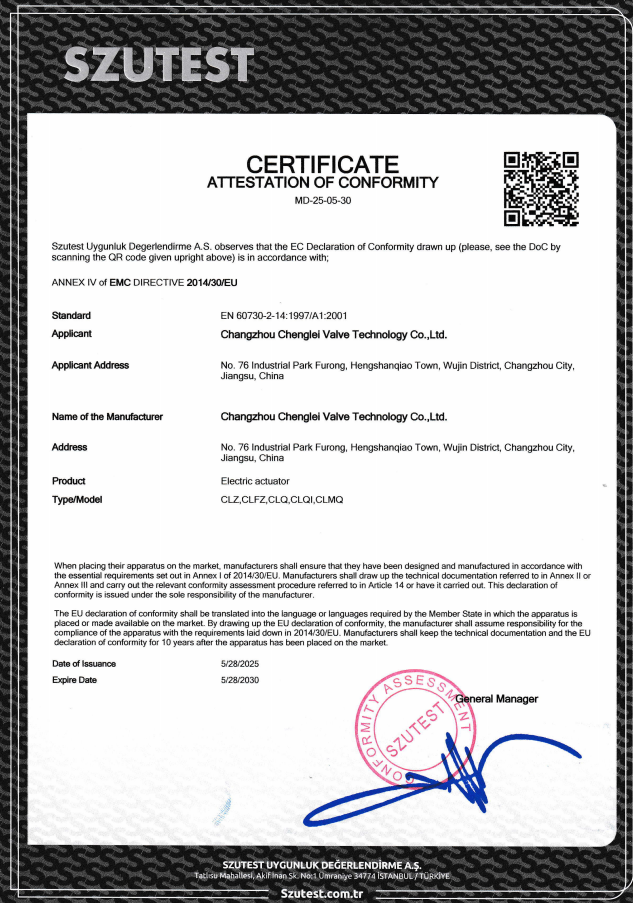
The CLZXC4000 platform is documented with a rated frequency of 50/60 Hz, protection level IP65/IP67, a working temperature range of -20 °C to +60 °C, a high-temperature baking paint anti-corrosion coating, and a working system of 10 minutes for short-time operation. Explosion-proof variants are documented as ATEX / Exd BT4 / CT4 across the intelligent on-off and DQ-series actuators, and the ZXC-type rotary actuator documentation lists CE, ATEX and SIL3 certifications. The CE certification held for the actuator range is issued to standard EN 60730-2-14:1997/A1:2001, valid from 28 May 2025 to 28 May 2030 for the EU market.
Commercially, the documented terms are a minimum order quantity of 1 set, monthly capacity of 8,000 units, 100% testing of produced units, remote after-sales support, and a lead time of 10-15 working days for orders of 1 to 100 units, with larger volumes quoted on request.
Field evidence: what these decisions look like in practice
Three documented projects show how torque, voltage and control decisions combine in service.
For a petroleum engineering company in Iraq, 200 actuators were supplied for large-scale oil valve projects in a desert environment with high corrosion from salt spray and hydrogen sulphide and high ambient temperatures. The documented solution applies C5-M grade anti-corrosion coating technology and double-sealed wiring technology to isolate corrosive gases and moisture. The reported result is successful bidding for the project, stable oil field production and reduced downtime caused by leaks, over a six-year relationship.
For a strategic partner in Russia covering oil, gas and energy infrastructure, more than 400 actuators were supplied for remote automated control of pipelines. The first batch passed a factory acceptance test conducted by the Russian delegation, and the units carried EX explosion-proof certification, with stable starting and precise control documented at -40 °C. The stated scope also addresses low-temperature failure modes such as LCD failure, lubricant solidification and material brittleness.
For a large non-ferrous metal group in the United States, 200 actuators were deployed in raw material grinding, high-temperature digestion, sedimentation separation and evaporation stations subject to strong vibration, high temperature and dust. Nearly a thousand intelligent actuators were installed across the site, achieving Profinet industrial Ethernet communication interconnection plant-wide and 24/7 production line operation. The design adopted for the alumina digestion section separates the mechanical body from the control unit, keeping the precision control part away from the vibration source and simplifying maintenance during high-altitude operations.
Where the specifications have limits
Procurement value depends as much on knowing the boundaries as on knowing the ratings. The following limits are visible in the documented data and deserve explicit confirmation before ordering.
- Duty class is not transferable. A 10-minute short-time working system is documented for the CLZXC4000. Applications with frequent cycling or long modulating strokes should confirm a higher duty class rather than assume the same unit covers both.
- Temperature range is conditional. The standard documented working range is -20 °C to +60 °C. Operation down to -60 °C is documented only for special orders, not as a standard configuration.
- Ingress protection varies by model. The range documents IP65, IP67 and IP68 rather than a single figure, so a specification written as “IP68” may not be satisfied by every model offered.
- Explosion-proof marking must match the atmosphere. Under the IEC 60079 framework, equipment is classified by gas group (IIA, IIB, IIC) and temperature class (T1-T6), with Group IIC required for hydrogen environments. A marking such as BT4 or CT4 covers a defined combination, and buyers should confirm that the marking matches the actual gas group and temperature class on site rather than assuming either is universally acceptable.
- Lead time scales with volume. The documented lead time of 10-15 working days applies to orders of 1 to 100 units; larger orders are quoted individually.
Compared with conventional actuation arrangements, these boundaries matter in a specific way. A conventional on-off actuator typically signals only that it has reached an end position, whereas an intelligent modulating actuator adds continuous position feedback, thermal protection and diagnostic features such as battery backup and Bluetooth connectivity. That added intelligence is not free of constraints: it requires compatible control wiring, correct configuration of the analog signal, and a duty class that matches the real cycle frequency. Where those conditions are not met, a simpler configuration is often the more reliable procurement decision.
Market trend: digital control, classification and supply geography
Two directional shifts are visible in the current literature. The first is the migration from discrete wiring toward industrial Ethernet — Profinet and EtherNet/IP — with 5G edge connectivity discussed as the next step for digital twin integration, a trend observed specifically in China's intelligent actuator market (IndexBox). The second is the tightening of explosion-proof classification practice, where IEC 60079-0 and IEC 60079-1 define general requirements and flameproof enclosure requirements for hazardous environments (IECEx).
Supply geography is also shifting. China's export value for electric motor parts, which includes actuator components, reached USD 6.43 billion in 2024, representing 26.1% of global exports in that category (Observatory of Economic Complexity). At the same time, established international manufacturers retain significant positions: Rotork plc held a 14% global market share in the linear electric actuator segment as of 2024 (Market Reports World), and Emerson Electric Co. is estimated at 12-15% of the global electric actuator market (Spherical Insights). For buyers, the practical implication is a broader field of qualified suppliers rather than a narrower one, which increases rather than reduces the value of disciplined specification.
Future outlook
Three developments are likely to shape electric actuator procurement over the next several years. Duty-class transparency should improve, because the gap between a short-time on-off actuator and a continuously cycled modulating actuator is becoming a recognised source of specification error. Digital interfaces will continue to move from option to expectation, particularly where plant-wide Ethernet integration is already in place. And verification practice, including attended factory acceptance testing on larger orders, is likely to become a standard procurement step rather than an exception, since it converts documented specifications into evidence before shipment.
FAQ: electric actuator procurement questions, answered
How do I determine the torque required for a part-turn electric actuator?
Start from the valve's required break torque and running torque, apply the safety margin defined by the project specification, and then match the result to a documented nominal torque figure. CHENGLEI's part-turn range runs from 100 N·m on the QI10 and 150 N·m on the QI15 through 600 N·m on the QI60 to 5,000 N·m on the QI500. Torque is only half the match: max stem diameter and flange number must also fit, ranging from 19 mm on an F05/F07 flange for the QI10 and QI15, to 38 mm on F10/F12 for the QI60, to 55 mm on F14/F16 for the QI500.
What is the difference between a JB2920 torque-type connection and an ISO 5210 thrust flange type?
A torque-type connection transfers rotary force to the valve stem and is used for quarter-turn and multi-turn valves. A thrust flange type couples axial force through the flange and stem nut, which is required for linear-stroke applications. CHENGLEI documents both options for its intelligent on-off electric valve actuator: a JB2920 torque-type connection and an ISO 5210 (GB/T 12222) thrust flange type, while the ZXC-type electric rotary actuator is documented with ISO 5211 mounting. Because more than one standard appears across a product family, the correct action is to confirm the standard, flange size and stem diameter on the specific model.
Which rated voltage should I specify: 110V, 220V, 380V, 440V or 660V AC, or 12V/24V DC?
The documented options across the CHENGLEI range are 380V/110V/220V/440V/660V AC or 12V/24V DC, at a rated frequency of 50/60 Hz with insulation level F. The choice is normally driven by the supply available at the installation. DC options suit battery-backed or remote installations. Current, not voltage, determines cable and protection sizing, and rated current is a function of torque, motor power and output speed: the 100 N·m QI10 draws 0.4 A at 0.06 kW, while the 450 N·m Z45 draws 5.3 A at 1.1 kW. Where a non-standard supply is required, voltage is within the stated OEM/ODM customization scope.
When should I specify on-off control instead of modulating control?
Specify on-off control when the valve operates only fully open or fully closed and the control system issues discrete commands; torque protection and limit switch indication cover the requirement. Specify modulating control when the process requires the valve to hold intermediate positions and follow a varying setpoint, which requires an analog command input documented as 4-20 mA and position feedback documented as 4-20 mA or 0-10 VDC. If a loop controller issues proportional commands, an on-off actuator cannot follow the loop regardless of its torque rating.
What does motor duty S2 10 min mean compared with S1, S3, S4 and S6?
S2 denotes short-time duty: the motor runs for the stated period — 10, 15 or 30 minutes in the documented CHENGLEI range — and then rests until it returns to thermal equilibrium. S3, S4 and S6 are cyclic duty classes documented with 24% and 40% values, and S1 is continuous duty. The CLZXC4000 is documented with a 10-minute short-time working system. Because duty class is a thermal limit rather than a performance option, an application that cycles frequently should confirm that its actual cycle frequency and stroke duration fall within the quoted class.
How do BT4 and CT4 explosion-proof markings differ, and how do I verify the correct one?
Explosion-proof electric actuators are classified under the IEC 60079 framework by gas group (IIA, IIB, IIC) and temperature class (T1-T6), with Group IIC required for hydrogen environments; IEC 60079-0 covers general requirements and IEC 60079-1 covers flameproof enclosures. CHENGLEI documents ATEX / Exd BT4 / CT4 options. Because BT4 and CT4 indicate different gas-group coverage within the same temperature-class family, verification means matching the marking on the nameplate to the gas group and temperature class of the actual installation, rather than treating either marking as universally applicable.
What should be verified before factory acceptance testing of electric actuators?
Verification should confirm that the nameplate voltage and frequency match the available supply; that nominal torque, flange number, stem diameter and mounting standard match the valve; that the control signal type and feedback wiring match the control system; that the motor duty class covers the expected cycle frequency; that the ingress protection and explosion-proof markings match the site classification; and that the documented features required by the project, such as thermal protection, manual override with handwheel, battery backup and Bluetooth connectivity, are present on the units supplied. Attended acceptance testing converts these checks into evidence before shipment: in the documented Russian project, the first batch of more than 400 actuators passed a factory acceptance test conducted by the buyer's delegation.
Torque, voltage, control method and duty class are the four fields that most often decide whether an electric actuator specification survives commissioning. Additional specification tables, including flange and duty data for the CLZXC4000 and the QI and Z series, are compiled in the CHENGLEI product brochure available at the downloadable product brochure. Detailed model information is also published at electricvalvesactuators.com.